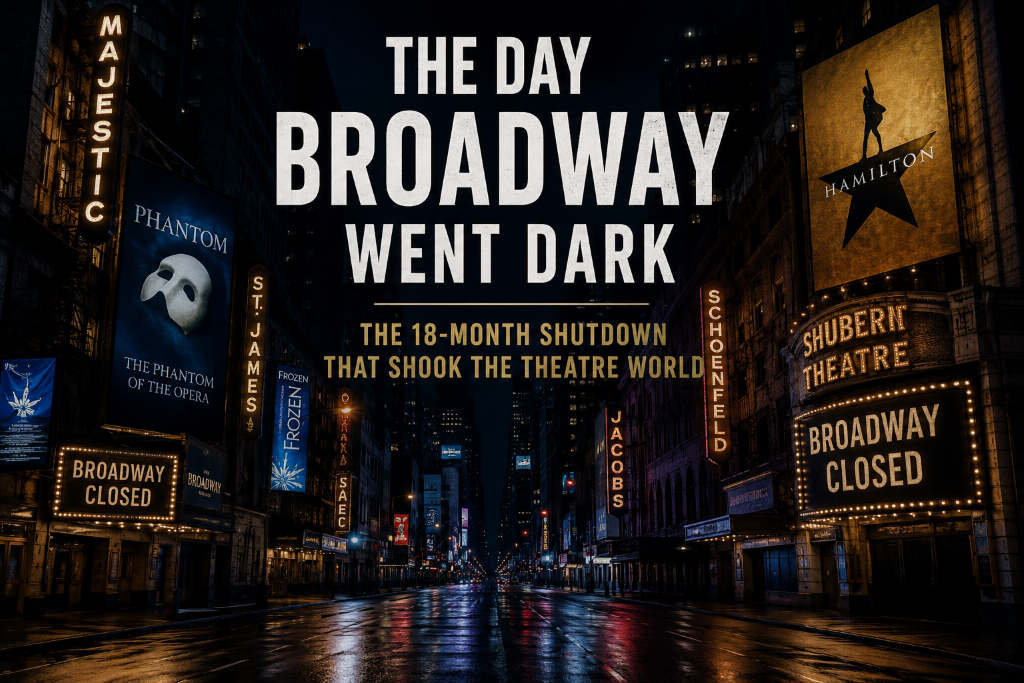
The Day Broadway Went Dark
When the World’s Greatest Theatre District Fell Silent
At eight o’clock on a normal Thursday evening, Broadway should have been alive.
Orchestras would have been tuning. Stage managers would have been calling places. Audiences would have been settling into velvet seats while actors waited behind curtains for the house lights to fade.
But on March 12, 2020, the theatres did not open.
The marquees were still illuminated. The posters remained on the walls. Costumes hung in dressing rooms, scenery stood ready backstage, and thousands of tickets had already been sold.
Yet Broadway—the theatrical engine that had survived wars, recessions, blackouts, strikes and terrorist attacks—suddenly stopped.
The original announcement suggested that the shutdown would last barely a month.
It lasted 18 months.
This is the story of the day Broadway went dark, the people trapped behind the closed doors, and the uncomfortable question the shutdown forced the theatre industry to confront:
What remains of Broadway when there is no audience?
CASE FILE
Incident: Complete suspension of Broadway performances
Date: March 12, 2020
Location: Broadway Theatre District, New York City
Productions affected: 31 running shows, including eight in previews
Additional productions affected: Eight shows preparing to open
Initial expected reopening: Week of April 13, 2020
Major reopening milestone: September 14, 2021
Total interruption: Approximately 18 months
1. The Final Hours Before the Shutdown

The warning signs had been building.
COVID-19 infections were rising across New York. Sporting events were being cancelled, offices were beginning to empty, and public-health authorities were warning against large indoor gatherings.
Broadway nevertheless continued performing.
Theatre is an industry built around physical presence. Performers stand close together. Musicians share orchestra pits. Crew members work in narrow backstage corridors. Hundreds—or thousands—of spectators sit shoulder to shoulder for several hours.
Closing a Broadway production, however, is not as simple as locking a theatre door.
Every cancelled performance affects actors, musicians, stagehands, wardrobe teams, ushers, cleaners, box-office employees, producers, restaurants, hotels and countless surrounding businesses. Millions of dollars can move through the district in a single week.
Then came the order that made continued operation impossible.
On March 12, New York State announced that gatherings of 500 people or more would be cancelled or postponed. Because a Broadway theatre is defined as having at least 500 seats, the restriction effectively shut down the entire Broadway industry.
The Broadway League announced that all performances would be suspended immediately. At first, the closure was scheduled to continue only through April 12, with performances expected to resume the following week.
It sounded temporary.
Actors left personal belongings in their dressing rooms. Productions preserved sets as though performances might resume within weeks. Tickets were exchanged rather than abandoned. Opening nights were postponed, not cancelled.
Few understood that some casts had just taken their final bows.
2. Thirty-One Productions Frozen in Place

When Broadway stopped, 31 productions were running. Eight of them were still in previews, while another eight were rehearsing for planned spring openings.
Every show occupied a different position.
Long-running productions such as The Phantom of the Opera, Wicked, Chicago and The Lion King possessed established audiences and recognizable brands. Newer shows were far more vulnerable. Some had not yet received reviews. Others had spent millions preparing for openings that never arrived.
A Broadway production depends on momentum.
Advertising builds recognition. Preview performances generate word of mouth. Reviews influence ticket sales. Awards season can transform a struggling production into a long-running success.
The shutdown interrupted that machinery at the worst possible moment.
Shows approaching opening night lost their chance to establish themselves. Investors faced mounting uncertainty. Cast members who had trained for months suddenly had no performances, no reliable income and no clear return date.
Broadway had experienced interruptions before, including labour disputes, severe weather, the attacks of September 11 and major power failures.
But those closures were measured in days.
This time, nobody knew whether Broadway would return in weeks, months—or at all.
3. The One-Month Closure That Kept Expanding

The first deadline passed.
Broadway did not reopen in April.
The shutdown was extended through the summer, then through September. By June 2020, performances had been suspended for the remainder of the year while theatre owners, unions and medical experts studied testing, sanitation, audience movement and backstage safety.
In October, the Broadway League suspended ticket sales through May 30, 2021.
The same announcement revealed the enormous scale of the crisis: nearly 97,000 workers depended on Broadway, while the industry contributed approximately $14.7 billion annually to New York City’s economy.
Broadway was not merely a collection of theatres.
It was an ecosystem.
When the theatres closed, nearby restaurants lost pre-show diners. Bars lost post-show crowds. Hotels lost theatre tourists. Costume shops, rehearsal studios, ticket agencies, marketing firms and technical suppliers lost business.
The damage also reached people rarely seen by an audience: dressers, wig makers, prop builders, company managers, stage-door attendants, cleaners and substitute musicians.
Many theatre workers earn benefits according to weeks worked. Losing performances therefore threatened not only salaries but also health coverage and pension eligibility.
The silence inside the theatres spread far beyond Times Square.
4. The Shows That Never Returned

Broadway’s shutdown did not pause every production.
For some, it ended them.
Shows with limited financial reserves could not withstand months without revenue. Productions that had expected strong spring ticket sales faced continuing expenses while earning nothing at the box office.
Several productions eventually announced permanent closures. Others abandoned planned openings, delayed indefinitely or returned in significantly changed form.
This was one of the shutdown’s most painful realities: the final audience had not known it was witnessing a closing performance.
There had been no farewell speeches.
No final company photograph.
No emotional last curtain call.
Actors had left theatres expecting to return within weeks. Some never again performed those roles. Backstage workers had stored equipment for another night that never came.
Broadway tradition treats closing night as a ritual. The company and audience understand that a shared journey is ending.
COVID-19 denied many productions that ending.
The curtain simply stayed down.
5. Can Theatre Exist Without a Theatre?

As the shutdown continued, Broadway artists moved online.
Performers streamed concerts from their homes. Companies held virtual reunions. Writers presented readings through video platforms. Archival performances attracted audiences who could no longer enter theatres.
These projects kept artists visible and helped raise emergency funds, but they also revealed the limits of digital theatre.
A recording can preserve a performance.
It cannot fully recreate the exchange occurring inside a live auditorium.
Theatre depends on simultaneous presence. Actors respond to laughter, silence, tension and applause. Audiences influence rhythm without speaking. Every performance changes because the people sharing the room are different.
Broadway’s buildings were dark, but the deeper loss was not electricity.
It was the disappearance of the crowd.
The shutdown exposed a contradiction at the centre of commercial theatre. Broadway is a global cultural brand, yet its central product cannot be stored, shipped or experienced in exactly the same way twice.
Without a gathering, Broadway loses the condition that makes it Broadway.
6. A Crisis of Survival—and Identity

The pandemic also exposed inequalities that had existed long before March 2020.
Many theatre professionals survived through temporary employment, unemployment assistance, emergency funds or work outside the industry. Others left New York altogether. Some questioned whether they could afford to return.
At the same time, the national reckoning over racial inequality reached Broadway.
Artists and advocacy groups challenged the industry’s employment practices, leadership structures and treatment of Black theatre professionals. The shutdown became more than an economic emergency; it became an enforced pause during which Broadway was asked to examine who controlled its stages and whose stories received investment.
The central question changed.
It was no longer simply:
When can Broadway reopen?
It became:
What kind of Broadway deserves to reopen?
The pandemic had destroyed the illusion that success at the box office automatically meant stability for the people creating the work.
Broadway could not return simply by turning the lights back on. It had to rebuild casts, reassemble orchestras, retrain crews, renegotiate schedules, restore audience confidence and convince thousands of workers that coming back was worth the risk.
7. Preparing to Raise the Curtain Again

In May 2021, New York announced that Broadway tickets could be sold for performances beginning September 14 at full theatre capacity, subject to health and safety requirements.
The announcement did not mean every production would reopen on the same date.
Each show faced a separate reconstruction process.
Actors needed rehearsals after more than a year away. Technical systems required inspection. Costumes had to be refitted. Musicians needed to reunite. Replacement cast members had to be hired where original performers had moved on.
The industry also adopted health protocols intended to protect audiences and employees. Vaccination requirements and face coverings became part of the Broadway experience during the early reopening period. By December 2021, the Broadway League reported that more than two million people had attended over 2,000 performances since theatres began reopening.
Broadway was operating again—but not yet normally.
Breakthrough infections occasionally forced individual performances to be cancelled. Cast members, understudies and swings became essential to keeping productions alive.
The reopening was not a single triumphant moment.
It was a fragile, show-by-show return.
8. September 14, 2021

On September 14, four of Broadway’s most recognizable productions—Hamilton, Wicked, The Lion King and Chicago—resumed performances. Lackawanna Blues also began previews.
The date became the symbolic reopening of Broadway.
Audiences returned to familiar theatres. Cast members addressed emotional crowds. Opening numbers received applause before performers could finish their first lines.
After 18 months of absence, ordinary theatrical rituals felt historic: an orchestra tuning, an usher scanning a ticket, a stage manager calling places, a curtain moving upward.
The return of Hamilton came after 552 days without a performance at the Richard Rodgers Theatre.
But Broadway did not simply resume where it had stopped.
Some shows were gone. Some workers never returned. Production costs had changed. Audience habits had changed. Tourism had changed. The relationship between performers, employers and public health had changed.
The lights came back.
The old Broadway did not.
9. What the Numbers Reveal

The first full post-shutdown Broadway season, 2022–2023, attracted approximately 12.3 million admissions and generated nearly $1.58 billion in gross ticket sales. Theatres filled 88.4 percent of available seats, indicating a substantial recovery, though attendance had not yet reached the pre-pandemic peak.
Employment recovered more slowly.
New York State labour data showed that the annual average job count in the Broadway-related industry dropped by approximately 53 percent between 2019 and 2020. By 2023, employment had returned to roughly 92 percent of its 2019 level.
Broadway has since regained substantial commercial strength. The 2025–2026 season recorded approximately 14.6 million admissions and $1.91 billion in gross revenue.
Those figures suggest resilience.
They do not erase what happened.
The industry survived, but survival required public assistance, private investment, union negotiations, health protocols and the determination of thousands of workers who returned without knowing whether audiences would do the same.
10. The Unsolved Question

Why did the Broadway shutdown feel so unsettling?
Because it exposed how vulnerable live performance truly is.
Broadway appears permanent. Its theatres have stood for generations. Its productions become cultural landmarks. Its marquees create the impression of an industry that will always be there.
But every performance depends on a temporary agreement.
Actors must arrive.
Workers must be paid.
Audiences must gather.
The city must remain open.
For 18 months, that agreement collapsed.
The shutdown proved that Broadway is not the buildings, the posters or the illuminated signs. It exists only when artists and audiences occupy the same space at the same time.
On March 12, 2020, the theatres went dark.
What disappeared was not simply entertainment.
It was the living connection that turns a room full of strangers into an audience.
And when Broadway finally returned, the greatest applause was not for a famous song, an elaborate set or a celebrity performer.
It was for the fact that everyone had gathered again.
THE X-FILES VERDICT
Cause of shutdown: A statewide public-health restriction on large gatherings during the escalating COVID-19 outbreak.
Why the closure became historic: The initial one-month suspension expanded into Broadway’s longest industry-wide shutdown.
Who was affected: Not only performers and producers, but approximately 97,000 workers and a wider New York economy dependent on theatre tourism.
What changed permanently: Production economics, health practices, employment expectations and the industry’s understanding of its own vulnerability.
Final verdict: Broadway survived because the people behind it refused to treat darkness as the end of the story.
EDITOR’S NOTE
Broadway’s return is often remembered through photographs of cheering audiences and emotional curtain calls. But the deeper story belongs to those who waited without applause: the musicians, technicians, dressers, ushers, cleaners, craftspeople and theatre workers whose livelihoods disappeared overnight.
The shutdown revealed something audiences rarely see.
The magic onstage is supported by an enormous human structure—and when that structure is threatened, even the brightest marquee cannot keep a theatre alive.
References & Further Reading
The Broadway League
Broadway Theatres to Suspend Performances Through April 12, 2020
https://www.broadwayleague.com/press/press-releases/broadway-theatres-to-suspend-performances-through-april-12-2020/
New York State
New Mass Gathering Regulations Announced, March 12, 2020
https://www.governor.ny.gov/news/during-novel-coronavirus-briefing-governor-cuomo-announces-new-mass-gatherings-regulations
The Broadway League
Summer Performance Cancellations and Affected Productions
https://www.broadwayleague.com/press/press-releases/the-broadway-league-announces-summer-performance-cancellations-while-working-on-future-date-for-industry-to-return/
The Broadway League
Fall Performance Cancellations and Reopening Protocols
https://www.broadwayleague.com/press/press-releases/the-broadway-league-announces-fall-performance-cancellations-while-working-on-protocols-for-curtains-to-rise-again/
New York State
Broadway to Fully Reopen in September 2021
https://www.governor.ny.gov/news/governor-cuomo-announces-broadway-fully-reopen-its-doors-september
The Broadway League
2022–2023 Broadway End-of-Season Statistics
https://www.broadwayleague.com/press/press-releases/20222023-broadway-end-of-season-statistics-show-that-broadway-had-attendance-of-123-million-and-grosses-of-158-billion/
New York State Department of Labor
Post-Pandemic Broadway Employment Recovery
https://content.govdelivery.com/accounts/NYDOL/bulletins/3a8cb2b
NEXT FILE
https://immersivelabkorea.com/phantom-of-the-opera-final-curtain/
Continue the Investigation
If you enjoyed this file, continue exploring THE SHOW X-FILES, where we uncover the hidden stories, mysteries, and unforgettable moments that shaped the world of live entertainment.
Image Credit: Images belong to their respective copyright holders and are used for editorial, commentary, and educational purposes only.


