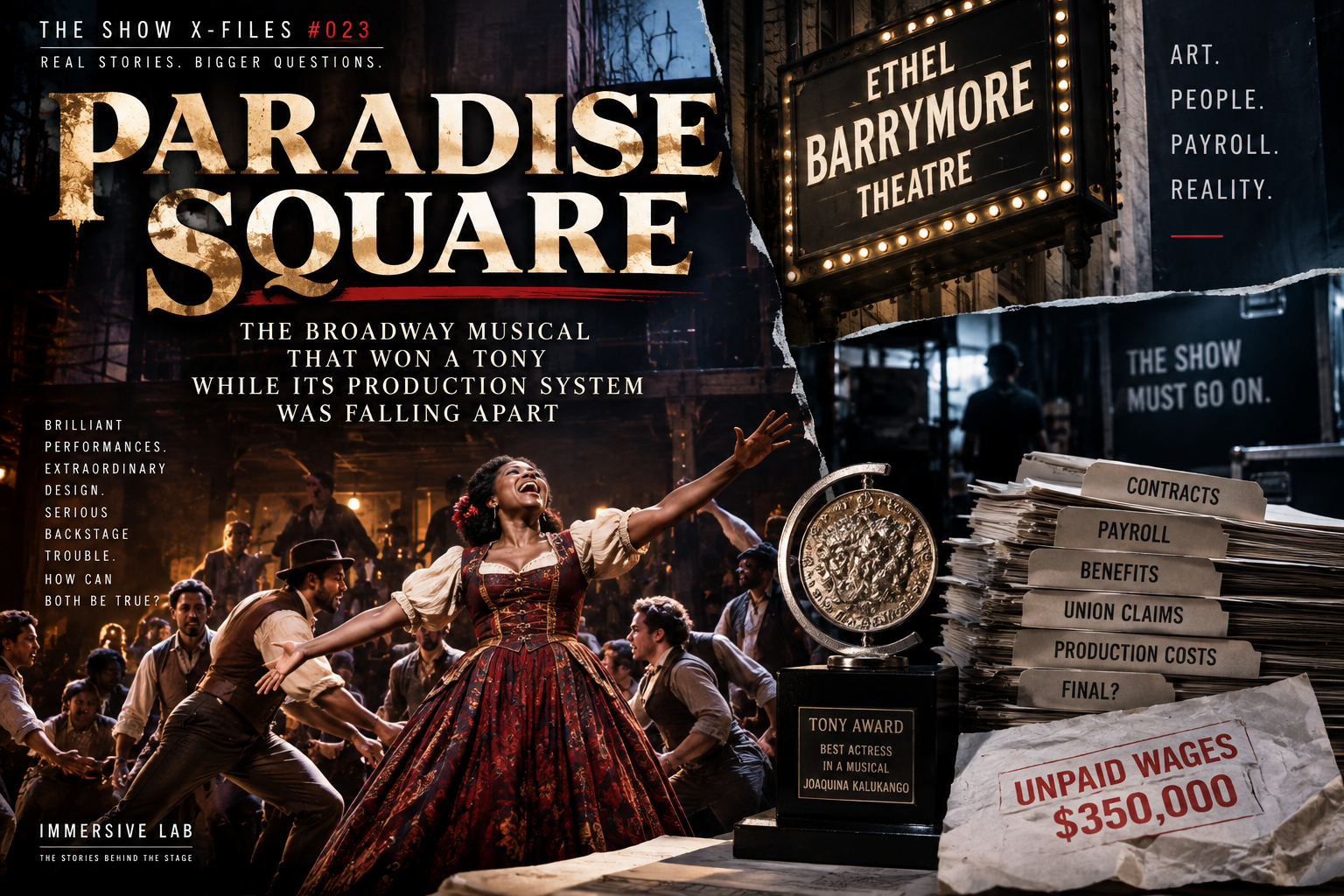
Paradise Square : The Broadway Musical That Won a Tony While Its Production System Was Falling Apart
On June 12, 2022, Joaquina Kalukango walked onto the Tony Awards stage and accepted Best Actress in a Musical for Paradise Square.
The musical itself had received 10 Tony nominations, including Best Musical, Best Book, Best Original Score, Scenic Design, Costume Design, Lighting Design and Choreography.
One month later, unions representing Broadway actors, stage managers and theatrical designers were pursuing claims involving nearly $350,000 in allegedly unpaid wages, payments and benefit contributions.
Four days after that report, Paradise Square was gone.
That collision makes this one of the most useful production cases in modern Broadway. Because the mystery is not simply why an expensive musical closed. It is this: how can a production be artistically successful enough to receive 10 Tony nominations while the system responsible for paying and supporting the people who created it is breaking down?
For IMMERSIVE LAB, that question matters more than the box-office obituary. This is a story about the difference between the show the audience sees and the production infrastructure the audience never sees.
Two Paradise Squares Existed at the Same Time

The first existed onstage. Set in New York’s Five Points during the Civil War, Paradise Square brought Black Americans and Irish immigrants together inside a fictional saloon as the country moved toward the 1863 Draft Riots.
Its Broadway creative organization was formidable. Moisés Kaufman directed. Bill T. Jones led choreography. Allen Moyer designed the scenery, Toni-Leslie James the costumes, Donald Holder the lighting, Jon Weston the sound, and Wendall K. Harrington and Shawn Edward Boyle the projections.
The production employed a large ensemble—reported at around 40 performers—and placed dance at the center of its theatrical language.
And then there was the second Paradise Square. That one existed backstage: contracts, payroll, benefits, cash flow, union obligations, operating expenses, production management. The audience never bought a ticket to see that show. But eventually it became impossible to separate the two.
March 15, 2022: The Machine Starts Running

Paradise Square began Broadway previews at the Ethel Barrymore Theatre on March 15, 2022, and officially opened April 3. It closed July 17. The official Broadway record lists 23 previews and 108 regular performances.
That makes Paradise Square very different from Nick & Nora or other shows that never found an audience at all. This production did not disappear before audiences could discover it. It survived long enough to receive major awards recognition. Its problems therefore force us to look beyond the usual explanation: “the critics didn’t like it.”
Critical response was mixed, but the production received significant praise for its performers, choreography and physical production. Review coverage repeatedly highlighted the dancing even when critics questioned the musical’s dramaturgy.
And then the Tony nominations arrived. Ten of them. Broadway’s own industry was saying that important parts of this production represented some of the season’s strongest work. That is what makes what happened next so revealing.
A Broadway Musical Is Also a Weekly Operating System
A musical can look finished on opening night. Financially and operationally, it isn’t.
Every week the production must continue supporting a complex network: actors, stage managers, musicians, crew, design obligations, theatre costs, advertising, insurance, benefit contributions, royalties, maintenance, and dozens of other expenses.
The set may already exist. The costumes may already have been made. But the organization has to keep functioning every Monday after Sunday’s curtain falls. This is one of the most misunderstood differences between capitalization and operation. Money raised to build and launch a production does not automatically guarantee that the production can survive its weekly running costs.
A Broadway musical is therefore not merely a creative product. It is a live operating company with a performance attached to it. And unlike many businesses, it has an unforgiving deadline. At 8:00 PM, the curtain still has to rise.
Then COVID Hit the Company
The production was operating during Broadway’s difficult post-shutdown recovery period. Producer Garth Drabinsky later cited COVID-related financial difficulties directly, noting that the show was produced after the start of the pandemic and was not eligible for federal Shuttered Venue Operators Grant funds, while insurers would no longer cover new productions for pandemic-related losses.
That matters operationally. A shutdown does not mean every cost disappears. The audience disappears. Ticket revenue disappears. But a production organization still exists. This is a classic live-entertainment risk: revenue can stop faster than obligations do.
A large Broadway musical has high fixed and semi-fixed costs. Unexpected cancelled performances therefore affect more than the box office for those individual nights. They reduce the financial room available to absorb the next problem. And Paradise Square would soon face much larger ones.
The Tony Awards Created an Extraordinary Contradiction

On May 9, Paradise Square received its 10 Tony nominations, including Best Musical, Best Book, Best Original Score, Best Actress, two Featured Actor nominations, Best Scenic Design, Best Costume Design, Best Lighting Design and Best Choreography.
Then came June 12. Joaquina Kalukango won Best Actress, delivering a performance of “Let It Burn” during the televised broadcast that received a standing ovation and has since been remembered as one of the most powerful Tony Awards performances in recent memory.
The moment was powerful. But from a production-management perspective, the nominations reveal something else. Look carefully at the categories: scenery, costumes, lighting, choreography, performance. These awards represent the labor of exactly the kinds of departments a production organization exists to support.
The artistic system was producing award-level work. Recognition of the work, however, did not guarantee the financial health of the organization underneath it. That distinction is essential. Awards measure artistic achievement. They do not audit production sustainability.
A standing ovation cannot tell you whether payroll is healthy. A Tony nomination cannot tell you whether benefit contributions are current. A beautiful lighting cue contains no information about the producer’s cash position. The audience sees outputs. Production management lives inside obligations.
July 11: Closing Announced
On July 11, the production announced that Paradise Square would close on July 17. Two days later, reporting revealed something far more serious.
Actors’ Equity Association and United Scenic Artists Local USA 829 were pursuing legal action connected with nearly $350,000 they said was owed in benefit contributions, wages and other payments. According to reporting, United Scenic Artists had already won more than $150,000 in unpaid wages and benefits in arbitration but had not yet received payment, while Actors’ Equity was separately seeking $189,877 in unpaid union dues and benefit fund contributions after the production fell behind on a payment schedule set up under a May settlement agreement.
The distinction in wording matters. These were union claims and allegations; they should not be rewritten as though every figure was already a final judicial finding. But the underlying labor dispute was real enough to enter formal proceedings—Actors’ Equity subsequently filed a federal lawsuit against the production seeking unpaid health, pension and 401(k) contributions.
The production had already closed. The financial and labor consequences had not. Actors’ Equity later added lead producer Garth Drabinsky—previously convicted of fraud in Canada in connection with his former production company Livent—to its “Do Not Work” list, effectively ending his ability to produce on Broadway.
The Designers Had Already Built the World

This is where the story becomes particularly important for IMMERSIVE LAB.
Consider scenic designer Allen Moyer. Or lighting designer Donald Holder. Or costume designer Toni-Leslie James. Their departments did not provide optional decoration. They constructed the physical language through which the audience experienced Five Points. All three were Tony nominated.
Now consider the production chain. A designer develops a concept. Assistants help document and execute it. Shops fabricate. Technicians install. The system is programmed. The show enters technical rehearsals. Changes continue. Opening night arrives. Reviews arrive. Awards nominations arrive.
From the audience’s perspective, the work is complete. But financially, the chain is only complete when everyone and every required contribution has actually been paid according to their agreements.
This leads to an uncomfortable production principle: a cue is not truly finished when it works. A set is not truly finished when it opens. A production obligation is finished when the people who created it have been properly compensated. That is production management, not accounting trivia.
Why Doesn’t Someone Simply Stop the Show?
This sounds obvious in retrospect. If a production is under financial pressure, why keep performing?
Because stopping also has consequences. A running Broadway production may still possess future ticket sales, potential award momentum, publicity, touring possibilities, investor expectations, employment, contracts, and the possibility—however uncertain—that stronger sales will improve the situation. Closing destroys many of those possibilities immediately.
This creates one of live entertainment’s most dangerous management tensions: continuing costs money; stopping can eliminate the possibility of recovery. The decision therefore isn’t “is the show profitable tonight?” It is: does the production have a credible path from today’s losses to tomorrow’s stability?
If the answer is yes, continuing can be rational. If the answer is no, every additional performance can deepen exposure. The problem is determining when one condition has become the other.
Success Can Actually Hide Production Risk
This is where Paradise Square differs from an obvious theatrical disaster.
Imagine a show receiving terrible reviews, playing to empty seats and earning no awards attention. Everyone knows there is a problem. Now imagine the opposite: a leading performer wins a Tony, the choreography electrifies audiences, the production receives nominations across creative disciplines, television viewers see the company perform. The artistic achievement is real. That success can coexist with another reality underneath.
This is why live production needs separate dashboards. One measures artistic quality. Another measures audience response. Another: sales. Another: cash flow. Another: labor and contractual compliance. Another: technical and safety risk. They influence one another. They are not interchangeable. A production can score extremely high in one and fail catastrophically in another.
The Set Tells Us Something About the Production
Allen Moyer’s scenic design was Tony nominated, and reviews described a large industrial structure dominating the Barrymore stage supporting a large company and choreography-intensive musical.
That matters financially because theatrical ambition creates operating consequences. More performers can mean more payroll. More complex scenery can mean more crew and maintenance. More costumes create additional wardrobe demands. More choreography can increase rehearsal and physical-maintenance requirements. More technical systems mean more people responsible for operating them.
None of this means a large production is financially irresponsible. It means something more basic: every creative decision creates an operational footprint. Producers do not merely finance what the audience sees. They finance the infrastructure required to make it happen eight performances a week. That is why the production budget should never be understood simply as the price of building the opening-night image. The real product is repeatability.
Broadway’s Invisible Supply Chain

Look at a curtain call. You see actors. Look at the credits. The organization suddenly expands: designers, associate designers, assistants, stage managers, company managers, musicians, wardrobe, hair, automation, props, carpenters, electricians, sound, projection, general management, press, advertising, ticketing, theatre operations. The list continues.
Paradise Square demonstrates why a major musical should be understood as a temporary industrial ecosystem. Every department depends on others. And most dependencies ultimately pass through the production company’s ability to organize money, contracts, schedules and communication. Production management is therefore not the administrative layer sitting underneath the art. It is the system that allows the art to continue existing.
The Most Dangerous Failure May Be Invisible to the Audience
Imagine attending Paradise Square during its final weeks without knowing anything about the disputes. The lights come up. The orchestra plays. The dancers perform. Kalukango sings. The scenery moves. The curtain falls. Nothing about that experience necessarily tells you that serious financial or labor problems may exist behind the production.
That is one of the unusual characteristics of professional live entertainment. A failing technical system often announces itself—a projector dies, automation stops, audio disappears, a scenic element fails to move. Financial-production failure can remain almost completely invisible. Until it suddenly isn’t.
July 17, 2022
Paradise Square gave its final Broadway performance on July 17. Its official run ended at 23 previews and 108 performances. Yet its Broadway record cannot be reduced to those numbers.
The show had received a Best Musical nomination. Joaquina Kalukango had won a Tony. Bill T. Jones’s choreography, Allen Moyer’s scenery, Toni-Leslie James’s costumes and Donald Holder’s lighting had all been recognized by Tony voters. And at almost exactly the same moment, unions representing some of the professionals who create Broadway productions were publicly pursuing unpaid-compensation claims.
Both things can be true. That is the case.
What Should a Producer Monitor Before This Happens?
The obvious answer is money. But that isn’t specific enough. A large production needs early-warning indicators. Not simply how much cash remains, but: how many weeks of operating obligations are covered? Which payments are contractually due next? Are benefit contributions current? What happens to cash flow if performances are cancelled? How dependent is survival on an award or publicity event? What sales increase would actually be required to reach stability? Are creative departments being asked to deliver work whose funding is not securely available? At what point does continuing the production create unacceptable exposure for employees and vendors? And most importantly: who has authority to stop?
These questions should exist before the crisis. Not after it.
The Lesson Is Not “Don’t Produce Expensive Musicals”
Broadway would be a much poorer art form if every producer avoided scale, risk and ambition. The lesson is different: creative ambition and financial capacity must remain synchronized.
A production can stretch technically. It can stretch artistically. It can even stretch financially for a limited period. But once those three systems begin moving at different speeds, risk accumulates somewhere. Often the audience never knows where. Until the system breaks.
What the Audience Never Saw
Onstage, Paradise Square portrayed a community trying to survive while the world around it fractured. Behind the production, another network was operating: contracts, payroll, benefits, union agreements, COVID disruption, ticket revenue, weekly expenses, technical departments, design teams, performers, and producers trying to keep the show running.
The audience saw choreography. Production saw labor. The audience saw scenery. Production saw obligations. The audience saw a Tony-winning performance. Production management had to see whether the entire machine could make it to next week’s payroll.
That is why Paradise Square belongs in THE SHOW X-FILES. Not because Broadway produced another expensive show that closed. But because it demonstrates something audiences almost never have reason to consider: a show can look successful from every seat in the theatre while the organization behind it is already in serious trouble.
The curtain can still rise. The lighting can still be beautiful. The audience can still stand. The Tony can still be won. And the production system can still be failing.
Production Perspective
There is a phrase often used in entertainment: “the show must go on.” Paradise Square exposes the limit of that idea.
For a producer, the real responsibility is not merely making sure tonight’s performance happens. It is making sure the system that creates tonight’s performance remains capable of supporting the people who must create tomorrow’s. That changes the production question from can we keep the show running? to can we keep the show running responsibly? Those are not the same question. And sometimes the difference between them exists entirely backstage.
References & Further Reading
Playbill — Broadway Unions Bring Legal Action to Paradise Square Producers
Playbill — Broadway’s Paradise Square Closes July 17
The Hollywood Reporter — Unions Take Paradise Square to Court
Variety — Paradise Square Closes on Broadway, Leaving a Trail of Lawsuits
TheaterMania — Theatrical Unions Taking Paradise Square to Court
Image Credits
All photographs remain the property of their respective photographers and copyright holders. Use only images whose licences, official press permissions or other applicable rights permit publication.


