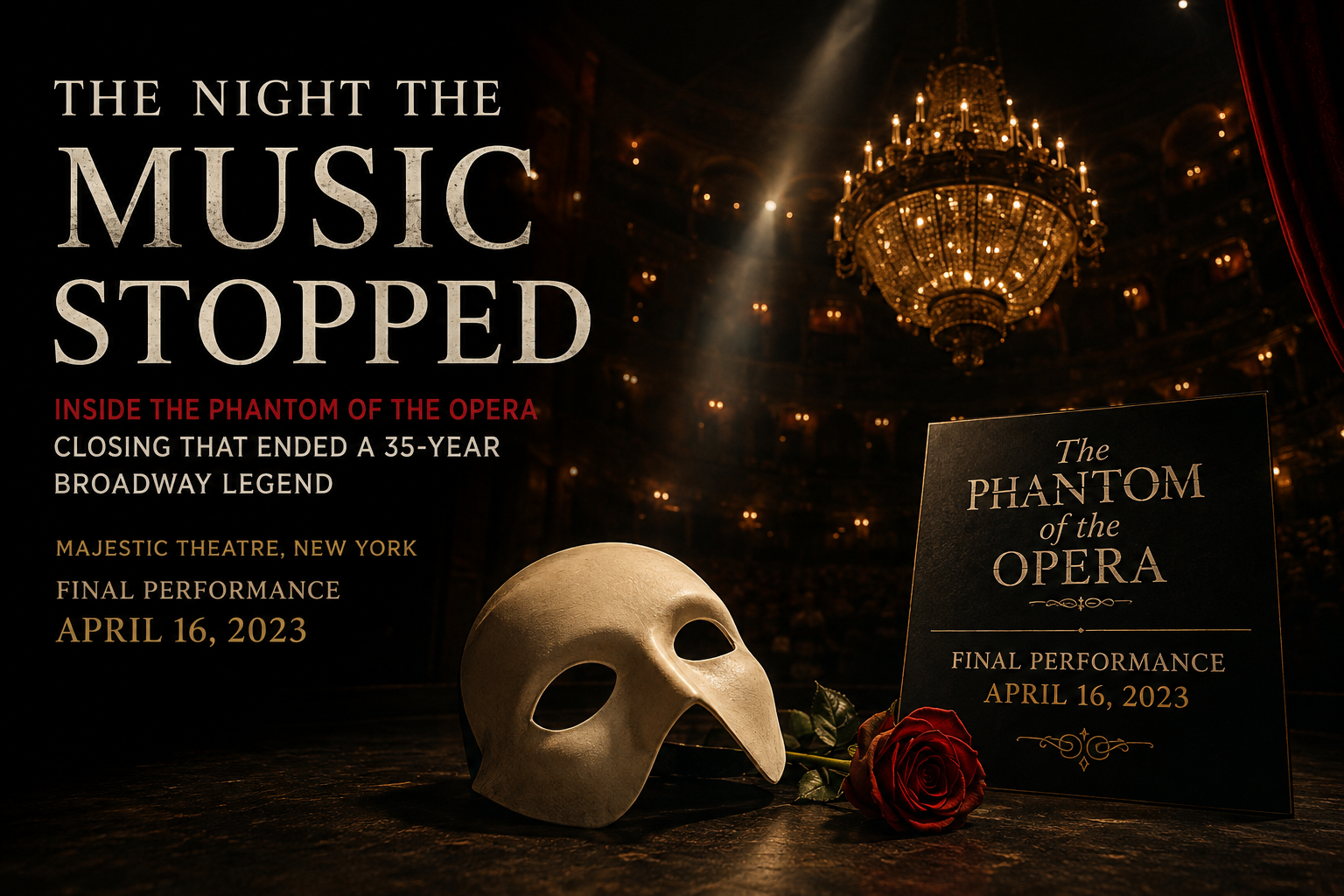
The Night the Music Stopped
Inside the Phantom of the Opera Closing That Ended a 35-Year Broadway Legend
Status: CLOSED CASE
Location: Majestic Theatre, New York City
Final Performance: April 16, 2023
Running Time of Investigation: 35 Years, 13,981 Performances
There Was No Accident.
There was no fire. No structural failure. No government order. No sudden disaster.
Yet one of Broadway’s greatest legends disappeared.
On April 16, 2023, the chandelier rose one final time inside New York’s Majestic Theatre. Minutes later it descended for the last time. When the curtain fell, Broadway lost the longest-running musical in its history.
For thirty-five years, The Phantom of the Opera had seemed untouchable. Generations assumed it would never close. Then, unexpectedly, it did.
Officially, the explanation was economics. But was money alone enough to end Broadway’s most enduring success?
This file investigates the final chapter of a production many believed would outlive every other musical on Broadway.
CASE FILE
Production: The Phantom of the Opera
Composer: Andrew Lloyd Webber
Lyrics: Charles Hart
Original Broadway Opening: January 26, 1988
Venue: Majestic Theatre
Final Broadway Performance: April 16, 2023
Total Performances: 13,981
A Musical That Became Broadway Itself

When The Phantom of the Opera opened in 1988, nobody expected it to redefine Broadway for more than three decades.
Its famous falling chandelier. Its underground lake. Its enormous staircase. Its lavish costumes. Its romantic tragedy. Everything about Phantom represented the traditional image of Broadway spectacle.
Millions of visitors came to New York with one performance already on their itinerary. For international tourists, Broadway often meant only one title. Phantom.
Over thirty-five years the production employed thousands of performers, musicians, technicians, wardrobe specialists, carpenters, electricians and stage managers. Entire careers were built inside the Majestic Theatre. Some crew members worked on the production for decades.
Broadway changed around Phantom. New musicals opened. Blockbusters arrived. Failures disappeared. Yet Phantom remained.
It survived economic recessions. The September 11 attacks. The 2008 financial crisis. Even the COVID-19 shutdown.
Which makes one question impossible to ignore. Why did it finally close?
The Pandemic Changed Everything

Broadway reopened in September 2021 after an eighteen-month shutdown. Phantom returned with enthusiastic audiences. Critics celebrated its survival. Fans believed the worst was over.
Behind the scenes, however, the economics had changed dramatically. Running one of Broadway’s largest productions had become significantly more expensive. Health protocols increased operating costs. Labour expenses rose. Maintenance costs continued to climb.
Unlike newer productions, Phantom required an enormous physical infrastructure. Large orchestras. Complex stage machinery. Hundreds of costumes. Special effects. Massive backstage storage.
The production had always been expensive. After COVID, it became even more expensive. Ticket sales remained strong. But “strong” was no longer enough.
The Announcement That Shocked Broadway
In September 2022, producers announced that Phantom would close in February 2023.
Fans immediately reacted. Instead of disappearing quietly, something unexpected happened. Ticket demand exploded.
People who had postponed seeing Phantom suddenly rushed to buy seats. Former cast members returned. International visitors changed travel plans. Media around the world covered the closing announcement.
Demand became so extraordinary that producers extended the closing date. The musical continued until April 16, 2023.
Ironically, the announcement of closure produced some of the highest ticket demand in years.
Was Broadway Changing?

Phantom represented an era when Broadway invested in permanent spectacular productions. Modern Broadway operates differently.
Today’s commercial theatre increasingly depends on shorter financial cycles. Limited engagements. Celebrity casting. Touring productions. Rapidly changing audience preferences.
Large-scale productions carrying enormous weekly operating costs face greater financial pressure than ever before.
The closure of Phantom therefore symbolized more than the end of one musical. It represented the gradual conclusion of Broadway’s “mega-musical” era.
The Last Performance
The final evening felt less like a performance and more like a farewell ceremony.
Former cast members filled the audience. Industry legends attended. Many backstage employees had spent decades inside the Majestic Theatre.
As the final curtain call approached, performers struggled to hide their emotions. When the chandelier rose for the last time, applause interrupted the performance. When it descended at the end, many audience members were crying.
Broadway had witnessed countless closing nights. Few carried the emotional weight of Phantom. Not because another show was ending. Because an era was ending.
What Happened Next?

The Majestic Theatre did not remain empty. Soon after Phantom closed, the theatre began renovations.
The Majestic underwent one of the largest renovations in its history before welcoming Gypsy in a later revival, marking a complete transformation of a theatre that many people associated exclusively with Phantom.
The building survived. The production did not.
The Investigation
Was Phantom a failure? Absolutely not. Closing after 13,981 performances is the opposite of failure.
The investigation instead reveals something more important. Even the greatest productions cannot escape changing economics.
Broadway audiences evolve. Operating costs evolve. Business models evolve. No production remains untouched forever.
Phantom did not close because audiences stopped loving it. It closed because sustaining one of Broadway’s most technically ambitious productions had become increasingly difficult in a post-pandemic world.
THE X-FILES VERDICT
Case Status: Closed
Primary Cause: Post-pandemic operating economics
Secondary Factors: Rising production costs, changing commercial theatre environment, Broadway business transformation
Historic Significance: The conclusion of Broadway’s longest-running production marked the symbolic end of an era defined by large-scale permanent mega-musicals.
Editor’s Analysis
History often remembers opening nights. Broadway professionals remember closing nights. Because closing nights reveal something opening nights never can. Whether a production truly mattered.
On April 16, 2023, the standing ovation lasted far longer than usual. Not because the audience wanted another encore. Because nobody wanted to become the person who stopped applauding.
When the house lights finally came on, thousands left the Majestic Theatre carrying the same realization. They had not simply watched the last performance of The Phantom of the Opera. They had witnessed the closing chapter of Broadway history.
References & Further Reading
The Phantom of the Opera — Official Broadway Closing Report
Internet Broadway Database — The Phantom of the Opera Broadway Production
Playbill — The Phantom of the Opera Final Broadway Performance
Andrew Lloyd Webber — Phantom Broadway Closing
Next in THE SHOW X-FILES
https://immersivelabkorea.com/what-happens-backstage-before-concert/
© IMMERSIVE LAB | THE SHOW X-FILES


