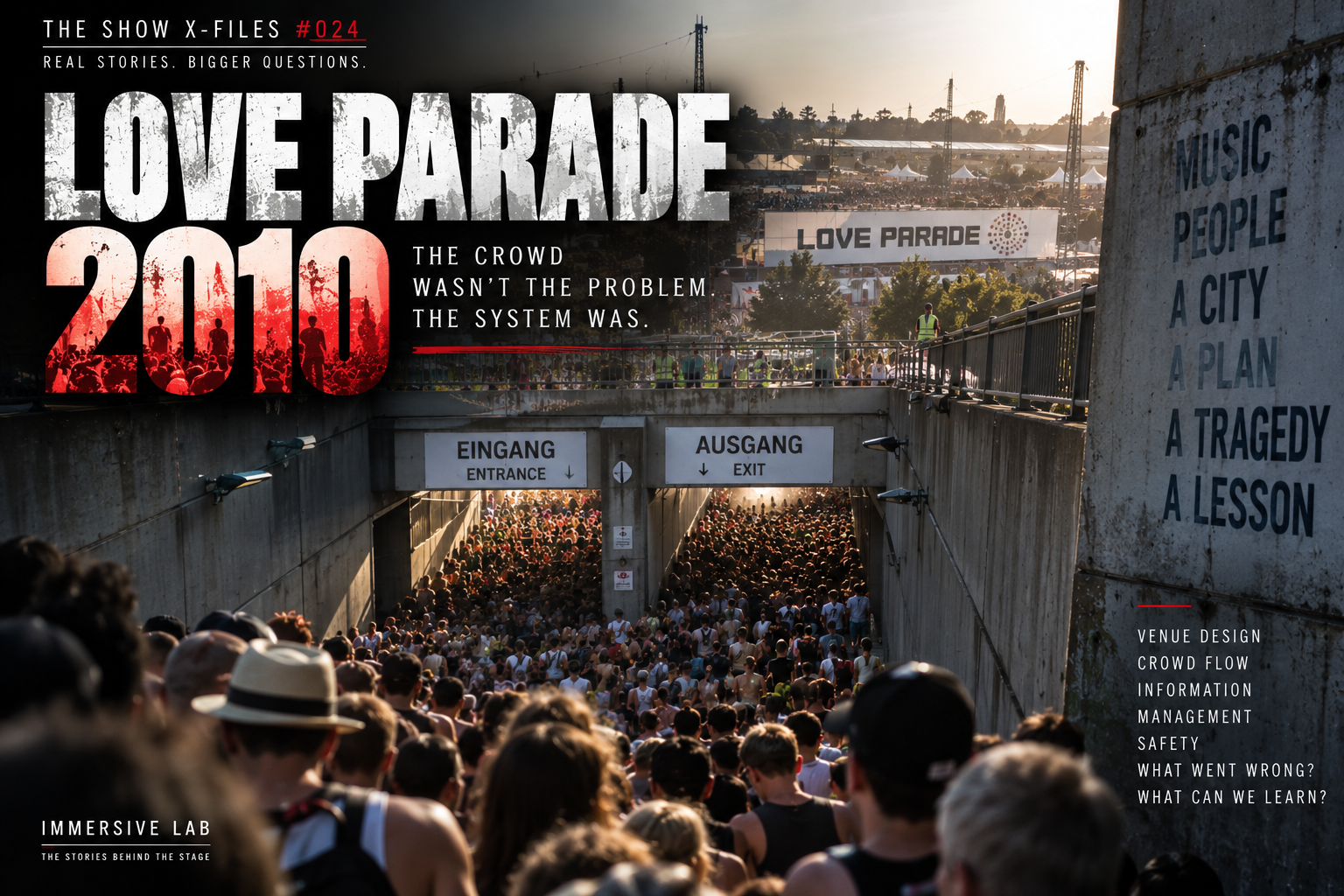
Love Parade 2010 : The Crowd Wasn’t the Problem. The System Was.
At around 4:30 p.m. on July 24, 2010, thousands of people were moving through the entrance system of the Love Parade in Duisburg, Germany.
Music was still playing inside the festival. From many parts of the site, the event still looked like a celebration.
But on a sloping access ramp connected to tunnels leading toward the festival grounds, something had begun to change. People were no longer simply walking. The crowd became so dense that individuals increasingly lost control over their own movement. Bodies were pushed sideways. People stumbled. Some fell. Others were forced over them.
Within a short period, 21 people were killed. Contemporary reporting placed injuries above 500, while later work drawing on the extensive German court investigation put the number above 650.
The tragedy was quickly described using familiar words: panic, stampede, chaos. But those words can hide the most important question. Because a crowd of hundreds of thousands does not suddenly become dangerous simply because the people inside it decide to behave irrationally.
So THE SHOW X-FILES #024 begins somewhere else: what if the crowd wasn’t the primary failure? What if the system carrying the crowd had already lost control?
This is not primarily a story about music. It is a story about site design, crowd engineering, communication and command. And it contains one of the most important lessons in live-event production: crowd safety is designed long before the audience arrives.
The Venue Changed Everything

The Love Parade had grown out of Berlin’s open urban environment. Duisburg was different.
The 2010 festival occupied roughly 100,000 square metres on the site of a former freight station. Railway infrastructure constrained one side. A freeway constrained another. And access to the festival grounds depended heavily on tunnels and a ramp.
Authorities had raised concerns about the size of the site in relation to expected attendance. Approval ultimately included a condition limiting concurrent attendance to 250,000 people.
This distinction matters. A festival site can have enough theoretical space for a crowd while still possessing a dangerous circulation system. Capacity is not merely how many people fit inside. It is also how they arrive, where they wait, how they enter, how they leave, what happens when incoming and outgoing flows meet, and where pressure accumulates when something changes.
For an event producer, the venue is therefore not a container. It is a flow machine.
The Festival Was Not the Bottleneck

One of the most revealing findings from subsequent analysis is counterintuitive. The main festival area itself was apparently not overcrowded when the fatal conditions developed. The critical problem emerged in the access system.
That difference changes how the disaster should be understood. Imagine a concert arena that can safely contain 50,000 spectators. That does not mean 50,000 people can safely pass through one entrance simultaneously. The capacity of the destination and the capacity of the route are two different engineering problems.
In Duisburg, the access route became the system’s critical component. A widely cited 2012 academic analysis by Dirk Helbing and Pratik Mukerji, published in EPJ Data Science and based substantially on video reconstruction and the available investigative record, concluded that the disaster resulted not from a single isolated mistake but from amplifying feedback and cascading effects characteristic of systemic instability.
The production lesson is fundamental: your event capacity is not determined by the largest space. It can be determined by the smallest critical pathway.
Two Directions. One Critical Route.

The ramp was not simply an entrance. People were moving toward the festival. Other people were trying to leave it. When large opposing flows share constrained space, the production problem becomes significantly harder.
Crowd researchers have long understood that dense counterflows can become unstable. The Love Parade’s planning included access-control points intended to regulate movement before visitors reached the tunnels. But on the day of the event, crowd-control measures encountered difficulties. Some cordons were eventually released. Incoming and outgoing flows increasingly interfered with one another.
Helbing and Mukerji’s reconstruction describes the resulting condition starkly: a situation effectively developed in which people could not easily escape from the accumulating crowd.
This was not simply “too many people.” It was people, direction, geometry, timing and control interacting at once. Those variables matter enormously.
The Numbers Had Already Warned of a Problem

A crowd is not just a headcount. It is a flow rate—how many people are moving through a given width during a given period.
An expert assessment discussed in the academic analysis examined the usable width of the main ramp, finding that obstacles reduced the effective width at its narrowest point. Using established safe-flow assumptions, researchers calculated a substantially lower maximum safe hourly flow through that section than the combined incoming and outgoing flows that planning estimates anticipated during the event’s peak hour.
That mismatch does not mean the full planned volume of people actually passed through the fatal location, or that the numerical gap alone caused the deaths—the researchers explicitly warn against that simplistic conclusion. Actual flow was affected by access controls, and the disaster did not occur precisely at the narrowest geometric point.
That is exactly why the case is so important. There was no single magic number that caused the disaster. There was a network of interacting conditions.
Then the Schedule Slipped
Live-event production people understand what happens when a schedule slips. One delay rarely stays isolated.
According to the reconstruction, completion work contributed to the festival grounds opening later than originally planned. Visitors accumulated. Access controls came under pressure earlier. Queues increased. Waiting times grew. Movement patterns began diverging from the assumptions behind the plan.
This is where event planning meets systems engineering. A production schedule might say: gates open, audience enters, first programming, peak attendance. But the crowd does not reset itself when the schedule changes. If gates open late, the people who were supposed to enter earlier do not disappear. They combine with people arriving later. The flow curve changes. The entire operating model must therefore respond.
A schedule delay can become a crowd-management problem.
The Most Dangerous Moment Did Not Look Like Panic
This is perhaps the most important correction to the popular narrative.
Video analysis found evidence of what researchers describe as crowd turbulence. At very high density, individuals can lose the ability to control their own movement. Forces propagate through bodies. People can be moved involuntarily. Small disturbances become waves. If someone falls, the consequences can cascade.
The Helbing and Mukerji analysis identified crowd turbulence developing on the ramp during the afternoon, worsening substantially as conditions progressed, with irregular movement eventually affecting much of the ramp and many people stumbling or falling.
Later research using eyewitness accounts reached a compatible conclusion: witnesses described transversal crowd waves and falls as central dangerous dynamics, while helping behaviour was common, and witnesses did not generally support the simplistic idea of a crowd suddenly entering “mass panic.”
This distinction matters because language changes prevention. If we say “people panicked,” the implied solution becomes controlling people’s behaviour. If we say “the system allowed dangerous density and crowd turbulence to develop,” the questions become completely different. Why did density reach that level? Why did flows converge? What information did controllers have? Who could reduce inflow? Where could pressure be released? How quickly could conditions be detected? Those are production questions.
What One Person in the Crowd Could See
Imagine standing inside that ramp. Your view might extend only a few metres. You cannot see the entire crowd. You cannot see the tunnel. You cannot see command posts. You cannot see aerial surveillance. You cannot calculate density. You do not know whether the route ahead is blocked. You feel pressure. You see someone climbing. You see another person trying to escape. What do you do?
This is why blaming individual audience members can be profoundly misleading. The systemic analysis notes that people inside a dense crowd often cannot understand what is happening even a short distance away. Their actions are responses to the local conditions available to them.
The event-management organization has the opposite responsibility. It must see what individuals cannot.
The People Above Had a Different Problem

Police and event personnel had access to information unavailable to the audience. There was surveillance. There was helicopter observation. There were personnel positioned around the site.
But information existing somewhere in an organization is not the same thing as information reaching the right decision-maker in time. The reconstruction identified communication and coordination difficulties between organizer and police among the interacting factors.
This introduces a production principle that extends far beyond Duisburg: a camera does not create situational awareness. Neither does a radio. Neither does a control room. Technology produces information. An operational structure must turn that information into decisions. That requires clearly defined answers to questions such as: who monitors crowd density? Who receives warnings? Who has authority to stop incoming spectators? Who controls barriers? Who can reverse a flow? Who can suspend programming? Who commands police? Who commands private security? Who decides that normal operation has become an emergency?
If these responsibilities are ambiguous, more information may simply produce more communication without producing faster action.
The Staircase Became a Signal

At the side of the ramp was a relatively narrow staircase. As conditions became increasingly dangerous, people began trying to reach it. Others climbed a pole or other structures.
From outside the crowd, such behaviour could potentially look like impatient festivalgoers attempting to bypass controls. From inside the crowd, it could mean something entirely different: escape.
The systemic analysis specifically warns that attempts to climb out could be misinterpreted as aggressive behaviour when they were actually signs of emergency. That is a crucial crowd-management insight. Audience behaviour is data. People climbing barriers may be breaking a rule. Or they may be communicating that the space below has become intolerable. Production teams need the ability to distinguish the two.
The System Had Multiple Owners

Large public events rarely have one organization controlling everything. There may be the promoter, venue operator, city authorities, police, fire services, medical services, private security, transport operators, production management, technical suppliers and local regulators. Each may perform its own job correctly while the interfaces between them fail.
This is one reason the Love Parade case resists a simple explanation. The 2012 academic analysis deliberately focused not on assigning legal responsibility but on the interaction of contributing factors. Its conclusion was that the disaster resulted not from one isolated mistake but from amplifying feedback and cascading effects characteristic of systemic instability. Later technical work drawing on the extensive court expert report similarly emphasized shortcomings across planning, licensing, coordination and information transfer.
This gives producers an uncomfortable but essential rule: safety does not live inside departments. Safety lives between them.
A Safety Plan Is Not the Same as a Safe Event
The Duisburg event had planning documents. It had authorities. It had police. It had security personnel. It had an evacuation analysis. It had access controls. Yet catastrophe still occurred.
Why? Because documentation is not the final safety system. Operations are. A safety plan is a model of what people expect to happen. The live event is what actually happens. Those two things begin separating the moment a train arrives late, a gate opens late, an artist schedule changes, weather shifts, a route becomes blocked, a barrier moves, a queue grows faster than expected, or thousands of spectators behave differently from the forecast.
The real safety capability is therefore not merely: can we follow the plan? It is: can we detect when reality has stopped matching the plan?
Production Perspective — Design, Information, Management
One expert framework discussed after Duisburg identified three broad ways of influencing crowd safety: design, information, and crowd management. For a live producer, these three layers are powerful.
Design. Can the physical environment safely carry the expected flows? Routes, widths, entrances, exits, barriers, holding areas, emergency access, direction separation. No amount of excellent communication can fully compensate for fundamentally unsuitable geometry.
Information. Can operators understand conditions in real time? CCTV, density observation, radio, counters, reports from security, transport information, audience behaviour. The important metric is not how much data exists. It is whether the data identifies danger early enough.
Management. Can someone act? Reduce inflow, open alternative routes, separate directions, remove barriers, redirect audiences, deploy staff, stop programming, begin emergency procedures.
Design creates the possibilities. Information identifies the condition. Management makes the decision. All three must work together.
When Should the Show Stop?
THE SHOW X-FILES has now encountered this question repeatedly. Nick & Nora asked why months of revisions could continue without solving the underlying problem. Paradise Square asked when keeping a production alive becomes an operational and financial responsibility. Love Parade makes the question literal.
When does someone stop the event? This is not a philosophical issue. In a crowd emergency, minutes matter. The authority structure needs to exist before the audience arrives. Not “we’ll decide together if something happens,” but: if indicator X reaches condition Y, person Z has authority to execute action A. That is the difference between discussion and command.
The Audience Is Part of the Production System
Producers often divide a show into departments: stage, lighting, video, audio, rigging, automation, security, front of house. But an audience of tens of thousands of people is itself a dynamic system. They arrive, queue, search, wait, move, stop, reverse direction, gather around attractions, leave simultaneously, react to weather, react to music, react to barriers, react to each other.
Audience experience therefore begins long before the first lighting cue. The journey from train station to gate is part of the show. The queue is part of the show. The exit route is part of the show. And the crowd-management plan is as much a piece of production infrastructure as the PA system—except its failure can have far more serious consequences.
21 People Never Went Home

Technical analysis is necessary. But it can also become emotionally sterile. Flow rates, density, bottlenecks, counterflows, ramp widths, control points, communication structures—all are important. But they describe a system whose failure had human consequences.
Twenty-one people died. Hundreds were injured. The Love Parade was never held again.
The correct production lesson is therefore not to admire the complexity of the failure. It is to understand that every line on a crowd-flow diagram ultimately represents people.
What the Production World Learned
The disaster became an important case in subsequent crowd-management research and practice. Later work drawing on the extensive court analysis says the lessons contributed to technical guidance treating traffic management and crowd management as an integrated system.
That means thinking beyond the festival fence: rail stations, roads, parking, pedestrian routes, waiting areas, entrances, controls, tunnels, ramps, public spaces. They form one connected system. A promoter cannot think “our responsibility starts at the gate,” because the gate may already be downstream of the problem.
The Real Failure Happened Before 4:30 PM
The fatal crowd conditions became visible during the afternoon of July 24. But the production failure cannot be understood as something that suddenly began when people fell. Parts of it existed earlier: in venue selection, in circulation assumptions, in expected flow models, in approval processes, in operational responsibilities, in contingency planning, and in the coordination architecture connecting organizations.
Then came the live variables: delayed opening, changing flows, control difficulties, congestion, incomplete situational awareness, communication problems. Each interacted with the others. No single one explains the disaster. Together, they created a system increasingly unable to absorb disruption.
That is what makes Love Parade 2010 more than a historical tragedy. It is a warning about production resilience.
The Production Question
For every major public event, producers should be able to answer one question before opening the gates: where will the audience go when the plan stops working?
Not when everything operates perfectly. When a gate fails. When the schedule slips. When transport delivers spectators faster than expected. When an entrance becomes blocked. When incoming and outgoing audiences collide. When thousands of people simultaneously decide to leave. When a security cordon cannot hold. When communication fails. When the model and reality diverge.
That is the scenario that reveals whether an event has merely been planned—or actually engineered for safety.
Production Takeaway
The most dangerous misconception about crowd disasters is that the crowd itself suddenly becomes the enemy. Love Parade 2010 demonstrates why that explanation is inadequate.
A crowd follows the possibilities created around it. Architecture determines where people can move. Barriers determine where they cannot. Scheduling determines when they arrive. Information determines what they understand. Management determines how flows are controlled. Command determines how quickly the system reacts when conditions become unsafe. And when all of those elements interact badly, thousands of perfectly ordinary individual decisions can produce an extraordinary collective danger.
That changes the producer’s question. Not how many people can we fit into this event? But: can our entire system safely move them when reality stops behaving according to plan? Because the audience should never have to discover the answer from inside the crowd.
References & Further Reading
Phys.org — Panic Was Not the Cause of the Love Parade Disaster: Study
MIT Technology Review — ‘Crowd Quakes’ Were a Key Factor in Love Parade Disaster
Wikipedia — Love Parade Disaster (cross-checking only)
Image Credits
All photographs remain the property of their respective photographers and copyright holders. Use only images whose licences, official press permissions or other applicable rights permit publication.


