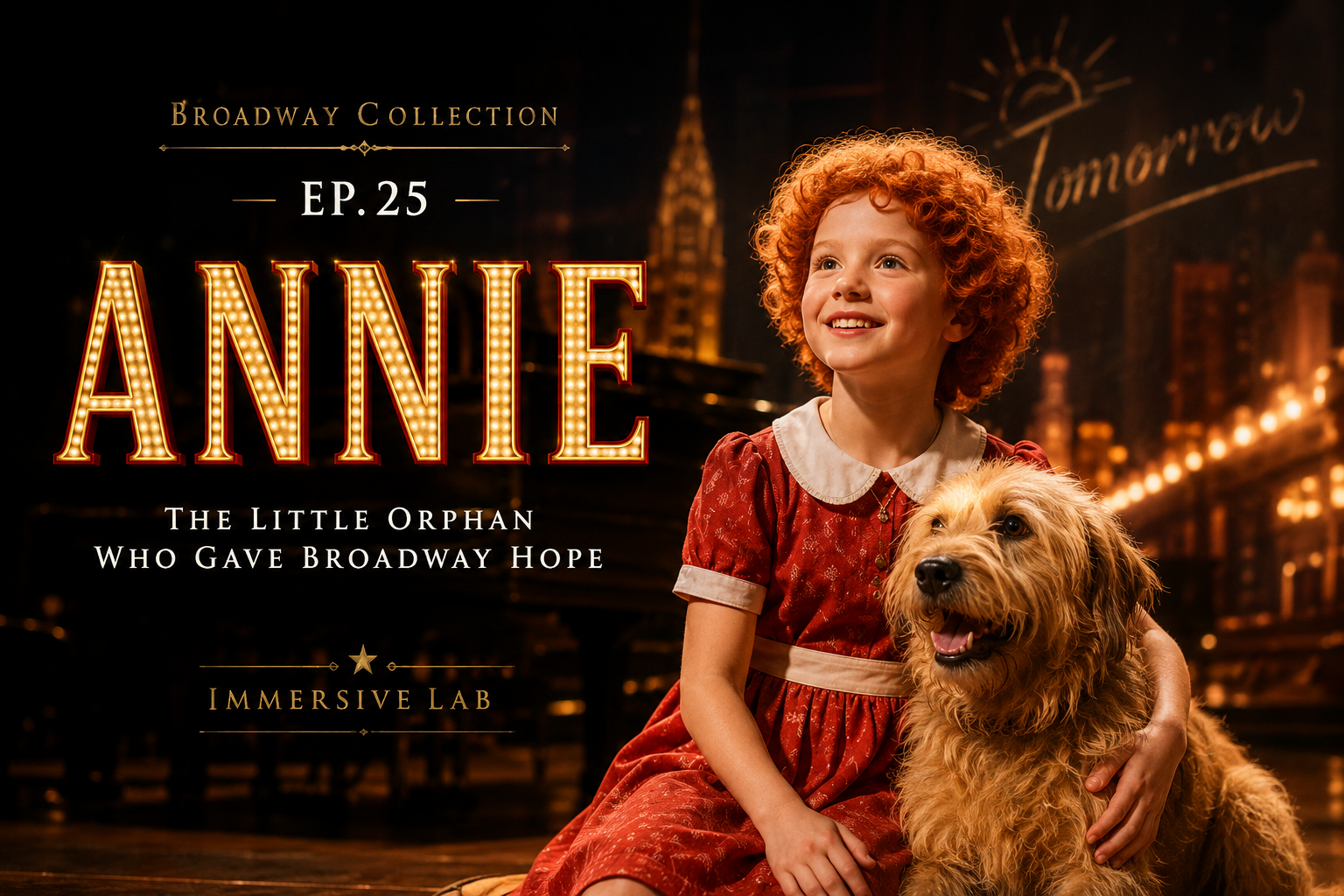
The Little Orphan Who Gave Broadway Hope
Can one little girl change the way the world sees hope?

Broadway has introduced unforgettable kings, queens, revolutionaries, and dreamers.
Yet one of its greatest heroes is neither powerful nor wealthy.
She is an eleven-year-old orphan with bright red hair, endless optimism, and an unshakable belief that “Tomorrow” will always be better.
When Annie premiered on Broadway in 1977, it quickly became much more than another musical.
It became a symbol of hope during uncertain times.
Even today, nearly fifty years later, Annie continues to remind audiences that optimism can survive even the darkest days.
A Story That Began as a Comic Strip

Before becoming one of Broadway’s most beloved musicals, Annie originated from Harold Gray’s famous comic strip Little Orphan Annie, first published in 1924.
The Broadway adaptation was created by Charles Strouse, Martin Charnin, and Thomas Meehan.
Rather than simply adapting the comic, the creative team transformed Annie into an uplifting musical about courage, family, and believing in tomorrow.
The show opened at the Alvin Theatre on April 21, 1977, and audiences instantly embraced its warmth and optimism.
It went on to win seven Tony Awards, including Best Musical, establishing itself as one of Broadway’s defining family productions.
Growing Up Without Losing Hope

Annie lives in a harsh orphanage run by the cruel Miss Hannigan.
Life is difficult.
Rules are strict.
Dreams seem impossible.
Yet Annie refuses to surrender to despair.
She believes her parents will someday return.
She believes kindness still exists.
Most importantly, she believes tomorrow will bring something better.
Her optimism is not childish innocence.
It is remarkable courage.
That unwavering spirit is why Annie has inspired generations of audiences around the world.
The Musical That Celebrated Optimism

Unlike many Broadway classics built around tragedy or romance, Annie celebrates resilience.
Its songs are filled with hope instead of fear.
Its characters discover family instead of loneliness.
Its message is simple enough for children to understand yet powerful enough for adults to remember.
Sometimes the greatest act of courage is simply refusing to give up.
The Song That Became a Global Anthem

Few Broadway songs are as universally recognized as “Tomorrow.”
Its melody is simple.
Its lyrics are unforgettable.
The song became an anthem far beyond the theatre, performed at concerts, schools, sporting events, and celebrations around the world.
More than a musical number, Tomorrow became a symbol of optimism itself.
For millions of people, Annie’s voice continues to represent hope in the face of uncertainty.
A Girl and Her Dog Won the World’s Heart

One of the musical’s most beloved characters never sings a solo.
Sandy, Annie’s faithful dog, symbolizes unconditional friendship and loyalty.
After rescuing Sandy from the streets, Annie finally has someone who believes in her without question.
Their relationship reminds audiences that family is not always defined by blood.
Sometimes it is built through kindness, trust, and love.
That simple idea has touched generations of theatre lovers.
A Millionaire Who Learned the Meaning of Family

At first, Oliver Warbucks appears to be a man who has everything.
Wealth.
Power.
Success.
Yet his life is missing something money cannot buy.
Meeting Annie changes him forever.
As their relationship grows, Warbucks discovers that true happiness comes not from business or fortune but from love, responsibility, and belonging.
His transformation is one of the musical’s greatest emotional journeys.
The Song That Never Grows Old

Every Broadway generation has its signature song.
For Annie, that song is “Tomorrow.”
Its message is timeless.
No matter how difficult today may seem, tomorrow offers another chance.
The melody has become one of the most recognizable in musical theatre history, performed by children, orchestras, choirs, and artists around the world.
More than a Broadway classic, it has become a universal symbol of optimism.
A Broadway Legend That Continues to Inspire
Since its 1977 premiere, Annie has been revived on Broadway several times and has toured internationally across Europe, Asia, Australia, and beyond.
The musical has also inspired multiple film adaptations, introducing Annie’s story to new generations.
Its enduring popularity proves that hope never goes out of style.
As long as audiences continue believing in tomorrow, Annie will always have a place on the Broadway stage.
Why Annie Still Matters Today
The world continues to face uncertainty.
People experience disappointment, hardship, and change.
Yet Annie reminds us that optimism is not weakness.
It is strength.
Her courage is not based on certainty.
It is based on faith that tomorrow can be better than today.
That message is as meaningful now as it was nearly fifty years ago.
References & Further Reading
ANNIE — Official Website
ANNIE The Musical
Tony Awards — Official Website
Tony Awards
Internet Broadway Database (IBDB)
IBDB
Playbill
Playbill
Broadway Collection Review
⭐⭐⭐⭐⭐ 5.0 / 5
| Category | Rating |
|---|---|
| Story | ⭐⭐⭐⭐⭐ |
| Music | ⭐⭐⭐⭐⭐ |
| Family Appeal | ⭐⭐⭐⭐⭐ |
| Emotional Impact | ⭐⭐⭐⭐⭐ |
| Rewatch Value | ⭐⭐⭐⭐⭐ |
Final Thoughts
Some Broadway musicals entertain.
Some become classics.
Annie became a symbol of hope.
With unforgettable songs, memorable characters, and a message that continues to inspire audiences of all ages, it remains one of Broadway’s most beloved family musicals.
Sometimes the greatest lesson a musical can teach is beautifully simple:
The sun will come out tomorrow.
Continue Exploring Broadway
→ Next Article
EVITA — The Woman Who Became a Nation’s Voice
You May Also Enjoy
- The Lion King — The Broadway Spectacle That Inspired the World
- The Sound of Music — A Timeless Musical of Family and Hope
- Les Misérables — The Musical That Defined Hope and Revolution
Image Credit
Promotional images and official posters featured in this article remain the property of their respective production companies and copyright holders. They are used solely for editorial, educational, review, and informational purposes.


