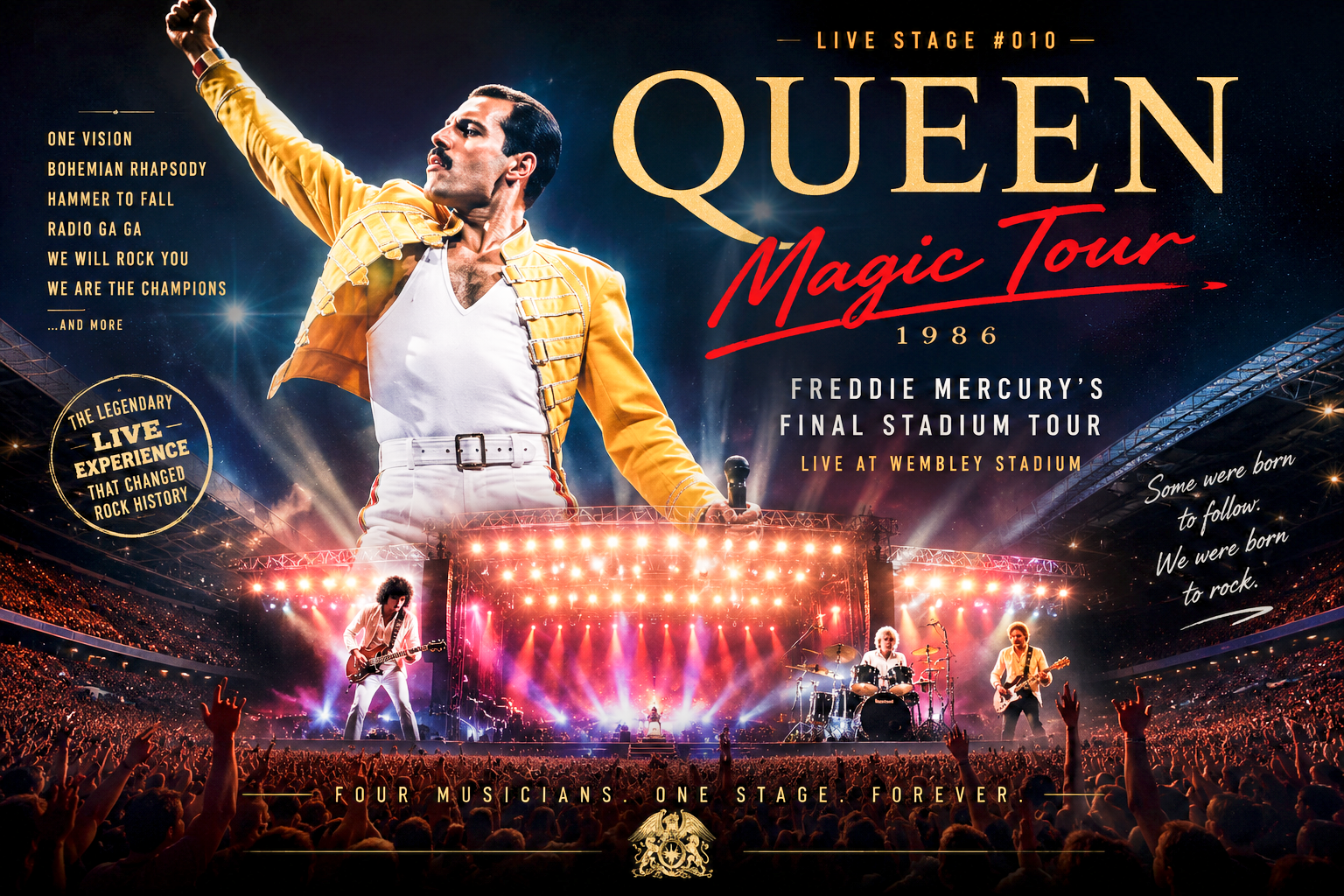
Queen – Magic Tour
The Final Tour That Became a Legend
Some concert tours are remembered because they broke attendance records.
Others are remembered for their spectacular stage production.
Queen’s Magic Tour is remembered because it became Freddie Mercury’s final tour with the band—a series of performances that would later be recognized as one of the most emotional chapters in rock history.
At the time, no one knew these concerts would become Queen’s farewell to stadium audiences.
Looking back today, every performance carries a deeper meaning.
The Tour That Followed A Kind of Magic

In 1986, Queen released A Kind of Magic, an album inspired in part by the film Highlander.
To support the album, the band launched the Magic Tour, performing across Europe in front of enormous stadium crowds.
Demand was extraordinary.
Tickets disappeared within hours.
Every venue became a celebration of one of the world’s greatest live bands.
Unlike many large productions of the era, Queen relied less on elaborate stage technology and more on the unmatched connection between the band and its audience.
Freddie Mercury’s Greatest Gift

Freddie Mercury possessed a rare ability.
He could make an audience of seventy thousand people feel as though they were part of a single performance.
A simple hand movement.
A smile.
A short vocal phrase.
Within seconds, an entire stadium would respond together.
His famous call-and-response moments became legendary.
There was almost no barrier between performer and audience.
Instead of watching a concert, fans became active participants in it.
This extraordinary connection remains one of the defining characteristics of Queen’s live performances.
Wembley Stadium

When people think about the Magic Tour, one venue immediately comes to mind.
Wembley Stadium.
Queen’s concerts there became legendary.
As daylight faded into night, Freddie Mercury stood before tens of thousands of fans, leading massive sing-alongs that echoed throughout the stadium.
Songs such as Bohemian Rhapsody, Radio Ga Ga, We Will Rock You, and We Are the Champions transformed into unforgettable communal experiences.
These performances are still regarded as some of the greatest stadium concerts ever recorded.
Music Without Barriers
Unlike productions built around complex visual effects, Queen placed complete confidence in musicianship.
Brian May’s guitar.
Roger Taylor’s powerful drumming.
John Deacon’s steady bass lines.
Freddie Mercury’s commanding voice.
The band’s chemistry required very little theatrical distraction.
Their greatest production element was the music itself.
That simplicity made every emotional moment even more powerful.
Director’s Note
Magic Tour reminds us that technology alone does not create unforgettable concerts.
The strongest connection between artist and audience comes from genuine performance.
Freddie Mercury understood that the most powerful stage effect was human emotion.
That lesson continues to inspire performers around the world today.
The Farewell Tour That United an Entire Stadium

When the Magic Tour ended in August 1986, neither Queen nor their fans knew they had witnessed the band’s final stadium tour with Freddie Mercury.
Years later, these performances would be remembered not simply as concerts, but as the closing chapter of one of the greatest live bands in music history.
Today, the Magic Tour represents something far greater than nostalgia.
It stands as a masterclass in audience connection, musical excellence, and timeless stage presence.
Wembley Became Rock History

Among all the concerts on the Magic Tour, the performances at Wembley Stadium have become legendary.
As darkness fell over London, Freddie Mercury stepped onto the stage with extraordinary confidence.
The opening notes of One Vision immediately electrified the crowd.
Throughout the night, Queen delivered one unforgettable performance after another.
Bohemian Rhapsody.
Hammer to Fall.
Radio Ga Ga.
We Will Rock You.
We Are the Champions.
Each song transformed thousands of individual voices into one enormous chorus.
The audience was no longer watching the concert—they became part of it.
Freddie Mercury’s Greatest Talent

Freddie Mercury possessed something that cannot be measured by technology or production budgets.
He understood people.
Every gesture.
Every smile.
Every pause.
Every movement across the stage created an emotional connection with the audience.
His famous call-and-response moments remain some of the most iconic interactions in concert history.
Even without elaborate visual effects, he could command an entire stadium with nothing more than his voice and personality.
Few performers have ever achieved that level of stage presence.
Why the Magic Tour Still Matters

Modern concerts often rely on massive LED screens, cinematic visuals, drones, or complex stage machinery.
The Magic Tour reminds us that spectacular technology is only part of great live entertainment.
What audiences remember most is authenticity.
Queen demonstrated that exceptional musicianship, emotional honesty, and genuine interaction could create unforgettable experiences that remain powerful decades later.
That lesson continues to influence performers across every musical genre.
Best Moment
One of the defining moments of the Magic Tour is “Radio Ga Ga.”
As Freddie Mercury encouraged the audience to clap in perfect rhythm, tens of thousands of people moved together as one.
The synchronized applause became an unforgettable visual symbol of the connection between artist and audience.
Even today, it remains one of the most recognizable live performance moments in rock history.
If You Watch Only One Performance

If you watch only one performance from the Magic Tour, choose “Radio Ga Ga” at Wembley Stadium.
It perfectly captures Freddie Mercury’s extraordinary charisma and Queen’s unique ability to transform a stadium full of strangers into a single united audience.
LIVE STAGE Commentary
Many artists have built larger stages.
Many tours have sold more tickets.
But very few performances have created the emotional connection achieved by Queen during the Magic Tour.
Its lasting legacy is not measured by production scale or commercial success.
It is remembered because it demonstrated that the true heart of live entertainment has always been the relationship between performers and their audience.
More than three decades later, the Magic Tour continues to inspire musicians, concert directors, and fans around the world.
References & Further Reading
1. Queen Official — Live Archive: The Magic Tour 1986
Queen Official — The Magic Tour 1986
2. Queen Official — Queen The Greatest: The Magic Tour
Queen Official — The Magic Tour Part 1
Next Episode
https://immersivelabkorea.com/pink-floyd-pulse-tour-the-concert-that-redefined-live-entertainment
LIVE STAGE #011
Pink Floyd – Pulse Tour
How did Pink Floyd transform music, light, lasers, and visual art into one of the most immersive concert experiences ever created?
Discover why the Pulse Tour remains a landmark in the history of live production and multimedia performance.
© IMMERSIVE LAB | LIVE STAGE Studio
From K-Pop to the world’s biggest concerts — bringing every unforgettable live performance to life.


