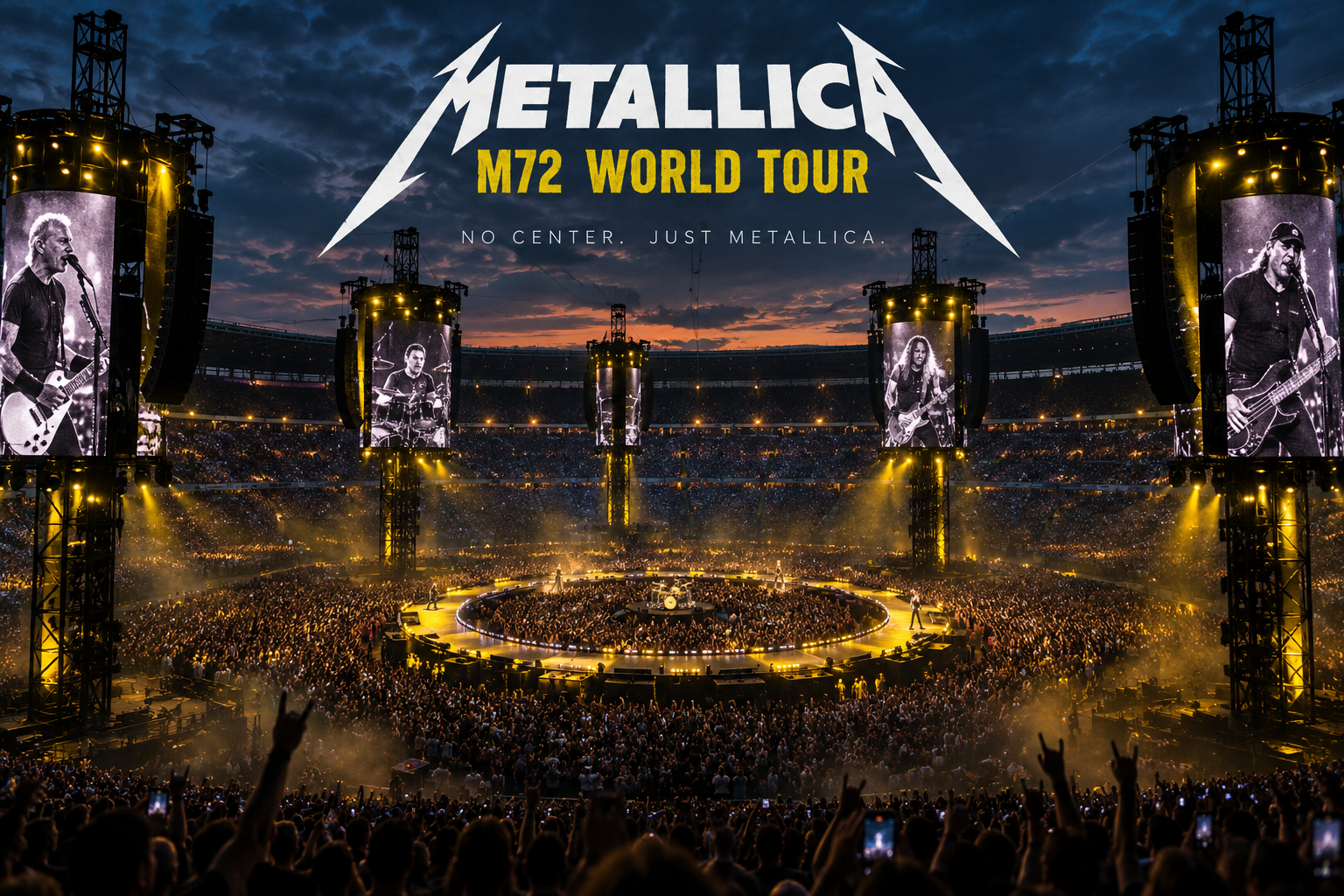
METALLICA — M72 WORLD TOUR
What Happens When You Remove the Center of a Stadium Concert?
A stadium concert normally has a center.
A front. A back. A visual hierarchy. A place where the drummer sits, where the PA points, where the video screens face, and where tens of thousands of people instinctively know to look.
For Metallica’s M72 World Tour, creative director and production designer Dan Braun proposed something far more disruptive: remove the center.
Put the audience there instead. Build a gigantic ring around them. Move Lars Ulrich’s drums to different positions during the concert. Place James Hetfield, Kirk Hammett and Robert Trujillo on a stage so large that they could sometimes be tens of metres apart.
Then somehow make every seat in a football stadium feel as though it belonged to the same concert.
Metallica themselves discovered that this was not simply a scenic-design decision. Lars Ulrich later admitted that when the band first rehearsed the production in Amsterdam, they had underestimated what the enormous distances would mean for musicians accustomed to communicating through eye contact and physical proximity.
So the most interesting question behind M72 is not: how big was Metallica’s stage? It is: what happens to an entire concert-production system when you remove the place where everything normally points?
That question leads directly into stage architecture, sound, lighting, video, performer communication, rigging and touring logistics. And M72 had to solve all of them simultaneously.
The Hole in the Middle

Metallica had used its famous Snake Pit concept for decades. Traditionally, however, there was still a recognizable performance center. Early M72 drawings followed that logic. Lars Ulrich’s drums occupied the middle.
Then the design team inverted it.
The Snake Pit became the center and the band moved around it. TAIT ultimately engineered and fabricated a 120-foot-wide in-the-round stage, with the enlarged Snake Pit occupying its interior.
That sounds like a simple geometric change. It wasn’t. Because once the drummer leaves the center, there is no longer one natural location around which the band can organize itself.
Metallica needed another solution. They built four of them.
Four Drum Kits, Four Temporary Centers
TAIT engineered four custom lifts—each platform measuring roughly 11 by 11 feet and rising about 5 feet 6 inches when raised—that allowed different Lars Ulrich drum kits to rise from beneath the stage at different positions around the ring.
This solved more than a theatrical problem. Every time the drums appeared somewhere else, the band’s visual center shifted. Instead of asking an entire stadium to stare toward one fixed point for two hours, the production could redistribute attention around the building.
But there was a cost.
Ulrich described the adjustment himself. When another member of Metallica stood on the opposite side of the ring, the separation could reach roughly 30–40 yards. The visual cues musicians normally take for granted—seeing a hand on a guitar neck, catching someone’s eyes, sensing where another player is standing—became harder.
During the early Amsterdam performances, the band therefore had to learn the stage almost as though it were a new instrument.
That is one of M72’s most revealing production lessons: stage design can change musical behavior. A designer can create extraordinary audience intimacy while simultaneously making the musicians farther apart from one another. The production then has to solve the contradiction it created.
Eight Towers Instead of One Roof

Now look upward.
A conventional stadium end-stage often concentrates enormous quantities of equipment around a large stage roof. M72 couldn’t rely on that visual architecture. The audience surrounded the performance. Anything placed above or around the ring could obstruct somebody’s view.
The answer was a second ring: eight enormous freestanding towers surrounding the stage. Stageco describes the cylindrical towers as approximately 100 feet tall, each engineered to carry substantial loads while keeping its footprint as small as possible so that sightlines would remain open.
This is where the M72 design becomes particularly intelligent. The towers were not merely structures holding screens. They became infrastructure hubs. Video lived there. Lighting lived there. PA lived there. Rigging functions were distributed through them.
The production effectively took systems that would normally cluster around a traditional stage and spread them around the stadium.
The Towers Had to Disappear While Being Impossible to Miss
There is an interesting contradiction here. Each tower was enormous. Yet production engineering needed to minimize its impact on the audience.
Stageco says one of the central engineering challenges was enabling each tower to carry the necessary load while keeping the base as small as possible.
That small detail explains a much larger principle. In an in-the-round show, structure itself becomes a sightline problem. A conventional stage can hide substantial engineering behind or above the performance. M72 had almost nowhere to hide. Tens of thousands of spectators surrounded the system from every direction.
Therefore engineering had to become part of the visual design. The eight towers did not pretend not to exist. They were given a coherent architectural language and became recognizable elements of the M72 environment.
This is a different approach from concealing production technology. Metallica made the infrastructure part of the scenery.
Then Came the Hardest Problem: Sound
A heavy-metal stadium concert needs enormous acoustic energy. But sheer volume wasn’t the difficult part. Consistency was.
Creative director Dan Braun wanted something unusually ambitious: broad stereo sound across the stadium rather than a conventional experience where stereo imaging becomes meaningful only in limited listening positions. His objective was essentially to give spectators throughout the building something approaching the definition of nearfield monitoring.
Meyer Sound’s solution became one of the most technically interesting elements of the entire M72 production. The system deployed a record 288 PANTHER large-format line-array loudspeakers.
But the number alone tells us almost nothing. The architecture does.
Three Rings of Sound
The 288 PANTHER loudspeakers were arranged in three concentric coverage rings around the stadium.
The outer system used the eight towers. Each tower carried PANTHER arrays distributed around the stadium. A second system was suspended over the performance ring, serving the inner audience area. Then the Snake Pit—the hole at the center of the doughnut—needed its own coverage: inward-facing UPQ-D2 loudspeakers addressed that space, while compact ULTRA-X40 loudspeakers handled front-fill duties around the outer edge of the stage.
Think about what the audio designers were solving. The audience wasn’t in one direction. It was: outside the ring, inside the ring, high above the ring, close to the towers, far from the towers, and everywhere between them.
There was no single “front.” So the PA could not behave like a conventional left-right system. The geometry of the audience dictated the geometry of the sound system.
288 Loudspeakers Were Not the Clever Part
The more revealing number is three networks.
The PANTHER system and associated processing were connected and monitored through three Milan AVB networks incorporating dozens of Luminex network switches and Galileo GALAXY processing platforms—one of the largest touring AVB networks ever deployed, according to Meyer Sound.
Why does that matter? Because once audio becomes geographically distributed around a stadium, system control becomes as important as loudspeaker output.
Signals have to arrive where intended. System health must be monitored. Failures need to be identifiable. Redundancy matters. Timing matters. Coverage boundaries matter.
This is where a stadium PA stops looking like a collection of speaker boxes and starts behaving like networked infrastructure. The audience hears Metallica. The audio department operates a distributed system spanning an entire stadium.
“One” Reveals What the System Could Do
M72 did not turn Metallica into a spatial-audio demonstration. That would have been contrary to the band’s direct musical character. Instead, spatial processing was used selectively.
Before “One,” the sound of a four-engine aircraft could travel around the stadium through Meyer Sound’s Spacemap Go environment. FOH engineer Greg Price recalled that the effect was convincing enough that some people outside the stadium wondered whether an actual aircraft was nearby.
The production lesson is important. Technology did not become the subject of the show. It appeared when it could strengthen a specific dramatic moment. The system had enormous capability, but restraint gave that capability meaning.
Lighting Without the Usual Ceiling

Lighting designer Rob Koenig faced essentially the same geometric problem as audio. Where do you put the lights when there is no conventional stage roof dominating the performance?
Again, the eight towers became part of the answer. Lighting positions were integrated around the video surfaces on each tower, alongside fixtures distributed around the stage itself.
This created a lighting environment very different from the familiar image of hundreds of fixtures hanging from horizontal trusses above a band. M72’s light could come from the towers, from the floor, from around the ring, and across enormous distances. The lighting system therefore reinforced the show’s architecture rather than sitting above it.
A Lighting Designer Couldn’t Know Where Metallica Would Be
There was another complication. The musicians moved. Constantly. In four directions. Across an enormous circular stage.
That makes followspot operation significantly more complicated than on a conventional end stage. Koenig deployed 16 Robe iFORTE LTX followspots with an eight-way RoboSpot remote follow system, allowing operators to track performers around the 360-degree environment from towers positioned around the stadium field.
Koenig’s show programming combined prepared cues with live intervention. That balance is critical. A Metallica concert is not a Broadway musical in which every performer occupies precisely predetermined coordinates at every second. The visual system needs structure. But it also needs to follow a live rock band.
Automation provides repeatability. Human operators provide judgement.
The Video Screens Couldn’t Have a Front Either
Large stadium concerts traditionally use giant video screens to solve a simple problem: the performer looks tiny from the upper seats. But a rectangular screen naturally creates a preferred viewing direction.
M72 had no preferred direction. So the eight towers became the video system too. Each tower carries three video walls forming a curved, cylindrical display, built from more than 1,600 ROE Visual LED panels supplied through 4Wall Entertainment.
This meant spectators could look toward different sectors and still encounter live performance imagery. Video therefore wasn’t simply scenery. It was visual access infrastructure.
That distinction matters. For someone near the stage, Metallica itself was the dominant image. For someone in the upper bowl, the tower screens reduced the visual distance. The screens connected those two scales of experience.
M72 Actually Contained Several Different Concerts
Stand inside the Snake Pit—where roughly 1,000 fans get placed each night—and the show feels almost like a club. Move to the stadium floor and the ring becomes a large-scale arena environment. Climb into the upper seating and the towers become much more important to the experience.
This is why simply calling M72 “immersive” doesn’t explain very much. The more useful idea is: the production was designed at multiple perceptual scales. The same show had to work from five metres away and from the top of a stadium.
That is a far more difficult design problem than creating one spectacular photograph from the best seat in the building.
And Then the Whole Thing Had to Move
This is where spectacular renderings meet touring reality.
TAIT supplied the 120-foot stage and fascia along with engineering, the drum lifts, storage systems, egress structures, video headers, bumpers, lighting brackets, wind bracing and other integrated elements. Stageco handled the eight ground-supported tower structures.
And those towers alone reveal the logistical scale. For the European leg, Stageco operated two identical leapfrogging tower systems, with each system travelling in roughly 25 trailers and being unloaded by a crew of about 15.
Two systems are important. Why build two? Because a stadium-sized structure can take long enough to dismantle, transport and reconstruct that simply moving the same structure sequentially may constrain the touring schedule. A leapfrog strategy changes the equation. While Metallica performs in one city, another structural package can advance toward the next.
The tour doesn’t merely transport a stage. It moves an industrial supply chain ahead of the band.
Before the Show Looked Like a Concert, It Looked Like a Construction Site
Metallica’s own account of the first Amsterdam build at the Johan Cruijff Arena in April 2023 is revealing. Before audiences arrived, the stadium floor contained steel, hardware, cables, cranes and industrial vehicles. The finished ring was emerging from what looked much more like a construction project than entertainment.
This is something promotional concert photographs almost always erase. The finished stage appears inevitable. It isn’t.
Every tower has to reach position. Every connection has to be made. Every system needs power. Every loudspeaker must be deployed. Every LED surface has to communicate. Every automation system must be tested. Every performer route must remain accessible. Every structural condition has to satisfy the venue and production requirements.
Only after those systems converge does the construction site become a Metallica concert.
The Four Drum Lifts Explain the Entire Show

If there is one piece of machinery that captures the logic of M72, it isn’t a giant video screen. It’s Lars Ulrich’s drum lift.
The drum kits disappear below the stage. Another rises somewhere else. The band gravitates toward the new position. The audience’s attention migrates. A different section of the stadium suddenly becomes closer to the musical center. Then the process happens again.
What appears to be a theatrical trick is actually a solution to the fundamental problem created by the ring. How do you create a center when you deliberately designed a concert without one? You make the center temporary.
The Stage Forced Metallica to Change
This may be the strongest evidence that M72 was more than an oversized production. The musicians themselves had to adapt.
Ulrich explained that the band spent the opening shows learning how to function at the scale of the new stage. Drum positions were adjusted as they discovered what worked, and the musicians gradually became comfortable operating across the enormous distances.
Usually we think of stage design as something built around an artist. Here the relationship worked in both directions. The stage changed how Metallica performed Metallica.
That is rare. And it is exactly why M72 deserves serious production analysis.
Production Logic — M72 Wasn’t One Giant System
The temptation is to describe M72 through superlatives: huge stage, huge PA, huge towers, huge screens.
That misses the more interesting achievement. M72 worked because the production was decentralized.
There wasn’t one performance center. There were four drum centers. There wasn’t one PA position. Sound was distributed through concentric systems. There wasn’t one video wall. Screens were distributed across eight towers. There wasn’t one traditional lighting roof. Lighting positions were distributed throughout the architecture. And there wasn’t even one touring structural system in the later European operation—there were two leapfrogging tower packages moving through the itinerary.
Everything follows the same design logic: if the concert has no single center, the production infrastructure cannot depend on one either. That is the hidden idea connecting the entire show.
What the Audience Never Sees

Imagine arriving at the stadium. You see a ring. Eight towers. Metallica surrounded by people. The design feels almost obvious.
That is the illusion. Behind that apparent simplicity are: four automated drum positions, a 120-foot in-the-round stage, eight 100-foot structural towers, multiple distributed video surfaces, hundreds of loudspeakers, networked audio infrastructure, remote performer tracking, structural wind considerations, egress systems, dozens of trailer loads, and crews rebuilding the environment city after city.
Yet none of those systems should demand that the audience understand them. Their purpose is exactly the opposite. They exist so that a spectator can forget about engineering and experience four musicians playing heavy metal in the middle of a stadium.
The Answer to the M72 Question
We began with a problem: what happens when you remove the center of a stadium concert?
Almost everything has to change. Stage design changes because there is no front. Sound changes because there is no privileged listening direction. Lighting changes because there is no conventional roof. Video changes because every side becomes an audience side. The musicians change because they can no longer rely on physical proximity. Touring logistics change because the infrastructure needed to support that geometry becomes enormous.
Metallica’s M72 World Tour therefore isn’t interesting simply because it is large. It is interesting because one decision about geometry propagated through virtually every department of the production.
Remove the center. Then redesign the concert around its absence. That was the real M72 experiment.
References & Further Reading
TAIT — Metallica M72 World Tour
Meyer Sound — Metallica M72 World Tour
Meyer Sound — Metallica M72 World Tour 2024
PLSN — Metallica M72 World Tour Production Spotlight
ROE Visual — Metallica Makes History on M72 World Tour
4Wall Entertainment — Metallica M72 World Tour
Next Episode
LIVE STAGE #023 — Ed Sheeran — Mathematics Tour
© IMMERSIVE LAB | LIVE STAGE Studio
From K-Pop to the world’s biggest concerts — bringing every unforgettable live performance to life.


