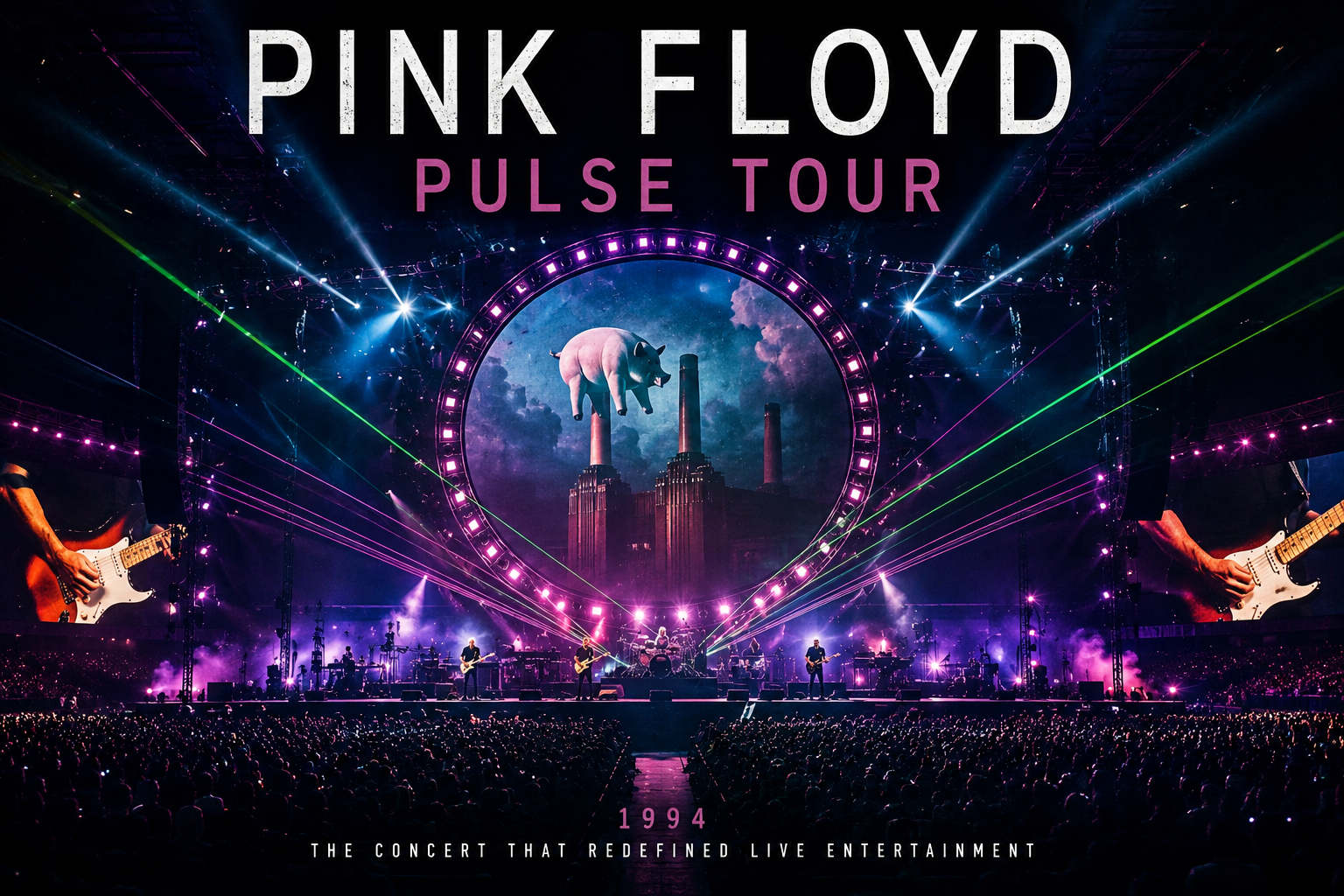
Pink Floyd – Pulse Tour
The Concert That Redefined Live Entertainment
Some concerts entertain audiences.
Some tours make history.
But only a handful completely redefine what a live performance can be.
Pink Floyd’s Pulse Tour (1994) belongs in that rare category.
It was far more than a rock concert.
It became an extraordinary fusion of music, architecture, lighting, lasers, projection, and visual storytelling—an immersive experience decades ahead of its time.
Today, many of the production techniques used in modern arena shows trace their roots back to what Pink Floyd achieved during the Pulse Tour.
A New Era After The Division Bell

Following the release of The Division Bell in 1994, Pink Floyd launched a worldwide tour unlike anything audiences had experienced before.
Rather than simply promoting a new album, the band sought to create an environment where every song became part of a larger visual narrative.
Massive circular projection screens.
Sophisticated moving lights.
Precision laser systems.
Architectural stage design.
Every technical element worked together as one integrated production.
The stage itself became an instrument.
When Technology Became Art

Many concerts use technology to impress audiences.
Pink Floyd used technology to tell stories.
Throughout the Pulse Tour, lighting changed with the emotional tone of each song.
Lasers moved like musical phrases.
Video projections expanded the meaning of the lyrics instead of distracting from them.
The audience wasn’t simply watching musicians perform.
They were surrounded by an atmosphere carefully designed to evoke emotion.
This philosophy would influence countless productions in the decades that followed.
The Return of The Dark Side of the Moon

One of the most unforgettable moments of the Pulse Tour came during the second half of the show.
Pink Floyd performed The Dark Side of the Moon in its entirety.
For many fans, it was the first opportunity to experience one of the greatest albums in rock history performed live from beginning to end.
As iconic songs such as Money, Us and Them, Time, and Brain Damage unfolded, synchronized visuals and lighting transformed the concert into a complete audiovisual journey.
More Than a Concert

The Pulse Tour demonstrated that live entertainment could become immersive art.
Instead of separating music, lighting, stage design, and visual effects into individual components, Pink Floyd combined them into one unified experience.
This approach has inspired generations of concert designers, multimedia directors, and live production companies around the world.
Many spectacular arena productions seen today still reflect ideas first explored during the Pulse Tour.
Director’s Note
As a landmark in live production history, the Pulse Tour proved that technology is most powerful when it serves the music rather than overshadowing it.
Its greatest achievement was not simply introducing advanced effects, but creating emotional experiences through the perfect balance of performance and visual storytelling.
That philosophy continues to shape modern concert production today.
The Tour That Changed Concert Production Forever

When the Pulse Tour concluded in 1994, it was already being described as one of the most ambitious concert productions ever created.
As the years passed, its reputation only grew stronger.
Today, the Pulse Tour is remembered not simply because of Pink Floyd’s music, but because it demonstrated how technology, architecture, lighting, and storytelling could merge into a single immersive experience.
It fundamentally changed expectations for large-scale live entertainment.
The Iconic Circular Screen

Perhaps the most recognizable element of the Pulse Tour was its enormous circular projection screen.
Unlike conventional rectangular displays, the circle became a visual symbol of Pink Floyd itself.
Throughout the concert, it transformed continuously.
Sometimes it displayed surreal films.
Sometimes abstract animations.
Sometimes breathtaking live camera images.
Rather than functioning as a background decoration, the screen became an active storyteller that expanded the emotional meaning of every song.
Even today, many arena productions continue to draw inspiration from this groundbreaking design.
Light, Lasers, and Emotion

The Pulse Tour proved that lighting could be as expressive as music.
Powerful lasers swept across the audience during Comfortably Numb.
Moving lights shifted color and intensity with every musical transition.
Smoke, projection, and architectural lighting combined to create a fully immersive atmosphere.
The audience wasn’t simply watching a concert.
They felt as though they had stepped inside Pink Floyd’s music.
This philosophy has become a foundation of modern multimedia concert production.
A Concert Film That Became a Classic

The tour also produced Pulse, one of the most celebrated concert films in rock history.
For millions of fans who never attended the live performances, the film became the definitive way to experience the tour.
Its outstanding cinematography, powerful sound mix, and faithful presentation preserved the atmosphere of the original concerts and introduced new generations to Pink Floyd’s extraordinary stage production.
Today, Pulse remains essential viewing for concert directors, lighting designers, and live production professionals.
Best Moment

If one performance defines the Pulse Tour, it is “Comfortably Numb.”
As David Gilmour’s soaring guitar solo filled the stadium, lasers illuminated the night sky while the circular screen displayed breathtaking visuals.
Music and technology reached perfect harmony, creating one of the most unforgettable moments in concert history.
If You Watch Only One Performance

Watch “Comfortably Numb” from the Pulse concert film.
It captures everything that made the Pulse Tour legendary—exceptional musicianship, cinematic visuals, innovative lighting, and an emotional atmosphere that continues to inspire live productions around the world.
Why the Pulse Tour Still Matters

Many tours have since introduced larger LED screens, more advanced graphics, and increasingly sophisticated technology.
Yet the Pulse Tour remains influential because it never allowed technology to overshadow the music.
Every visual element existed to strengthen the emotional impact of the performance.
That philosophy transformed concert production from technical presentation into artistic storytelling.
Three decades later, the Pulse Tour is still regarded as one of the greatest achievements in the history of live entertainment.
Other legendary tours pushed live entertainment even further, from Queen’s unforgettable Magic Tour to Madonna’s boundary-breaking Blond Ambition World Tour.
Next Episode
The Rolling Stones – Voodoo Lounge Tour
LIVE STAGE #012
The Rolling Stones – Voodoo Lounge Tour
Discover how one of the world’s greatest rock bands built a stadium spectacle that combined monumental stage design, timeless music, and record-breaking global success.
© IMMERSIVE LAB | LIVE STAGE Studio
From K-Pop to the world’s biggest concerts — bringing every unforgettable live performance to life.


