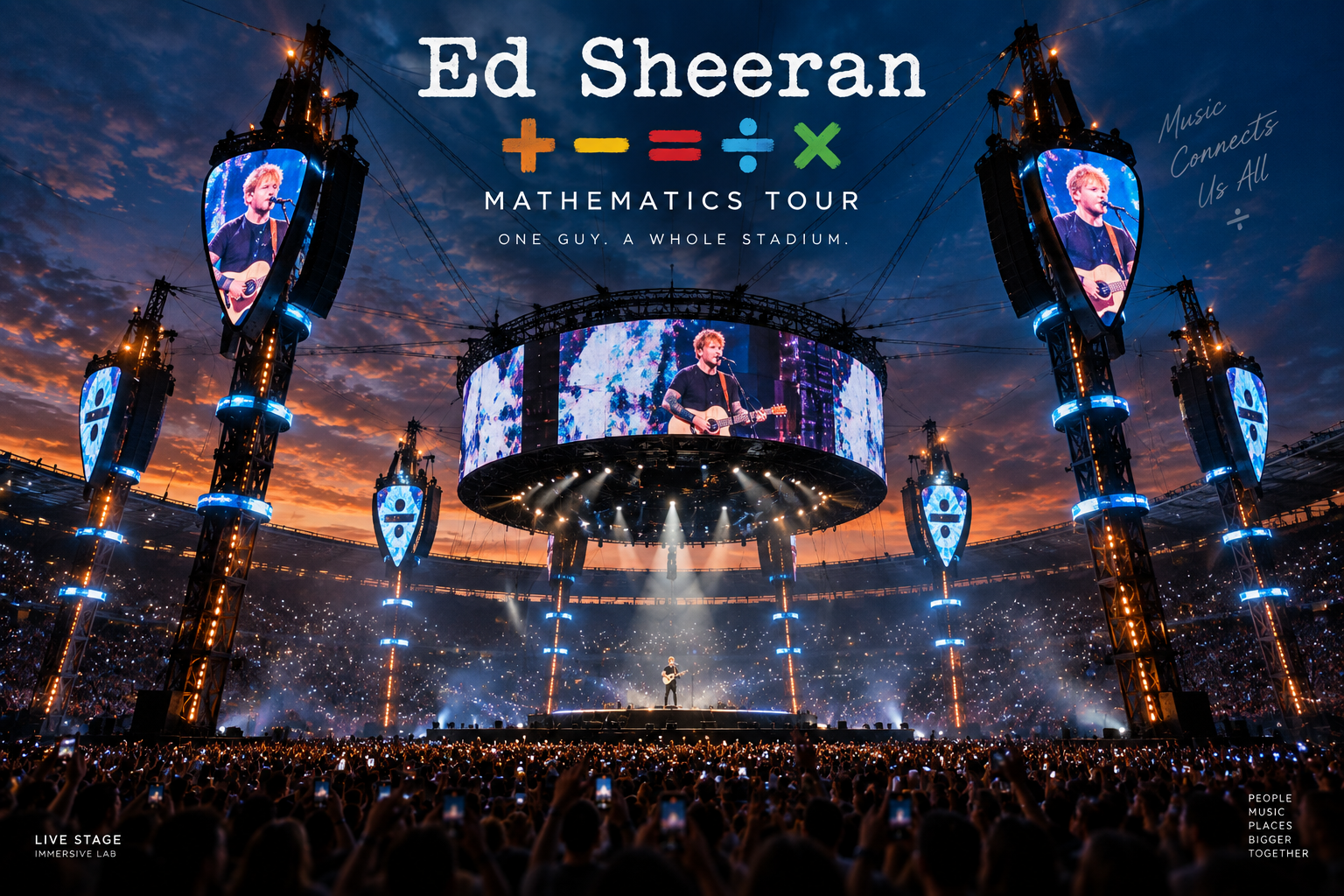
ED SHEERAN — MATHEMATICS TOUR
How Do You Make One Man Feel Close to 80,000 People?
Ed Sheeran’s stadium show begins with a contradiction.
The artist is almost deliberately small: one singer, one guitar, one loop station. The venue is not.
A stadium can place the furthest spectator more than a hundred metres from the performer. Put Sheeran at one end of that building and the very thing that made his concerts distinctive—the impression that one musician is building songs in front of you—starts to disappear.
For the Mathematics Tour, the production team did not solve that problem by simply building a larger conventional stage. They moved Sheeran into the middle of the stadium.
Then they encountered another problem: how do you put a roof over him without putting columns between him and the audience?
The answer became one of the most unusual pieces of touring engineering in recent stadium production: six 30-metre masts, 7.5 tonnes of truss, and a touring cable-net structure capable of supporting approximately 55 tonnes of production equipment above an open 360-degree stage.
The Mathematics Tour is therefore not really a story about making Ed Sheeran’s production bigger. It is about something harder: how do you make the infrastructure enormous while making it almost disappear?
The Problem With Four Posts
Creative and production designer Mark Cunniffe had been imagining an in-the-round stadium show for Sheeran since the artist’s first Wembley Stadium performance in 2015. But Cunniffe disliked a basic feature of many 360-degree concert structures: the supporting posts.
Put a conventional temporary roof over the center of a stadium and large columns inevitably occupy valuable sightlines. That is inconvenient for any performer. For Sheeran it was potentially fatal to the concept—there is no large dance company or band filling the stage, so much of the audience’s visual attention is directed toward one person.
Cunniffe wanted an unencumbered view of the artist across all 360 degrees—something he knew was theoretically possible with a cable-net system, but was not certain could actually be toured. Before presenting the concept to Sheeran and management, he brought the idea to technical designer Jeremy Lloyd of Wonder Works and structural engineer Rasti Bartek at Cundall to determine whether a touring cable-net solution was genuinely achievable.
That order is important. The creative idea did not become a finished design and then get handed to engineers with instructions to “make it work.” Engineering feasibility entered the creative process before the design was approved. As Lloyd later put it: “To my knowledge, a cable net system like this has never been toured before.”
Six Masts, But No Conventional Roof

The resulting structure looks almost deceptively simple. Six giant masts, each 30 metres tall, stand around the performance area, angled 15 degrees from vertical. Between them stretches a cable net built from 22mm-diameter galvanized steel spiral strand cable. Suspended within that system are the production elements normally associated with a stadium roof: PA, lighting and the central video halo.
Wonder Works describes the masts as built from 7.5 tonnes of truss, supporting a cable net capable of carrying approximately 55 tonnes of equipment above the stage. Stage One, which fabricated the steel and cable-net system to submillimetre accuracy, describes it as the first temporary, demountable, self-supporting cable structure of its kind to tour—an achievement later recognized with a commendation in the IStructE-affiliated steel construction awards.
This is where the Mathematics Tour becomes more than unusual scenery. A stadium roof is normally a substantial visual object. Here, the structural system was designed around absence. The less structure the audience noticed, the better the structure was doing its job.
55 Tonnes Had to Float Above an Open Stage

“Open sightlines” sounds like an aesthetic decision. Engineering them is anything but aesthetic.
Lighting has weight. Video has weight. PA has weight. Cable has weight. Rigging hardware has weight. And all of those loads have to travel through a temporary structure that will repeatedly be erected and dismantled—in roughly three to four days per stadium, according to Stage One and Wonder Works.
The cable net therefore was not simply a way to hang equipment. It was the central structural equation of the show. Stage One’s engineers noted that if the truss towers bent or deflected even slightly, the cables would slacken and thousands of pounds of suspended technology could be damaged. Every major component needed a repeatable assembly method; every connection needed to return to known geometry; every stadium presented new ground conditions.
The audience saw six sculptural masts. The engineering team saw a temporary load-bearing system carrying a concert above thousands of people.
Then Sheeran Had to Move
Solving the roof did not solve the performance. Put one musician at the center of 360 degrees of audience and another problem appears immediately: where is the front?
TAIT’s answer was a central automated revolve integrated into the stage, combined with 14 scissor lifts capable of rising to form a raised staircase at the center. Stage automation operator Kirsten Eddy, controlling the system through TAIT Navigator from beneath the stage, recalled that seeing the plans beforehand made the automation look modest—”only 14 lifts and one giant revolve”—until rehearsals revealed how constantly and functionally everything moved throughout the show, guided partly by a camera feed of the stage relayed from the halo above.
The machine therefore did something surprisingly subtle. It moved the artist so that the artist did not have to look as though he was constantly trying to reach everyone. Automation was not added merely to create spectacle. It solved an audience-relationship problem.
The Video System Had the Same Problem

Even with perfect sightlines, Sheeran is still physically small when viewed from the top tier of a stadium. Video had to solve that. But a conventional giant screen has a front and a back. The Mathematics Tour did not.
So the main visual surface became a large suspended circular LED halo above the revolving stage—reported by structural documentation at roughly 21 metres in diameter and around 45 tonnes, built using transparent LED technology so the screen could carry large-scale imagery without becoming a solid visual wall. Six surrounding masts also carried additional double-sided displays shaped like guitar plectrums, roughly 6 metres wide and 8 metres tall, featuring artwork adapted from the album.
This produced a hierarchy of images: at ground level, the real Ed Sheeran; above him, the enlarged Ed Sheeran; around the stadium, additional visual surfaces carrying imagery toward spectators facing different directions. The video system did not replace the performer. It extended his visibility.
Transparency Was a Design Tool
The choice of transparent LED is particularly important. A conventional opaque video wall would have created exactly the kind of visual obstruction the structural design had worked so hard to eliminate.
That means video and structural engineering were solving the same problem from different directions: how much equipment can be placed in the audience’s view without making it feel like equipment is in the audience’s view? The cable net minimizes structure. The transparent video minimizes visual mass. The elevated PA preserves sightlines. The rotating stage distributes the performer. Different departments were working toward the same experience—removing barriers between Sheeran and the stadium.
Lighting Had Nowhere to Hide

An open 360-degree stage also creates a difficult lighting environment. There is no conventional roof packed with fixtures, and no backstage side from which ugly infrastructure can safely disappear. Everything can potentially be seen.
Cunniffe specified a lighting rig built almost entirely around IP65 weather-resistant Ayrton fixtures: 138 Domino LT units, 48 Perseo Profile fixtures and 22 of Ayrton’s then-new Cobra laser-source fixtures—the first tour to use the Cobra. With no back wall or rear trusses in an in-the-round configuration, the masts themselves became the key light, backlight, side fill and creative lighting source simultaneously.
The IP65 requirement was not a minor specification. Cunniffe wanted the clean architectural lines to remain visible without conspicuous waterproof housings around the equipment—a technical specification directly serving a visual idea. Six of the Domino LT units doubled as followspots, tracked via Ayrton’s Follow-Me system, which Cunniffe noted meant “no visible crew members on or over the stage,” preserving the clean lines of the design.
Sound Had to Reach Every Direction Too

A circular audience cannot be served effectively by a conventional left-right PA hanging at one end of the field. For the tour’s Dublin debut, Meyer Sound and UK audio supplier Major Tom deployed 212 PANTHER large-format line-array loudspeakers—the global premiere of the PANTHER system—arranged in 14 hangs across two concentric rings suspended from the six masts, supplemented by flown 1100-LFC subwoofer arrays for low-frequency coverage.
The tour also became the first anywhere to run a Milan protocol AVB network fully digitally from the FOH mixing desk all the way to individual loudspeaker cabinets, monitored through Meyer Sound’s Nebra software platform across 26 Galileo GALAXY processors and dozens of Luminex network switches.
System engineer Adam Wells explained the motivation for the switch away from Sheeran’s earlier Meyer Sound LEO rig in blunt terms: “A LEO is 120 kilos, and a speaker that large and heavy logistically would never have worked” suspended from the cable-net structure. That conversation between Major Tom and Meyer Sound is what led directly to PANTHER’s development—a loudspeaker with LEO-level output but dramatically less weight.
The PA Was Part of the Structure’s Equation
Here the production becomes even more unusual. The loudspeakers weren’t simply objects being supported by the cable net—their placement and weight interacted with the overall balance of the suspended production system, alongside lighting and the 45-tonne video halo, all counterbalanced within the tensioned structure.
That is the opposite of a common production workflow, where scenery is designed first and audio engineers are later asked where they can fit a PA. On Mathematics, the answer to that question affected the architecture from the beginning—partly because the elevated position chosen for sightline reasons also improved acoustic geometry toward the furthest seats, according to the production’s audio engineering team.
Production Director and FOH engineer Chris Marsh, who has worked with Sheeran since 2010, has stressed that the guiding principle across all four of Sheeran’s world tours has been that he must be heard clearly from every seat in the venue—a standard the PANTHER-based Milan system was specifically built to meet at this scale.
A Lighter Loudspeaker Became a Touring Decision
PANTHER also solved a less visible problem: weight and transport. Meyer Sound describes the new system as substantially smaller, lighter and more energy-efficient than the LEO-based inventory Sheeran had used on the previous Divide Tour.
Across thousands of touring miles, that weight reduction compounds into fuel savings, simplified rigging loads on the cable net, and fewer logistical complications at every stadium the tour visited. A lighter loudspeaker becomes a logistical tool as much as an acoustic one—and in this specific production, it was also a structural necessity, since the cable-net system itself could not have supported a heavier legacy PA at the scale required.
Every Stadium Is a Different Equation
The show also had to cope with a reality that renderings conveniently ignore: stadiums are not identical. Dimensions change, seating bowls change, rigging and ground conditions change, coverage distances change.
For audio, Meyer Sound’s MAPP 3D prediction software was used to realign coverage for different stadium shapes and sizes across the tour’s multi-continent run, which had reached more than 4.5 million fans by mid-2023. Stage One also confirmed delivering three identical structural sets so that build, transport and strike could overlap across the touring schedule rather than forcing a single structure to travel sequentially between every date.
A successful world-tour design is not necessarily one enormous object that travels unchanged. It is often a system capable of adaptation, and duplication, without losing its identity.
The Biggest Production Decision Was to Keep the Stage Empty

Look again at the Mathematics stage. For something containing this much engineering, there is remarkably little visual clutter around Sheeran. That is deliberate.
No scenic castle. No enormous physical city. No traditional band risers occupying the center—though for this tour Sheeran was, for the first time, joined by a full band, each member stationed on a small individual “arrow stage” at the base of one mast, sheltered by a small roofette since the open design left no overhead cover.
Instead, the machinery is pushed outward, upward or underneath. Six masts carry infrastructure away from the performer. The cable net moves the roof into lines in the air. Video rises above him. The turntable and scissor lifts hide beneath him. The PA hangs high overhead. The technology creates empty space. That may be the production’s most important achievement.
Production Logic — Complexity Was Used to Manufacture Simplicity
There is a strange paradox in concert production. Sometimes the most technically complicated solution produces the simplest-looking result. Mathematics is an excellent example.
The production required specialist structural engineering, a tourable cable net accurate to submillimetre tolerances, hydraulic-assisted mast construction, automated stage machinery, performer tracking, transparent LED, networked digital audio and large-scale video processing.
But what does the audience see at the center? Ed Sheeran. A guitar. A microphone.
That is not a contradiction. That is the design objective. The production did not ask technology to make Sheeran appear more complicated. It asked technology to make a stadium disappear around him.
The Answer Isn’t “Build a Bigger Stage”
We began with one question: how do you make one man feel close to 80,000 people?
The Mathematics Tour answered it by refusing to solve scale with more visible mass. Move the performer to the center. Remove the conventional roof. Replace it with a cable net. Push supporting structure outward. Raise the PA. Keep video transparent where possible. Rotate the performer toward every section. Track him rather than confine him. Let technology surround the performance without occupying its emotional center.
That is why the Mathematics Tour matters from a production perspective. Its engineering is enormous. Its purpose is to make the show feel smaller.
References & Further Reading
Wonder Works — Ed Sheeran Mathematics Tour
Stage One — Ed Sheeran +–=÷× Tour Case Study
New Steel Construction — Commendation: Ed Sheeran Mathematics Tour
TPi — Behind the Scenes of Ed Sheeran’s Monumental +–=÷x Tour
Meyer Sound — Ed Sheeran “+–=÷x” Tour
Live Design — Mark Cunniffe Chooses Ayrton Rig for Mathematics Tour
Next Episode
LIVE STAGE #024 — The Weeknd — After Hours Til Dawn Tour
© IMMERSIVE LAB | LIVE STAGE Studio
From K-Pop to the world’s biggest concerts — bringing every unforgettable live performance to life.


