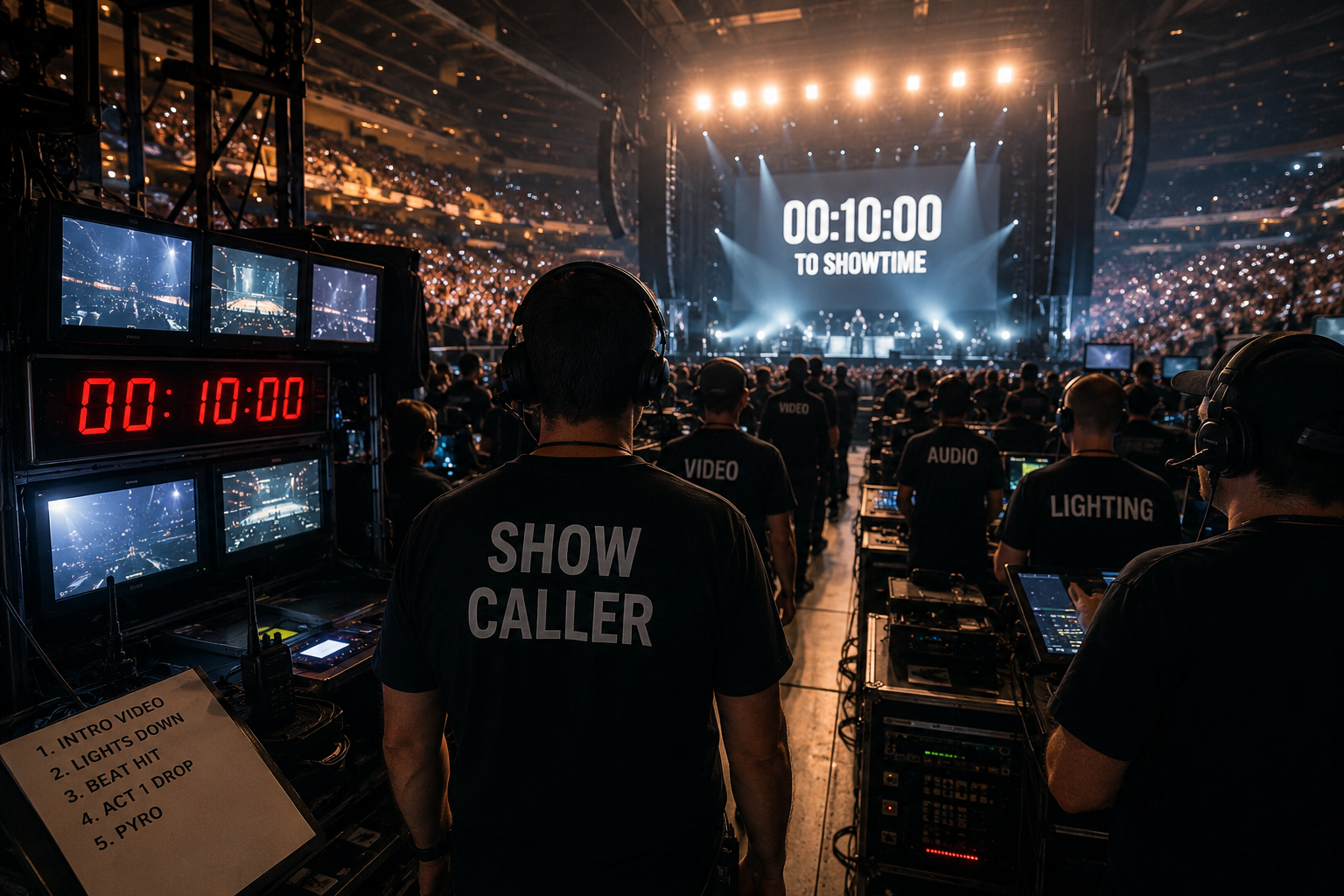
10 Minutes Before Showtime… What Really Happens Backstage at the World’s Biggest Concerts?
The audience hears the countdown. Behind the curtain, hundreds of people are waiting for one word: “Go.”
10:00

The stadium is already alive. Tens of thousands of fans are on their feet. Phones rise above heads. A low-frequency rumble rolls through the PA. Somewhere in the darkness, an LED screen flickers to life and the crowd reacts instantly.
To the audience, these final ten minutes feel like anticipation. Backstage, they feel completely different.
The stage manager is listening to communications. Lighting, video, audio and automation departments are at their positions. Performers are being moved toward entrances. Technicians are watching equipment that cannot be allowed to fail. The production team is no longer discussing how the show should work.
Those decisions were made long ago. Now the show has to work.
For the next ten minutes, hundreds of individual decisions must converge on a single moment. Showtime. This is the part of the concert backstage world that most audiences will never see.
10:00 — The Show Has Already Been Rehearsed Before Anyone Sees It

The strange thing about the final ten minutes is that very little should be spontaneous. Months of creative development may have preceded this moment. Staging, video, lighting, sound, performer movement and machinery have been designed, programmed, tested and rehearsed.
At facilities such as Rock Lititz in Pennsylvania, entire arena and stadium productions can be assembled before a tour reaches its first paying audience. Its Studio 1 alone provides 30,000 square feet of uninterrupted production space and is designed to accommodate full arena- and stadium-scale setups.
Why rehearse an entire stadium show inside another enormous building? Because discovering a problem in front of 60,000 people is too late.
The audience sees the finished illusion. The production team has already seen everything that could break it.
08:00 — Hundreds of People, but No One Is Watching the Same Show
Eight minutes remain, and the concert backstage operation is running at full intensity. The artist may be preparing for an entrance, but elsewhere completely different versions of the same concert exist.
At Front of House, audio engineers are thinking about sound. Lighting operators are watching cue sequences. Video teams are preparing cameras, playback and screens. Automation operators are monitoring moving machinery. Stage managers are concentrating on people, entrances, exits and timing. Security teams are watching the audience. Medical and safety personnel are watching for something nobody wants to happen.
This is one of the great paradoxes of live entertainment: thousands of people experience one show, while the people producing it are each concentrating on a different piece of it. Only when those pieces synchronize does the audience perceive a single performance.
Modern touring stages make that coordination increasingly complex. TAIT’s production for Justin Timberlake’s Forget Tomorrow World Tour, for example, included a 5-by-9-meter section of video wall capable of rotating 360 degrees, moving vertically and traveling toward the audience. Its J-Hope Hope On The Stage production used seventeen lifts that could move together or independently, with additional moving LED elements controlled through automation.
For an audience, those movements become spectacle. For an operator backstage, they are machinery carrying performers near people. The difference matters.
06:00 — The Most Important Word Is Not “Start”

Six minutes. Communication becomes shorter. There is little value now in long explanations. Everyone should already know the plan. What matters are precise instructions.
Stand by.
Anyone who has worked around professional live production understands the importance of those two words. A standby is not the cue itself. It is the warning that the cue is approaching.
Lighting may be standing by. Video may be standing by. Automation may be standing by. A performer may be waiting at an entrance. A stagehand may have one hand on a piece of scenery but cannot move it yet. The production is effectively holding its breath.
Then comes the word that releases the action.
Go.
Show calling is sufficiently specialized that Live Design’s 2026 Stage Managers Academy includes dedicated training in “Show Calling and Event Management.” Professional callers describe the work in terms of rhythm, pace and preparation—because a live show does not provide the luxury of stopping and trying again.
A “Go” delivered at the wrong moment may not simply make a light appear late. It can break the relationship between music, video, movement and the performer.
05:00 — Somewhere Above the Artist, Tons of Equipment Are Waiting

Five minutes before the show, look upward. The audience sees lighting. A rigger sees load.
Large touring productions suspend lighting trusses, video panels, speakers and scenic elements high above performers and spectators. Some of those elements move during the show. The engineering behind them is largely invisible. That invisibility is intentional.
On Ghost’s 2026 Skeletour, for example, TAIT describes an illuminated flown structure housing more than 800 moving lights and 400 LED panels. The structure can move above the stage and descend during selected songs, while automated lifts below the stage create performer reveals.
P!NK’s Summer Carnival Tour pushes the concept further: performer-flying systems move the artist over the audience as part of the show.
These moments may look wonderfully reckless. They are not supposed to be. Behind the apparent danger are engineering calculations, control systems, rehearsals, inspections and people whose job is to make the impossible-looking moment repeatable.
The best stage technology creates excitement precisely because the audience does not have to think about the machinery.
03:00 — The Artist Is Only One Part of the Countdown

Three minutes. This is where popular imagination and professional production diverge. Movies often show the star alone backstage, taking a breath before walking into the light. That moment certainly exists. But around it is an enormous operational system.
Musicians need to be ready. Dancers need to be positioned. In-ear monitoring must work. Wireless microphones must communicate reliably. Costume departments need the correct pieces in the correct place. Props have to be preset. Stage entrances must be clear. Automation must be ready. Camera positions must be confirmed.
Audio infrastructure at stadium scale is itself a specialist operation. Clair Global provides touring productions with audio, communications and technology systems across venues ranging from theaters to arenas and stadiums.
None of these departments needs applause. They need confirmation.
Ready. Clear. Stand by.
01:00 — Sixty Seconds Can Feel Longer Than the Entire Concert
One minute remains. The crowd may now sense that something is happening. House music changes. The lighting state shifts. A screen goes dark. Perhaps a low rumble appears.
These are not necessarily technical necessities. They are psychological ones. A great opening begins before the artist appears. The audience has to be moved from ordinary time into performance time. This is where concert design becomes storytelling.
The Weeknd’s After Hours Til Dawn Tour, for example, used multiple stages, LED-lined runways, large scenic environments and automated elements including a 30-foot-diameter moon. Dua Lipa’s Radical Optimism Tour incorporated moving rings, lifts and performer-flying systems while coordinating scenic, lighting and video elements.
The technology is impressive. But technology is not the point. The audience must feel something before it understands how it was done. That is the difference between equipment and show design.
00:30 — There Is No Undo Button

Thirty seconds. This may be the purest moment in live entertainment.
A film can be edited. A recording can be restarted. A photograph can be retaken. A live concert cannot. Once the opening sequence begins, tens of thousands of people experience the same irreversible moment together.
This is why backstage concentration can appear almost unnaturally calm. Panic is useless. Everyone has rehearsed what happens next. And if something does fail, the audience should ideally never know.
An automation operator may stop an unsafe movement. A stagehand may substitute a piece of equipment. An audio engineer may move to a backup signal. A performer may receive a different instruction. The audience continues watching the show.
Professionalism backstage is often measured not by whether problems occur, but by how invisible the solution becomes.
00:10 — The Final Countdown
Ten. The artist moves toward the entrance.
Nine. Stage personnel clear the path.
Eight. Video is ready.
Seven. Lighting is ready.
Six. Audio is live.
Five. Automation confirms.
Four. The opening cue approaches.
Three. The stadium is almost completely dark.
Two. For perhaps the first time all evening, tens of thousands of people seem to inhale together.
One. A voice on the production communication system says the word everyone has been waiting for.
“Go.”
00:00 — The Audience Thinks the Concert Has Just Begun
The first image explodes across the screen. Lights sweep over the stadium. The first note hits. The artist appears. The audience erupts.
And suddenly all the complicated machinery disappears.
Nobody thinks about the automation operator. Nobody thinks about the rigger. Nobody wonders who programmed the video server or checked the microphone frequencies. Nobody asks who called the opening cue.
That is exactly how it should be.
For the next two hours, engineering becomes emotion. Planning becomes spectacle. Thousands of technical decisions become one seemingly effortless moment.
The audience sees a star standing beneath the lights. Backstage, hundreds of people know what it took to put that person there at precisely the right second.
The Greatest Concerts Hide Their Complexity

Perhaps this is the real secret behind the world’s greatest live shows. They do not impress us by showing us how complicated they are. They make complexity disappear.
A moving platform feels like magic. A flying performer feels fearless. A stadium-sized video wall becomes part of a story. Thousands of lighting, audio, video and automation cues become something far simpler: a memory.
Rock Lititz describes itself not as a performance venue but as a place focused on the production elements of live shows. That distinction says something important about this hidden world. Much of what makes an extraordinary concert possible happens somewhere the audience will never be allowed to stand.
So the next time you are inside a stadium and the lights suddenly go dark, do not look only at the stage. Think about the final ten minutes you could not see.
Somewhere behind that curtain, someone has just said: Stand by. And an entire world is waiting for: Go.
That is the real story of every concert backstage — hundreds of decisions disappearing into a single unforgettable moment.
Continue Exploring WORLD DISCOVERY
Explore more extraordinary stories where performance, technology, architecture and human creativity come together.
Every great spectacle has another world hidden behind what the audience sees.
Explore More from IMMERSIVE LAB
Broadway Collection — The world’s greatest musicals.
LEGENDS — The visionaries who changed the performing arts.
LIVE STAGE — The world’s most unforgettable concerts and live performances.
THE SHOW X-FILES — Extraordinary stories behind the world’s biggest shows.
Editorial Note
This article was researched and written as editorial content about professional live-production practice. Specific production examples are based on publicly available information from production companies and live-entertainment industry sources.
References & Further Reading
Rock Lititz — Production & Rehearsal Campus
Rock Lititz — Studio 1 Virtual Tour
TAIT — J-Hope Hope On The Stage Tour
TAIT — Ghost Skeletour World Tour
TAIT — P!NK Summer Carnival Tour
Clair Global — Live Event Production
Live Design — Stage Managers Academy 2026
Next in THE SHOW X-FILES
https://immersivelabkorea.com/wp-admin/post.php?post=4010&action=edit
Image Credits
All photographs remain the property of their respective photographers and copyright holders. Images should be used only where the applicable license, permission, press-use terms, or other rights allow publication.
© IMMERSIVE LAB | THE SHOW X-FILES


