Julie Taymor: Why The Lion King Shows Its Tricks
The Lion King Worked Because She Refused to Hide the Trick
The first serious test of Julie Taymor’s idea for The Lion King did not reassure Disney. It did almost the opposite.
In late 1996, Taymor presented actors wearing early versions of the masks and puppets to senior Disney executives. The mechanics were unfinished. The masks were not fully painted. And the central concept created an immediate problem: people did not know where to look. Were they supposed to watch the actor? Or the animal above the actor? Thomas Schumacher, then president of Disney Theatrical Productions, later recalled that Taymor’s idea of the “double event”—seeing the puppet and the human simultaneously—simply did not work in that rehearsal-room presentation.
For a company adapting one of its most valuable animated films, that was not a small problem. It threatened the basic visual language of the production. Disney could have responded by making the animals more literal. Hide the performers. Improve the illusion. Make Simba look more like Simba. Taymor went in the opposite direction. She exposed the illusion. And that decision became one of the most recognizable theatrical languages in modern Broadway history.
The production therefore gives us a much more interesting question than simply asking how Julie Taymor adapted a successful Disney movie: why did The Lion King become more believable when Taymor refused to hide how the illusion worked?
Three Lions, One Decision

Taymor did not simply insist that Disney accept her first idea. She tested it. After doubts emerged, she prepared three approaches to the characters: one without the full mask concept, another using a more conventional half-mask approach, and her original design in which the animal mask sits above the performer’s face. The alternatives demonstrated that more conventional approaches could work.
Disney chief Michael Eisner nevertheless chose Taymor’s original concept. Accounts from the production’s development describe the decision as embracing the option carrying the greatest artistic risk. That decision matters because The Lion King was facing a problem unique to theatrical adaptation. The 1994 film could create animals perfectly. Animation did not have to explain why a lion could sing. Broadway did.
Put an actor inside a realistic lion costume and the production risks becoming cumbersome. Cover the actor’s face completely and an essential theatrical instrument disappears: human expression. Use ordinary makeup and the visual identity of the animals weakens. Taymor’s solution was not to choose between human and animal. She showed both. She called this the double event.
The animal is visible. The performer is visible. And the audience understands both simultaneously. Taymor has explained that placing masks above the performers’ faces allowed spectators to see the human and animal at the same time. This sounds simple. It is not. It asks the audience to perform part of the illusion themselves.
The Audience Finishes the Animal
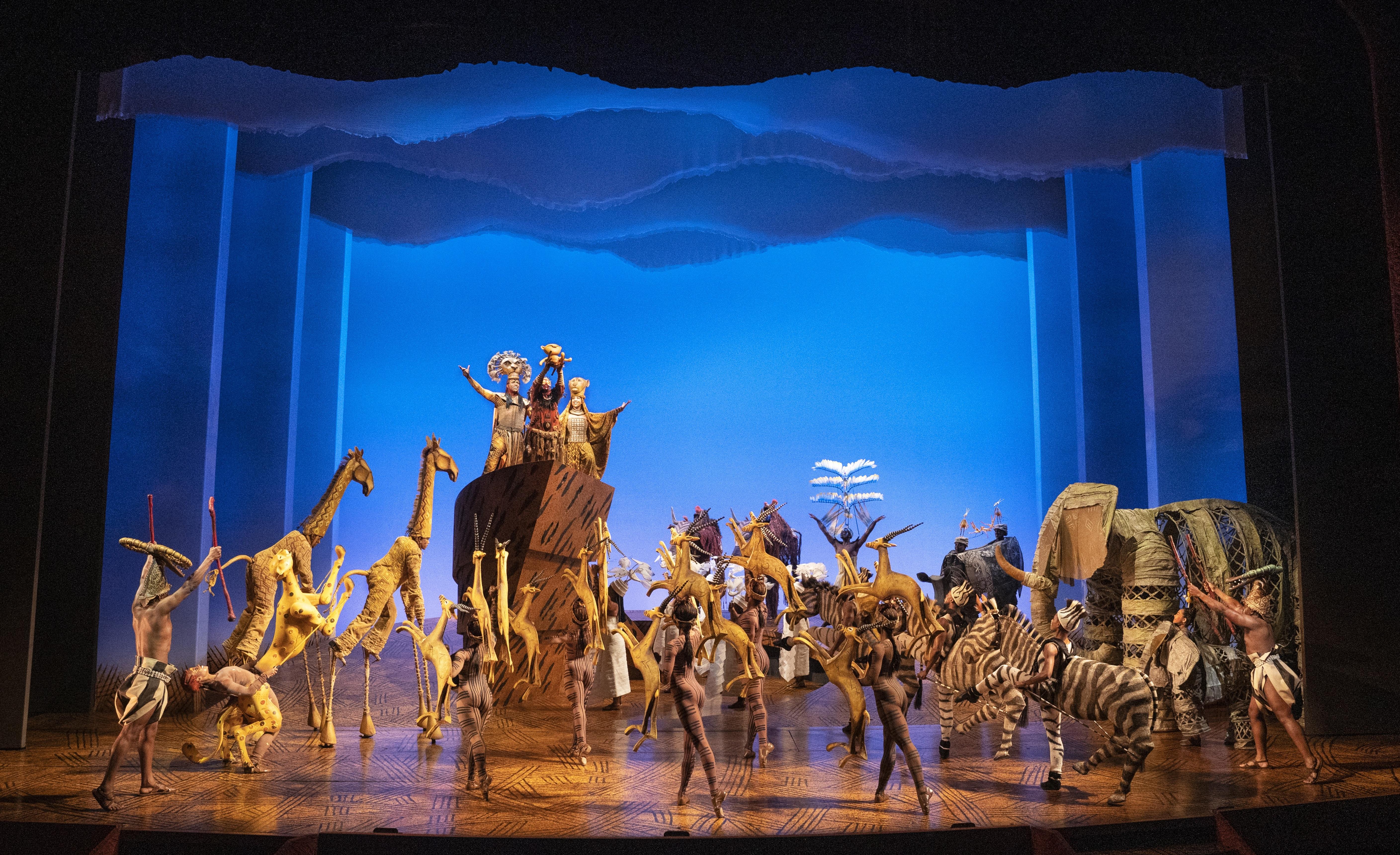
Look at Scar. The audience can see the actor’s face. Above him is the lion mask. The mask can change its relationship to the performer, moving forward during moments of aggression. The performer does not disappear. Neither does the mechanism. Yet after a short time, spectators stop experiencing these as disconnected objects. They perceive Scar.
That phenomenon is central to Taymor’s theatre. Traditional illusion often tries to remove evidence of fabrication. Hide the cable. Hide the operator. Hide the mechanism. Make the impossible appear physically real. Taymor asks something different of the spectator: I will show you how it works. Now imagine with me.
The Lion King therefore does not compete with cinema on cinema’s terms. It uses something cinema cannot reproduce in quite the same way—the spectator’s awareness that a transformation is happening physically, in real time, only meters away. The visible performer is not a flaw in the illusion. The performer is one half of it.
Look at the Giraffes’ Feet

The giraffes make this philosophy impossible to miss. Taymor wanted stilts. But she did not want the apparatus disguised. The audience can see how the performers’ arms and legs extend into the animal form. She has specifically explained that the production did not want to hide puppet strings or rods; exposing the mechanics was part of the theatrical experience.
This creates a strange effect. You know it is a human on stilts. You see the human on stilts. And somehow the clearer the construction becomes, the easier it is to accept the giraffe. Why? Because the production has changed the agreement with the audience. It is no longer saying: “Believe this is a real giraffe.” It is saying: “Watch us create a giraffe.”
Those are fundamentally different audience experiences. One depends on concealment. The other depends on participation. The spectator sees the performer, understands the theatrical device and mentally completes the image. That act of completion creates engagement. The audience is no longer merely consuming an illusion. It is helping construct one.
Then the Elephant Walked Down the Aisle
The opening of The Lion King makes another radical decision. The world does not begin only on the stage. During “Circle of Life,” animals enter through the auditorium. The spatial boundary between audience and performance is immediately weakened. A large elephant moves among spectators. Birds fly above performers. Giraffes extend vertically. The Pride Lands appear to arrive from multiple directions. The sequence transforms the theatre itself into part of the scenic environment.
This is Audience Experience Design, even though the term was far less common when the production was created. Instead of asking only what the stage should look like, the production effectively asks where the audience should experience the world beginning. That distinction is important. A conventional proscenium places spectacle in front of spectators. Circle of Life briefly surrounds them with it.
The audience has not yet learned the plot of the stage adaptation. It has already learned its rules. The mechanisms will be visible. Scale will change constantly. Humans will become animals without disappearing. And the auditorium itself may become part of Africa.
Pride Rock Is Not Just Scenery

Then Pride Rock rises. To an audience it is an iconic image. To a production team it is an engineering problem. Hudson Scenic Studios, which built scenic elements for the production, identifies its work on The Lion King as involving technical design, metal fabrication, automation and motion control, rigging, installation and other disciplines. Its project documentation specifically shows the automated Pride Rock unit ascending from the stage deck and rotating into position.
This is where the romantic language of theatre meets engineering. A scenic element that rises through a stage floor must occupy physical space below that floor. Its motion must be controlled. Its position must be repeatable. Performers must know where it will be. Stage management must integrate the movement into the cue sequence. Lighting must anticipate its arrival. The choreography must coexist with it. And all of this has to happen safely and consistently. Eight performances a week.
The audience sees a rock emerging from the African landscape. Backstage, multiple systems have just executed a coordinated mechanical event. That distinction is exactly what IMMERSIVE LAB is interested in. Spectacle is the visible result. Coordination is the invisible production.
What Happens When Pride Rock Has to Travel?
Touring exposes the engineering problem even more clearly. A Broadway theatre can accommodate infrastructure designed specifically around a production. A touring show cannot assume every venue has identical architecture. Theatrecrafts’ technical documentation of The Lion King notes an important difference: the Broadway Pride Rock rises through the stage, while touring configurations have used automated units that track onto the stage because reproducing the original below-stage mechanism is not practical everywhere.
The image remains recognizable. The engineering changes. This is an important production lesson. A successful touring design cannot simply reproduce equipment. It must reproduce the audience’s perception of the moment. That means identifying what is essential. Does Pride Rock absolutely have to emerge through the floor? No. Does it need to arrive with the same dramatic authority and preserve the rhythm of the scene? Yes. The technical solution can therefore change while the theatrical intention remains intact. That is touring design at its best.
More Than 100 Masks and Costumes—But Scale Wasn’t the Point

Disney records that Taymor co-designed more than 100 costumes and animal masks for the Broadway production. The number sounds impressive. But counting masks tells us very little about why the production works. The important issue is that different animals required different theatrical solutions. There is no single “Lion King puppet system.” Some forms extend the performer’s body. Some sit above it. Some are manipulated externally. Some depend heavily on costume. Some exaggerate scale. Others rely on surprisingly simple materials and visible mechanisms.
Taymor and puppet co-designer Michael Curry therefore were not solving one problem repeatedly. They were solving variations of the same question: what is the minimum visual information required for an audience to recognize this animal while still seeing the performer who creates it? The answer changes from species to species. That variation prevents the stage from becoming a parade of identical technical tricks. The audience keeps learning new visual rules.
Scar Reveals Why the Mechanism Matters
Scar demonstrates the concept particularly well. A Los Angeles Times account of the production described one Scar costume as consisting of 34 separate pieces weighing a total of 45 pounds, with electronics allowing the performer to control the mechanical lion mask above his head.
Here engineering affects acting. The mask is not merely something worn. Its position can become part of the performance. When the animal component moves toward the human face, the relationship between actor and puppet changes. That means the puppet has to respond to dramatic intention. The mechanism therefore sits at an unusual intersection: Costume Design → Puppet Engineering → Actor Movement → Character Performance.
If any one of those systems becomes dominant, the character can fracture. Too much mechanism and the audience watches machinery. Too much costume and movement becomes restricted. Too little animal information and Scar becomes simply a human performer with decoration. The production succeeds when those elements disappear into a single readable character—even though none of them is literally hidden.
Light Has to Unite Two Faces

The double event creates another problem that is rarely obvious from the auditorium. Lighting. If the audience must simultaneously read the performer’s human face and an animal mask positioned above it, illumination becomes part of the storytelling mechanism. The production’s original lighting was designed by Donald Holder, who received the 1998 Tony Award for the work. Richard Hudson received the scenic design Tony, while Taymor won for both direction and costume design.
The challenge is not simply making everything bright enough to see. Light determines hierarchy. Which surface catches the eye first? Does the mask cast unwanted shadow across the performer? Does the audience read the human expression? Does the animal silhouette remain strong? How does the same object behave under warm daylight, darkness, saturated color or silhouette? Taymor’s double event therefore depends on more than masks. It needs lighting to preserve the visual conversation between human and animal. The concept is directorial. Its execution is collaborative.
The People Who Made Taymor’s Idea Physically Possible
This is where descriptions of The Lion King as simply “Julie Taymor’s vision” become incomplete. Taymor conceived and directed the production and designed its costumes while co-designing masks and puppets with Michael Curry. But the visual language depended on a major creative team: Richard Hudson (scenic design), Donald Holder (lighting design), Michael Curry (mask and puppet co-design), Garth Fagan (choreography), and Tony Meola (sound design). The official production credits document those responsibilities.
This matters because theatrical innovation rarely belongs to one department. A director can propose that the machinery remain visible. But somebody must engineer that machinery. A puppet designer can create an extraordinary object. But choreography must determine how it occupies space. Scenery can create scale. But lighting determines when that scale becomes visible. Sound and music establish emotional dimension while all of those visual systems operate. The director’s achievement is therefore not doing everything personally. It is establishing a strong enough theatrical principle that every department can solve its own problems inside the same world.
Five or Six Weeks to Make the Language Work

Taymor later recalled that the show was assembled through roughly five or six weeks of rehearsal followed by a three-week technical period before its first public performances in Minneapolis. That detail matters. Because unusual theatrical languages need to be learned. An actor using a puppet is not simply acting while carrying an object. The performer must understand where the puppet’s focus appears to be. Movement has to communicate weight that may not literally exist. The performer’s body and the puppet must sometimes behave as one creature while remaining visibly separate.
Add stilts, masks, large costumes, scenic automation, choreography, lighting and music, and rehearsal becomes more than learning blocking. It becomes systems integration with human bodies inside the system. That is why the early Disney demonstration failed. The concept alone was not enough. It needed the theatre. Lighting. Finished mechanics. Color. Distance. Movement. Context. Only then could the double event become readable.
July 8, 1997 — The Audience Gives the Answer
The pre-Broadway production began performances at Minneapolis’ Orpheum Theatre on July 8, 1997. Broadway previews followed at the New Amsterdam Theatre on October 15, with the official Broadway opening on November 13.
The risky visual experiment was no longer being demonstrated to executives in a rehearsal room. It was being tested on paying audiences. Taymor recalled an extraordinary response to the opening sequence in Minneapolis: within moments of the performance beginning, spectators were already reacting intensely. The experiment had found its environment. The problem Disney executives had encountered—where do I look?—had become part of the pleasure. Watch the actor. Watch the animal. Watch both. The audience learned how to see the production.
Broadway Didn’t Need Another Version of the Movie

This may be Taymor’s most consequential decision. Disney already possessed the animated Lion King. Trying to reproduce it literally onstage would have placed theatre in competition with animation. The stage would almost certainly lose that contest. Animation can change scale instantly. It can make animals move naturally. It can create landscapes without gravity, rigging, load limits or stage dimensions.
Taymor instead emphasized precisely what animation could not offer: visible human creation happening in real time. The Broadway production made no attempt simply to reproduce the visual appearance of the animated film. Disney’s own historical account emphasizes that the stage version developed an original design language using multiple mask and puppetry techniques.
That choice contains a lesson extending far beyond The Lion King. When adapting material from another medium, the goal does not have to be replication. The more useful question can be: what can this medium do that the original cannot? For theatre, one answer is presence. A performer is actually there. A puppet is actually moving. A giant scenic unit is actually rising. A person on stilts is actually balancing. The risk is real enough for the audience to perceive. That physical reality gives the illusion weight.
The Result Was Not a Small Experiment
The Broadway production opened on November 13, 1997 and won six Tony Awards, including Best Musical, Best Direction of a Musical for Taymor, Best Costume Design for Taymor, Best Choreography for Garth Fagan, Best Scenic Design for Richard Hudson and Best Lighting Design for Donald Holder. Taymor became the first woman to receive the Tony Award for Best Direction of a Musical.
But the more revealing legacy is visible in the production itself. The masks were not abandoned. The puppet operators were not hidden. The giraffe stilts remained visible. The human faces remained visible. The theatrical machinery became part of the aesthetic. The very ideas that could have been interpreted as incomplete illusion became the show’s identity.
Editor’s Take — The Trick Was Trust

The most important innovation in Julie Taymor’s The Lion King may not be a puppet, mask or automated scenic element. It is trust. Taymor trusted that spectators did not need every mechanism concealed. She trusted them to hold two images in their minds at once: performer and animal, fabrication and fiction, mechanism and magic.
That is a valuable lesson for contemporary immersive production, where technology can easily become obsessed with eliminating every visible boundary between reality and illusion. Sometimes greater technical invisibility creates stronger immersion. But not always. The Lion King demonstrates another possibility: an audience can understand exactly how an illusion is being created and still surrender completely to it. The technology does not have to disappear. It has to acquire meaning. That distinction is why the production still matters to designers, directors and producers nearly three decades after its Broadway opening. Julie Taymor did not hide the trick. She made the trick part of the story.
References
Julie Taymor — Queen of The Lion King
IBDB — The Lion King Original Broadway Production
Theatrecrafts — The Lion King Technical Production
From a director who showed audiences how theatrical magic was made, LEGENDS next turns to a performer whose voice became inseparable from one of Broadway’s most recognizable characters.


