Kristin Chenoweth: How Glinda Became Popular
“Popular” Was Written With Her in Mind. Then She Had to Make Glinda Human.
Stephen Schwartz did not simply ask Kristin Chenoweth to audition for a finished role in Wicked. He called her about a song. Chenoweth later recalled that Schwartz told her the number had been written with her in mind and asked her to come to a reading. She walked in, sang “Popular” for the first time, and immediately understood the character she wanted to play.
That sounds like the beginning of an obvious success story. It was not. Because the most interesting production problem facing Chenoweth was almost the opposite of Idina Menzel’s. Elphaba needed the audience to discover that the supposedly wicked witch was human. Glinda presented a different danger. She could become entertaining so quickly that the audience might never look beneath the entertainment.
The high voice. The perfect smile. The hair. The dresses. The comic timing. The bubble. The word “Popular” itself. Every theatrical system around Glinda could turn her into a dazzling caricature. Chenoweth’s real job was harder: how do you make the funniest and brightest person onstage increasingly complicated without destroying the qualities that made audiences love watching her in the first place?
The Role Arrived Through a Song

The development history of Wicked helps explain why Chenoweth became so deeply connected to Glinda. Stephanie J. Block, who participated in the musical’s early development as Elphaba, recalled that Chenoweth joined during an early two-week workshop and presentation for Universal executives. This was not yet the Broadway production audiences know today. The musical was still being built.
That distinction matters. Creating a character during development means an actor’s strengths can become part of the production’s vocabulary. A joke that works can remain. A rhythm can influence rewriting. A musical phrase can acquire a performance identity before opening night. A relationship between two actors can reveal something that the writers had not fully seen on the page.
With Chenoweth, the creative team possessed an unusually specific instrument. She had a classically trained soprano capable of extraordinary height and clarity. She also possessed aggressive comic timing. Those abilities normally suggest different theatrical traditions. Chenoweth could put them inside the same character. That combination became useful because Glinda herself is built from contradiction. She wants to appear effortless. Performing her is anything but.
“Popular” Is a Comedy Number Built Like Choreography
Listen to “Popular” without watching it and the song already has comic architecture. Watch Chenoweth perform it and another layer appears. The humor is not produced only by Stephen Schwartz’s lyrics. It comes from timing physical behavior against musical rhythm. A turn. A pause. A look. A hair movement. A sudden change in vocal color. An interruption. A word extended just slightly beyond expectation.
The bedroom scene could easily become a singer standing in front of an audience delivering a funny song. Instead, Glinda appears to be inventing the performance while she is doing it. That illusion requires precision. Comedy often works because the audience believes something spontaneous has happened. But on Broadway, spontaneity has to coexist with repeatability. The joke has to survive Tuesday night. Wednesday matinee. Wednesday night. Thursday. Friday. Twice Saturday. Sunday. The audience should not see the structure. The performer absolutely must know it. This is one reason Chenoweth’s Glinda deserves attention from a production perspective. She turned vocal phrasing into blocking.
Glinda’s Voice Is Also Scenic Design

There is another clever mechanism inside the performance. Chenoweth does not use one uniform vocal identity. Glinda can sound extraordinarily polished and operatic. Then suddenly conversational. Then childish. Then commanding. Then ridiculous. The changes tell the audience where Glinda is emotionally before the script necessarily explains it.
That is a form of character design. A costume designer controls silhouette and material. A lighting designer controls visibility. Chenoweth controls vocal texture. The result is almost architectural. Different parts of the voice create different rooms inside the character. The brilliant upper register belongs to the public Glinda. The comic sounds reveal the girl beneath the presentation. Later, quieter singing can expose emotional information that the earlier Glinda would have hidden. So when people describe Chenoweth simply as having “the voice of Glinda,” they miss part of the production achievement. The important thing was not merely how high she could sing. It was how many versions of Glinda she could construct with the same instrument.
Susan Hilferty Had the Opposite Problem
Then costume designer Susan Hilferty entered the equation. Hilferty described the fundamental visual relationship between the musical’s two women very clearly. Elphaba was designed to feel connected to earth. Glinda was connected to sky, light, bubbles and air. At Shiz, Hilferty deliberately dressed Elphaba in dark blue and Glinda in white, giving each of them, in her words, “an icon” that made them specifically representative—Glinda for goodness, Elphaba for evil.
This is costume design functioning as dramaturgy. Before the friendship fully develops, the audience can already read the opposition. Dark / light. Ground / air. Weight / buoyancy. Asymmetry / balance. The characters do not merely tell us they are different. The stage picture tells us first. And Chenoweth has to perform inside that picture.
A Dress Can Tell the Audience How to Read a Character

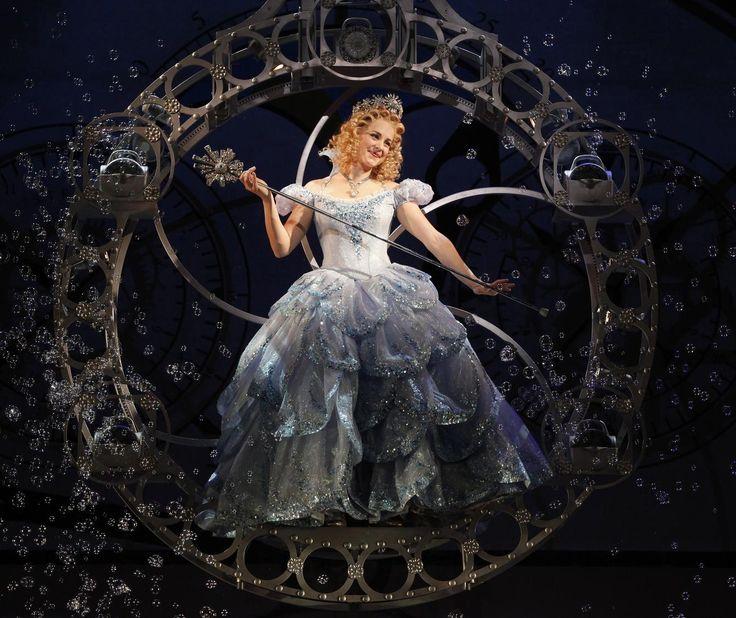
Hilferty’s final Glinda silhouette looks almost weightless. That impression is deceptive. Glinda’s famous Bubble Dress is built from nine different fabrics with entirely hand-sewn sequins—reported weights for the gown have varied considerably across productions and performers, but every account agrees on one thing: it is a substantial, heavy garment engineered to look like it might float away.
That is excellent stage design because the engineering reality and the dramatic meaning move in opposite directions. The costume is physically substantial. The character appears weightless. Chenoweth therefore had to complete the illusion physically. A dress cannot perform lightness by itself. The performer determines how that mass moves. How she enters. How she turns. How she occupies the center of a stage picture. The costume supplies the silhouette. The actor supplies its behavior.
There Was Also a Legal Design Problem
One of the most fascinating details in Wicked’s visual development had nothing to do with artistic taste. It involved rights. The Broadway creative team could not simply copy the familiar visual language of MGM’s 1939 The Wizard of Oz. Hilferty has explained that her designs drew instead on William Wallace Denslow’s original illustrations for L. Frank Baum’s 1900 novel—separate source material with its own history, predating and legally distinct from the famous film.
That constraint is easy for an audience to miss. But it demonstrates something fundamental about production design. Creative teams do not work in unlimited visual space. They work inside copyright, licensing, budget, materials, performer requirements, touring requirements, maintenance, safety, and storytelling. Restrictions do not necessarily weaken design. Sometimes they force a production to develop its own language. Wicked had to create an Oz that audiences immediately recognized as Oz without merely copying the Oz they already knew. Glinda became one of the clearest examples of that solution.
And the Costume Kept Changing
The San Francisco tryout was not simply a preview of a finished Broadway object. It was a laboratory. Glinda’s party dress, for instance, was originally designed in blue for the San Francisco tryouts before being changed to pink for Broadway. As scripts, lyrics, music and other elements evolved during that period, costume work changed alongside them.
That detail reveals what audiences rarely understand about new musicals. A costume is not designed in isolation and then locked. Change the scene and a quick change may become impossible. Move a song and a costume may appear at the wrong dramatic moment. Change choreography and a garment may restrict movement. Rewrite a character and the visual progression may no longer make sense. Development is systemic. Touch one department and several others move. Chenoweth was creating Glinda inside that moving machine.
Why Glinda Could Not Simply Be “Good”

This is where Chenoweth made a particularly important choice. In the cultural memory of Oz, Glinda arrives already labeled. The Good Witch. That label creates a performance trap. If she is simply good from the beginning, there is nowhere interesting for the character to travel.
Chenoweth understood the problem early. She has said that even as a child watching The Wizard of Oz, she felt there was something about Glinda that was not entirely straightforward and wanted to investigate what might really be happening underneath that image. That instinct aligns perfectly with Wicked’s larger structure. Elphaba questions the label wicked. Glinda must complicate the label good. One character is misunderstood by society. The other becomes exceptionally skilled at operating inside society.
That makes Glinda’s comedy dramatically useful. At first, the audience laughs at her superficiality. Later, those same social instincts become politically significant. She understands presentation. She understands crowds. She understands status. She understands how people want their heroes to look. “Popular” is therefore not merely comic relief. It quietly tells us what Glinda’s real expertise is. She understands perception.
The Bubble Is the Final Version of That Idea
When Glinda first appears, she does not simply walk onstage. She arrives as an image. Light. Sparkle. Elevation. Costume. Music. A bubble. The character has effectively become a public monument to herself. This is production design expressing status. By the time the audience meets Glinda at the beginning of the musical, she already understands how to perform “goodness” for a crowd.
That makes the later revelation of her younger self more effective. The audience sees the finished public image before discovering the immature girl from whom it developed. Structurally, Wicked works backward. The spectacle comes first. The human being comes second. Chenoweth therefore has to spend the rest of the musical explaining the person hidden inside an entrance that already looks complete.
The Hardest Scene May Not Be “Popular”

The clearest evidence arrives near the end. “For Good” removes much of the machinery that defines the characters elsewhere. The comic velocity drops. The rivalry is gone. The production does not need Glinda to dominate the room. Two performers simply have to listen to each other.
Chenoweth later observed that her voice and Menzel’s were extremely different individually, yet they could blend when singing together. That contrast became particularly meaningful in their final duet. From a sound and performance perspective, this is beautiful dramaturgy. For most of the show, difference creates energy. At the end, difference creates harmony. The voices do not become identical. They coexist. The musical resolves its central friendship not by erasing contrast but by arranging it.
June 6, 2004
When the 2004 Tony Awards arrived, Chenoweth and Menzel were both nominated for Best Performance by a Leading Actress in a Musical. Menzel won. But treating that result as a competition between the performances misses what made the original production so effective. The two roles were designed in relation to one another.
Glinda’s brightness intensified Elphaba’s darkness. Elphaba’s seriousness made Glinda’s comedy more volatile. Menzel’s vocal weight altered the way Chenoweth’s soprano registered. Chenoweth’s precision changed how Menzel’s rawness was perceived. Susan Hilferty explicitly designed their costumes through that same relationship. The production was not built from two isolated stars. It was built from contrast.
July 18, 2004

Chenoweth played her final performance as Glinda on July 18, 2004; Jennifer Laura Thompson took over the role two days later. The production continued. That fact presents one of the great tests of any successful Broadway role. Can the character survive the person who created it? With Glinda, the answer was clearly yes.
But something interesting happened. The role remained open to new performers while Chenoweth’s original performance continued to function as a cultural reference point. Later Glindas inherited the costume silhouette. The bubble. The songs. The blocking architecture. The comic opportunities. But they also inherited an expectation created by the original performer: Glinda must be funny without becoming empty. That is much harder to preserve than a costume.
The Production Lesson Hidden Inside “Popular”

Kristin Chenoweth did not design the Bubble Dress. She did not write “Popular.” She did not direct Wicked. She did not create the scenery or lighting. Stephen Schwartz wrote the music and lyrics. Winnie Holzman wrote the book. Joe Mantello directed. Wayne Cilento choreographed. Eugene Lee designed the scenery. Susan Hilferty designed the costumes. Kenneth Posner designed the lighting. Tony Meola designed the sound.
But the actor stands at the intersection of all those decisions. That is where Chenoweth’s production significance becomes clear. A designer can make Glinda look light. A composer can make her sound brilliant. A writer can make her funny. A director can establish rhythm. But ultimately someone has to make all those decisions appear to belong to one human being. Chenoweth did that. And because she did, the production could push Glinda’s theatricality extraordinarily far without losing the character underneath it.
Editor’s Take — The Most Difficult Illusion Wasn’t the Bubble

The obvious stage illusion surrounding Glinda is her entrance. A woman descends into Oz inside a glowing bubble wearing an enormous sparkling gown. But that is not the production’s most impressive illusion. The harder illusion is convincing an audience that someone this carefully constructed could still be emotionally spontaneous. Everything about Glinda initially looks manufactured: her image, her voice, her social behavior, her clothes, her smile, even her goodness.
Kristin Chenoweth gradually makes the audience see the person operating that machinery. That is why “Popular” matters far beyond being a funny song. It reveals Glinda’s central production skill before she understands it herself: she knows how to stage an identity. By the end of Wicked, that ability is no longer merely comic. It has consequences.
Julie Taymor taught us that visible machinery can strengthen theatrical illusion. Idina Menzel showed how machinery can disappear inside a character’s emotional action. Kristin Chenoweth demonstrates something different again: sometimes the character herself is the stage machinery. And Glinda works because, beneath all that polish, the audience eventually sees the human being pulling the levers.
References
Playbill — Original Glinda’s Bubble Floats Away July 18
The Daily Beast — How Wicked Changed Kristin Chenoweth
V&A Collections — Susan Hilferty’s Wicked Costume Designs
Julie Taymor taught us that visible machinery can strengthen theatrical illusion; Idina Menzel showed how machinery can disappear inside emotion. LEGENDS continues from there.


