Idina Menzel: How Wicked Built Elphaba
Before “Defying Gravity” Became an Anthem, Elphaba Had a Problem
During Wicked’s pre-Broadway development, Idina Menzel was already spending much of the musical onstage as Elphaba. But something was wrong. The character audiences would later associate with one of Broadway’s most recognizable songs did not yet have a sufficiently clear point of view.
After the San Francisco tryout, Menzel remembered that Elphaba had originally been “much more of an observer… Everything happened around her.” The creative team spent the summer rewriting the show, giving the character more intelligence, humor and agency.
That detail changes the way we should look at Menzel’s performance. Elphaba did not simply arrive fully formed and become famous because Menzel could sing “Defying Gravity.” The role was constructed through rehearsal, rewriting, vocal technique, direction and eventually stage engineering. And Menzel was inside that process while it was happening.
So the production question is not simply why Idina Menzel became a Broadway star. It is this: how did a performer, a developing character and a massive piece of stagecraft converge to create the Elphaba that Broadway still recognizes more than two decades later?
Elphaba Was Being Rewritten Around a Living Performance

Creating a role in a new musical is fundamentally different from inheriting an established one. There is no definitive performance to study. The script can move. Songs can change. Scenes can disappear. A character who made sense on Monday may behave differently after Friday’s rewrite.
Menzel described exactly this instability while discussing her collaboration with director Joe Mantello. As scenes and lines changed, she had to continually reassess who Elphaba was. She credited Mantello with pushing her toward greater specificity and helping her locate the character inside a musical that was still evolving.
That makes the original Elphaba an unusually useful production case study. Menzel was not merely interpreting Wicked. For a crucial period, Wicked was developing while she was interpreting it. Actor and production were feeding information back into each other. The San Francisco response revealed weaknesses. The writers revised. Mantello redirected. Menzel adjusted. The audience reacted again. That is theatrical development as a feedback loop. And it helped turn Elphaba from someone watching events happen into the character driving them.
Two Women Created the Musical’s Central Contrast
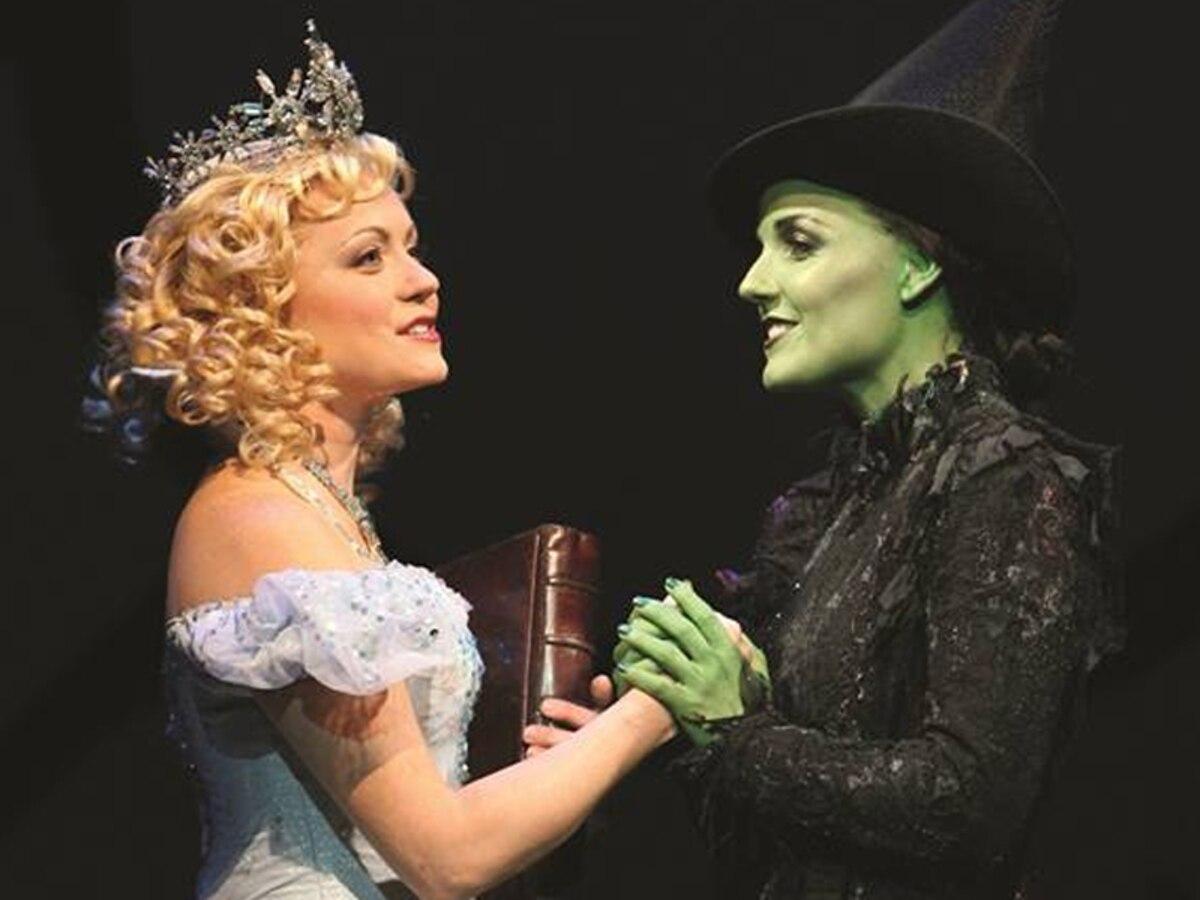
There was another production variable that could not be solved on the page: Kristin Chenoweth. Menzel’s Elphaba and Chenoweth’s Glinda did not simply represent two characters with different personalities. They brought radically different performance energies onto the same stage. Chenoweth’s comic precision and bright soprano contrasted with Menzel’s darker, contemporary vocal attack. The production could use that difference rather than trying to smooth it away.
Menzel herself later pointed to their final duet as a favorite moment because their voices were so different individually yet could blend when they sang together. That observation reveals something important about Wicked. The friendship does not work theatrically despite the contrast. The contrast is the theatrical engine. Costume reinforces it. Movement reinforces it. Vocal arrangement reinforces it. Character writing reinforces it. Even the visual palette reinforces it. One woman moves toward pink. The other becomes inseparable from green. One appears socially effortless. The other carries visible resistance. The production keeps placing opposites next to each other until the audience begins to understand their relationship through contrast before either woman needs to explain it.
Then Comes the Act I Problem

Every major musical has structural pressure points. Wicked has an enormous one. The end of Act I. By the time “Defying Gravity” begins, several production systems have to reach their peak simultaneously. Elphaba must make a decisive psychological transition. Stephen Schwartz’s score must keep increasing musical pressure. The ensemble must transform the scene around her. Lighting must redirect attention. Smoke and effects alter the visual environment. And eventually Menzel has to leave the stage floor. Literally.
IBDB credits Paul Rubin and ZFX with the production’s flying sequences and Chic Silber with special effects. This matters because “Defying Gravity” is frequently discussed as though it were primarily a song. Onstage, it is also a cue sequence. The audience experiences one continuous emotional escalation. The production team experiences a chain of precisely coordinated events.
The Lift Cannot Become the Story
This is where the engineering becomes interesting. Flying a performer is inherently spectacular. But Wicked cannot allow the audience’s dominant thought to become: how are they lifting her? If that happens, the emotional climax turns into a technical demonstration.
The engineering therefore has to arrive at exactly the moment when the story makes vertical movement psychologically inevitable. Elphaba has rejected the authority controlling her. She has decided not to return. The scene has nowhere left to go emotionally except upward. So the production converts an internal decision into physical space. Defiance becomes elevation. That is the important distinction. The lift is not impressive merely because Menzel rises. It works because scenic engineering has been assigned a dramatic verb. Rise. The machine completes an idea already established by the actor and score.
But Menzel Still Has to Sing Up There

The machinery does not replace the performer’s problem. It adds another one. Menzel has to deliver one of the most demanding sequences in the show while participating in a large technical effect. She acknowledged the difficulty herself. Discussing “Defying Gravity,” she said she loved performing it when she felt well—but when she did not, it was extremely hard. She also spoke about working carefully with a voice teacher and breaking down the music to identify areas that could become problematic when she was ill.
That is a revealing piece of backstage reality. A Broadway role is not designed for one extraordinary night. It has to survive a schedule. Eight performances in a normal Broadway week changes the production equation. A vocal choice that works spectacularly once may be useless if it cannot be repeated. A physical movement that looks powerful may need modification if it compromises breath. A costume can affect movement. A harness can affect physical freedom. Smoke, heat, fatigue and illness can change what a singer experiences.
So the real production achievement is not: can Idina Menzel sing this note? It is: can the entire system allow the performer to deliver the dramatic event repeatedly without destroying the instrument that makes the event possible? That instrument is the performer.
“Defying Gravity” Is Actually Several Departments Performing Together
Watch the number again from a production perspective. Do not watch only Elphaba. Watch what happens around her. The environment darkens and changes. The ensemble becomes an opposing force. Costume creates a huge black silhouette. Smoke obscures spatial information. Lighting isolates the central figure. The music expands. The flying system changes her elevation. Her voice continues above everything.
What appears to be one star moment is actually a carefully layered production stack: Performance → Music → Costume → Lighting → Effects → Automation/Flying → Ensemble → Sound. Remove one layer and the scene changes. Remove the performer’s conviction and the machinery becomes empty. Remove the flying effect and the visual metaphor loses scale. Lose the lighting hierarchy and the silhouette weakens. Lose vocal clarity and the technical climax overwhelms the character. Great production integration is often difficult to notice precisely because the departments stop looking separate. The audience remembers: Elphaba flew. The production team made hundreds of individual decisions that allowed that sentence to exist.
October 30, 2003

Wicked began Broadway previews at the Gershwin Theatre on October 8, 2003 and officially opened on October 30. Menzel originated Elphaba. Chenoweth originated Glinda. Joel Grey played the Wizard. Norbert Leo Butz played Fiyero.
But opening night did not freeze the meaning of Menzel’s performance. Something else began happening. Audiences started carrying Elphaba beyond the theatre. The original cast recording became a major point of contact between the show and people who had never entered the Gershwin. Playbill later described the album as double-platinum and noted the importance of Menzel’s voice to a generation of musical-theatre listeners. That changed the relationship between performer and role. Elphaba was no longer only a character seen in New York. She became a voice heard repeatedly in bedrooms, cars, schools and rehearsal studios.
A Broadway Role Becomes a Vocal Template
This creates an unusual legacy problem. Once an original performance becomes famous enough, later performers do not inherit a blank role. They inherit expectations. Where should the voice grow? How should “The Wizard and I” build? What should the final phrases of “Defying Gravity” feel like? How much grit belongs in Elphaba? How vulnerable should she be? How powerful?
Menzel’s performance became one of the reference points against which later Elphabas would inevitably be heard. Playbill’s retrospective on performers who played Elphaba described the part as exceptionally vocally demanding and traced a succession of actresses who had to confront the role after Menzel created it. But replication would be a mistake. The production needs consistency. The performer needs individuality. That tension is central to long-running theatre.
The Show Must Stay the Same. The Performer Cannot.

A long-running Broadway musical depends on repeatability. Blocking must survive. Lighting cues must survive. Flying positions must survive. Orchestration must survive. Scenic transitions must survive. Safety procedures absolutely must survive. But a replacement actor cannot simply become a photocopy of the original.
This is where Menzel’s legacy becomes more interesting than imitation. She established a dramatic architecture for Elphaba: the outsider, the resistance, the vulnerability, the anger, the humor, the friendship, the decision, the ascent. Later performers can inhabit that architecture differently. That is how a production language survives without becoming a museum.
June 6, 2004 — Broadway Confirms the Performance
At the 2004 Tony Awards, held at Radio City Music Hall, Menzel won Best Performance by a Leading Actress in a Musical for Elphaba, beating an A-list field that included Chenoweth herself. Wicked performed “Defying Gravity” during the ceremony with Menzel, Chenoweth and company.
The award matters historically. But from a production perspective, something more interesting had happened. A performer had become inseparable from a technical image. Mention Menzel’s original Elphaba and many people do not first imagine dialogue. They imagine the black silhouette. Green face. Cape. Light. Smoke. Arms extended. And elevation. That is not merely star power. It demonstrates what happens when performance identity and stage design become mutually reinforcing.
January 2005 — The Machine Suddenly Had to Stop

There is one more fact that reveals the physical reality beneath the spectacle. Menzel was scheduled to play her final Broadway performance on January 9, 2005. During the January 8 matinee, however, a trap door opened as part of the show’s “melting sequence” near the end of the performance, and an elevator that was meant to lower her had already partially descended—causing her to fall and crack a rib.
The show was halted for roughly 45 minutes while standby Shoshana Bean prepared to go on. On her scheduled final day, Menzel—unable to get into costume—still came out in a track suit for about 30 seconds of dialogue and singing to complete the story for the sold-out crowd, then took her final bow at curtain call. The actress who had become famous for flying above the Gershwin stage had been reminded, brutally, that Broadway spectacle remains physical work. Her original run as Elphaba ended not with an abstract symbol of theatrical machinery, but with its real-world consequences. That incident should not be sensationalized. It should be understood as part of a larger production truth: every apparently effortless stage effect depends on bodies, timing, procedures and risk management. The audience sees magic. The production team must see hazards. Both realities exist at the same time.
Menzel Did Not Stay Inside Oz
It would be easy to make the rest of this story a conventional celebrity biography. Rent. Wicked. Frozen. Concerts. Television. Film. That is not what matters here. For LEGENDS, the more important question is what Menzel’s career demonstrates about contemporary musical performance.
Before Wicked, she had already originated Maureen Johnson in Rent, a production that brought a more contemporary vocal energy into Broadway’s mainstream. After Elphaba, that voice moved far beyond Broadway. IBDB records Menzel’s Broadway career from Rent and Aida through Wicked, If/Then and, most recently, Redwood, which ran on Broadway in 2025. The through-line is not simply fame. It is the increasingly porous boundary between Broadway vocal performance and contemporary popular vocal culture. Menzel could inhabit both. Elphaba was the role where that intersection became globally visible.
What Idina Menzel Actually Changed

Menzel did not invent Broadway belting. She did not invent the eleven-o’clock number. She did not invent stage flying. And she did not create Elphaba alone. Stephen Schwartz wrote the music and lyrics. Winnie Holzman wrote the book. Joe Mantello directed. Wayne Cilento choreographed. Eugene Lee designed the scenery. Susan Hilferty designed the costumes. Kenneth Posner designed the lighting. Tony Meola designed the sound. The flying and effects teams engineered the physical spectacle.
That collaborative reality is essential. Menzel’s contribution was different. She helped establish how the central character could live inside all of those systems at once. Her Elphaba had to remain emotionally readable inside a production of enormous visual scale. Her voice had to coexist with spectacle rather than be swallowed by it. And when the production finally lifted her above the stage, the audience had to believe they were witnessing a decision—not merely a machine. That is the difference between performing beside stagecraft and making stagecraft feel like an extension of performance.
Editor’s Take — The Machine Only Works When the Actor Makes Us Forget It

There is a useful contradiction at the center of Idina Menzel’s Wicked. Julie Taymor’s The Lion King—the previous LEGENDS story—creates wonder partly by allowing audiences to see the theatrical mechanism. Wicked often does the reverse. At the climax of “Defying Gravity,” the production wants the machinery to disappear inside emotion. Both strategies can work. What determines the difference is not how sophisticated the technology is. It is why the technology is there.
Elphaba does not rise because Broadway has a flying system. She rises because, at that exact moment, remaining on the ground would feel dramatically wrong. And Menzel’s greatest production contribution was making an enormous technical event feel like something her character had chosen to do. For a few minutes, the performer, score, light, costume, sound, smoke and machinery stopped being departments. They became one action: defy gravity. That is when stage technology stops demonstrating what it can do—and starts telling the story.
References
IBDB — Wicked Original Broadway Production
Playbill — Injured Menzel Makes Surprise Appearance at Jan. 9 Wicked Performance
New York Theatre Guide — A Timeline of Wicked on Broadway and Beyond
Next in LEGENDS: from an actor who had to build a character while the show itself was still being rewritten, LEGENDS turns to a performer whose voice became inseparable from one of Broadway’s most recognizable characters.


