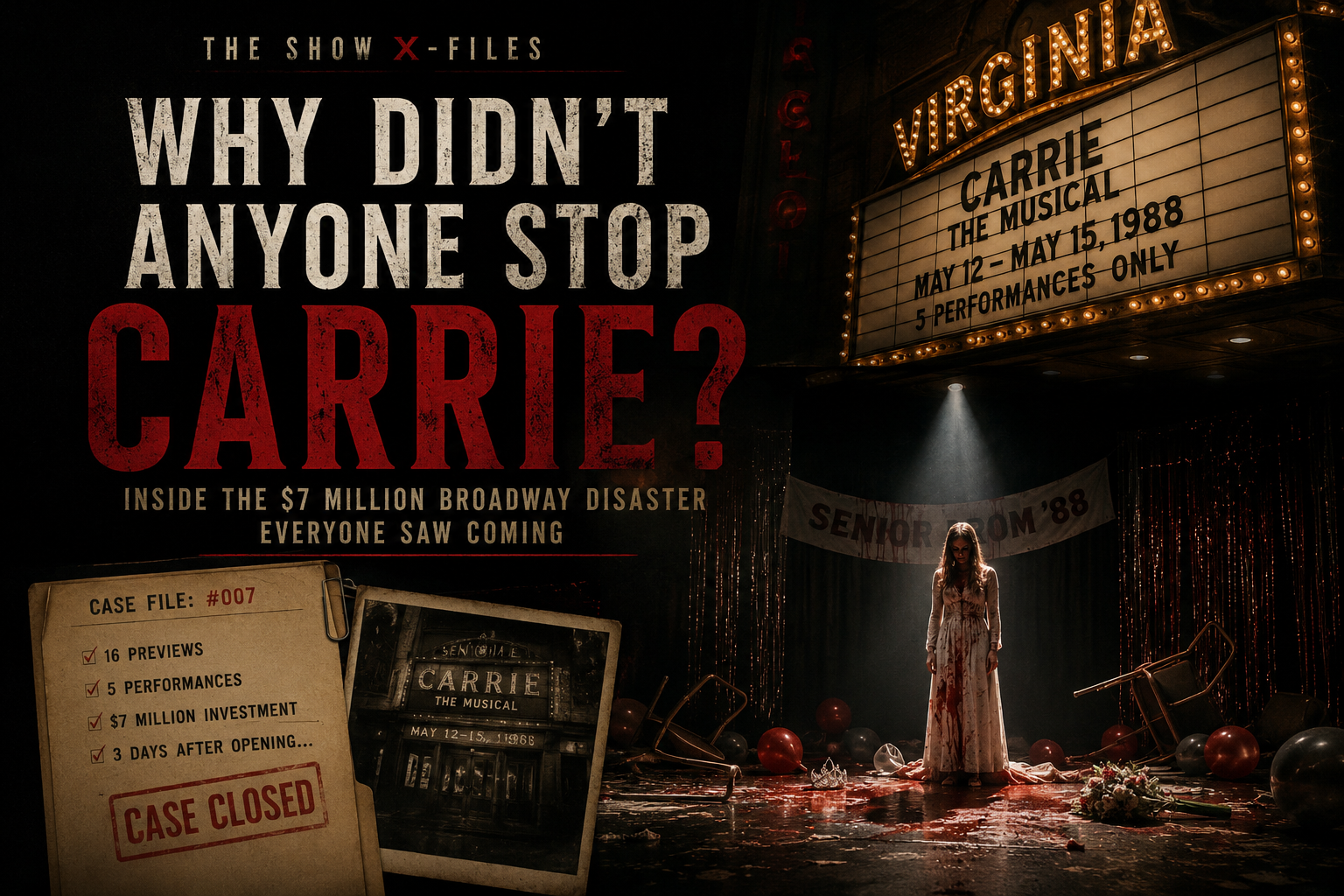
Why Didn’t Anyone Stop Carrie? Inside the $7 Million Broadway Disaster Everyone Saw Coming
CASE STATUS: CLOSED
LOCATION: Virginia Theatre, Broadway, New York
OPENING: May 12, 1988
CLOSING: May 15, 1988
PREVIEWS: 16
REGULAR PERFORMANCES: 5
ESTIMATED CAPITALIZATION: More than $7 million
Three Days After Opening, It Was Over
On Sunday night, May 15, 1988, the cast of Carrie walked onto the stage of Broadway’s Virginia Theatre knowing something the audience now knew too.
The show was finished.
Only three days earlier, Carrie had officially opened on Broadway.
Seven years of development had led to this theatre. Millions of dollars had been committed. The Royal Shakespeare Company was involved. Terry Hands, then one of the most prominent figures in British theatre, was directing. Debbie Allen was choreographing. Betty Buckley was playing Margaret White. Seventeen-year-old Linzi Hateley was making her Broadway debut as Carrie.
Everything about the project suggested importance.
Everything about its ending suggested catastrophe.
The production had played 16 previews and only five regular Broadway performances when the curtain came down permanently. Contemporary reporting put its capitalization at more than $7 million, making it one of the most expensive quick failures Broadway had seen. The official production record confirms just how abruptly it disappeared.
The story subsequently became Broadway folklore.
A famous novel. A famous film. A prestigious theatre company. A huge budget. Five performances.
But reducing Carrie to a punchline hides the more interesting case.
Because Carrie did not suddenly become troubled on opening night.
There had already been warnings.
So the real X-FILES question is not: Why did Carrie flop?
It is: Why didn’t anyone stop it before Broadway?
1. The Evidence Begins Before New York
The idea itself did not sound absurd.
Stephen King’s 1974 novel Carrie had already proved that the story could capture a mass audience. Brian De Palma’s 1976 film adaptation turned the prom-night bloodbath into one of modern horror cinema’s defining images.
The ingredients seemed theatrical: a bullied teenage girl, a fanatically religious mother, adolescent cruelty, sexual anxiety, telekinetic power, and a prom that becomes a massacre.
Composer Michael Gore, lyricist Dean Pitchford and book writer Lawrence D. Cohen—the screenwriter of the 1976 film—spent years developing a musical version.
Then the project acquired an unlikely partner: the Royal Shakespeare Company.
Instead of beginning as a modest American workshop, Carrie received a major staging at the Royal Shakespeare Theatre in Stratford-upon-Avon in February 1988 before transferring to Broadway.
On paper, that pedigree offered credibility.
In practice, it created one of the central tensions of the production.
What exactly was Carrie supposed to be? A psychological tragedy? A horror musical? A pop musical about teenagers? A grand operatic mother-daughter drama? A spectacular supernatural event?
The answer appeared to be: all of them.
And that was dangerous.
2. The Problem Was Not Simply “Bad Songs”
Broadway failures are often explained retrospectively as though everyone should have recognized the disaster immediately.
The reality of Carrie was more complicated.
Some of its material had genuine dramatic power. The relationship between Carrie and Margaret White gave the musical an emotional centre. Betty Buckley and Linzi Hateley were not amateurs trapped in an obviously worthless production. Hateley even received a Theatre World Award for her Broadway debut despite the show’s collapse.
That matters. Because it helps explain why the production could continue despite its problems.
There was enough talent—and enough material that seemed potentially powerful—to make people believe the show might still be fixed.
The problem was coherence.
The intimate scenes between Carrie and her mother belonged to one theatrical universe. The high-school sequences could feel as though they belonged to another. Then the production had to transform into supernatural horror.
Instead of one dramatic language becoming progressively darker, audiences were being asked to move among competing styles.
That creates a particularly dangerous problem in live entertainment.
A technically flawed scene can be repaired. A weak transition can be rewritten. A song can be replaced.
But when the production itself does not agree on what kind of experience the audience is supposed to be having, almost every department begins solving a different problem.
3. The Impossible Prom
Eventually every version of Carrie must confront the scene everyone is waiting for.
Prom night. Carrie believes, perhaps for the first time, that she has been accepted. She is crowned prom queen. Then blood falls from above. Humiliation becomes rage. And the room becomes a weapon.
On film, editing, camera placement, visual effects and multiple takes can control exactly what the audience sees.
Theatre has none of those protections.
Everything must happen live. The blood must work. The performer must remain able to sing and move. The costume must react predictably. Lighting must preserve visibility. Effects must appear dangerous without becoming dangerous. And Carrie’s telekinetic destruction has to feel frightening rather than mechanical.
Playbill’s retrospective reporting describes the original production as technically challenging, involving numerous special effects and the crucial requirement of dousing its leading actress in fake blood.
This was not an optional effect. It was the image the audience had paid to see.
If the prom sequence failed theatrically, the entire adaptation risked collapsing at precisely the moment it was supposed to become unforgettable.
That is one of the most important lessons hidden inside Carrie.
The more famous a scene is before the audience enters the theatre, the less room a stage adaptation has to disappoint them.
4. Then Came Stratford
The Royal Shakespeare Company production opened in Stratford-upon-Avon before Broadway. Linzi Hateley played Carrie. Barbara Cook originally played Margaret White.
The production then crossed the Atlantic with much of its principal company intact, but one major role changed: Betty Buckley replaced Cook as Margaret for Broadway.
That alone tells us something important. This was not a finished machine simply being transported from England to New York. The production was still evolving. And Broadway was approaching.
This is where the case becomes more interesting than the familiar “terrible musical loses $7 million” narrative.
A large production accumulates momentum. Contracts have been signed. Theatre dates have been secured. Designs have been fabricated. Performers have been hired. Marketing has begun. Investors have committed money. Every additional step makes stopping harder.
The question gradually changes from “Should we continue?” to “How can we make what we already have work?”
Those sound like similar questions. They are not. The first permits cancellation. The second assumes survival.
5. Broadway Was Not Starting From Zero
Previews began at the Virginia Theatre on April 28, 1988. That gave the company 16 public preview performances before the official opening on May 12.
Previews exist precisely because Broadway shows are not expected to arrive completely frozen. Writers rewrite. Directors restage. Songs move. Jokes disappear. Technical sequences are adjusted. Audiences become a diagnostic instrument.
But there is a limit to what previews can repair.
Sixteen performances may be enough to fix pacing. They cannot easily resolve a fundamental disagreement between concept, design, tone and storytelling.
And every day the clock moves closer to opening night. Once critics arrive, experimentation largely ends.
Carrie was therefore caught in a familiar high-risk production trap: The show needed major change at exactly the moment when there was least time available to make major change.
6. The Reviews Turned a Problem Into a Verdict
Carrie officially opened on May 12. Critical reaction was brutal.
The production rapidly became not merely an unsuccessful musical but an event—a Broadway spectacle people discussed because of how dramatically it seemed to have gone wrong.
Yet there is an important myth worth correcting. The theatre was not simply empty.
Playbill’s historical Broadway data records total grosses of $341,396 across the run and an overall average capacity of 71.33 percent. The final partial week fell to 61.89 percent capacity.
That changes the interpretation. This was not a case in which nobody wanted to see the show. People were attending. Curiosity existed. The title was famous.
But for a production capitalized at more than $7 million, curiosity was not enough. The economics were unforgiving.
And then the financial structure broke. Playbill later reported that, amid the disastrous reviews and troubled run, financial backers withdrew money at the last minute.
Three days after opening, Carrie closed.
7. The $7 Million Question
Contemporary reporting immediately asked the obvious question: how could this much money be spent on a musical that disappeared almost instantly?
That is the wrong question if it is asked only after the failure.
The more useful question is: At what point during development should the decision to continue have been challenged?
Large productions create their own gravity. The more money invested, the more psychologically difficult abandonment becomes. The more prestigious the collaborators, the harder it becomes to conclude that the central concept may be wrong. The closer opening night gets, the more every problem is treated as something that can be repaired with another rehearsal, another technical adjustment or another rewrite.
This phenomenon is not unique to Broadway. It appears in films, festivals, concerts, architecture, technology projects and major events. Past investment begins influencing future decisions even though the money already spent cannot be recovered.
In economics, that logic is associated with the sunk-cost effect. In show business, it can sound much simpler: We have come too far to stop now.
There is no evidence that a single meeting or a single individual made Carrie continue for precisely that reason. That would be an irresponsible claim.
But the production provides an extraordinary case study in what happens when a project with visible creative problems has already acquired enormous institutional, artistic and financial momentum.
8. The Most Important Evidence Appeared 24 Years Later
If the story ended in 1988, it would be easy to conclude that Carrie was simply a terrible idea for a musical.
Then something unexpected happened. The writers did not forget it.
For years, regional theatres, colleges and other groups reportedly expressed interest in performing the work, but the creators resisted releasing the Broadway version.
Composer Michael Gore later explained that the team had not achieved the production they originally wanted and had been unhappy with what reached Broadway.
Eventually director Stafford Arima met with Gore, Pitchford and Cohen. Instead of trying to rehabilitate the reputation of the 1988 spectacle, they went back into the material. Line by line. Song by song. Scene by scene.
The result was a substantially revised Carrie. MCC Theater presented it Off-Broadway in 2012 with Molly Ranson as Carrie and Marin Mazzie as Margaret.
The creative team rewrote lyrics, introduced new songs and refocused the narrative. Arima described the goal as finding a specifically theatrical identity for Carrie, rather than simply putting the novel or film onstage.
That statement may contain the most important clue in the entire case.
The fundamental challenge was never merely: How do we reproduce Carrie?
It was: What does Carrie become when it is theatre?
9. Failure Became the Workshop
The 2012 production was not a conventional revival. It was closer to an investigation of the original crime scene.
What had worked? What had distracted from the story? What belonged to Carrie and Margaret? What belonged to the teenagers? What needed spectacle? What needed intimacy? What had been designed because it served the drama—and what had been designed because Broadway expected something big?
The revised production did not erase 1988. It used 1988 as evidence.
That is why Carrie occupies such a strange position in theatre history. Most failures disappear. This one became more famous.
The disastrous Broadway run generated books, bootlegs, fan communities, retrospectives and eventually new productions. The failure became part of the work’s identity.
Carrie acquired something its original producers never intended: a second life because it had died so spectacularly the first time.
10. So Who Should Have Stopped Carrie?
Perhaps nobody. That may be the most uncomfortable answer.
Because stopping a show before opening requires certainty that theatre rarely provides. History is filled with productions that looked troubled in previews and later became successes. Creative work is inherently unstable before an audience sees it.
A producer who kills every difficult project will avoid spectacular failures. That producer may also kill extraordinary successes.
The lesson of Carrie therefore cannot simply be: “Someone should have cancelled it.”
The deeper lesson is about diagnosis. A production team must distinguish between two very different conditions: a show that is difficult because it is unfinished, and a show that is difficult because its central theatrical idea has not yet been solved.
The first needs rehearsal. The second may need reconstruction.
In 1988, Carrie reached Broadway while still carrying questions large enough that 24 years later its original creators were willing to dismantle significant parts of it and try again.
That is the evidence that matters.
THE X-FILES VERDICT
Was Carrie simply a bad musical? NO. The existence of powerful performances, enduring songs, decades of fascination and a substantially reworked second life makes that explanation too simple.
Did audiences completely reject it? NO. Historical box-office data shows meaningful attendance during its extremely short run.
Did critics contribute to its collapse? YES—significantly. But the production’s problems existed before the reviews appeared.
Was the $7 million budget the cause? NOT BY ITSELF. The budget amplified the consequences of failure and made sustainability much more difficult.
What actually failed? The strongest evidence points not to one disastrous decision but to a production that reached Broadway before its competing theatrical identities had been fully reconciled.
CASE CLOSED?
Not quite.
Thirty-seven years after its Broadway collapse, Carrie remains one of musical theatre’s most discussed failures.
That longevity creates a paradox. Thousands of Broadway shows have opened. Many ran longer. Many received better reviews. Many made more money. Most disappeared from cultural conversation.
Carrie did not.
Perhaps Broadway’s most infamous failure achieved something its successful contemporaries could not. It became immortal. Not because everything went right. Because almost everything that could go wrong became part of the legend.
And for anyone producing the next ambitious show, Carrie leaves behind a question far more useful than “How do we avoid a flop?”
It asks: When everyone is working desperately to fix the show, who is still willing to ask whether they are fixing the right problem?
That is why the case of Carrie still matters. And that is why THE SHOW X-FILES is reopening it.
EDITOR’S ANALYSIS
For IMMERSIVE LAB, Carrie is especially interesting from a production perspective.
Large-scale entertainment projects often fail not because they lack talent, money or ambition, but because those resources begin moving faster than the central creative decision.
A spectacular technical solution cannot repair an unclear dramatic objective. More rehearsals cannot automatically solve a conceptual contradiction. And money already spent is not proof that more money should follow.
The professional lesson is therefore not “take fewer risks.” Broadway would be a much poorer place if producers followed that rule.
The lesson is more demanding: Take enormous risks—but build moments into the process when someone still has the authority to question the premise itself.
That is the line between persistence and momentum without control.
Carrie crossed it. Then, 24 years later, its creators went back and tried to cross it again differently.
References & Further Reading
Internet Broadway Database (IBDB)
Carrie — Original Broadway Production
Playbill — Carrie Broadway Production Archive
Production Archive
Playbill — Anatomy of a Murdered Show
Creators Talk About the Musical’s Second Coming
Next in THE SHOW X-FILES
https://immersivelabkorea.com/the-25-million-show-broadway-almost-never-saw/


