Seven Performances in the Future: The Via Galactica Broadway Experiment
Broadway’s 1972 Attempt to Make Actors Weightless
On November 28, 1972, Broadway opened a musical set exactly 1,000 years in the future. Its stage was built around an idea almost no conventional musical needed to solve: actors had to appear as though gravity had weakened.
Performers bounced across large trampolines. Spaceships moved through the stage environment. The story unfolded in the year 2972 on a distant asteroid. The production occupied the newly opened Uris Theatre and was directed by Peter Hall, with music by Galt MacDermot, the composer of Hair.
Four days later, it was over. Via Galactica closed on December 2 after only 15 previews and seven regular performances. That number makes it easy to file the musical under “Broadway flops.” But doing that misses the much more interesting production question: what happens when a stage technology successfully communicates a physical idea—but the audience still cannot understand why it should care about the people using it?
Broadway Had to Invent a New Physical Language
The premise itself demanded something unusual. Via Galactica, written by Christopher Gore and Judith Ross with music by Galt MacDermot, took place in 2972. Its central character, Gabriel Finn, was played by Raúl Juliá; Irene Cara was also among the company. Peter Hall conceived and directed the production, while John Bury designed both scenery and costumes.
Broadway could easily paint stars on scenery. That was not the difficult part. The production needed the performers themselves to belong to another physical world. The answer was startlingly literal: change the way their bodies moved. Large trampolines were incorporated into the stage so performers could bounce through the space, creating an impression of reduced gravity. The device became so visually memorable that Brendan Gill’s contemporary New Yorker review specifically described the cast bouncing on “enormous trampolines.”
That tells us something important. The effect registered. The audience could see the idea. Technically, the theatrical metaphor was legible. But legibility is not the same as storytelling.
The Trampoline Solved the Wrong Question
Imagine the design meeting. The script says the audience is entering a civilization a thousand years in the future. The designers face a problem: how do we make Earth-bound performers look as if they inhabit a different gravitational environment?
A trampoline is an ingenious theatrical answer. It transforms a biological limitation—the human body cannot float—into choreography. No digital compositing. No cinematic cut. No post-production. A performer pushes against the stage and temporarily escapes it. For several seconds, gravity appears negotiable.
But once the production solved that problem, another question remained: what dramatic information does weightlessness communicate? If Gabriel Finn jumps higher, have we learned anything new about Gabriel Finn? If an entire ensemble appears to float, has the relationship between two characters changed? Does the effect increase danger? Desire? Isolation? Conflict? If not, technology may be communicating location without communicating drama. That distinction sits at the heart of Via Galactica.
Then the Technology Began Controlling the Production

The show did not open when originally planned. IBDB records that the opening had been scheduled for November 21, 1972, but was moved to November 28.
A first-person recollection preserved by Performing Arts Legacy gives an unusually revealing glimpse behind that delay. Original company member James Dybas recalled that technical difficulties pushed opening night back a week and described several production mishaps. In one incident, he remembered oil from a spaceship mechanism dripping onto audience members below.
That recollection is valuable precisely because it should not be inflated into something it does not prove. It does not establish that one malfunction destroyed the musical. It shows something more useful: the futuristic machinery was not merely decoration. It had become an operational variable. Once scenery moves over an audience, performers depend on specialized surfaces, and physical effects become embedded in choreography, every creative idea acquires a second identity. It becomes a maintenance problem. A cueing problem. A rehearsal problem. A safety problem. A stage-management problem. And potentially a reliability problem. The more indispensable the effect becomes to the show’s identity, the less easily the production can simply remove it.
$900,000 Was Riding on Seven Performances
Playbill’s historical archive puts the production’s cost at approximately $900,000—a substantial Broadway capitalization for 1972. The investment was not attached to an inexperienced creative team. Peter Hall was an internationally prominent director. Galt MacDermot had written the music for Hair and had just won the Drama Desk Award for Outstanding Music for Two Gentlemen of Verona. John Bury was responsible for scenery and costumes. George Faison handled ensemble movement. Lloyd Burlingame designed lighting. Jack Shearing was credited with sound design. Raúl Juliá led the cast as Gabriel Finn.
These facts make the seven-performance run more interesting, not less. Talent was present. Money was present. Technical ambition was present. A distinctive visual concept was present. What the production could not guarantee was that those ingredients would combine into an audience experience.
A Spectacle Can Be Perfectly Visible and Dramatically Invisible

Contemporary criticism helps locate the problem. Brendan Gill’s New Yorker review attacked the book while explicitly remembering the bouncing performers and spaceships. That is a remarkable combination. More than half a century later, the technological imagery is still easy to describe. The dramatic experience was far less secure.
This creates a useful test for immersive and technologically ambitious productions today. After removing the technology, ask: what changes between the characters? Then put the technology back and ask: does it make that change more powerful? If the first question has no convincing answer, the second cannot rescue it. A spectacular machine can amplify drama. It cannot manufacture the underlying human relationship on its own.
The Audience Had Another Problem: Orientation
Science fiction creates a special challenge for theatre. A contemporary apartment requires almost no explanation. A restaurant requires almost none. Neither does a recognizable historical street once costume and scenery establish the period. But Via Galactica asked a 1972 Broadway audience to understand a fictional society in 2972. IBDB records that futuristic setting explicitly.
Every invented world therefore spends part of the audience’s attention budget. Who are these people? Where are they? What are the rules? What does this object do? Why do people move this way? What matters here? The production’s visual inventions can help answer those questions. But every new theatrical language also creates something the audience must decode.
This gives immersive production an uncomfortable equation: novelty increases attention, and novelty also increases cognitive load. The more unfamiliar the world, the clearer the dramatic architecture must become. Otherwise the audience spends its energy understanding the environment instead of feeling the story.
The Uris Theatre Made the Gamble Even Bigger

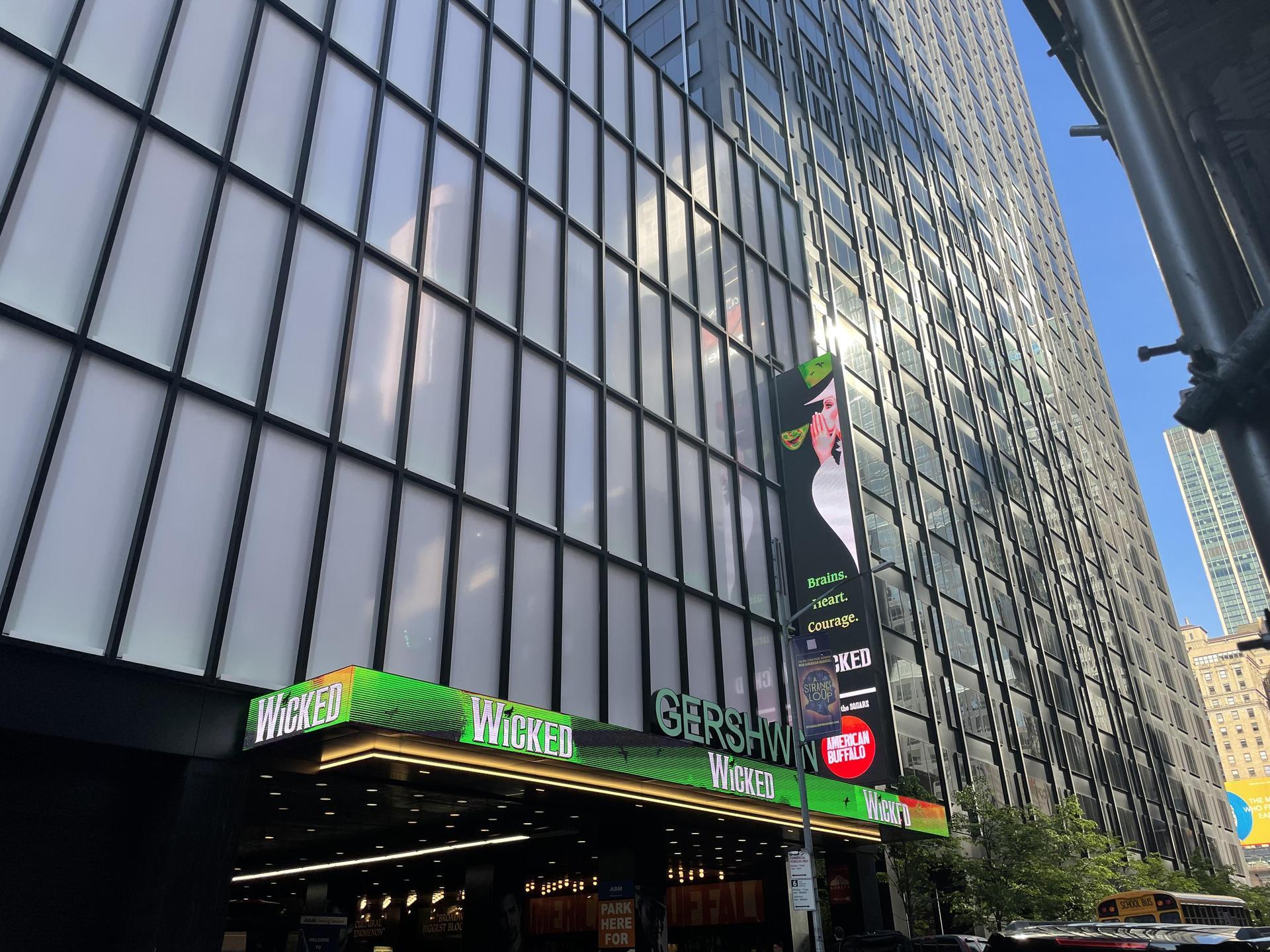
There was another layer of symbolism. Via Galactica was the first theatrical production to play the new Uris Theatre. Today that venue is known as the Gershwin Theatre.
So the production was not merely presenting a futuristic musical. It was helping introduce a major new Broadway house. The combination was almost irresistible: a new theatre, a new science-fiction world, a celebrated director, the composer of Hair, Raúl Juliá, and a stage vocabulary built around physical spectacle. It looked like the future arriving on Broadway. Instead, the production became an example of how difficult it is to make the future emotionally understandable.
November 28 → December 2

The chronology is brutally short. November 6: first preview, according to Playbill. November 21: originally scheduled opening date. November 28: actual opening. December 2: closing. Fifteen previews. Seven performances.
Seven performances do not provide enough evidence to claim that every component of Via Galactica was artistically unsuccessful. Nor does its short run prove that trampolines, futuristic scenery or experimental movement were mistakes. That would be the wrong lesson. The more interesting lesson lies in their relationship.
A 1972 Problem That Has Become More Important in 2026
Today we can do far more than Via Galactica could. LED walls can replace environments instantly. Real-time engines can generate responsive worlds. Tracking systems can follow performers. Automation can move massive scenery with repeatable precision. Projection can erase architecture. Spatial audio can place sound almost anywhere. Drones, robotics and interactive systems can give physical space behaviours that would have seemed impossible in 1972.
Which means the fundamental question has become more—not less—important: why does the audience need this technology at this exact moment? “Because we can” is an engineering answer. “Because audiences have never seen it” is a marketing answer. Neither is necessarily a dramatic answer. The strongest production technology changes what the audience understands or feels. It can make danger physically immediate. Transform scale. Reveal information. Alter perspective. Collapse distance. Turn architecture into narrative. Make an impossible action believable. But it needs a job.
The Production Test Via Galactica Leaves Behind
Before approving an expensive effect, IMMERSIVE LAB would ask five questions: what specific problem does it solve? What does the audience understand because of it? What emotion becomes stronger because it exists? What operational complexity does it add every night? If it fails, can the story survive?
Those questions connect Creative Direction directly to Scenic Engineering and Production Management. They also prevent a common mistake: evaluating technology only during the moment when it works. A producer must evaluate the entire lifecycle—design, fabrication, programming, rehearsal, operation, maintenance, failure recovery, and its actual narrative value. The effect lasts seconds. The production carries it for months. Or, in this case, potentially only seven performances.
Editor’s Take
Via Galactica should not be remembered merely as the strange Broadway musical that put actors on trampolines. That reduces a genuinely ambitious experiment to trivia. Its more useful legacy is that technical innovation creates a debt that the rest of the production must repay. Every spectacular device asks for rehearsal time, money, maintenance, audience attention and creative justification. When that device deepens the story, the debt can be worth paying. When the audience remembers how the actors floated but struggles to understand why the characters mattered, the technology may have solved the hardest engineering problem while leaving the most important theatrical problem untouched.
References
IBDB — Via Galactica Original Broadway Production
Ovrtur — Via Galactica Production Record
Playbill — Via Galactica Vault
King Kong would confront the inverse problem decades later: what happens when the impossible stage machine works so well that it becomes more compelling than the musical around it?


