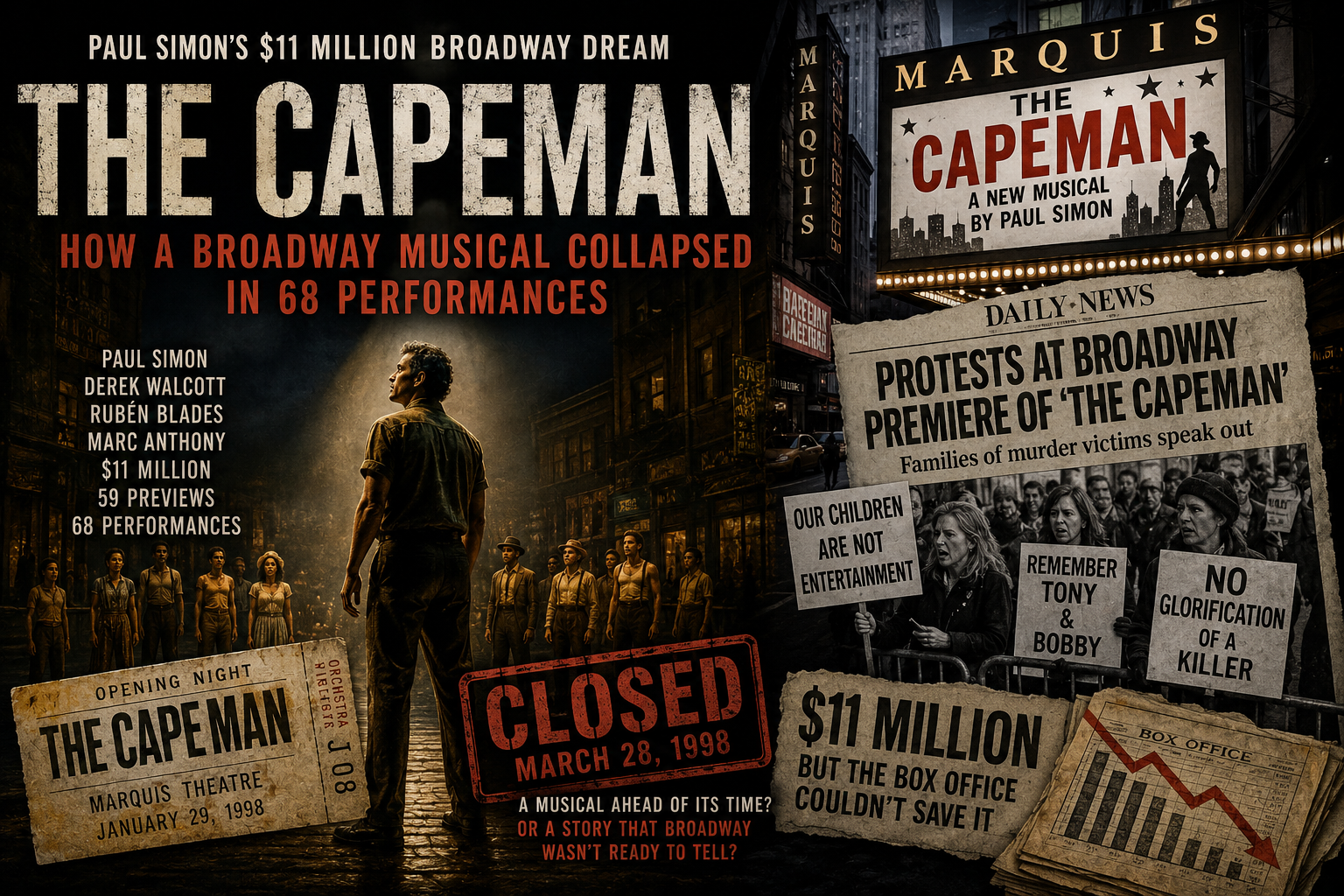
The Capeman: How Paul Simon’s $11 Million Broadway Dream Collapsed in 68 Performances
It had Paul Simon, a Nobel Prize-winning writer, Marc Anthony, Rubén Blades and an $11 million budget. But outside the theatre, families of two murdered teenagers were asking a question Broadway could not ignore: Whose story was this musical really telling?
CASE STATUS: COMMERCIAL FAILURE / CREATIVE CRISIS / ETHICAL CONTROVERSY
LOCATION: Marquis Theatre, New York
FIRST PREVIEW: December 1, 1997
OPENING: January 29, 1998
CLOSING: March 28, 1998
PREVIEWS: 59
PERFORMANCES: 68
MUSIC: Paul Simon
BOOK & LYRICS: Paul Simon and Derek Walcott
DIRECTOR OF RECORD: Mark Morris
BROADWAY COST: approximately $11 million
Opening Night Had Two Shows
January 29, 1998.
Inside Broadway’s Marquis Theatre, one of the most anticipated new musicals of the season was finally opening.
Paul Simon had written the music. Derek Walcott, winner of the Nobel Prize in Literature, collaborated on the book and lyrics. Rubén Blades and a young Marc Anthony were playing two stages in the life of the central character.
Millions of dollars had been spent.
After nearly two months of previews and repeated revisions, The Capeman was finally ready to face Broadway.
But another drama was unfolding outside.
Relatives of Tony Krzesinski and Robert Young, two teenagers killed in Manhattan in 1959, stood with protesters outside the theatre.
Their objection went directly to the premise of the musical.
The protagonist audiences were about to spend an evening understanding was Salvador Agrón, the teenager convicted of killing them.
One victim’s sister summarized the objection with devastating simplicity: the family’s tragedy had become entertainment. Around 60 protesters participated in the opening-night demonstration reported by The Washington Post.
Broadway critics would soon judge whether The Capeman worked as theatre.
The protesters were asking something more difficult: Should this story have been told this way at all?
1. The Crime Came Before the Musical

To understand why The Capeman became so controversial, we have to return almost forty years.
New York City. Salvador Agrón was a 16-year-old Puerto Rican gang member.
During a confrontation in Manhattan, two teenagers—Tony Krzesinski and Robert Young—were fatally stabbed.
Agrón was convicted. The press seized on his appearance and nickname: The Capeman.
He was sentenced to death, becoming the youngest person on New York’s death row at the time. His sentence was later commuted to life imprisonment, and he eventually served roughly two decades before being paroled. He died in 1986.
But Agrón’s later life complicated the tabloid image.
In prison he educated himself and wrote poetry.
That transformation interested Paul Simon.
And therein lay both the artistic opportunity—and the danger.
2. Paul Simon Didn’t Want to Write a Murder Story
Simon was interested in identity. Immigration. Puerto Rico and New York. Race. Poverty. Youth. Violence. Prison. Redemption.
The music would combine the sounds of 1950s New York with Puerto Rican and Latin influences, doo-wop, gospel and rock.
This was ambitious material. It also represented Simon’s first Broadway musical.
The problem wasn’t simply that Agrón had committed murder. Drama has been built around killers for centuries.
The problem was perspective.
If a musical spends hours exploring the childhood, culture, fear, anger, imprisonment and eventual transformation of the killer—where do the people he killed exist in the story?
That question would eventually follow The Capeman all the way to opening night.
3. Two Extraordinary Artists Entered Broadway
Paul Simon was hardly an unknown songwriter. His career had already produced one of the most celebrated catalogues in American popular music.
For the book and lyrics he collaborated with Derek Walcott, the Caribbean poet and playwright who had received the 1992 Nobel Prize in Literature.
On paper, the combination was formidable. Simon brought music. Walcott brought poetry and theatre.
But Broadway songwriting is a peculiar discipline.
A brilliant song can stop time. A theatrical song often has to do the opposite. It must move character, conflict or story forward.
Contemporary criticism of The Capeman would repeatedly admire Simon’s music while questioning whether the dramatic machinery surrounding it worked. The Los Angeles Times, for example, praised the melodic writing while arguing that the music and stage storytelling never fully connected.
That distinction would become central to the case. A great score does not automatically create a great musical.
4. The Production Couldn’t Find Its Director
Long before the critics arrived, The Capeman had another warning sign.
Leadership kept changing.
Susana Tubert was involved as an early director. Then Eric Simonson. Then Mark Morris.
Contemporary reporting before the Broadway opening documented the succession of directors and the difficulty of assembling a coherent creative team.
Changing a director does not automatically mean disaster. Development is messy.
But every director interprets the fundamental questions differently: Who is the protagonist? What does the audience need to know? Where should sympathy sit? How much information does a scene require? What should music accomplish? What is the production actually about?
When those answers continue changing late in development, the entire show can become unstable.
And The Capeman was approaching Broadway.
5. December 1, 1997: The Public Experiment Began

Previews started at the Marquis Theatre on December 1.
Opening night was originally expected much earlier than January 29.
Instead, previews became an extended repair period. Eventually 59 previews would be played before the musical officially opened.
Think about what that means operationally.
At night: perform the show. During the day: repair the show.
Actors had to absorb changes while continuing to perform for paying audiences. Scenes were being reconsidered. Songs were moved. Material disappeared.
The production was simultaneously presenting itself and rebuilding itself.
This is one of Broadway’s most dangerous conditions. The workshop has followed the show into the theatre.
6. Then the Show Doctors Arrived
As opening night approached, Broadway veterans were brought in to help.
Jerry Zaks worked on the production. Joey McKneely worked on choreography.
Playbill reported that more than 30 minutes had been cut as the production was sharpened before its delayed opening.
Thirty minutes is not polishing. It is surgery.
The official opening, originally scheduled for January 8, was pushed to January 29.
This is an important X-FILES warning sign we’ve now encountered repeatedly.
Titanic. Dance of the Vampires. Merrily We Roll Along. And now The Capeman.
When previews become the place where a production is still discovering its fundamental identity, every additional performance increases pressure.
More money is being spent. More people are seeing the unfinished version. More expectations accumulate. And opening night keeps getting closer.
7. But The Capeman Had a Problem Rewriting Couldn’t Easily Fix
A scene can be shortened. A song can be moved. A dance can be replaced. A set can be redesigned.
But what happens when the central problem is the moral position of the story itself?
Victims’ rights groups had already objected during previews.
Members of the victims’ families believed the musical centered the killer while their loved ones risked becoming secondary figures in his redemption narrative.
That concern was not invented after bad reviews. It existed before the show opened.
And it raised a question every fact-based production eventually confronts: Understanding someone is not the same as excusing them.
But can an audience always tell the difference?
8. Representation Added Another Layer
The controversy wasn’t only about victims and perpetrators. It was also about Puerto Rican representation.
Some critics worried that another major New York production centered on Puerto Rican gang violence could reinforce stereotypes.
The comparison to West Side Story was unavoidable.
Ironically, THE SHOW X-FILES investigated West Side Story itself in FILE #012. Four decades later, The Capeman found itself entering related territory.
But there was another side.
For some Latino artists and audience members, the production represented something rarely seen at Broadway scale: Puerto Rican music, performers and cultural identity occupying a major Broadway theatre.
Tito Puente publicly welcomed that visibility at the opening despite the protests. Contemporary reporting captured both the objections and the significance some Latino observers attached to the production.
That makes the case more complicated than: The musical was offensive.
Different communities were asking different questions of the same production.
9. January 29: The Critics Finally Entered

After 59 previews—after directors—after rewriting—after more than 30 minutes of cuts—The Capeman officially opened.
The response was overwhelmingly damaging.
The score received praise. Other elements did not. The book, dramatic structure and staging became frequent targets.
Playbill later summarized the reviews as generally negative when announcing the closing.
The production had reached the point every troubled Broadway musical fears: the development period was over. Now there was a permanent public verdict.
And unlike Merrily We Roll Along, The Capeman had another problem.
Its controversy meant people weren’t merely debating whether it was good theatre. They were debating whether its very point of view was defensible.
10. $11 Million Was Now at Risk
The production cost approximately $11 million—an enormous Broadway capitalization for 1998.
And the box office wasn’t strong enough.
Playbill’s Broadway records show total grosses of approximately $8.04 million, with average attendance of about 76% of capacity across previews and performances.
Those numbers require context.
Gross revenue is not profit. A Broadway production has weekly operating costs. Advertising. Theatre expenses. Salaries. Musicians. Crew. Royalties. Marketing.
An expensive production cannot survive merely because thousands of people are buying tickets. It has to generate enough revenue to support the machine.
The Capeman wasn’t doing it.
11. March 5: The End Was Announced

Just five weeks after opening night, producers announced that The Capeman would close.
March 28.
The final statistics: 59 previews, 68 performances, approximately $11 million capitalization.
A project Paul Simon had spent years developing would disappear from Broadway less than two months after officially opening.
This was not a marginal disappointment. It became one of the era’s most famous Broadway failures.
12. But Was the Music a Failure?
Here the case becomes interesting again.
Broadway rejected the production. That does not mean every component failed.
Even contemporary negative reviews often separated Simon’s score from the problems of the musical surrounding it.
And The Capeman received Tony nominations for Best Original Score, Best Orchestrations and Best Scenic Design.
That creates the same distinction we’ve encountered elsewhere in X-FILES: a production can fail even when important parts of it succeed.
The challenge is diagnosing which part audiences are rejecting.
13. The Victims Could Not Be Edited Out of the Case
This is where The Capeman differs sharply from FILE #017.
Merrily We Roll Along had a dramaturgical problem. Its reverse chronology made emotional connection difficult. That could be studied. Rewritten. Restaged. Recast.
The Capeman faced something that could not be solved merely through theatrical technique.
Two teenagers were dead. Their families were real. Salvador Agrón was real.
The suffering did not belong to the writers.
When artists dramatize real violence, they inherit a responsibility fictional storytelling does not carry in quite the same way.
Every decision about perspective becomes an ethical decision.
Who gets a song? Who gets a backstory? Who gets complexity? Who gets remembered? And who becomes merely the event that allows somebody else’s transformation to begin?
14. This Is Not an Argument Against Difficult Stories
That distinction matters.
The lesson of The Capeman cannot simply be: Don’t make musicals about criminals.
That would eliminate enormous areas of theatre, film, literature and opera.
Nor does empathy equal endorsement. Art must be allowed to examine people who have done terrible things.
The more useful production question is: Has the work earned the perspective it asks the audience to inhabit?
And when real victims exist, another question follows: Does the story’s search for complexity accidentally redistribute sympathy?
There is no spreadsheet capable of answering those questions. But producers ignore them at enormous risk.
15. Paul Simon’s Biggest Mistake May Not Have Been Musical
Paul Simon knew how to make music. The score proves that.
The more revealing problem may have been attempting to learn Broadway while simultaneously carrying an unusually difficult $11 million production.
Pop songwriting and theatrical storytelling are related disciplines. They are not identical.
Broadway adds: book structure, staging, character arcs, scene transitions, commercial economics, technical production, audience expectations, and—in this case—ethical responsibility toward real people.
The project wasn’t asking Simon to master one unfamiliar system. It was asking him to master several at once.
That is an enormous production risk even for an extraordinary artist.
16. The Star-Power Fallacy
Paul Simon. Derek Walcott. Marc Anthony. Rubén Blades. Mark Morris. Bob Crowley.
On a poster, those names look like risk reduction.
In production, they can create the opposite.
Great artists bring strong ideas. Strong ideas do not automatically align.
The larger the reputation of each collaborator, the more difficult it may become to establish a single creative authority capable of saying: This is the story. This is the perspective. This stays. This goes.
The history of The Capeman suggests that assembling extraordinary individuals is not the same thing as assembling an extraordinary production system.
That’s a lesson that extends far beyond Broadway.
17. The Final Performance

March 28, 1998. The Marquis Theatre.
After 68 regular performances, The Capeman closed.
Paul Simon attended. At the end, he addressed the audience.
Playbill reported that he received standing ovations and questioned what success meant in the face of the response inside the theatre that night.
It was an emotionally understandable reaction.
But commercial theatre has two verdicts. The artistic verdict. And the economic verdict.
They do not always agree.
A room full of people can love a final performance. A production can still be financially unsustainable. Both things can be true.
18. Broadway Failure Wasn’t the End of the Music
Like several cases in this X-FILES cluster, The Capeman did not completely disappear after Broadway.
The music continued to have a life beyond the failed original production.
That is important because it helps isolate the failure.
The songs were not necessarily the fatal flaw. The original Broadway configuration was.
Score. Book. Perspective. Direction. Scale. Economics. Controversy. Expectations.
All collided in one production.
Broadway didn’t reject a single ingredient. It rejected the finished combination.
THE X-FILES VERDICT
Was The Capeman a major Broadway financial failure? YES. The approximately $11 million production closed after 59 previews and 68 regular performances.
Did it simply fail because Paul Simon couldn’t write good music? NO. The score was frequently distinguished from the production’s other problems and received a Tony nomination.
Was the production already unstable before opening? YES. Directorial changes, extensive revisions, an extended preview period and more than 30 minutes of cuts preceded opening night.
Was the controversy invented by critics after opening? NO. Victims’ relatives and victims’ rights advocates protested the production, including on opening night.
Was reaction within the Latino community uniformly negative? NO. Contemporary reporting also documented Latino artists and audiences who valued the production’s cultural representation and music.
So what killed The Capeman? There is no single culprit. Creative instability. A difficult book. A huge budget. Weak critical reception. Commercial pressure. And a fundamental ethical controversy embedded inside the material itself. Together they produced something much harder to repair than a broken set. The production never fully solved what story it was asking Broadway to believe.
CASE CLOSED?
Outside the Marquis Theatre, the victims’ families asked a question that remains uncomfortable nearly three decades later.
Inside, Paul Simon was asking audiences to see Salvador Agrón as something more complicated than a newspaper headline.
Both impulses can exist simultaneously. That is precisely why this case matters.
The easiest version of The Capeman would have made Agrón a monster. Another easy version would have transformed him into a misunderstood victim.
The difficult version had to hold crime, consequence, culture, poverty, punishment and redemption together—without allowing one truth to erase another.
Broadway did not believe the 1998 production achieved that balance.
After years of development, three directors, 59 previews, emergency revisions and approximately $11 million—the curtain fell.
But the most important lesson wasn’t written on the closing notice. It was already standing outside the theatre on opening night.
Every production decides whose eyes the audience will see the story through.
When the story is fictional, that decision belongs mostly to the artist.
When the blood was real—the people outside the theatre may still have a claim on the story.
EDITOR’S ANALYSIS
FILE #018 exposes a production risk we have not examined this directly before.
Ethical risk can become production risk.
Producers routinely assess: budget risk, technical risk, schedule risk, ticket-sales risk, casting risk.
But true-story entertainment adds another category: perspective risk.
A project can be factually accurate and still create an ethical problem through what it chooses to emphasize.
That matters enormously today.
Documentaries. True-crime series. Immersive exhibitions. Biographical musicals. Historical spectacles.
All of them transform real lives into audience experiences.
The crucial question is therefore not merely: “Is this true?”
It is: “What does our way of telling the truth make the audience feel—and about whom?”
The Capeman never found a sufficiently convincing answer before Broadway’s clock ran out.
That makes it more than a famous flop.
It makes it a case study every producer working with real tragedy should read.
References & Further Reading
IBDB — The Capeman
Official Broadway Production Record
Playbill — Closing Report
Paul Simon’s Capeman Closing
Playbill — Opens to Protests
The Capeman Opens After Major Revisions
The Washington Post — Opening Night Protest
Protest at The Capeman Premiere


