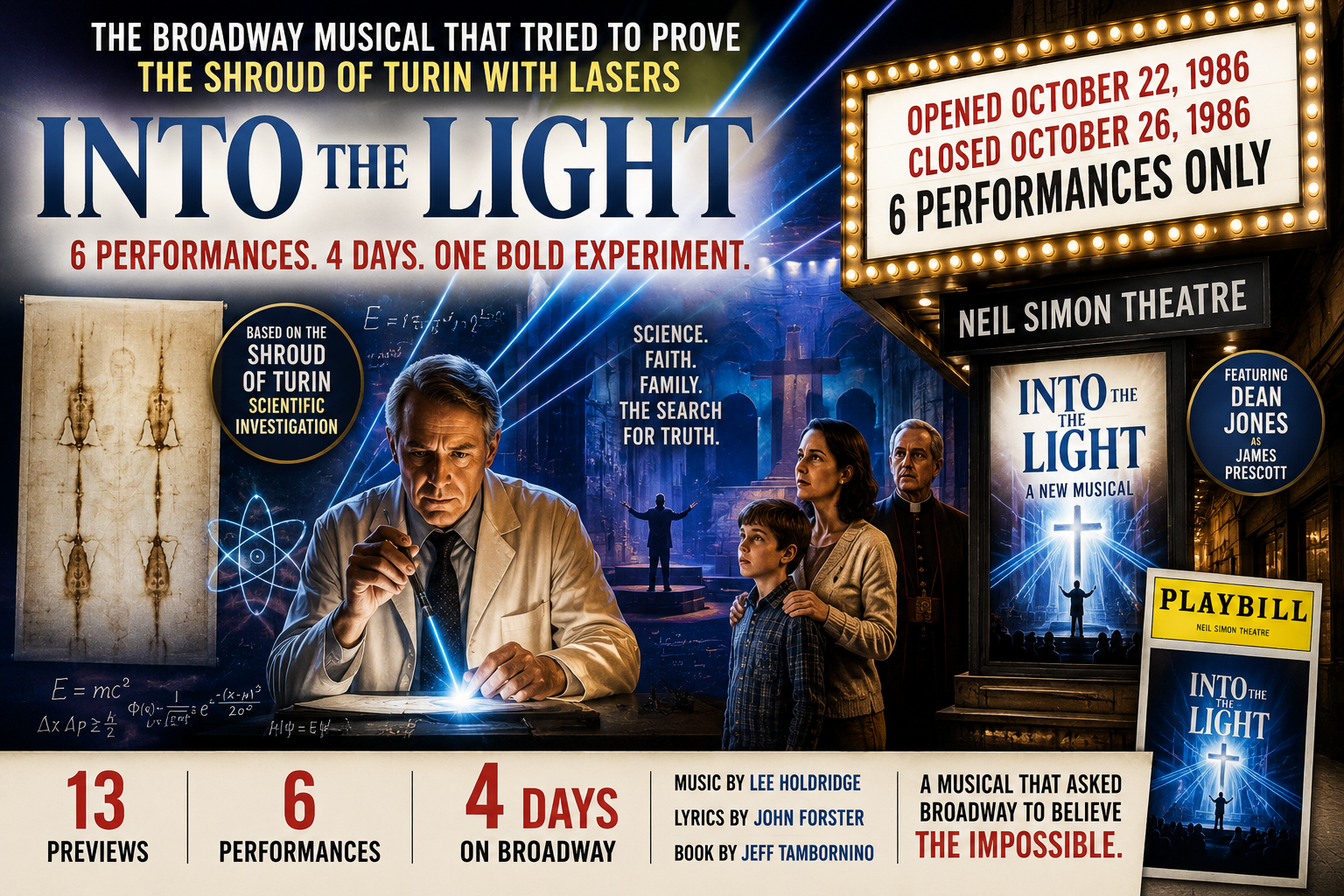
Into the Light: The Broadway Musical That Tried to Prove the Shroud of Turin With Lasers
A nuclear physicist. The Shroud of Turin. Science, faith, projections and laser beams. Broadway gave the experiment six performances.
CASE STATUS: CONCEPTUAL / COMMERCIAL FAILURE
LOCATION: Neil Simon Theatre, New York
FIRST PREVIEW: October 9, 1986
OPENING: October 22, 1986
CLOSING: October 26, 1986
PREVIEWS: 13
REGULAR PERFORMANCES: 6
BOOK: Jeff Tambornino
MUSIC: Lee Holdridge
LYRICS: John Forster
DIRECTOR: Michael Maurer
LEAD: Dean Jones
IBDB’s official record confirms the extraordinary numbers: 13 previews, six regular performances, and only four days between opening and closing.
Six Performances
October 26, 1986.
Inside Broadway’s Neil Simon Theatre, the curtain came down on a new musical.
Four days earlier, it had opened.
Now it was finished.
Not after a season. Not after a difficult few months. After six regular performances.
But the strangest thing about Into the Light isn’t how quickly it disappeared.
It’s what Broadway had attempted to put onstage.
The central subject was the Shroud of Turin—the ancient linen cloth revered by many Christians as the burial cloth of Jesus.
The musical followed a nuclear physicist obsessed with scientifically examining it.
His investigation damages his relationship with his family.
Science collides with faith. Religious figures enter the story. His son has an imaginary friend.
And the production surrounds all of this with projections and laser effects.
UPI’s opening-night coverage specifically noted the production’s projections and laser beams while describing its attempt to dramatize scientific examination of the Shroud.
This was not another conventional Broadway romance.
It was trying to turn an argument about evidence, belief and the existence of the miraculous into musical theatre.
Which gives THE SHOW X-FILES a fascinating question: Can an idea be too difficult to sing?
1. Broadway Was Asked to Examine Evidence

The protagonist is physicist James Prescott, played by Dean Jones.
Prescott becomes consumed by scientific investigation of the Shroud of Turin.
The setting is Los Alamos, New Mexico.
The official IBDB production record lists songs with titles such as: “The Data,” “It Can All Be Explained,” “A Talk About Time,” “The Testing,” and “To Measure the Darkness.”
Even the song list reveals the challenge.
Most musicals use songs when ordinary speech becomes emotionally insufficient. Love. Grief. Ambition. Jealousy. Fear.
But Into the Light was also asking music to carry something different: analysis. Data. Testing. Scientific explanation.
Theatre can dramatize those subjects. But transforming information into emotion requires an extraordinary piece of dramaturgy.
2. The Real Scientific Investigation Was Already Dramatic

The concept did not emerge from nowhere.
The Shroud of Turin had become the subject of major scientific attention. A team of researchers was permitted to conduct an intensive examination of the cloth in 1978.
The event fascinated scientists, believers and skeptics. It contained all the ingredients of intellectual drama: What is this object? How old is it? How was the image produced? Is it evidence of something extraordinary? Or can science explain it?
Into the Light attempted to take that collision and place it inside a fictional family story.
James Prescott’s obsession with the investigation begins damaging his relationships. That was the bridge.
The science would provide the external mystery. The family would provide the emotional stakes.
On paper, that’s not necessarily a bad structure. But Broadway doesn’t perform ideas on paper.
3. Science Versus Faith Wasn’t Really the Problem
This distinction matters.
The failure of Into the Light does not prove that religion or science cannot work in musical theatre.
Broadway has repeatedly transformed apparently impossible subjects into compelling drama. Politics. War. Mental illness. History. Murder. Economics. Revolution.
The question is never simply: What is the subject?
The more important question is: What human conflict allows an audience to experience the subject?
That’s where Into the Light struggled.
If audiences have to process an explanation before they can feel its consequence, the theatrical engine slows. Information is entering. Emotion is waiting.
4. Then Came the Lasers

The production was not visually modest.
Neil Peter Jampolis and Hervig Libowitzky were credited with projection design, while Jampolis also handled lighting and scenic design with Libowitzky credited on scenery.
UPI described a physical production featuring projections and laser beams.
That immediately makes FILE #020 interesting from the IMMERSIVE LAB production perspective.
Because this is a problem still encountered in immersive entertainment today: Technology can amplify an idea. It cannot clarify an idea that the audience does not understand.
A laser can make a moment larger. Projection can visualize invisible information. Lighting can create transcendence.
But none of those systems can answer the basic dramaturgical question: Why should I care about this person right now?
If that connection isn’t established, spectacle becomes decoration.
5. The Musical Tried to Make the Invisible Visible
To be fair, the designers faced a formidable assignment.
How do you stage scientific investigation? How do you visualize microscopic evidence? How do you make metaphysics theatrical? How do you show an audience the collision between rational explanation and religious belief?
Projection and lighting were logical tools.
This was 1986—long before today’s ubiquitous LED walls, real-time engines and immersive projection environments. So the attempt itself was ambitious.
The problem wasn’t using technology. The problem was expecting technology to shoulder too much narrative weight.
The audience still needed a story.
6. Then There Was the Imaginary Friend
James Prescott has a son, Mathew.
And Mathew has an imaginary companion. A mime.
That choice tells us something about the production’s struggle.
The writers were trying to counterbalance dense scientific and theological material with theatrical fantasy.
On one side: physicists, data, testing, the Shroud, faith. On the other: a child’s imagination.
Conceptually, that could create contrast. But it also increased tonal complexity.
What kind of musical were audiences watching? Family drama? Scientific mystery? Religious allegory? Comedy? Spectacle? Inspirational musical?
The more identities a production tries to occupy simultaneously, the more precisely those identities have to be integrated.
Otherwise the audience begins watching the seams.
7. Before Broadway, Detroit
Into the Light did not simply arrive in New York without testing.
Before Broadway, the production played Detroit’s Fisher Theatre in September and early October 1986.
Then it moved to New York. Broadway previews began October 9.
That means the production had an out-of-town engagement plus 13 Broadway previews before critics delivered their final verdict.
This wasn’t Moose Murders, where a chaotic production became legendary almost instantaneously. The creators had opportunities to observe audiences.
Which makes the next question more difficult. What happens when the problem isn’t a scene that needs fixing—but the fundamental theatrical premise?
8. October 22, 1986

Opening night. Neil Simon Theatre. Dean Jones stood at the center of the production.
The musical finally faced New York critics.
And the response was brutal.
UPI’s review opened with the observation that it would require something close to a miracle for a musical inspired by scientific investigation of the Shroud to become a Broadway success. The review did, however, single out young Danny Gerard and the physical production for praise.
That distinction is important.
Again we encounter the X-FILES principle: a failed production can contain successful components.
Performers may work. Design may work. Music may contain effective moments. Yet the system can still fail.
9. Broadway Had Seen Strange Ideas Before
It’s tempting to say the concept was simply ridiculous.
A musical about the Shroud of Turin? Of course it failed.
But that explanation is intellectually lazy.
Broadway history is full of premises that sound absurd when reduced to one sentence.
A murderous barber singing about revenge. Cats introducing themselves for an evening. The founding fathers rapping. A witch explaining why history misunderstood her. A musical narrated by the victims of failed presidential assassins.
Unlikely subjects are not automatically bad subjects. Sometimes they produce the most original theatre.
The difference is execution.
10. The Real Failure May Have Been Translation
Scientific inquiry has its own language. Religion has its own language. Musical theatre has another.
Into the Light had to translate between all three. That’s extraordinarily difficult.
Science asks: What can we demonstrate?
Faith asks: What can we believe?
Theatre asks: What can we feel?
Those are not identical questions.
The production needed to make them collide inside the characters rather than simply coexist inside the show.
When a musical becomes primarily an explanation of its ideas, the audience may intellectually follow the argument without emotionally entering it.
That’s the difference between understanding the subject and experiencing the drama.
11. Four Days

October 22. Opening. October 23. October 24. October 25. October 26. Closing.
IBDB records only six regular performances.
The musical had barely become an official Broadway production before it was gone.
Smithsonian later included Into the Light among Broadway’s notable musical flops, emphasizing the bizarre collision of science, archaeology, metaphysics and theatrical spectacle.
And like Moose Murders, its strange premise helped ensure that the failure would be remembered.
12. The Irony of the Title
The title promised revelation.
Into the Light.
The characters were searching for truth. Science would investigate. Faith would be challenged. Evidence would illuminate mystery.
But Broadway audiences apparently experienced something else: too many ideas competing for the same stage.
This gives the title an unintended historical irony.
The production went Into the Light—for four days—and disappeared.
13. But Here’s the More Interesting Question

What if Into the Light were created today?
This is where FILE #020 becomes particularly relevant to IMMERSIVE LAB.
Imagine the same core subject using contemporary tools: massive projection, microscopic imagery, 3D scanning, immersive sound, data visualization, AI-assisted reconstruction, interactive museum-style storytelling.
Technically, the Shroud could be presented today in ways impossible in 1986. The scientific investigation could become visually spectacular.
But would that solve the original problem?
Not necessarily.
Because the same rule applies in 2026: Better technology does not automatically create better storytelling.
A 20-meter LED wall cannot manufacture emotional stakes. A projection system cannot repair an unclear protagonist. Immersive sound cannot decide whose story we are following.
Technology makes storytelling louder. It does not automatically make storytelling clearer.
14. This Is Why Producers Need a One-Sentence Test
Before approving spectacle, ask: What does the audience desperately want to happen?
Not: What is the technology? Not: What is the historical subject? Not: What is the intellectual argument?
What does the audience want?
If that answer takes five minutes to explain, the production may have a problem.
This applies equally to Broadway musicals, concerts, media façades, immersive exhibitions, opening ceremonies, theme parks, and large-scale multimedia shows.
Complex technology can hide the weakness temporarily. Opening night exposes it.
15. Spectacle Can Become a Warning Sign
This does not mean spectacle is bad.
THE SHOW X-FILES exists partly because extraordinary spectacle is fascinating.
But when a troubled production keeps adding visual elements, producers should ask a dangerous question: Are we improving the story—or distracting ourselves from it?
More lasers. More projection. More scenery. More effects.
Each addition feels like progress.
But the audience does not experience production meetings. They experience the final sequence of information and emotion.
If the underlying story remains unclear, additional spectacle can actually make the confusion larger.
16. Six Performances Became the Legacy
Today, Into the Light occupies an unusual corner of Broadway history.
Not because it transformed musical theatre. Not because its score became a standard. Not because it returned decades later like Merrily We Roll Along.
It survives because people still ask: Wait—there was really a Broadway musical about the Shroud of Turin?
Yes. There was.
The New Yorker later cited it in a discussion of notorious Broadway failures, with playwright Paul Rudnick recalling the almost unbelievable nature of the premise itself.
Failure created curiosity. Curiosity created memory.
Just as it did with Moose Murders.
17. But FILE #019 and FILE #020 Failed Differently
This distinction is important for the X-FILES cluster.
Moose Murders suffered from production momentum and the apparent inability of the system to stop itself.
Into the Light presents a different failure: concept-to-stage translation.
The creators had an idea. A large idea. Science versus faith. Evidence versus belief. Family versus obsession.
They added theatrical machinery capable of visualizing that idea.
But the bridge between idea and audience emotion never became strong enough.
That is a completely different production failure. And therefore worth studying.
18. The Producer’s Question
Every ambitious production eventually reaches this point.
Someone presents an extraordinary concept. A giant visual. A new technology. An unusual historical subject. An immersive environment.
Everyone in the room becomes excited.
Then somebody has to ask: Where is the human story?
That person may sound boring. They may even appear to be resisting innovation.
But it may be the most important question asked during the entire production.
Because audiences rarely remember technical specifications. They remember what the technology allowed them to feel.
Into the Light had light. Lasers. Projection. Science. Religion. Mystery.
What it couldn’t generate strongly enough was the one thing no production technology can purchase: connection.
THE X-FILES VERDICT
Did Into the Light really last only six Broadway performances? YES. It opened October 22, 1986 and closed October 26 after 13 previews and six regular performances.
Was it really inspired by scientific investigation of the Shroud of Turin? YES. Contemporary reporting explicitly described the musical as dealing with a scientific team’s analysis of the Shroud.
Did the production actually use lasers and projections? YES. Contemporary coverage specifically praised the physical production’s projections and laser effects.
Was Dean Jones the lead? YES. He played physicist James Prescott.
Was everything about the production condemned? NO. Contemporary criticism singled out aspects of the physical production and Danny Gerard’s performance positively even while rejecting the musical overall.
So why did it fail? Not because Broadway cannot handle difficult subjects. Not because science cannot become theatre. Not because religion cannot become theatre. And not because lasers are inherently empty. The more convincing explanation is that Into the Light never found a theatrical language strong enough to transform its enormous intellectual argument into equally powerful human drama.
CASE CLOSED?
October 26, 1986.
The lasers switch off. The projections disappear. The Neil Simon Theatre goes dark.
Thirteen previews. Six performances.
The equipment can be removed. The scenery can be dismantled.
But the question behind the production remains.
How do you put an idea onstage?
Not an event. Not a celebrity. Not a familiar story. An idea. Science. Faith. Proof. Belief.
For Into the Light, Broadway’s answer lasted four days.
But nearly forty years later, the failure may be more relevant than ever.
Because our stages now possess technology the 1986 designers could barely have imagined.
LED. Lasers. Projection mapping. Real-time graphics. Immersive audio. Artificial intelligence.
We can visualize almost anything.
Which means the old question has become even more important: Just because we can show it—does the audience have a reason to care?
EDITOR’S ANALYSIS
FILE #020 may look like a strange Broadway footnote.
For IMMERSIVE LAB, it isn’t.
It’s a production-design case study.
Modern entertainment increasingly begins with technology: “We’ll build an enormous LED wall.” “We’ll projection-map the building.” “We’ll use lasers.” “We’ll make it immersive.” “We’ll use AI.”
That’s backwards.
The correct order is: human conflict → audience emotion → narrative → spatial experience → technology.
Technology should be the final amplifier. Not the original reason the production exists.
Into the Light attempted something ambitious in 1986. Its designers used contemporary visual technology to make science, religion and metaphysics visible.
The ambition deserves respect.
The failure deserves study.
Because every generation receives better production tools.
But the audience arrives with the same fundamental requirement: Give me a reason to feel something.
References & Further Reading
IBDB — Into the Light
Official Broadway Production Record
Playbill — Into the Light
Broadway Production Archive
UPI — October 23, 1986
Holy Shroud Fails to Save New Broadway Musical
Smithsonian Magazine — Broadway’s Top Ten Musical Flops
Broadway’s Top Ten Musical Flops


