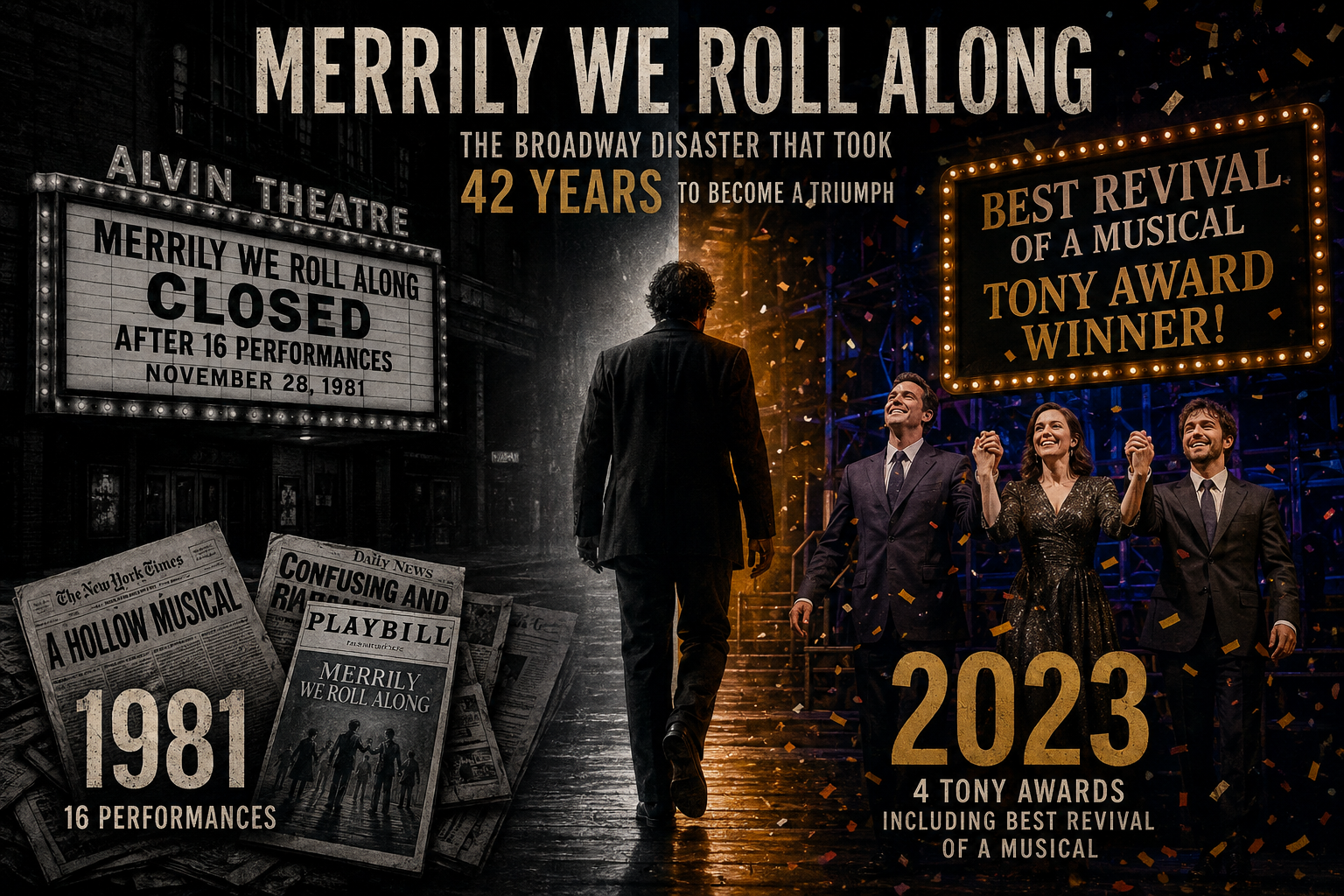
Merrily We Roll Along: The Broadway Disaster That Took 42 Years to Become a Triumph
In 1981, a Stephen Sondheim–Harold Prince musical closed after just 16 performances. Broadway eventually gave it another verdict: Best Revival of a Musical.
CASE STATUS: FAILED → REBUILT → VINDICATED
LOCATION 1981: Alvin Theatre, New York
FIRST PREVIEW: October 8, 1981
OPENING: November 16, 1981
CLOSING: November 28, 1981
REGULAR PERFORMANCES: 16
MUSIC & LYRICS: Stephen Sondheim
BOOK: George Furth
ORIGINAL DIRECTOR: Harold Prince
BROADWAY RETURN: October 10, 2023
2024 TONY AWARDS: 4 wins, including Best Revival of a Musical
Broadway Had Already Made Its Decision
November 28, 1981.
The curtain came down at the Alvin Theatre.
Merrily We Roll Along was finished.
Or so Broadway thought.
Only twelve days had passed since opening night. Sixteen regular performances.
For almost any Broadway musical, that would be an obituary.
But this wasn’t just any musical.
Stephen Sondheim wrote the music and lyrics. George Furth wrote the book. Harold Prince directed.
This was the creative partnership that had already given Broadway Company, Follies, A Little Night Music, Pacific Overtures and Sweeney Todd.
These weren’t inexperienced artists learning Broadway. They were among the people redefining it.
And their new musical had just collapsed.
Then something unusual happened.
The creators did not accept Broadway’s verdict.
Neither did generations of directors, actors and audiences who encountered the work afterward.
For decades, Merrily kept changing. Productions came and went. The book was revised. The staging evolved. The characters aged differently in the hands of new performers.
And eventually, in 2023, the musical returned to Broadway.
This time Broadway didn’t close it after 16 performances.
In 2024, it gave Merrily We Roll Along the Tony Award for Best Revival of a Musical.
Which leaves THE SHOW X-FILES with an extraordinary question: How can Broadway be completely finished with a musical in 1981—and celebrate essentially the same musical 42 years later?
1. The Story Was Moving in the Wrong Direction
Or perhaps the right direction. That depended on how you looked at it.
Merrily We Roll Along begins near the end.
Franklin Shepard is a successful Hollywood producer. He has money. Status. Influence. And a wreckage of damaged relationships behind him.
Then the musical moves backward. Scene by scene, year by year, the audience travels toward the past.
The bitter adults become younger. The compromises disappear. Broken friendships repair themselves. Cynicism becomes optimism.
Until eventually we reach three young friends looking toward a future that they believe will be extraordinary.
The audience knows something they don’t. We’ve already seen what that future does to them.
It is a brilliant dramatic idea.
It is also a dangerous one.
Conventional storytelling makes us meet characters and then discover what happens to them.
Merrily asks us to meet the consequences first—and discover the causes afterward.
2. The Audience Met Frank at His Worst
That created an immediate problem.
When audiences first meet Franklin Shepard, he is already successful and deeply compromised.
The idealistic young artist is buried somewhere in the future of the evening—which means the past of his life.
The audience has not yet met him.
Normally, a story earns our emotional investment before destroying it.
Merrily reversed that transaction. It showed audiences the damaged product first and asked them to care enough to wait for the explanation.
This is one of the most interesting distinctions in theatrical storytelling: chronological information and emotional information are not the same thing.
The audience may understand what year it is. That does not mean they understand why they should care.
3. Then the Cast Made the Experiment Even Harder
Prince’s original concept added another layer.
The principal performers were young.
Oxford’s study of the production notes that the 1981 company used actors roughly 16 to 26 years old to portray characters across decades of their lives.
Conceptually, there was logic to it. The audience would eventually arrive at the characters’ youth and discover who they really were.
But the production was asking young performers to convince audiences that they had already lived through marriages, divorces, careers, compromises and decades of friendship.
Before the audience understood the theatrical device, they first had to decode it.
Who are these people? How old are they? Where are we? What year is it? How do these relationships fit together?
Those are expensive questions in theatre.
Every second the audience spends solving logistics is a second they are not emotionally entering the story.
4. The Preview Period Became an Emergency Room

October 8, 1981. Previews began.
The problems became impossible to ignore. The production entered an unusually turbulent period of revision.
Songs changed. Scenes changed. The opening changed. The central character changed. Even casting changed.
Scholarly examination of surviving scripts, scores and archival material shows that Merrily underwent drastic revision while it was already in production.
This wasn’t ordinary polishing. The creative team was trying to make the audience understand the basic dramatic machine.
One of the biggest interventions involved Franklin Shepard himself. The production needed a clearer way into the character.
But there was another problem: time.
Broadway previews are public performances. Every night brings another audience. Every audience leaves with an opinion. Word of mouth begins before the critics officially arrive.
A troubled production is therefore fighting two clocks: the creative clock—and the reputation clock.
5. Even the Preview Count Tells a Story
There is an archival wrinkle worth noting.
The Internet Broadway Database records 44 previews and 16 regular performances for the original Broadway production.
Some retrospective sources, including scholarship on the show’s revision history, describe 52 previews.
Rather than pretending the discrepancy does not exist, THE SHOW X-FILES will use the official IBDB production record for our statistics: 44 previews, 16 performances.
But whichever historical count is used, the conclusion is unchanged.
Merrily spent far longer trying to become ready than it spent officially open.
That fact alone tells us how severe the development crisis had become.
6. November 16: The Critics Arrived
Eventually previews had to end.
November 16, 1981. Opening night.
The reviews were largely damaging.
The score received substantial admiration. The musical itself did not.
Audiences and critics struggled with the reverse chronology, the book and the emotional distance created by the concept. Later historical accounts consistently identify those dramaturgical problems as central to the original production’s failure.
And Broadway economics do not allow unlimited time for audiences to reconsider.
Twelve days later—the show closed.
7. Sixteen Performances

There are Broadway failures. And then there is the number 16 attached to Sondheim and Prince.
The production opened November 16. It closed November 28.
Sixteen performances.
The failure also marked a rupture in one of modern musical theatre’s defining creative partnerships.
Sondheim and Prince had spent years pushing the form together. Merrily became the end of that extraordinary run.
At the time, the obvious interpretation was brutal: the experiment had failed. Broadway had rejected it. Move on.
But one piece of evidence refused to cooperate with that conclusion.
8. The Score Wouldn’t Die
The original Broadway cast recording remained.
And inside it were songs that increasingly seemed incompatible with the idea that Merrily was simply a worthless flop.
“Not a Day Goes By.” “Old Friends.” “Good Thing Going.” “Our Time.” “Opening Doors.”
The official Masterworks Broadway archive notes that although the original production failed after 16 performances, its score contained some of Sondheim’s most enduring material.
The cast album allowed people who had never seen the failed production to encounter the music without the staging problems that had surrounded it.
That mattered.
A Broadway production disappears when it closes. A score doesn’t have to.
Every recording became another opportunity for someone to ask: If the music is this good, is the musical really dead?
9. Sondheim and Furth Kept Reopening the Case
They did something that separates Merrily from many famous flops.
They kept working on it.
Scholar Andrew Buchman’s examination of the production history describes Sondheim and Furth repeatedly revising the musical over the following years, making it arguably one of the most extensively revised works in Sondheim’s Broadway canon.
The show appeared again. La Jolla. Arena Stage. York Theatre. Donmar Warehouse. Kennedy Center.
Different directors approached the central problem from different directions.
The New York Public Library’s account of the show’s development documents this long chain of revisions and productions.
This wasn’t a revival history anymore. It was research and development conducted across decades.
Each production became another experiment.
10. Failure Became Data

This is where Merrily becomes enormously relevant beyond Broadway.
The original failure generated information.
The audience had trouble connecting with Frank. Information.
The chronology created confusion. Information.
Young actors portraying older characters created distance. Information.
The opening did not establish the emotional rules clearly enough. Information.
The creators could interpret those problems as proof that the entire idea was wrong. Or they could treat them as evidence.
They chose the second.
This is one of the most productive ways creative work can respond to failure: Don’t defend the failed version. Study it.
11. But They Never Removed the Dangerous Idea
This may be the most important finding in FILE #017.
The obvious fix would have been: Tell the story forward. Start young. Let the friends become successful. Show the friendship disintegrate. Easy.
Except then it wouldn’t really be Merrily We Roll Along.
The reverse chronology was the problem. It was also the point.
So rather than eliminating the dangerous idea, successive versions tried to make that idea emotionally legible.
This is fundamentally different from simplifying a failed concept until nothing distinctive remains.
Sometimes the feature causing the difficulty is precisely the feature worth protecting.
The production challenge becomes: How do we make the audience understand it without destroying what makes it special?
12. Maria Friedman Changed the Equation
Decades later, director Maria Friedman approached the musical with a crucial advantage.
She had history. She knew what had failed. She knew what revisions had been tried. She also understood Sondheim’s work intimately, having performed his material herself.
Her production originated in London in 2012 and eventually became the foundation for the New York Theatre Workshop staging and the 2023 Broadway revival.
But one particularly consequential decision appears almost obvious in retrospect: let adult actors play adults.
Jonathan Groff. Daniel Radcliffe. Lindsay Mendez.
Instead of asking very young performers to manufacture decades of lost history, the production allowed mature performers to carry that history physically.
Then, as the story moved backward, audiences watched adulthood fall away.
The reverse chronology remained. The emotional decoding became easier.
13. Now the Ending Became Devastating
This is the strange genius of Merrily.
Its final scene is chronologically the beginning.
Frank. Charley. Mary. Young. Hopeful. Looking at Sputnik crossing the night sky.
Their future appears limitless.
But the audience has already seen that future.
We know the friendships will fracture. We know ambition will carry a price. We know what these people will lose.
So the final optimism becomes tragedy.
Nothing terrible happens in the final scene. That is precisely why it hurts.
The audience supplies the tragedy.
Forty years of productions had helped theatre-makers understand how to make that mechanism work.
14. October 10, 2023
Merrily We Roll Along returned to Broadway.
Not the Alvin Theatre this time. The Hudson Theatre.
Jonathan Groff as Franklin Shepard. Daniel Radcliffe as Charley Kringas. Lindsay Mendez as Mary Flynn. Maria Friedman directing.
The production officially opened October 10, 2023.
Think about the historical symmetry.
Broadway had already conducted this trial.
1981: Guilty. Close it.
2023: The case reopened.
And this time the evidence landed differently.
15. June 16, 2024: Broadway Reversed the Verdict
At the 77th Tony Awards, Merrily We Roll Along won:
Best Revival of a Musical. Best Performance by a Leading Actor in a Musical — Jonathan Groff. Best Performance by a Featured Actor in a Musical — Daniel Radcliffe. Best Orchestrations — Jonathan Tunick.
Four Tony Awards.
The musical that lasted 16 performances in 1981 was now officially Broadway’s Best Revival of a Musical.
There are comeback stories. Then there is this.
16. So Was Broadway Wrong in 1981?
This is where the easy version of the story becomes dangerous.
We could say: The critics were idiots. The masterpiece was there all along.
That makes a satisfying headline. It is also too simple.
The 1981 production had genuine dramaturgical and staging problems. The work underwent substantial revision afterward. The later production benefited from decades of accumulated understanding.
Casting changed. Staging changed. Interpretation changed. Audiences changed. And the cultural reputation of Stephen Sondheim changed enormously.
So the 2023 success does not prove that the exact 1981 production should have succeeded.
It proves something much more interesting: A failed production and a failed work are not necessarily the same thing.
17. Compare It With Seussical
FILE #016 examined another musical that survived Broadway failure.
But the two cases are different.
Seussical discovered an enormous life in schools, community theatres and regional productions after its Broadway version failed.
Merrily did something stranger. It kept returning to the laboratory. Again. Again. Again.
Until eventually it returned to the scene of the original crime: Broadway itself.
And won.
That makes Merrily one of the clearest demonstrations in theatrical history that failure can have a shelf life.
A verdict can expire.
18. The 42-Year Development Process
Most producers would never describe forty-two years as development.
Financially, that would be absurd.
But artistically, that is essentially what happened.
1981 did not produce the final answer. It produced Version One of a long public experiment.
Subsequent productions tested different solutions. Different performers revealed different relationships. Different directors changed emphasis. The creators revised the material.
And eventually Maria Friedman’s production found an unusually effective balance between the musical’s intellectual structure and its emotional life.
The result demonstrates something uncomfortable about creative production: sometimes the idea is ahead of the production capable of expressing it.
THE X-FILES VERDICT
Did the original Merrily We Roll Along fail on Broadway? YES. The original production closed November 28, 1981 after only 16 regular performances.
Was the score simply rejected as worthless? NO. The score remained one of the most admired elements of the production and continued circulating through its cast recording.
Was the show substantially revised afterward? YES. Archival and scholarly research documents extensive revisions across subsequent productions.
Did they eliminate the reverse chronology? NO. The central structural gamble survived.
Did Merrily eventually return to Broadway? YES. The first Broadway revival opened October 10, 2023 at the Hudson Theatre.
Did Broadway finally reverse its verdict? YES. In 2024, Merrily We Roll Along won Best Revival of a Musical, while Jonathan Groff, Daniel Radcliffe and Jonathan Tunick also won Tonys for the production.
So what changed? The musical. The production. The performers. The audience. The historical context. And perhaps most importantly—our understanding of how the story wanted to be told.
CASE CLOSED?
Imagine being inside the Alvin Theatre on November 28, 1981.
The final performance ends. Sixteen performances. The scenery will come down. The cast will leave. Broadway will move on.
Nothing about that night suggests that the story is beginning.
But somewhere inside the failed production is a score people refuse to forget. A structure people refuse to stop solving. Characters directors want to revisit.
A musical that keeps creating one irritating question: What if we tried it again?
Again. Again. Again. Again. Again. Again. Again.
Then Broadway. Again.
Forty-two years after the original opening, three old friends appeared on a Broadway stage and began moving backward through their lives.
This time audiences followed them. This time the emotional machinery worked.
And this time, when Broadway delivered its verdict, the word wasn’t failure.
It was: Best Revival.
Merrily We Roll Along did not prove that every failed show deserves another chance.
It proved something harder.
Sometimes the most important question after a failure isn’t “What went wrong?”
It’s “What was worth saving?”
EDITOR’S ANALYSIS
Merrily We Roll Along gives THE SHOW X-FILES a different kind of production failure.
There was no collapsing hydraulic system. No phantom investor. No festival fire. No catastrophic accident.
The machine that failed was communication between the stage and the audience.
That is arguably harder to diagnose.
A broken motor can be replaced. A failed network can be repaired.
But when technically competent work reaches an audience and the audience simply does not connect, the creative team faces a much more dangerous problem.
They have to decide whether the idea is wrong or the execution of the idea is wrong.
Merrily demonstrates the enormous difference between those diagnoses.
Had the creators concluded in 1981 that reverse chronology itself was worthless, the work we know today might never have existed.
Instead, they protected the dangerous idea and kept changing the machinery around it.
For producers, designers and creators working today, that may be the most valuable lesson in the case: Do not confuse the failure of Version One with proof that the central idea has failed.
But the opposite is equally important. Do not romanticize failure.
Study it. Find exactly where the audience disconnected. Change what needs changing. Protect what makes the project unique. Then test again.
Merrily We Roll Along required an absurdly long experiment.
Broadway waited 42 years for the result.
It was worth reopening the file.
References & Further Reading
IBDB — Original Broadway Production
Merrily We Roll Along (1981)
Oxford Handbook of Sondheim Studies — “Growing Pains”
Revising Merrily We Roll Along
New York Public Library — Merrily’s Revision History
Merrily We Roll Along: An Alternative Autobiography?
Tony Awards — 2023 Broadway Revival
Merrily We Roll Along


