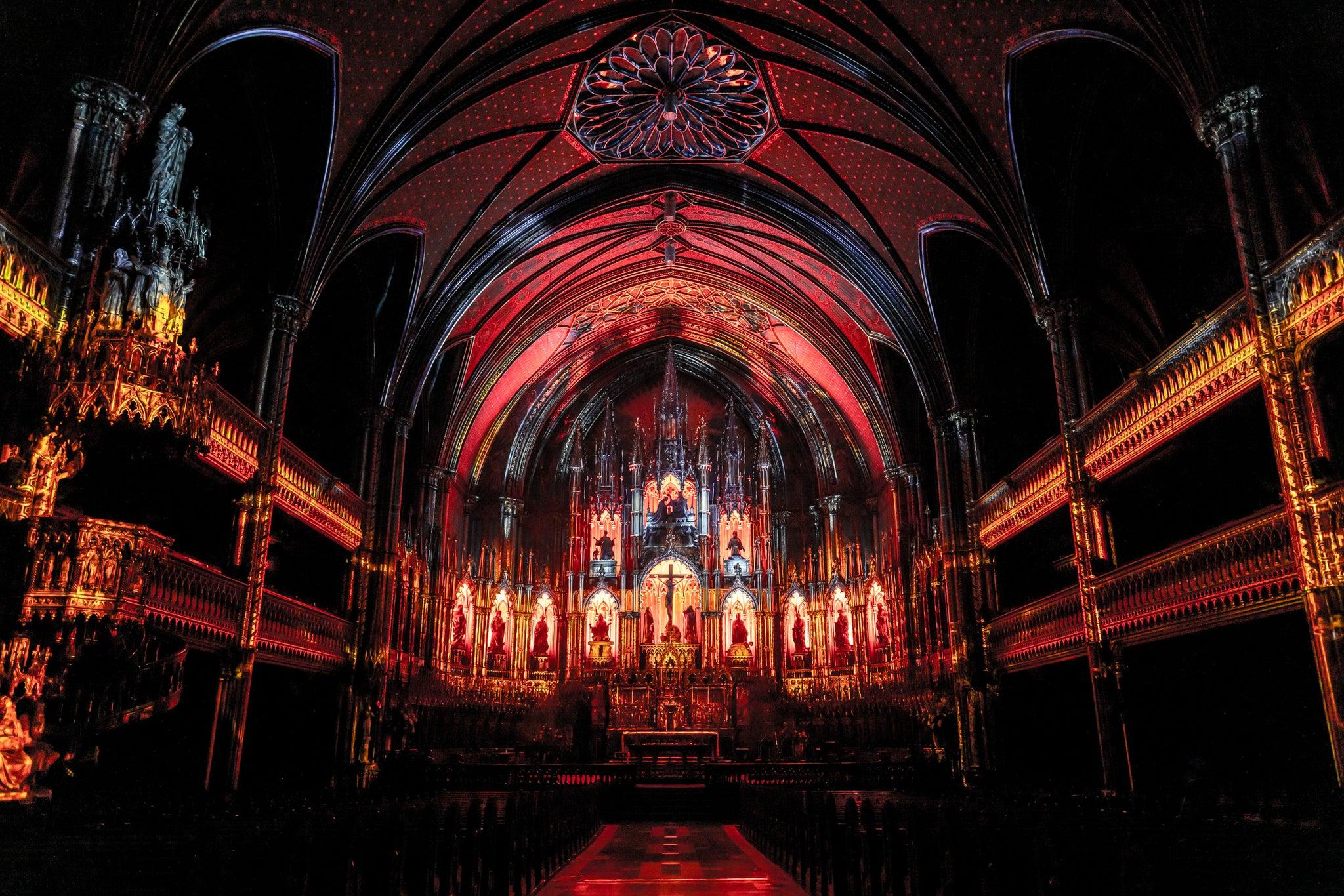
The Basilica Was Already Spectacular. So Moment Factory Chose Not to Replace It.
Inside AURA Montréal, where 21 projectors, 140 lights, lasers and orchestral sound transform a 19th-century church without hiding the architecture that makes it extraordinary
In March 2017, Montréal’s Notre-Dame Basilica faced an unusual production problem.
The building did not need scenery.
Its carved wood, stained glass, paintings, sculptures, soaring vaults and richly decorated sanctuary already contained more visual information than most stage designers would dare to put into a single performance.
Moment Factory had been commissioned by the Fabrique de la paroisse Notre-Dame de Montréal to create a permanent multimedia experience inside it. But the brief came with a constraint more important than any projector specification: the production had to reveal the Basilica’s architecture and artworks while respecting a place that remained an active religious site.
The resulting production was AURA.
Its technical inventory would eventually include 21 projectors, 140 lighting fixtures, four lasers and 20 mirrors, with Moment Factory’s X-Agora system mapping imagery across one of the most irregular projection surfaces imaginable.
But those numbers are not what makes AURA interesting.
Its real achievement begins with a much harder question: How do you transform extraordinary architecture without making the technology more important than the architecture itself?
The Building Had to Remain the Main Character

Projection mapping often begins with a blank façade. Notre-Dame Basilica offered almost the opposite condition.
Nothing was blank.
Columns interrupt surfaces. Arches change depth. Sculptures create shadows. Decorative elements alter colour and reflectivity. The sanctuary contains intricate three-dimensional forms rather than a convenient flat projection plane.
Moment Factory described this as a technical challenge unlike anything it had previously projected onto: the combination of colour, texture, complexity and scale required the mapping to be treated with extraordinary precision.
This changes the designer’s objective.
A conventional projection surface asks: What image should we put here?
A heritage building asks: What is already here that the image can reveal?
That distinction became the foundation of AURA.
The Basilica would not disappear beneath content. It would remain visible enough for the audience to understand that the apparent transformations were happening to a real place.
Before the Show Begins, Almost Nothing “Happens”

AURA does not immediately seat visitors in darkness and attack them with spectacle. The experience deliberately begins more slowly.
Visitors first move through a sequence of illuminated stations, exploring architectural details and artworks at their own pace. The Basilica currently describes this section as approximately 15–20 minutes, followed by a seated multimedia performance of about 25 minutes.
Moment Factory called the idea “active spectatorship.” Instead of directing every visitor toward the same image at the same second, the first phase allows people to wander, observe and establish their own relationship with the building.
That decision is more important than it appears. Because once the main show begins, the production will control attention very strongly.
The opening exploration gives the audience something first: a memory of the real architecture.
They have seen the columns before they appear to move.
They have looked at the altar before light transforms it.
They understand the scale of the ceiling before projection changes its apparent depth.
Without that baseline, transformation loses part of its power.
Twenty-One Projectors Faced a Surface That Refused to Behave Like a Screen

According to the Media Architecture Biennale project documentation, AURA’s original system used 21 projectors: 14 for the principal show and seven for the exploratory introduction.
But projector count alone tells us very little. The harder problem was geometry.
A video wall is predictable. Pixels occupy known positions on a flat surface.
Inside Notre-Dame, imagery has to survive architectural depth. A line travelling across a wall may encounter moulding, disappear around a column, cross an arch and continue onto another plane.
Content therefore cannot simply be enlarged until it fills the building. It has to be fitted to the building.
Moment Factory used its X-Agora platform to create complex three-dimensional maps of the Basilica’s surfaces. The project documentation describes the mapping process as being executed with pixel-level attention to the site’s intricate geometry.
This is the difference between projection and architectural projection.
The building is not merely receiving an image. Its geometry is determining the image.
140 Lights Do Something Projection Cannot

If AURA were only a projection-mapping show, it would be easy for the architecture to become a screen. The lighting system prevents that.
The original installation incorporated approximately 140 lighting fixtures throughout the Basilica.
Projection places imagery onto surfaces. Lighting reveals the surfaces themselves.
That difference allows the production to move continuously between two visual states. Sometimes the audience sees a transformed Basilica. At other moments, they see the Basilica itself—its wood, ornament, volume and depth—reshaped by light.
This is especially important in a heritage environment. If every surface is continuously covered with video, the building gradually loses its material identity.
Light can preserve it.
A column remains a column.
A sculpture remains a sculpture.
A vault remains physically present even while its perceived scale changes.
The architecture and the media therefore do not have to compete. They can alternate control.
Four Lasers Needed Twenty Mirrors

One of AURA’s most striking technical details is also one of its simplest numbers.
Four lasers. Twenty mirrors.
The mirrors extend and redirect the laser language through the complex interior.
This produces something fundamentally different from projection. Projection lands on architecture. Laser light can occupy the volume between architectural surfaces.
That gives the production another spatial layer.
Walls and vaults define the physical room.
Projection animates their surfaces.
Lighting reveals their material form.
Laser establishes lines through the air.
The audience is therefore not looking at one image system. They are sitting inside several overlapping definitions of the same space.
This is how a static building can appear to expand without physically moving.
Nothing structural changes. Perception does.
The Show Has Three Acts, but Almost No Conventional Plot

The current AURA performance is structured into three chapters:
The Birth of Light.
The Obstacles.
The Open Sky.
There are no actors carrying a conventional narrative across the stage. No dialogue is required to explain what the audience should feel.
Instead, light, projection, sound and architecture provide the dramatic progression.
That was partly a response to the project’s ambition to reach visitors from different backgrounds. Moment Factory says its challenge was to create a universal experience capable of captivating and inspiring people while respecting the Basilica’s religious heritage.
This is a useful distinction for location-based multimedia.
A historic building already contains stories. Adding another literal story can sometimes compete with them.
AURA instead creates an emotional structure.
Beginning.
Resistance.
Release.
The production provides the trajectory. The building supplies the meaning.
Sound Had to Make Stone Feel as Though It Could Breathe

Visual transformation gets most of the attention in projection experiences, but AURA was conceived from the beginning as an integration of sound, light and video.
Moment Factory describes whispers suggesting echoes of the Basilica’s past, pulses of light resembling a heartbeat and an original orchestral score working with the architecture.
This is where sound becomes architectural.
A projected image tells the eye that something has changed. Sound can tell the body that the room itself has changed.
Reverberation, low frequencies, orchestral dynamics and silence can make the same physical volume feel intimate in one moment and enormous in another.
The Basilica already possessed a powerful acoustic identity; it has long hosted major musical performances and contains the renowned Casavant organ.
The production therefore did not begin acoustically from zero either.
As with the visuals, the existing building was part of the instrument.
The Hardest Cue May Be Knowing When to Stop
There is an obvious temptation when working with this much technology.
Use everything.
Projection.
Lighting.
Laser.
Sound.
Effects.
Everywhere.
All the time.
AURA demonstrates why that approach would weaken the experience.
Moment Factory described the production’s progression as moving from subtle to spectacular.
That phrase contains a fundamental show-design principle.
Spectacle requires contrast. If everything begins at maximum intensity, there is nowhere for the production to go.
AURA’s initial wandering phase establishes restraint.
Architectural lighting isolates details.
Visual information accumulates.
The audience sits.
Then the scale expands.
Projection begins to connect surfaces.
Music increases the emotional pressure.
Laser enters the volume.
The architecture appears increasingly unstable.
The show earns its largest moments because it has not spent them during the first minute.
Nothing Is Allowed to Drill Through the Story of the Building
Permanent immersive installations have a problem temporary shows can sometimes avoid. They must coexist with the site.
Notre-Dame is not an abandoned monument converted into an entertainment venue. It remains a functioning Basilica with religious, historical and cultural significance. It was elevated to minor basilica status in 1982 and designated a National Historic Site of Canada in 1989.
That makes technical design inseparable from heritage responsibility.
Equipment cannot be considered only according to image quality.
Sightlines matter.
Mounting matters.
Cable routes matter.
Maintenance access matters.
The daytime appearance of the Basilica matters.
Religious use matters.
The show has to arrive every evening without making the building feel like a permanent equipment warehouse during the rest of its life.
This is a very different design problem from constructing a purpose-built immersive room.
In a black box, technology owns the space.
At Notre-Dame: technology is a guest.
AURA Changed the Building Without Asking the Building to Move

Compare AURA with many contemporary immersive environments.
Some build LED walls. Others construct projection rooms. Others create moving scenery or programmable architecture.
Notre-Dame does none of those things.
The Basilica remains physically almost exactly where it was.
Its arches do not move.
Its columns do not rotate.
Its ceiling does not open.
Yet during the show, those architectural relationships appear to change.
This is perhaps projection mapping’s most powerful production capability. It can create kinetic architecture without kinetic machinery.
A wall can appear to dissolve.
A ceiling can appear to rise.
Ornament can detach visually from the surface.
Depth can appear where none exists.
The building performs without moving a kilogram of masonry.
For heritage sites, that is not merely visually useful. It can be strategically important.
The Experience Became Another Reason to Visit the Basilica
AURA was not conceived only as an artistic experiment.
Moment Factory identifies several business objectives behind the project: creating an innovative experience, diversifying the Basilica’s offer, generating visitation, increasing dwell time, showcasing culture and extending operating periods.
The results are significant.
The Basilica reports that between 2017 and 2020, AURA was seen by more than 650,000 people from 137 countries.
The experience continues today.
That matters for WORLD DISCOVERY because it shows how multimedia can change the economics of a cultural landmark without changing the landmark’s fundamental identity.
By day, visitors can encounter the Basilica as heritage. By night, the same architecture becomes the principal performer in a ticketed multimedia experience.
The asset is the same. The audience relationship changes.
Production Logic — Don’t Project Onto the Building. Project From the Building.
There are two ways to approach architectural projection.
The first begins with content.
Create an impressive animation.
Find a large surface.
Map the animation onto it.
The second begins with architecture.
Study the columns.
Study the arches.
Study ornament.
Study texture.
Study sightlines.
Study what the audience notices naturally.
Then ask what light and image could make those existing characteristics more visible.
AURA belongs much closer to the second approach.
That is why the Basilica can move perceptually without losing its identity.
The strongest moments do not say: Look what our projectors can do.
They say: Look what was already here.
The technology simply changes the conditions under which we notice it.
Editor’s Take — The Architecture Should Still Win
For IMMERSIVE LAB, AURA contains an especially important lesson because projection mapping is now easy to misunderstand.
Higher brightness does not automatically create better architectural media. More projectors do not automatically create deeper immersion. Covering every available surface does not automatically create stronger storytelling.
A historic building already has composition.
It already has rhythm.
It already has hierarchy.
It already has texture.
And it already has memory.
The designer’s first responsibility is therefore not to fill the architecture. It is to read it.
Moment Factory brought 21 projectors, 140 lights, lasers, mirrors, sound and a sophisticated mapping system into Notre-Dame Basilica. Yet the most successful outcome is that visitors can leave remembering the building more strongly than the equipment.
That may be the clearest test of architectural multimedia: when the technology disappears from the audience’s memory, but the place does not.
References & Further Reading
Moment Factory — AURA at Notre-Dame Basilica
Notre-Dame Basilica of Montréal — The AURA Experience
Moment Factory — AURA, From Subtle to Spectacular
Notre-Dame Basilica — History & Heritage


