A Supermarket With 60 Doors to Somewhere Else
Inside Omega Mart, where Meow Wolf turned grocery shelves, hidden portals and audience curiosity into a 52,000-square-foot performance system
On February 18, 2021, a new supermarket opened in Las Vegas.
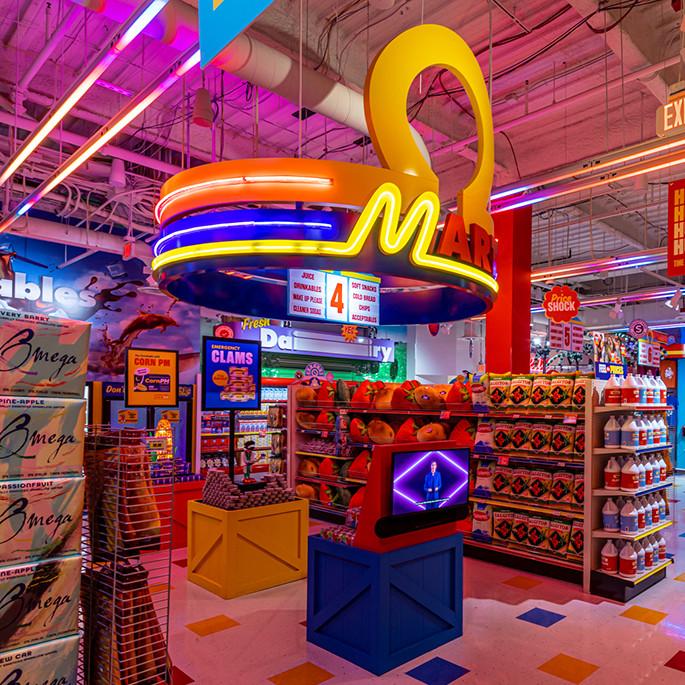
Its shelves carried products with names such as Mammoth Chunks, Nut Free Salted Peanuts and Personalized Bleach. But customers who opened certain freezer doors or stepped inside a clothing rack could leave the supermarket entirely—and enter another world.
This was Omega Mart, Meow Wolf’s second permanent immersive exhibition, built inside AREA15 across approximately 52,000 square feet. At opening, Meow Wolf described four large themed areas containing dozens of installations and 60 unique rooms and portals.
Those numbers are impressive, but they are not what makes Omega Mart interesting from a production perspective.
The unusual part is what is missing.
There is no conventional stage.
No fixed auditorium.
No curtain.
No single direction in which the audience must look.
And no guarantee that two visitors will experience the story in the same order.
So Omega Mart has to solve a problem that conventional theater rarely encounters: How do you direct an audience when you have surrendered control of where they go next?
The First Set Is Something Everyone Already Understands

Omega Mart does not begin by showing visitors an alien planet. It begins with a grocery store.
That choice is more sophisticated than it appears.
Most people already understand the spatial grammar of a supermarket. Products sit on shelves. Freezers contain food. Clothing racks display merchandise. Staff areas are separate from customer areas.
No explanation is necessary.
That familiarity gives the designers something valuable: expectation.
Then they begin breaking it.
Meow Wolf’s current visitor guide encourages guests to open freezer doors, step into a clothing rack and investigate corners where portals may be hidden. Its project credits describe even more specific transitions: an apparently ordinary shelving unit contains a dark rift, while a round clothing rack becomes a passage to another dimension.
The supermarket therefore performs two jobs simultaneously. It is scenery. But it is also misdirection.
Instead of announcing that the audience has entered an immersive attraction, Omega Mart allows reality to malfunction gradually.
A product looks wrong.
A shelf sounds strange.
A freezer opens somewhere it shouldn’t.
The transition into the fiction is not a scene the visitor watches. It is something the visitor accidentally triggers.
A Portal Can Do the Job of a Theatre Curtain
Consider what happens when someone crawls through one of those openings.
For a moment, the supermarket disappears. The visitor’s field of vision narrows. The destination is partly concealed. The body physically crosses a threshold. Then another environment appears.
Traditional stagecraft achieves similar transformations with masking, curtains, blackouts, scenery and automation.
Omega Mart uses circulation.
A corridor can become a blackout.
A narrow opening can create suspense.
A freezer door can perform the function of a reveal.
A hidden passage can separate two completely incompatible visual worlds without requiring either one to disappear.
This means architecture is doing something normally assigned to stage machinery: it is controlling transitions.
But there is an important difference. The stage manager does not call the cue. The visitor does.
Hundreds of Creators Had to Build One World Without Making It Look Like One Artist Made It
Omega Mart was not created by a small design team imposing one visual language.
Meow Wolf’s project credits describe hundreds of Meow Wolf creators and dozens of collaborating artists, while later project reporting records 325 artists and collaborators working over roughly three years.
That creates a production problem. If hundreds of creative voices are allowed to remain genuinely different, how do you prevent a 52,000-square-foot environment from becoming a collection of unrelated installations?
The answer is not necessarily visual consistency.
Omega Mart can tolerate stylistic collisions because another system holds the experience together: the fictional world.
Dramcorp.
The supermarket.
The Factory.
The Source.
The products.
The employee culture.
The portals.
The visitor does not need every room to look as though it came from the same designer. The narrative framework gives those differences somewhere to belong. Meow Wolf’s own credits organize the exhibition around anchor spaces including Dramcorp, Factory, Front of House, Omega Mart and Seven Monolith Village.
This is an important distinction. A conventional production often creates unity through one design language. Omega Mart can create unity through shared fiction.
Then 12,000 Square Feet of Fake Rock Becomes a Screen

One of the strongest demonstrations of this approach appears in the Projected Desert.
Here, the supermarket’s retail vocabulary disappears.
Project documentation describes a 360-degree projection-mapped environment built around more than 12,000 square feet of fabricated rockface created by KHS&S. Work by artists including Alex and Allyson Grey, Android Jones, Amanda Sage and Luis Tamani was integrated through editorial and animation work by Cocolab, with music written specifically for Omega Mart by Brian Eno.
The production decision worth examining is not simply the use of projection mapping. It is the decision to project onto irregular physical scenery.
A rectangular screen tells the audience where media begins and ends. Rock does not.
Every ridge, cavity and angle interrupts the image. Physical geometry and digital imagery have to cooperate.
When that relationship works, projection stops feeling like content displayed on architecture. It begins changing the architecture itself.
This is why the 12,000-square-foot figure matters less than what the surface accomplishes. The rockface disguises the boundary between scenic construction and moving image.
The screen stops looking like a screen.
Omega Mart Does Not Tell Everyone the Same Story
A conventional performance controls sequence. Scene one happens before scene two. An audience receives information together.
Omega Mart abandons that certainty.
Someone can spend twenty minutes reading absurd product labels. Someone else can immediately disappear through a portal. Another visitor may concentrate on individual artworks. Someone may investigate the fictional corporation behind the supermarket. Another person may simply enjoy getting lost.
Meow Wolf explicitly describes the experience as a trail of clues and secret spaces that visitors can choose to follow or not follow.
That changes the fundamental unit of storytelling. The question is no longer: What does the audience learn next? It becomes: What could they discover here?
Narrative moves from time into space.
Instead of placing information at minute 17, designers place it behind a door, inside a terminal, on a package or at the end of a passage.
The building becomes the timeline.
One Card Adds a Second Version of the Experience

Visitors who want to investigate further can use the optional Omega Access Card.
Meow Wolf describes it as a gameplay card that allows deeper interaction with Omega Mart. Project documentation explains that the system uses internally developed RFID and gameplay technology; visitors can “boop” stations throughout the exhibition to encounter surveys, questions and information connected to the fictional store and its world.
The interesting part is not RFID itself. RFID is infrastructure.
What matters is that the interaction belongs to the fiction. The visitor is not merely pressing a museum touchscreen to request more information. They are performing an action that makes sense inside Omega Mart.
That distinction separates interactive equipment from interactive storytelling. Technology disappears when the audience thinks primarily about what they are doing rather than what device makes it possible.
Freedom Creates a Production Problem: Visitors Can Miss Everything
There is a price for giving an audience agency.
They can walk past your best work. They can misunderstand a clue. They can choose the least dramatic route. They can leave without solving the story.
A tightly directed attraction could prevent this. But every additional instruction would reduce the pleasure of discovery.
Omega Mart therefore has to function at several depths simultaneously. At the surface, it can work as surreal visual entertainment. Look deeper and it becomes satire. Follow the clues and another narrative layer appears. Use the Access Card and the fictional corporate system becomes more interactive.
This allows different visitors to extract different experiences from the same infrastructure. It also means the production cannot depend on everyone understanding everything.
That is a radical departure from conventional show direction. Confusion is not necessarily failure here. Sometimes it is part of the invitation.
Sixty Rooms Also Mean Sixty Places Where the Illusion Can Fail
The photographs make Omega Mart look chaotic. Operationally, it cannot be.
Every portal that visitors crawl through must survive repeated use. Every interactive station has to respond. Projection alignment matters. Audio from one environment cannot simply overwhelm another. Lighting must support both art and circulation. Physical scenery has to tolerate contact. Computers, sensors and playback systems need monitoring.
And the attraction has to remain safe while encouraging visitors to explore places that deliberately appear secret.
The project credits reveal how multidisciplinary individual spaces become. Even a single portal can involve lead artists alongside graphic designers, CAD designers, fabricators, lighting designers, sound designers and installation personnel.
This exposes one of immersive entertainment’s least glamorous truths: the more spontaneous an experience feels, the more disciplined its infrastructure usually has to be.
A failed monitor in a gallery is a technical fault. A portal that no longer reacts inside Omega Mart can become a broken piece of the fictional universe.
Maintenance is therefore not separate from storytelling. It protects storytelling.
The Show Is Happening Everywhere at Once

At one moment inside Omega Mart, one visitor might be reading packaging while another crawls through a clothing rack. Someone else may be standing inside the Projected Desert. Another visitor is using an Access Card. Someone is trying to understand Dramcorp. Someone has ignored the narrative completely.
There is no single “now.”
That makes Omega Mart fundamentally different from a performance controlled by a linear cue stack. Traditional show control asks: What happens next? Omega Mart has to ask: What can happen here?
That difference is crucial. The production is not simply a sequence. It is a network of possible encounters.
And the audience decides which parts of that network become their show.
Production Logic — Design Curiosity Before Designing Spectacle
The easiest lesson to take from Omega Mart would be the wrong one. Build more rooms. Add projection. Install interactive technology. Hide doors.
None of those elements alone explains why the experience works.
The deeper production mechanism is curiosity management.
A familiar object is made slightly wrong. A sound escapes from somewhere unexpected. A passage is partly concealed. A product contains information that seems unnecessary—until it connects with something found later. The designers repeatedly create small reasons for the visitor to investigate.
That changes the director’s role. Instead of constantly saying: Look here. The environment asks: What happens if you go there?
Once that question becomes strong enough, the audience begins directing itself.
Editor’s Take — The Grocery Store Is Not the Gimmick

Omega Mart’s supermarket façade is easy to remember because it is funny. But the supermarket may actually be the project’s most precise piece of production design.
It gives every visitor a shared set of rules before breaking them. We know what a freezer is for. We know how shelves work. We know where customers are supposed to walk.
That means Meow Wolf does not have to spend the first ten minutes teaching us how to understand its fictional universe. It can begin with reality—and corrupt it.
For IMMERSIVE LAB, that is the most transferable lesson from Omega Mart. Immersion does not always require constructing a world the audience has never seen. Sometimes the stronger starting point is a world they understand completely.
Change one rule. Then another. Then let them discover the door themselves.
At that moment, the audience is no longer looking at the production. Their curiosity has become part of the production.
References & Further Reading
Meow Wolf — History of Omega Mart
Meow Wolf — Omega Mart Visitor Guide
Meow Wolf — Omega Mart Creative Credits
blooloop — Omega Mart Innovation Case Study


