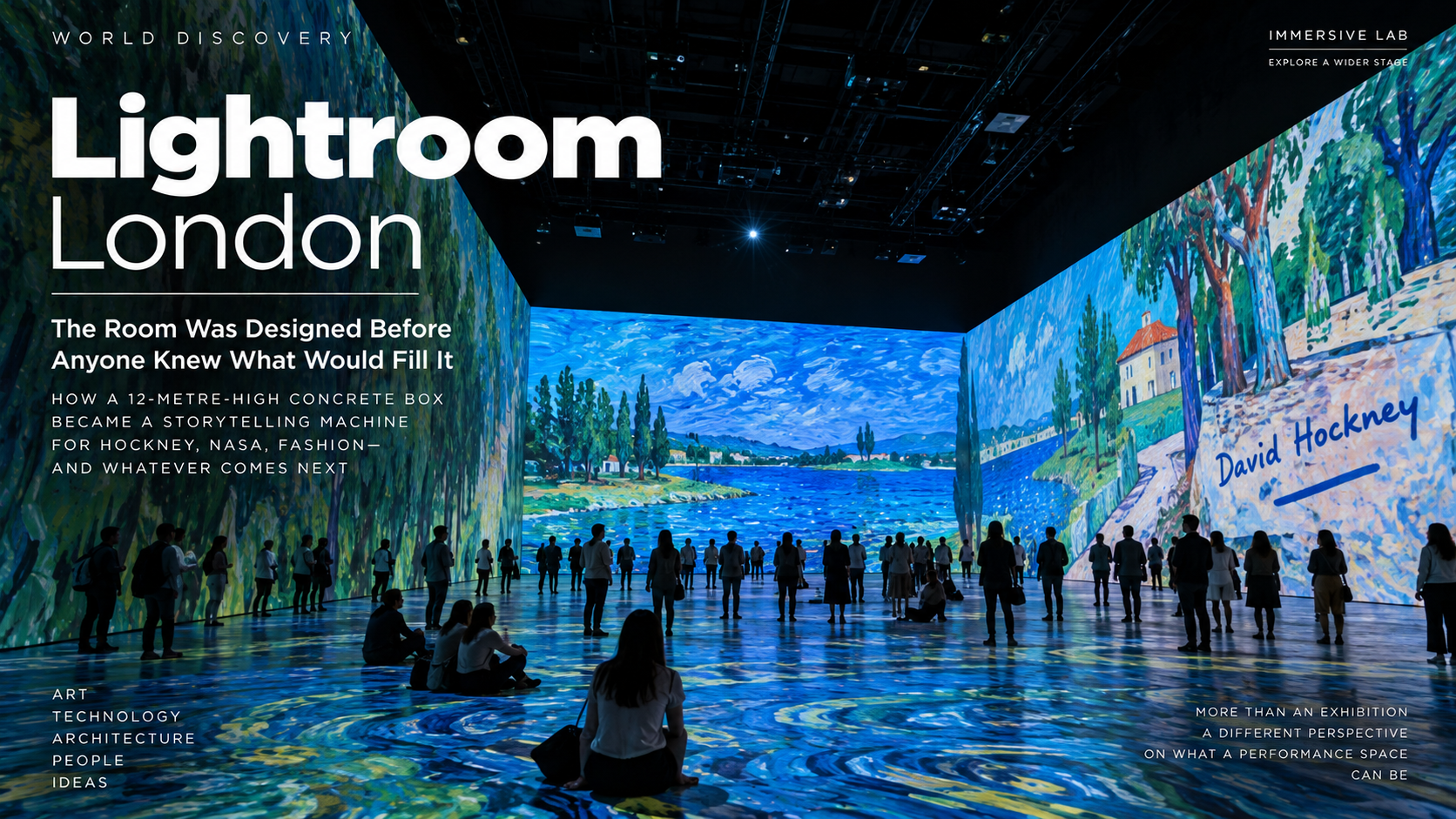
Lightroom London : The Room Was Designed Before Anyone Knew What Would Fill It
How a 12-Metre-High Concrete Box Became a Storytelling Machine for Hockney, NASA, Fashion—and Whatever Comes Next

Imagine commissioning a performance venue without knowing what the performance will be.
No permanent stage. No proscenium. No preferred viewing direction. No artist whose requirements can determine where the audience should sit.
Instead, you excavate a room beneath London, make it approximately 18.5 metres wide, 26 metres long and 12 metres high, surround the audience with projection and highly controlled sound, and deliberately leave the creative problem unfinished.
That room became Lightroom, the immersive venue in King’s Cross created by 59 Studio and London Theatre Company and designed architecturally by Haworth Tompkins. Its central space can accommodate up to 380 people in promenade configuration.
The interesting question is not whether giant projections can make art look spectacular. We already know they can. The harder question is this: how do you build an immersive venue that does not force every future artist to make the same immersive show?
That is where Lightroom becomes more interesting than its screens.
Start With an Empty Concrete Volume
A conventional theater is full of instructions. Face this way. Perform here. Enter there. Sit here. Look toward the stage. Even before a director arrives, architecture has already written part of the production.
Lightroom attempts something almost opposite. At its center is a vast subterranean volume. Haworth Tompkins describes it as 18.5 × 26 × 12 metres, reached gradually from the street-level foyer through a sequence of transitional spaces.
The main room has no conventional theatrical front. That absence matters. If one wall were clearly dominant, every production would inherit the same hierarchy. Instead, 59 Studio describes Lightroom as a four-wall storytelling canvas.
An audience can stand. Sit. Move. Turn. Look upward. Look behind themselves. The production must therefore create orientation rather than inherit it. That changes almost everything.
28 Projectors Do Not Automatically Create Immersion
There is a temptation in immersive entertainment to treat scale as the creative idea. More pixels. More surfaces. More projectors. Bigger images. Lightroom demonstrates why that is insufficient.
For its projection infrastructure, the venue uses 28 Panasonic PT-RQ22K 3-Chip DLP projectors, each rated at 20,000 lumens. Panasonic also documented an additional 14 PT-RZ12K projectors used to cover the floor for The Moonwalkers.
Those numbers are impressive. But they immediately create another problem. A picture on one wall is an image. A picture extending across multiple walls and the floor is a geometry problem. Edges must meet. Perspective must survive corners. Brightness has to remain consistent. Colour differences become visible at architectural scale. And an audience standing inside the image can see failures that might disappear on a conventional screen.
The technical objective is therefore not to make spectators notice 28 projectors. It is to make them forget the projectors exist.
Then Put 380 People Inside the Picture

Projection becomes considerably harder when the audience occupies the same space as the image. In a cinema, viewers sit safely behind the projector. At Lightroom, people are physically inside the projection environment. They walk across the floor. They change viewing position. They interrupt light. They create shadows. They look at images from angles a conventional screen designer would never choose.
This produces an unusual design constraint: the audience is both observer and obstruction. You cannot solve that simply by increasing brightness. Instead, the content itself must tolerate human bodies entering the visual field.
A shadow passing across an enormous landscape may barely matter. A shadow passing across a carefully positioned face may destroy the image. Spatial content therefore has to be composed not only for architecture but for unpredictable audience movement. That makes Lightroom closer to performance design than to cinema projection.
David Hockney Was the First Real Test

Lightroom opened on February 22, 2023 with David Hockney: Bigger & Closer (not smaller & further away). The project had been developed through roughly three years of close collaboration between Hockney and Lightroom. The resulting show moved through six thematic chapters using Hockney’s paintings, photography, digital work, stage designs, narration and newly created material.
It would have been easy to produce an enormous slideshow. That was not the objective. 59 Studio approached the material as a show. Mark Grimmer wrote and directed it. Nick Corrigan led video design. Gareth Fry designed sound. Ben Pearcy designed lighting. Nico Muhly composed the original score.
Those credits reveal something important. This was an exhibition using the production vocabulary of theater. Direction. Video design. Sound design. Lighting. Music. Programming. Editing. Animation.
The artwork remained Hockney’s. But the experience of encountering it became temporal. There was now sequence. Rhythm. Transition. Silence. Scale. Movement. And duration. A gallery had acquired a cue stack.
Seven Media Servers Had to Hold the World Together
The visual system behind Bigger & Closer also illustrates how quickly immersive scale becomes a playback problem. The show required large video resolutions and 10-bit video playback. 59 Studio used seven disguise vx 4 media servers, hardware designed for high-performance playback; disguise notes that the vx 4 can handle up to four uncompressed 4K60 video streams and lossless 10-bit content.
That matters because immersive content does not behave like one movie file sent to one display. Multiple surfaces must remain synchronized. If one part of the room drifts, the architecture fractures. A horizon crossing a corner must arrive simultaneously on both walls. An animation travelling around the room cannot pause while another server catches up. A musical hit loses its power if the image reaches one surface a fraction too late.
At this scale, synchronization is not technical housekeeping. Synchronization is part of the composition.
The Most Radical Technology May Actually Be the Sound
A room covered in imagery creates another production dilemma. Where do the loudspeakers go?
Conventional immersive audio might distribute many loudspeakers around the audience. But that introduces physical objects onto walls intended to function as uninterrupted visual surfaces. Creative Technology, which worked with HOLOPLOT on Lightroom’s audio system, described the challenge clearly: conventional speaker arrangements would have required multiple wall cavities or mounting locations around all four walls, potentially compromising the 360-degree visual environment.
The solution used HOLOPLOT X1 Matrix Array technology. Rather than treating sound merely as something filling the room, the system can control its direction with unusual precision. Lightroom’s audio design can therefore use sound spatially without covering the visual architecture with conventional speaker positions.
This changes storytelling. A voice does not necessarily need to feel as though it comes from “the sound system.” It can appear connected to a particular area. Music can expand. Narration can feel intimate. Attention can be redirected without putting an arrow on the wall. The screen may surround the audience. Sound can tell them where to look.
That Solves a Problem Giant Screens Usually Create

The larger an image becomes, the less certain attention becomes. A cinema director knows approximately where spectators are looking. At Lightroom, someone may be studying the left wall while another person watches the floor and someone behind them is looking in the opposite direction. There is no single frame.
This is one of the paradoxes of immersive design: giving audiences more visual freedom makes directing their attention more difficult.
So composition must operate differently. Brightness can attract the eye. Movement can pull attention across a surface. A sudden blackout can reset orientation. Sound can lead spectators toward another part of the room. A slowly emerging image can create anticipation without demanding that everybody discover it at exactly the same instant. The production is no longer merely arranging pixels. It is choreographing perception.
The Architecture Prepares the Audience Before the First Image Appears
One of Lightroom’s least spectacular design decisions may be one of its smartest. Visitors do not simply open a door from bright London and walk immediately into the projection room. Haworth Tompkins designed a progression from the street-level foyer through what it describes as linear acclimatisation zones before reaching the subterranean show space.
That transition has production value. Eyes adapt. Noise changes. The city begins to disappear. Anticipation builds. The audience is psychologically separated from King’s Cross before the main visual environment takes control.
In theater, we normally think of the show beginning when the lights go down. At Lightroom, the show can begin architecturally before the first programmed cue.
Then NASA Arrived—and the Same Room Had to Become the Moon

The strongest test of a flexible venue is not whether its first production succeeds. It is whether the second production can make the room feel different.
In December 2023, Lightroom opened The Moonwalkers: A Journey with Tom Hanks. 59 Studio combined bespoke animation with high-resolution NASA imagery to tell the story of Apollo and future Artemis missions, narrated by Tom Hanks with an original score by Anne Nikitin.
Now the same concrete volume that had held Hockney’s swimming pools, landscapes and stage designs had to produce an entirely different spatial sensation. The additional floor projection became particularly important. Panasonic documented 14 PT-RZ12K projectors delivering 12,000 lumens each onto the floor, helping transform the room into an environment in which the image was no longer only around spectators but beneath them.
That is the difference between installing an exhibition and building a media architecture. The room remained. The world changed.
Reliability Is Part of the Artistic Experience

Immersive venues have an operational problem that spectacular launch photographs rarely show. They repeat. Again. And again. And again. Unlike a one-night projection-mapping spectacle, Lightroom can run shows throughout the day, seven days a week, for months.
A projector failure is therefore not simply an equipment fault. If one section of a continuous architectural image disappears, the audience sees the system. The illusion collapses.
Panasonic cites the RQ22K’s filterless design, dust-resistant optical system and up to 20,000 hours of maintenance-free operation as relevant to Lightroom’s long-running exhibition schedule. The venue also uses eight Panasonic PTZ cameras—four AW-UE150 and four AW-HE130 units—to monitor playback and diagnose technical problems from the control room.
That monitoring system is not glamorous. It will probably never appear in an Instagram reel. But it may be more important to the business than another dramatic animation. A permanent immersive venue cannot merely create spectacle. It has to reproduce spectacle reliably enough to sell the next ticket.
The Technician Is Part of the Performance Even When Nobody Sees Them
Lightroom’s own description of its technician role is revealing. The venue says the primary creative output is delivered through video, lighting and sound, making technicians responsible for the consistent daily delivery of the visitor experience.
That wording deserves attention. In many galleries, technical systems support the artwork. Here, technical delivery is inseparable from the artwork’s public existence. A misaligned projector is not backstage inconvenience. It is visible content damage. An audio fault is not merely a speaker problem. It changes narrative. A failed server can remove an entire section of visual space.
The operator is therefore not maintaining equipment around the show. The operator is maintaining the conditions under which the show continues to exist.
And Then Lightroom Did Something More Important Than Opening Another Venue
The London site became a prototype. Lightroom says its shows have now played across multiple cities, with work presented in South Korea, China, the United States and Europe, reaching a large cumulative audience. The London venue is used not only for public presentation but to test ideas, refine technical delivery and prepare shows for international distribution.
This changes the business model. Traditionally, touring a major exhibition means moving physical objects. Crates. Cases. Artworks. Scenery. Rigging. Sometimes entire stage systems.
A digitally authored immersive production creates another possibility. The expensive creative work—animation, edit, programming, sound design, spatial logic—can become a repeatable content asset. The physical venue still matters enormously. But once compatible technical environments exist elsewhere, the show can travel partly as data.
That makes Lightroom more than a room. It becomes a development laboratory for a format.
Seoul Proves the Idea Is No Longer Only London

The model has already travelled. 59 Studio identifies Lightroom sites in London, South Korea and Singapore, while Lightroom itself describes a broader international distribution network.
This raises a production question that will become increasingly important: how much of an immersive show belongs to its original building? A Broadway musical can tour because the production establishes specifications for stage dimensions, rigging, automation, sound and scenery. A Lightroom production faces a related challenge. Projection geometry must translate. Resolution must survive. Brightness must remain adequate. Sound must reproduce the intended spatial behavior. Audience circulation must still make sense.
Content may be digital. Experience is not. Every destination has to rebuild the conditions that make those files meaningful.
A Blank Canvas Is Never Really Blank
Calling Lightroom a blank canvas sounds simple. It is not. A genuinely useful blank canvas requires enormous preparation: projection infrastructure, media servers, signal distribution, acoustic treatment, spatial audio, control systems, monitoring, cooling, power, network infrastructure, maintenance access, fire strategy, audience circulation, architectural darkness, operational staffing.
All of that work exists so that the next artist can encounter a room that appears to impose fewer rules. That is the paradox. The more effortless a flexible performance space feels, the more engineering may be hidden behind that freedom.
The Production Lesson Is Not “Use More Projection”
Lightroom could easily be misunderstood as another argument for giant images. That would miss the point. Its most useful lesson is about neutral infrastructure. The venue does not know whether tomorrow’s content will be a painting, a lunar landscape, fashion history or something not yet invented. So the permanent system should not become the creative identity. It must provide enough capability for the identity to change.
This is different from Sphere Las Vegas, where the monumental display architecture is itself an unmistakable part of the experience. It is different from The Shed, where the building physically changes its footprint. Lightroom’s transformation happens largely through information.
The concrete stays where it is. The projectors stay where they are. The audience enters the same volume. Yet the perceived architecture can disappear completely. A swimming pool can replace it. Then the Moon. Then a runway. Then darkness.
The Room Does Not Need to Move If Perception Can
The Shed asked whether architecture could physically adapt to performance. Lightroom offers almost the inverse proposition. What if the architecture remained still, but everything the audience perceived inside it could change?
That distinction points toward two very different futures for performance space. One uses mechanical transformation. The other uses perceptual transformation. Lightroom’s walls do not roll away. Its floor does not rotate. The ceiling does not fly. Instead, synchronized video and spatial sound continuously rewrite what those surfaces mean.
Concrete becomes sky. Floor becomes landscape. Wall becomes painting. The room remains 18.5 metres by 26 metres. The experience does not.
And that may explain why the most important measurement at Lightroom is not the size of the projection surface or the number of projectors. It is the distance between the room that physically exists and the room the audience believes it has entered. That distance is where the show happens.
Continue Exploring WORLD DISCOVERY
WORLD DISCOVERY explores places where architecture, performance, technology and audience experience combine to create forms of spectacle that could not exist in a conventional venue.
About WORLD DISCOVERY
WORLD DISCOVERY is an IMMERSIVE LAB series examining how extraordinary spaces become performance experiences through architecture, technology, art and production.
Explore More from IMMERSIVE LAB
Explore LIVE STAGE for major concert production, THE SHOW X-FILES for hidden failures and production risks, Broadway Musical Collection for the craft behind musical theater, and LEGENDS for the creators who changed performance practice.
References & Further Reading
e-architect — Lightroom London, King’s Cross
RIBAJ — Hockney Show Opens at Haworth Tompkins’ Lightroom
59 Studio — David Hockney: Bigger & Closer
Image Credits
All photographs remain the property of their respective photographers and copyright holders. Use only images whose licences, official press permissions or other applicable rights permit publication.


