WORLD DISCOVERY
The Museum Without Walls — How teamLab Borderless Changed the Way We Experience Art
What happens when the artwork leaves the wall, crosses the room—and begins to follow you?
You enter a museum.
Instinct tells you what should happen next. Find the first gallery. Look for the title beside the artwork. Read the explanation. Move to the next room. Follow the route until you eventually reach the exit.
At teamLab Borderless in Tokyo, that familiar ritual begins to collapse almost immediately.
There is no conventional sequence telling you what to see first.
There are no captions beside the artworks.
More importantly, some of the artworks refuse to remain inside the rooms where you first encounter them.
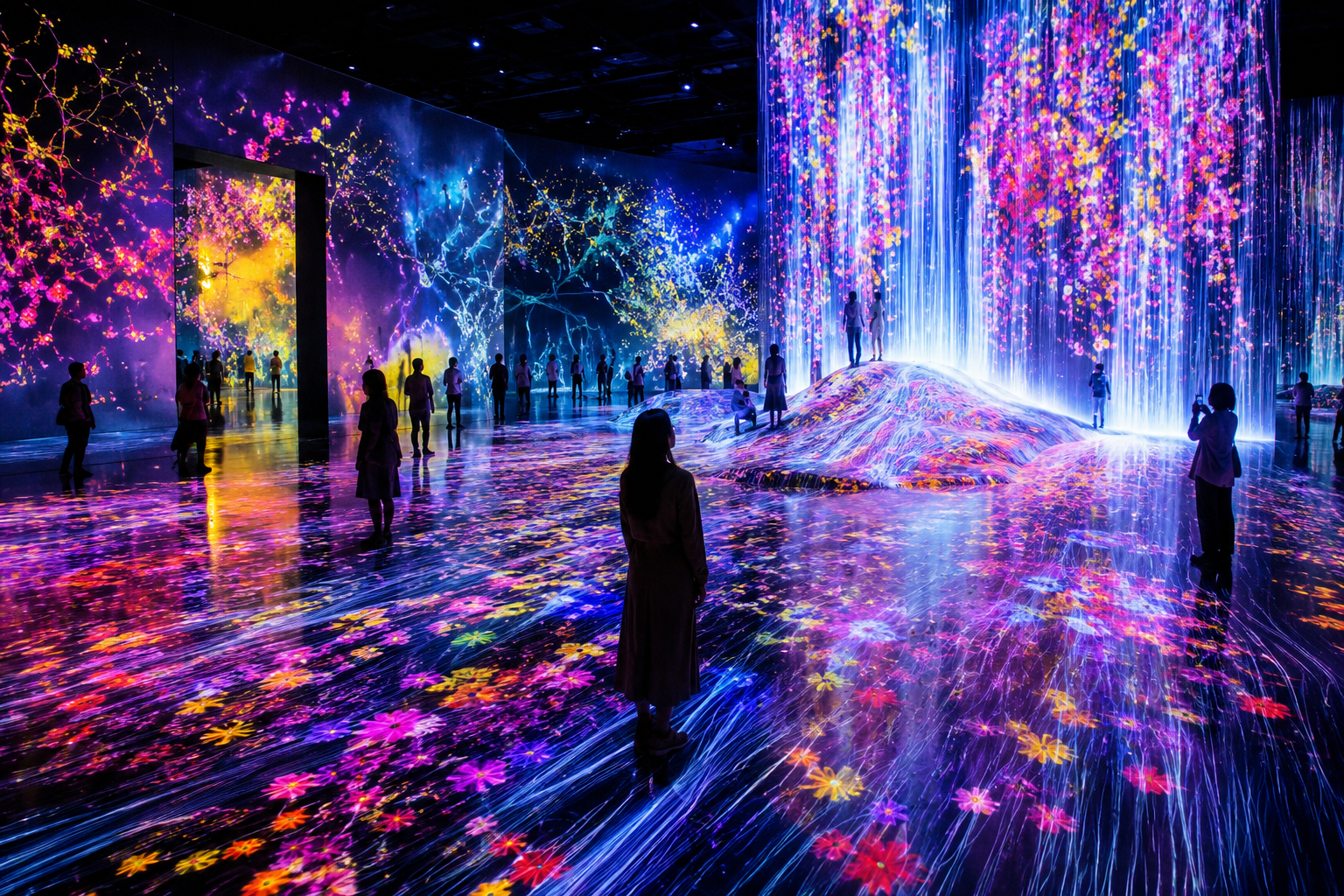
Flowers spread across walls. Digital creatures move from one space into another. Light escapes the architectural boundaries that normally separate one artwork from the next. Images encounter other images, influence them, overlap with them and sometimes disappear before you can find them again.
You are no longer walking through a building filled with individual artworks.
You are walking inside one continuously changing world.
And that seemingly simple difference may explain why teamLab Borderless has become one of the most significant experiments in immersive culture.
A Museum That Refuses to Give You a Map

The current teamLab Borderless opened at Azabudai Hills in Tokyo on February 9, 2024, following the closure of the original Odaiba location.
Mori Building and teamLab describe it as a “museum without a map.”
That phrase is not marketing decoration. It explains the entire experience.
The Azabudai Hills museum contains more than 70 works, including new pieces created for the location. The works are designed to move beyond individual rooms, communicate with other works and create a continuous environment rather than a collection of isolated galleries.
This is why conventional artwork labels are absent.
If the artwork itself can leave the room, where would you put the label?
The official teamLab app instead allows visitors to identify and learn about works nearby. In Infinite Crystal World, visitors can even participate through the app and influence the work.
It sounds like a minor curatorial decision.
It is actually a radical one.
Traditional museums are built around certainty. This painting is here. This sculpture is there. This gallery contains this period.
Borderless replaces certainty with discovery.
You do not simply ask: “What should I look at next?”
You begin asking: “Where did that artwork go?”
When the Artwork Stops Behaving Like an Object

A painting has a frame. A sculpture has physical boundaries. Even a cinema screen tells us precisely where the image begins and ends.
Digital art does not necessarily have to obey those rules.
That is the opportunity teamLab has spent years exploring.
At Borderless, projection, light, mirrors, sound, computation and physical architecture work together so that an artwork can appear to extend beyond its original location.
A butterfly does not need to understand that a doorway marks the end of one gallery.
A digital waterfall does not have to remain inside a rectangular screen.
Flowers do not have to stop because the wall ends.
Once those boundaries disappear, the museum itself begins behaving differently.
Instead of architecture containing artworks, architecture becomes part of their behavior.
That distinction is fundamental.
The building is no longer merely the box. The building becomes part of the medium.
The Audience Is No Longer Standing Outside the Picture

For centuries, much of Western museum culture has depended upon distance.
The artwork is there. The viewer is here. We observe. We interpret. We move on.
Immersive digital environments challenge that relationship because the spectator’s body occupies the same visual field as the work.
A visitor walks through projected flowers. A silhouette interrupts light. A movement may trigger a response. Another visitor changes what you see.
Suddenly the audience is no longer external to the composition.
People become temporary elements inside it.
This does not mean the visitor becomes the artist. That distinction matters.
But it does mean that the artwork cannot always be experienced independently of the people occupying the space.
The crowd itself becomes part of the visual environment.
One visitor may discover a quiet image alone. Minutes later, the same space may be filled with moving silhouettes.
The artwork has not simply been watched twice. It has existed under two different conditions.
This Is Where Digital Art Begins to Resemble Live Performance
Here is where teamLab Borderless becomes particularly interesting from the perspective of IMMERSIVE LAB.
A conventional painting can remain substantially unchanged whether ten people see it today or nobody sees it.
A live performance is different.
The audience arrives. The lights change. Bodies occupy the space. Time passes. The experience exists. Then it is gone.
Borderless shares something with that logic.
Many of its environments are continuously generated or changing. Visitors move through them at different moments and in different directions. The precise combination of image, sound, people and position that you encounter may never return in exactly the same way.
That gives digital art something traditionally associated with theater and concerts: presence.
You had to be there.
A photograph can record what you saw. A video can record movement. Neither completely records the sensation of standing inside the environment while it changes around you.
That is the point where exhibition begins to approach performance.
Light Is No Longer Illumination. It Is Material.

Stage designers have understood this for generations.
Light does not merely allow an audience to see something. Light can create space. It can compress distance, reveal architecture, hide architecture, direct attention, create rhythm and change emotional temperature.
Borderless pushes this idea further because sometimes there is almost no conventional object left to illuminate.
Light itself becomes the object.
The museum’s Light Sculpture – Flow environment demonstrates the idea particularly clearly.
In July 2026, the space reopened with the special exhibition On the Asymmetry of the Universe, introducing the new Asymmetric Existence and Chromatic Existence series.
In Asymmetric Existence, teamLab plays with a striking contradiction: one light sculpture exists in physical space but is absent from its mirror image, while another appears in the mirror without corresponding to an object in physical space.
Chromatic Existence goes further, treating ordered flows of color as a form of sculpture without a conventional material surface.
This is no longer the old question: “What color should we light the sculpture?”
The question has become: “What if the light is the sculpture?”
For anyone interested in stage design, projection, media façades or immersive environments, that shift is important.
Technology has moved beyond decorating physical objects. It can now create spatial experiences whose apparent form exists primarily through light, movement and perception.
Why Mirrors Matter So Much
Mirrors appear frequently in immersive environments for an obvious reason.
They make a finite room appear infinite.
But their effect is more psychological than architectural.
A mirror makes it difficult to determine where the artwork ends. A light source appears once in physical space and again in reflection. Then another mirror repeats it.
Soon the visitor loses the ability to identify the actual dimensions of the room.
This is one of immersive design’s most powerful techniques. Remove the audience’s certainty about the boundary of the space.
Traditional architecture tells you where you are. Immersive architecture can deliberately make that information unstable.
That instability encourages exploration. And exploration increases time.
Instead of moving efficiently from Exhibit A to Exhibit B, visitors wander. They turn around. They return to rooms. They follow images. They search for something they saw earlier.
The museum becomes less like a corridor and more like a landscape.
Why Four Million Visitors Matter
An artistic experiment can be fascinating without becoming popular.
Borderless has managed both.
As of July 31, 2026, the Azabudai Hills museum had welcomed more than four million visitors from over 185 countries and regions in approximately two and a half years. International visitors accounted for roughly 70 percent of the total.
During 2025 alone, teamLab reported approximately 1.69 million visitors to Borderless.
Those numbers matter because they suggest something larger than enthusiasm for digital projection.
People are willing to travel internationally for an experience that is difficult to classify using the old categories.
Is Borderless an art museum? An immersive attraction? A digital theater? An architectural experience? An interactive installation?
In some ways, the difficulty of answering the question is precisely its significance.
The cultural spaces attracting future audiences may increasingly exist between categories.
The Technology Is Powerful — But Technology Is Not the Story

There is a danger when writing about immersive art.
It is easy to become obsessed with equipment.
Projectors. Sensors. Computers. Tracking. Real-time rendering. Mirrors. LEDs. Sound systems.
All of those technologies matter.
But a room full of expensive technology is not automatically an immersive experience.
The same principle applies to a concert. More lighting fixtures do not guarantee better lighting design. A larger LED screen does not guarantee a stronger show. A brighter projector does not create a more meaningful story.
Technology becomes valuable only when the audience stops thinking about the equipment and begins responding to the experience.
Borderless is strongest when visitors stop asking: “How are they projecting this?”
and begin wondering: “Where is this taking me?”
That difference separates demonstration from art.
The Museum Visit Becomes Choreography

Watch people inside an immersive exhibition and something fascinating happens.
They behave differently.
In a traditional gallery, visitors frequently stand at an appropriate viewing distance.
At Borderless, they crouch. Turn. Follow. Reach. Walk through images. Wait for something to return. Photograph one another inside the artwork.
The exhibition is effectively choreographing the audience without giving explicit choreography.
Architecture creates pathways. Light attracts attention. Movement creates curiosity. Sound pulls people toward another space. A disappearing image encourages pursuit.
This is very close to how an experienced stage director manages attention.
The difference is that there are no assigned seats.
Every visitor edits their own version of the performance.
There Is No Best Seat

A theater has premium seats. A concert has front rows. A cinema has an ideal viewing position.
Borderless deliberately weakens that hierarchy.
There may be spectacular positions inside individual spaces, but the overall experience is not organized around one privileged viewpoint.
You discover it by moving.
That makes the visitor responsible for part of the experience.
Stay in one place and you see one version. Walk through a doorway and you may find another. Return ten minutes later and the environment may have changed.
The absence of a single correct viewing position is one of the most important differences between immersive space and traditional spectacle.
The audience is no longer asking: “Where should I sit?”
The audience is asking: “Where should I go?”
Perhaps the Museum Did Not Disappear After All
It would be easy to say that teamLab destroyed the museum.
It did not.
What it challenged was our expectation of what a museum must be.
The walls still exist. The building still has entrances, exits and safety systems. Technology still requires enormous physical infrastructure.
But the visitor is encouraged to stop thinking about those boundaries.
That is the illusion.
And like the best theatrical illusions, its success depends upon hiding enormous complexity behind a seemingly effortless experience.
The future museum may still contain paintings. The future theater may still contain a stage. The future concert may still place an artist beneath a spotlight.
New forms do not necessarily destroy old ones.
But Borderless demonstrates that another possibility now exists.
A cultural space can become something we do not simply enter to look at.
We enter it to move through, influence, discover and remember.
Perhaps that is why millions of people have crossed its threshold.
They are not simply visiting an exhibition.
For an hour or two, they are entering a world that refuses to stay still.
And when the artwork leaves the wall, crosses the room and disappears around a corner, there is only one thing left to do.
Follow it.
Continue Exploring WORLD DISCOVERY
Explore more destinations where history, culture, architecture, and unforgettable experiences come together.
Every journey reveals another remarkable story waiting to be discovered.
Next in WORLD DISCOVERY
https://immersivelabkorea.com/inside-the-world-of-the-orient-express/
Next Journey: Orient Express — When the Train Became the Stage
About WORLD DISCOVERY
WORLD DISCOVERY is IMMERSIVE LAB’s global editorial series exploring remarkable places, cultures, architecture, natural wonders, and human stories that continue to inspire travelers around the world.
Explore More from IMMERSIVE LAB
Broadway Collection — The world’s greatest musicals.
LEGENDS — The visionaries who changed the performing arts.
LIVE STAGE — The world’s most unforgettable concerts and live performances.
THE SHOW X-FILES — Extraordinary stories behind the world’s biggest shows.
Editorial Note
IMMERSIVE LAB creates in-depth stories that connect culture, performance, history, architecture, and human creativity through carefully researched editorial content designed for curious readers around the world.
References & Further Reading
teamLab Borderless — Official Museum
Azabudai Hills — teamLab Borderless
teamLab — Current Works and Light Sculpture: Flow
Image Credits
All photographs remain the property of their respective photographers and copyright holders. Use only images whose license, official press terms or other applicable permission allows publication.


