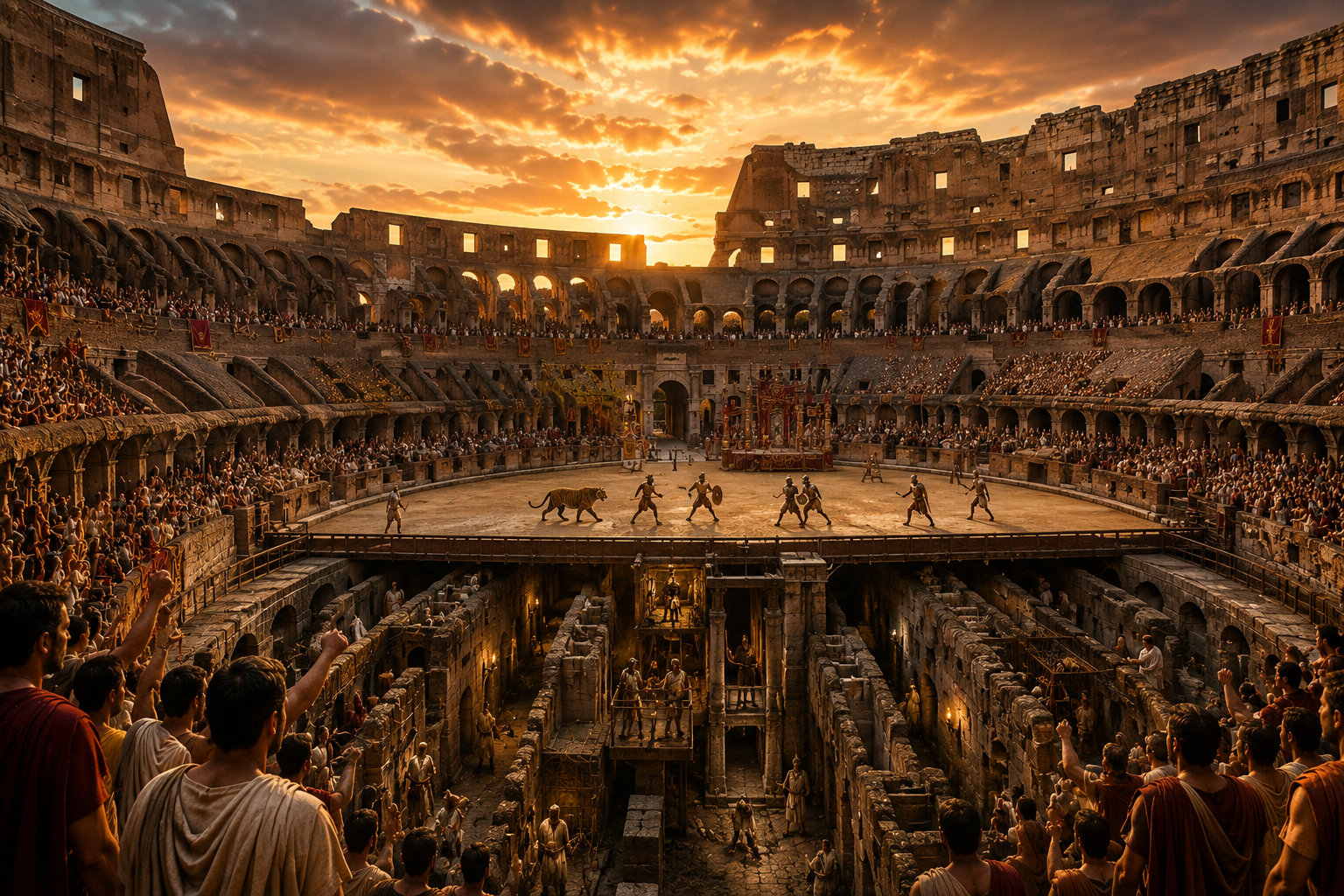
Colosseum Reimagined — The Greatest Live Show of the Ancient World
Before stadium concerts, moving stages, trapdoors and spectacular entrances, Rome had already built a machine for live entertainment.
Rome, nearly two thousand years ago.
Tens of thousands of people are waiting.
From their seats, they see only the arena.
They do not see what is happening underneath it.
Below the wooden floor, men move through dark corridors. Animals wait in cages. Ropes tighten. Winches turn. Elevators rise. Stage workers prepare an entrance the audience cannot predict.
Then a trapdoor opens.
Something appears from beneath the floor.
The crowd erupts.
Today, we associate this kind of theatrical machinery with Broadway, Las Vegas and stadium concerts.
But Rome had already understood the principle.
Hide the mechanism. Control the anticipation. Then reveal the impossible.
The Colosseum was not simply an arena where spectacles happened.
It was an enormous performance machine.
And perhaps the most fascinating way to rediscover it is not to ask how spectacular modern technology could make the Colosseum.
It is to ask a more surprising question:
How much of the modern live-entertainment industry had Rome already invented?
The Building Was Already Part of the Show

The Flavian Amphitheatre—later known as the Colosseum—was built in the first century CE under the Flavian emperors and inaugurated under Titus in AD 80.
Its scale remains extraordinary.
UNESCO historical material describes a circumference of approximately 527 metres, a height of about 48.5 metres, and seating for roughly 50,000 spectators.
The Archaeological Park of the Colosseum describes it as the world’s largest amphitheatre and emphasizes that it was capable of supporting surprisingly complex stage machinery as well as services for enormous audiences.
That last point matters.
The Colosseum was not simply big.
Many structures are big.
The achievement was that Rome combined monumental architecture with audience management and show technology.
Thousands of people had to enter.
Find their places.
See the arena.
Move through circulation routes.
Experience a spectacle.
Then leave.
That makes the Colosseum strangely familiar to anyone who has worked inside a modern stadium.
The materials have changed.
The fundamental problem has not.
How do you transform a massive crowd into an audience?
Architecture Designed Around the Audience

Modern stadium designers obsess over sightlines.
Where should spectators sit?
How steep should seating be?
How quickly can people enter and exit?
How much of the field can each person see?
The Romans were confronting versions of the same questions almost two millennia ago.
The amphitheater organized spectators around a central arena, with the cavea rising around the performance area.
From above, the logic is instantly recognizable.
There is no conventional theatrical proscenium.
The audience surrounds the action.
That changes everything.
A performer entering the arena is exposed from almost every direction.
There is no backstage wall to hide behind.
So Rome created another solution.
Backstage went underground.
Beneath the Arena Was Another World

Look at the Colosseum today and the underground structure is visible because much of the original arena floor no longer survives.
But ancient spectators would not have seen it.
They saw a continuous arena surface.
Underneath was the hypogeum—a dense system of corridors, chambers, machinery and working spaces.
The official Archaeological Park describes underground preparations taking place beneath an arena floor filled with trapdoors. Men and animals could be raised unexpectedly through freight elevators powered by winches and pulleys.
Today, fourteen underground corridors remain visible across an area of roughly half a hectare.
Think about what that means theatrically.
The audience sees the effect.
The technicians see the mechanism.
Exactly the same principle governs contemporary live entertainment.
Above stage:
magic.
Below stage:
engineering.
The Hypogeum Was Ancient Rome’s Backstage

Imagine standing underground moments before a spectacle.
Above you are thousands of spectators.
You cannot necessarily see them.
But you can hear them.
Workers prepare machinery.
Animals wait.
Gladiators move toward entrances.
Stage personnel coordinate cues.
The floor above separates two completely different realities.
For the spectator:
anticipation.
For the crew:
operation.
Anyone who has stood backstage during a major concert will recognize the psychology.
The audience hears music and sees light.
Behind the curtain, someone is counting seconds.
The Colosseum worked on the same principle.
Spectacle depends on invisible labor.
Rome Had Stage Lifts Long Before Broadway

Perhaps the most surprising technology was vertical movement.
Ancient machinery could raise people, animals and scenic elements from underground spaces toward the arena.
Winches.
Pulleys.
Ropes.
Elevators.
Trapdoors.
The official Colosseum documentation describes large freight elevators associated with underground control areas and the mechanisms used to lift performers and animals toward the arena.
To a Roman spectator, the mechanical explanation did not matter.
What mattered was the entrance.
Imagine an apparently empty arena.
Then—
a door opens from the floor.
An animal appears.
Or a performer rises into view.
That is not fundamentally different from the logic behind a modern pop star suddenly emerging through a stadium stage.
The engineering changed.
The dramatic cue did not.
Every Great Entrance Begins With Something Hidden
Concert designers understand this instinctively.
If the audience sees the artist walk casually onto the stage, the entrance has limited dramatic power.
So performers disappear.
The stadium goes dark.
Sound builds.
Video begins.
A platform rises.
Suddenly the artist appears.
The audience screams.
Rome understood the same emotional equation.
Absence + anticipation + reveal = spectacle.
The hypogeum allowed the Colosseum to control that equation repeatedly.
This is why calling it simply an “arena” understates what was happening.
It was also stage infrastructure.
Animals Could Enter Like Special Effects
Among the spectacles staged in the amphitheater were venationes—animal hunts—as well as gladiatorial contests known as munera. The Archaeological Park continues to explain these forms of entertainment in its present-day interpretation of the monument.
For ancient spectators, exotic animals could themselves become spectacle.
But presentation mattered.
An animal merely standing in an arena is one thing.
An animal appearing unexpectedly from beneath the floor is another.
The entrance turns reality into theater.
This remains one of live entertainment’s most important principles.
The object does not necessarily need to be extraordinary.
Its arrival can make it extraordinary.
The Arena Floor Was a Giant Stage

The Latin word arena is associated with sand—the material covering the performance surface.
But conceptually, the Colosseum’s arena functioned much like a giant stage deck.
It concealed machinery.
Supported action.
Separated performers from technical infrastructure.
Provided entrances.
Allowed scenic transformations.
Modern stage designers might recognize the logic immediately.
A contemporary stadium stage may conceal:
hydraulic lifts,
automation tracks,
cable systems,
trapdoors,
power distribution,
communications,
effects equipment.
Ancient Rome relied on different technologies.
But the fundamental separation was already there:
performance above, machinery below.
Then Imagine 50,000 People Reacting at Once

Technology alone does not create spectacle.
An empty Colosseum would simply have been architecture.
The missing ingredient was the crowd.
Roughly 50,000 people reacting together can create something no scenic device can reproduce.
A roar travels through architecture.
Emotion becomes contagious.
One section responds.
Another follows.
Expectation grows.
This is the same phenomenon that gives stadium concerts their extraordinary power today.
You can listen to a song alone through headphones.
But hearing tens of thousands of people sing it simultaneously becomes another experience.
The Colosseum understood collective emotion long before anyone used the phrase live entertainment industry.
The audience was not simply consuming spectacle.
The audience was amplifying it.
The Emperor Was More Than a Spectator

There was another layer.
Power.
The spectacles were connected with imperial authority. UNESCO’s historical overview notes that emperors organized public shows as part of their relationship with Roman citizens.
This turns the Colosseum into something larger than entertainment infrastructure.
It was also political theater.
The crowd watched the arena.
But the crowd could also see imperial presence.
The spectacle communicated abundance.
Control.
Power.
Generosity.
Rome could bring animals, fighters and elaborate machinery into one monumental venue and make thousands of people witness the same event.
In modern language, we might call this image-making.
Rome called it empire.
The Most Powerful Technology May Have Been Crowd Psychology
Imagine a modern show without social media.
No television.
No livestream.
No giant LED screens outside the venue.
If you were not physically present, you missed the event.
That gave live spectacle extraordinary social power.
Stories traveled afterward.
People described what they had seen.
Memory enlarged the event.
Reputation preceded the next spectacle.
This is something contemporary entertainment has partially lost.
Today almost everything can be recorded.
Ancient spectacle was fundamentally ephemeral.
It happened.
Then it disappeared.
What remained was memory.
And memory is often where spectacle becomes legend.
What Would We See If the Colosseum Were Complete?
This is where imagination becomes dangerous.
Popular culture often fills the Colosseum with spectacular images that may be visually exciting but historically uncertain.
WORLD DISCOVERY should do something different.
Instead of pretending we know every visual detail, we can reconstruct principles supported by archaeology.
We know there was an arena floor.
We know underground corridors existed.
We know machinery raised people and animals.
We know gladiatorial contests and animal hunts were presented.
We know enormous audiences gathered around the arena.
That is already enough.
We do not need to turn archaeology into fantasy.
The verified reality is spectacular enough.
Rome Even Experimented With Water Spectacle
The early history of the Colosseum also contains evidence connected with water performances.
The Archaeological Park notes that the underground layout includes structures associated with the naumachiae, or naval spectacles, linked to the amphitheater’s inauguration. Once the original wooden underground system was replaced by masonry, such water shows could no longer take place in the same way.
The precise reconstruction of these early aquatic spectacles remains a subject requiring caution.
But the underlying ambition is remarkable.
Rome was already exploring a question that contemporary spectacular entertainment still asks:
How far can we transform the venue itself?
Stage becomes landscape.
Floor becomes water.
Architecture becomes illusion.
The technology changes.
The ambition survives.
The Colosseum Was a Production Ecosystem

The arena did not operate alone.
Nearby facilities supported the spectacle.
The Ludus Magnus, established under Domitian, was the best-known of the gladiatorial training facilities associated with the Colosseum district.
The Archaeological Park also identifies other supporting structures: additional training schools, sailors’ barracks connected with the operation of the velum, weapons storage, medical facilities, spaces associated with the dead, and even a scenography factory and storehouse known as the Summum Choragium.
Stop there for a moment.
A scenography factory.
That phrase changes how we see the Colosseum.
The spectacle required more than performers.
It required production.
Training.
Storage.
Equipment.
Operations.
Scenery.
Technical labor.
In other words, the Colosseum was connected to something resembling an ancient entertainment production district.
The arena was only what the audience saw.
Two Thousand Years Later, the Backstage Is Finally Visible
There is an extraordinary irony in the modern Colosseum.
Ancient audiences could see the show but not the backstage.
Modern visitors can see the backstage—but the original show is gone.
The hypogeum is exposed.
The corridors can be studied.
The mechanisms can be reconstructed.
We can walk through spaces once hidden beneath the spectacle.
In a sense, history has reversed the building.
Backstage has become the attraction.
And that makes the Colosseum uniquely valuable to anyone interested in performance design.
We are not simply looking at ruins.
We are looking inside the machine.
Today the Colosseum Is Experimenting With Interpretation Again
The relationship between ancient spectacle and modern media has not disappeared.
The Archaeological Park previously presented Blood and the Arena, an immersive production staged in the amphitheater’s arena.
The project used multimedia imagery, virtual reconstruction, lighting, sound, music and holographic elements to evoke aspects of the inaugural spectacles of AD 80.
That raises an important question.
How should technology behave inside one of the world’s most historically significant performance spaces?
Should it attempt to overwhelm the monument?
Or should it help visitors understand what is no longer visible?
The second approach is far more interesting.
The Colosseum does not need technology to become spectacular.
It needs technology only when technology helps us see through time.
A Night at the Colosseum Changes the Building Again

In 2026, visitors can experience the monument after normal daytime crowds have disappeared.
The official A Night at the Colosseum program runs on Tuesday and Thursday evenings and takes visitors through the first tier, arena floor and underground levels.
The experience is specifically structured around the viewpoints of spectators and protagonists of the ancient spectacles.
Visitors descend underground.
They encounter the corridors.
They learn about lifts and hoists.
They walk through the hypogeum under moonlight.
A permanent exhibition in the underground area now incorporates holographic projections, educational video, original artifacts and reconstructions of ancient armor.
That is an important evolution.
The technology is not replacing the ruin.
It is helping the ruin speak.
If We Reimagined the Colosseum, What Should We Actually Recreate?
Not blood.
Not violence for entertainment.
Not Hollywood fantasy.
What deserves to be recreated is the experience architecture.
Imagine an interpretive installation built around historically grounded principles.
The audience enters while hearing a distant crowd.
The arena remains partially concealed.
Underground machinery is reconstructed digitally.
A transparent visualization reveals the hidden elevators beneath the floor.
Sound demonstrates how fifty thousand people might transform the acoustic environment.
Lighting shows how an animal or gladiator could suddenly emerge from darkness.
Augmented layers reveal missing seating without physically rebuilding it.
Then everything disappears.
The visitor is left standing inside the ruin again.
That would not attempt to replace history.
It would briefly make history legible.
The Best Technology Would Know When to Disappear
This is perhaps the most important principle.
When working with heritage, technology can easily become the loudest thing in the room.
A giant projection may attract attention.
But if visitors leave remembering only the projector, the interpretation has failed.
The Colosseum should remain the protagonist.
Technology should behave like stage crew.
Invisible when unnecessary.
Precise when needed.
Powerful at the right moment.
Then gone.
The ancient Romans understood this relationship perfectly.
The audience did not applaud the winch.
They reacted to what emerged from the floor.
The Colosseum and the Modern Stadium Are Not Strangers
Put an ancient amphitheater beside a modern stadium and the technologies seem completely different.
Concrete versus ancient masonry.
LED screens versus daylight.
Digital audio versus human voice.
Hydraulics versus ropes and pulleys.
But step back.
The similarities become difficult to ignore.
Both organize enormous crowds around a central event.
Both depend on controlled entrances.
Both require backstage operations.
Both use technology to create reveals.
Both transform architecture through collective emotion.
Both make an individual feel part of something much larger.
And both depend on the same final ingredient:
anticipation.
The audience waits.
Something is about to happen.
That feeling may be one of the oldest technologies in entertainment.
The Greatest Live Show of the Ancient World

The Colosseum is usually introduced through statistics.
Its age.
Its dimensions.
Its gladiators.
Its emperors.
Those facts matter.
But they can hide something even more fascinating.
The Colosseum was designed around experience.
A spectator approached monumental architecture.
Entered with thousands of others.
Moved through a carefully organized structure.
Found a place overlooking the arena.
Waited.
Then the building revealed things that had been hidden beneath the floor.
That sequence feels remarkably modern.
Entrance.
Anticipation.
Reveal.
Reaction.
Memory.
Two thousand years later, concert producers still build shows around the same emotional architecture.
Our lifts are faster.
Our lights are brighter.
Our screens are enormous.
Our sound systems can shake entire stadiums.
But when the house goes dark and fifty thousand people begin screaming because something is about to appear—
Rome would understand exactly what is happening.
Perhaps the Colosseum’s greatest legacy is not that it was an ancient stadium.
It is that beneath its ruined stone we can still recognize the blueprint of live spectacle.
The world’s most famous ancient arena was also one of history’s greatest stages.
Continue Exploring WORLD DISCOVERY
Explore more destinations where history, culture, architecture, and unforgettable experiences come together.
Every journey reveals another remarkable story waiting to be discovered.
Next in WORLD DISCOVERY
https://immersivelabkorea.com/alhambra-reimagined-when-architecture-learns-to-perform-with-light/
Next Journey: Stonehenge After Dark — When Mystery Becomes the Performance
About WORLD DISCOVERY
WORLD DISCOVERY is IMMERSIVE LAB’s global editorial series exploring remarkable places, cultures, architecture, natural wonders, and human stories that continue to inspire travelers around the world.
Explore More from IMMERSIVE LAB
Broadway Collection — The world’s greatest musicals.
LEGENDS — The visionaries who changed the performing arts.
LIVE STAGE — The world’s most unforgettable concerts and live performances.
THE SHOW X-FILES — Extraordinary stories behind the world’s biggest shows.
Editorial Note
IMMERSIVE LAB creates in-depth stories that connect culture, performance, history, architecture, and human creativity through carefully researched editorial content designed for curious readers around the world.
References & Further Reading
Parco Archeologico del Colosseo — The Colosseum
Parco Archeologico del Colosseo — Underground Levels
Parco Archeologico del Colosseo — Spectacles in the Colosseum Arena
Parco Archeologico del Colosseo — A Night at the Colosseum 2026
Parco Archeologico del Colosseo — Blood and the Arena
UNESCO — Historic Centre of Rome
Image Credits
All photographs remain the property of their respective photographers and copyright holders. Use only images whose licenses, official press permissions or other applicable rights permit publication.


