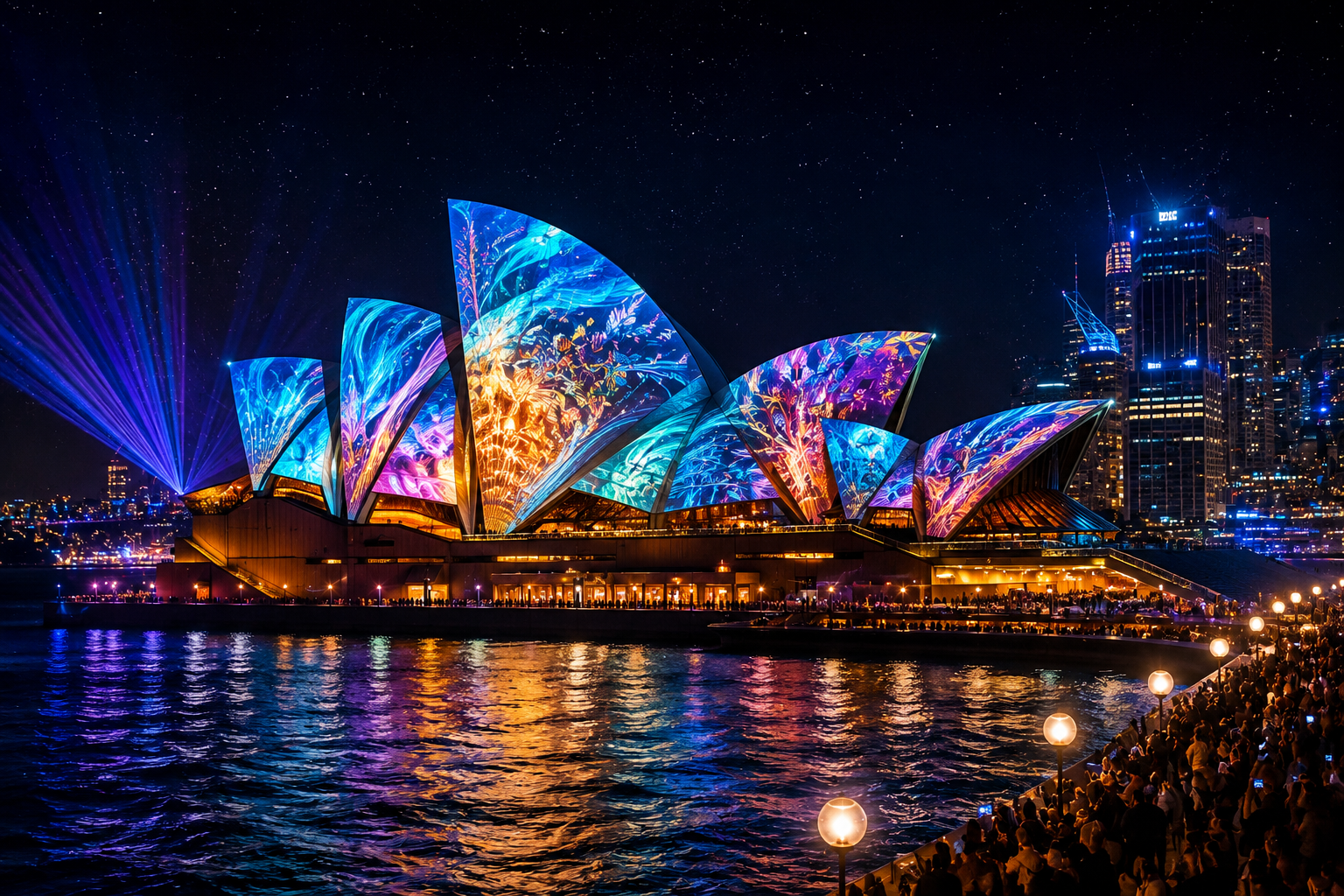
Sydney Opera House After Dark — When the Building Becomes the Performance
The audience came for a performance. Then the performance escaped the theatre and climbed onto the roof.
Sydney Harbour after sunset.
The ferries are still moving across Circular Quay. The Harbour Bridge stands in the distance. Across the water, one of the world’s most recognizable buildings appears exactly as millions of photographs have taught us to expect.
White sails.
Dark harbour.
Sydney skyline.
Then the architecture changes.
Colour touches one shell.
An image spreads across another.
The curved ceramic surfaces begin carrying forms that were never part of Jørn Utzon’s original architecture. Patterns move across the sails. Music accompanies the transformation.
Suddenly the question becomes difficult to answer:
Are we looking at a building—or watching a performance?
This is where Sydney Opera House becomes particularly interesting to IMMERSIVE LAB.
Because it demonstrates something more sophisticated than simply projecting beautiful pictures onto a famous landmark.
For decades, the building was primarily understood as a place that contained performances.
Opera happened inside.
Concerts happened inside.
Theatre happened inside.
But through projects such as Lighting of the Sails, Vivid LIVE and Badu Gili, the relationship has changed.
Now the architecture itself can become part of the program.
And in 2026, that idea reached another remarkable chapter.
A Theatre That Refused to Stay Inside

Sydney Opera House opened in 1973.
Its function was obvious.
It was a performing arts centre.
But its architecture immediately created an unusual problem—or perhaps an opportunity.
The building was already visually stronger than almost anything that could be placed in front of it.
Its roof forms were not neutral.
They were sculptural.
Visible from the harbour.
Recognizable from extraordinary distances.
And unlike the rectangular façades normally used for projection, the Opera House sails offered something far more difficult:
curved architecture with an identity of its own.
That distinction matters.
A conventional screen waits for content.
Sydney Opera House does not.
The building already has a visual language.
Any artist working on the sails has to negotiate with it.
The architecture cannot simply disappear behind the image.
The image must learn how to live on the architecture.
Then Sydney Discovered the Building Could Become a Canvas

The transformation did not happen overnight.
The Opera House’s own history records major moments in which its sails became part of public spectacle. During the celebrations surrounding the 2000 Olympic period, the sails were illuminated as part of a major artistic program.
Later came something even more consequential.
In 2008, Brian Eno curated the first Vivid LIVE music program at Sydney Opera House. Over time, Vivid LIVE became an annual meeting point between contemporary music, visual art and one of the world’s most recognizable pieces of architecture.
Today, Sydney Opera House describes Lighting of the Sails as one of Vivid Sydney’s most significant free events, co-curated by the Opera House and Destination NSW.
That means something fundamental has changed.
The roof is no longer simply roof.
During these moments, it becomes programmed cultural space.
2026: Opera Mundi Arrives on the Sails

For Vivid LIVE 2026, French multimedia artist Yann Nguema was commissioned to create Opera Mundi.
Nguema’s approach is particularly appropriate for this building.
His work combines science, music, computer programming and large-scale projection. For Sydney, the concept responded to transformations in the natural world—land, sea and sky—and to the natural forms that influenced architect Jørn Utzon.
Animation was created with Anima Lux, accompanied by a score from Mischa Blanos.
The resulting work ran for approximately 18 minutes.
But duration is not the important number.
The important idea is this:
The projection did not treat the Opera House as an arbitrary screen.
Its conceptual starting point was connected to the architectural imagination that produced the building itself.
Nature inspired architecture.
Decades later, digital art inspired by nature returned to that architecture.
That creates a loop:
nature → architecture → digital art → architecture again.
This is far more interesting than a giant video being played on a wall.
Projection Mapping Is Easy Until the Screen Stops Being Flat

Imagine creating an image for a cinema.
You know where the corners are.
You know the aspect ratio.
You know the viewing direction.
Now remove almost every one of those certainties.
The Sydney Opera House sails curve.
They overlap.
They face different directions.
Their surfaces respond differently depending on the viewing position.
An image that looks coherent from one position may behave differently from another.
The building therefore becomes part of the content-production problem.
Artists must think architecturally.
Where should movement begin?
How should a form travel across a curved shell?
Which parts of an image should disappear?
How much visual information can the architecture carry before the work becomes unreadable?
And perhaps most importantly:
Should the projection fight the shape—or reveal it?
The strongest architectural projection tends to choose the second option.
The Curves Are Not a Problem. They Are the Instrument.
This is where Sydney differs from a giant LED billboard.
A billboard asks:
What image do you want to show?
An architectural canvas asks:
What can this building do to the image?
The difference is enormous.
On the Opera House, curvature can distort an image.
But distortion can become choreography.
The separation between shells can interrupt a composition.
But interruption can become rhythm.
A surface disappearing around a curve can appear inconvenient.
Or it can make an image seem to move around the architecture.
The building is no longer merely supporting the artwork.
It is performing with it.
For IMMERSIVE LAB, that is the essential point.
When Painting Begins to Move

The history of Lighting of the Sails shows how many different artistic languages can inhabit the same architecture.
In 2023, Life Enlivened transformed the work of celebrated Australian artist John Olsen into an animated projection.
Images selected from Olsen’s long career were animated by creative technologists Curiious, translating his fascination with Australian landscape and nature onto the Opera House sails.
Think about the transformation.
A painting is normally bounded.
Canvas has edges.
The viewer stands in front of it.
But once animated across the Opera House, the relationship changes.
The artwork acquires enormous scale.
Movement.
Duration.
Sound.
Architecture.
And a city as its viewing environment.
Painting becomes event.
Fabric Became Architecture in 2024

The following year produced another fascinating transformation.
For Lighting of the Sails: Echo in 2024, artist Julia Gutman collaborated with Pleasant Company.
Gutman’s practice draws upon fabric and textiles contributed by her community. For the Opera House work, those textile-based images were digitized and transformed into a monumental animated projection.
Again, scale changes meaning.
Something associated with touch, intimacy and hand-made material suddenly occupies one of the largest cultural canvases in Australia.
Fabric becomes light.
Light becomes architecture.
Architecture becomes public artwork.
This is what architectural media can do when it is more than decoration.
It can force us to encounter familiar artistic materials in completely unfamiliar ways.
In 2025, the Sails Carried a Life Story

In 2025, Kiss of Light brought the work of David McDiarmid to the sails.
McDiarmid’s work crossed art, fashion, nightlife, activism and radical self-expression. Thirty years after his death, his visual legacy was transformed into animation for Vivid Sydney.
The production was animated by VANDAL with a soundtrack by Stereogamous.
Notice what has happened across just three editions.
2023:
painting.
2024:
textile.
2025:
activist visual culture.
2026:
science, programming, nature and digital art.
Same architecture.
Completely different artistic identities.
That is one of the great strengths of programmable architecture.
The building stays. The cultural voice changes.
But Sydney Had Already Discovered Something Even More Important
In 2016, Songlines transformed the sails using works by six First Nations artists.
The Sydney Opera House describes it as the first time its sails were used exclusively as a canvas for Aboriginal artists.
The project connected art, history, landscape and systems of cultural exchange to a building standing on Tubowgule, land of the Gadigal people.
This matters because media architecture is never just technical.
A projector does not decide what a building should say.
People do.
Curators do.
Artists do.
Institutions do.
Communities do.
And when the building is culturally significant, the decision about what appears on its surface becomes culturally significant as well.
Then Badu Gili Made the Sails Speak Every Night

That idea continued with Badu Gili, launched in 2017.
The name means “water light” in the language of the Gadigal people.
Rather than operating only as an occasional festival projection, Badu Gili established a recurring nighttime experience presenting First Nations stories and artwork on the eastern Bennelong sails. The current Badu Gili: Wonder Women is a six-minute projection celebrating six female First Nations artists and is presented several times after sunset.
The Opera House reports that Badu Gili attracted more than 16,000 visitors during its first month, with hundreds of thousands later coming to the waterfront to experience the work.
This changes the meaning of projection mapping again.
It is no longer simply:
“Look what technology can do.”
It becomes:
“Whose stories can this architecture carry?”
That is a much more powerful question.
The Audience Is Outside the Theatre Now

Traditional performance architecture is designed around a boundary.
Ticket holders enter.
Doors close.
Performance begins.
Lighting of the Sails reverses that logic.
The audience can stand outside.
On the Western Broadwalk.
Across Circular Quay.
Near the harbour.
On surrounding public spaces.
The architectural exterior becomes the stage.
And because the work is visible in public space, someone who never intended to attend an art event can suddenly encounter one.
A commuter can become an audience member.
A tourist can stop walking.
A family can watch from the waterfront.
Someone on a ferry may see part of the work while moving across the harbour.
There is no single ideal seat.
The city becomes part of the auditorium.
And Accessibility Becomes Part of the Performance Design
In 2026, Sydney Opera House offered audio-described sessions for Opera Mundi.
Visitors who are blind or have low vision could sit on the Western Broadwalk while live visual descriptions communicated the projected imagery.
This may appear like a small programming detail.
It is not.
If immersive experience is supposed to expand how audiences encounter art, then accessibility cannot remain an afterthought.
The question is not only:
How spectacular can we make this?
It must also be:
Who gets to experience the spectacle?
The most sophisticated future of immersive design will not merely increase visual resolution.
It will increase access.
There Is a Reason You Cannot Put Anything You Want on the Sails
This may be the most revealing part of the entire story.
Sydney Opera House has an official policy governing illumination of its sails.
The reason is explicit: the sails possess major architectural, heritage and cultural significance and must be protected from exploitation.
Third-party illumination is tightly controlled, and ordinary third-party requests are limited to static single-colour illumination, with separate treatment for projections associated with major Opera House events.
Why does that matter?
Because the moment architecture becomes a giant media surface, enormous commercial pressure becomes possible.
Every famous building could become advertising inventory.
Every façade could carry a logo.
Every landmark could become a screen.
Technically, that future is possible.
Culturally, it may be disastrous.
Sydney offers another model.
The ability to display something does not automatically mean it should be displayed.
The Difference Between a Media Façade and a Cultural Canvas
This distinction is becoming increasingly important.
Consider two scenarios.
In the first, a famous building displays a giant commercial logo.
People photograph it.
The image spreads online.
The building has functioned as advertising.
In the second, an artist creates work specifically for the architecture.
The geometry of the building influences the composition.
Sound supports the visual language.
The work connects with place, history or culture.
The audience gathers to experience it.
The building has become part of an artistic event.
Both use light.
Both may use projection.
Both may attract enormous attention.
But they are not the same thing.
One uses architecture as media inventory.
The other creates a relationship with architecture.
That relationship is what separates spectacle from meaningful experience.
Vivid LIVE Changes What a Performing Arts Centre Can Be
The 2026 Vivid LIVE program ran from 22 May to 13 June at Sydney Opera House.
Inside, audiences experienced contemporary music performances.
Outside, Opera Mundi transformed the sails.
Across Sydney, Vivid expanded through light, music, ideas and public experience; the 2026 festival ultimately ran for 23 nights and days.
This produces an interesting inversion.
Normally, architecture advertises what is happening inside.
A poster tells us about the concert.
A marquee tells us about the show.
But during Vivid LIVE, the Opera House itself becomes part of what people have come to see.
The venue becomes content.
That idea has enormous implications for the future of performance architecture.
What Happens When Every Venue Can Perform?
Imagine the next generation of cultural buildings.
Concert halls whose façades react to the music inside.
Theatres whose architecture changes visually before the curtain rises.
Museums whose exterior artworks evolve according to exhibitions.
Stadiums whose outer skin becomes part of the concert narrative.
Public plazas where audiences outside participate in performances happening inside.
Technologically, much of this is already possible.
The harder problem is artistic.
What should the building say?
When should it speak?
When should it remain silent?
Sydney Opera House provides an important answer.
Architecture should not perform simply because technology allows it to.
There should be a reason.
Sometimes the Most Powerful Cue Is Darkness
Live-show designers understand this.
If every lighting fixture operates at full intensity for the entire performance, nothing feels important.
Contrast creates attention.
Darkness creates anticipation.
Silence gives sound meaning.
The same principle applies to architectural media.
A landmark permanently covered in moving images eventually becomes background.
But when familiar architecture suddenly transforms for a limited period, people notice.
They stop.
They look.
They photograph.
They wait for the next sequence.
The transformation has value because it is temporary.
The building remembers how to become architecture again.
From Utzon’s Sails to a Digital Stage
Jørn Utzon could not have designed Sydney Opera House specifically for today’s projection technologies.
Yet the architecture possesses qualities that make digital interpretation unusually powerful.
Its geometry is unmistakable.
Its relationship with water multiplies the visual effect through reflection.
Its position on Bennelong Point creates long sightlines.
Its white tiled shells provide a distinctive surface.
Its cultural identity is already enormous.
Digital technology did not create those strengths.
It discovered another way to activate them.
This distinction is important.
The best media architecture does not rescue weak architecture.
It reveals possibilities already hidden inside strong architecture.
When the Building Becomes the Performance

Return to Sydney Harbour.
The night is darker now.
Inside the Opera House, another performance may be beginning.
Musicians walk onto a stage.
House lights fade.
An audience becomes quiet.
But outside, another audience is forming.
No curtain.
No conventional auditorium.
No rectangular screen.
Only architecture, harbour, projected light and people looking upward.
For several minutes, the sails stop behaving like the roof of a theatre.
They carry painting.
Memory.
First Nations stories.
Digital animation.
Nature.
Music.
Technology.
Then the projection ends.
The images disappear.
The white shells return.
And Sydney Opera House becomes what it was before.
Except the audience now understands something it may not have noticed earlier.
The building was never merely the container for the performance.
It had been waiting to become part of it.
Sometimes the greatest stage is the theatre itself.
Continue Exploring WORLD DISCOVERY
Explore the places where performance, architecture, technology and human imagination transform the way we experience the world.
Every destination reveals another possibility for what a stage can become.
Next in WORLD DISCOVERY
Next Journey: To Be Announced
About WORLD DISCOVERY
WORLD DISCOVERY is IMMERSIVE LAB’s global editorial series exploring extraordinary places where performance, art, architecture, technology and human experience intersect.
Explore More from IMMERSIVE LAB
Broadway Collection — The world’s greatest musicals.
LEGENDS — The visionaries who changed the performing arts.
LIVE STAGE — The world’s most unforgettable concerts and live performances.
THE SHOW X-FILES — Extraordinary stories behind the world’s biggest shows.
Editorial Note
IMMERSIVE LAB explores the world through the language of performance—discovering how architecture, technology, art and live experience can transform places into unforgettable cultural stages.
References & Further Reading
Sydney Opera House — Vivid LIVE
Sydney Opera House — About Vivid LIVE & Lighting of the Sails
Sydney Opera House — Opera Mundi 2026
Sydney Opera House — Contemporary Art / Lighting of the Sails Archive
Sydney Opera House — 50 Years of Extraordinary Moments
Sydney Opera House — Badu Gili: Wonder Women
Sydney Opera House — Illumination of the Sails Policy
Vivid Sydney — Official Festival Site
Image Credits
All photographs remain the property of their respective photographers and copyright holders. Use only images whose licences, official press permissions or other applicable rights permit publication.


