Sleep No More Gave the Audience 100 Rooms — and No Map
Inside Punchdrunk’s McKittrick Hotel, where masks, choreography, sound and obsessive scenic detail turned audience freedom into a directing system
On March 7, 2011, audiences began entering a group of converted warehouse buildings on West 27th Street in Manhattan.
Inside were nearly 100 rooms spread across roughly 100,000 square feet: bedrooms, offices, hospital spaces, shops, corridors, a ballroom and rooms filled with letters, photographs, suitcases, medical objects and personal belongings.
There was no conventional auditorium.
There were no assigned seats.
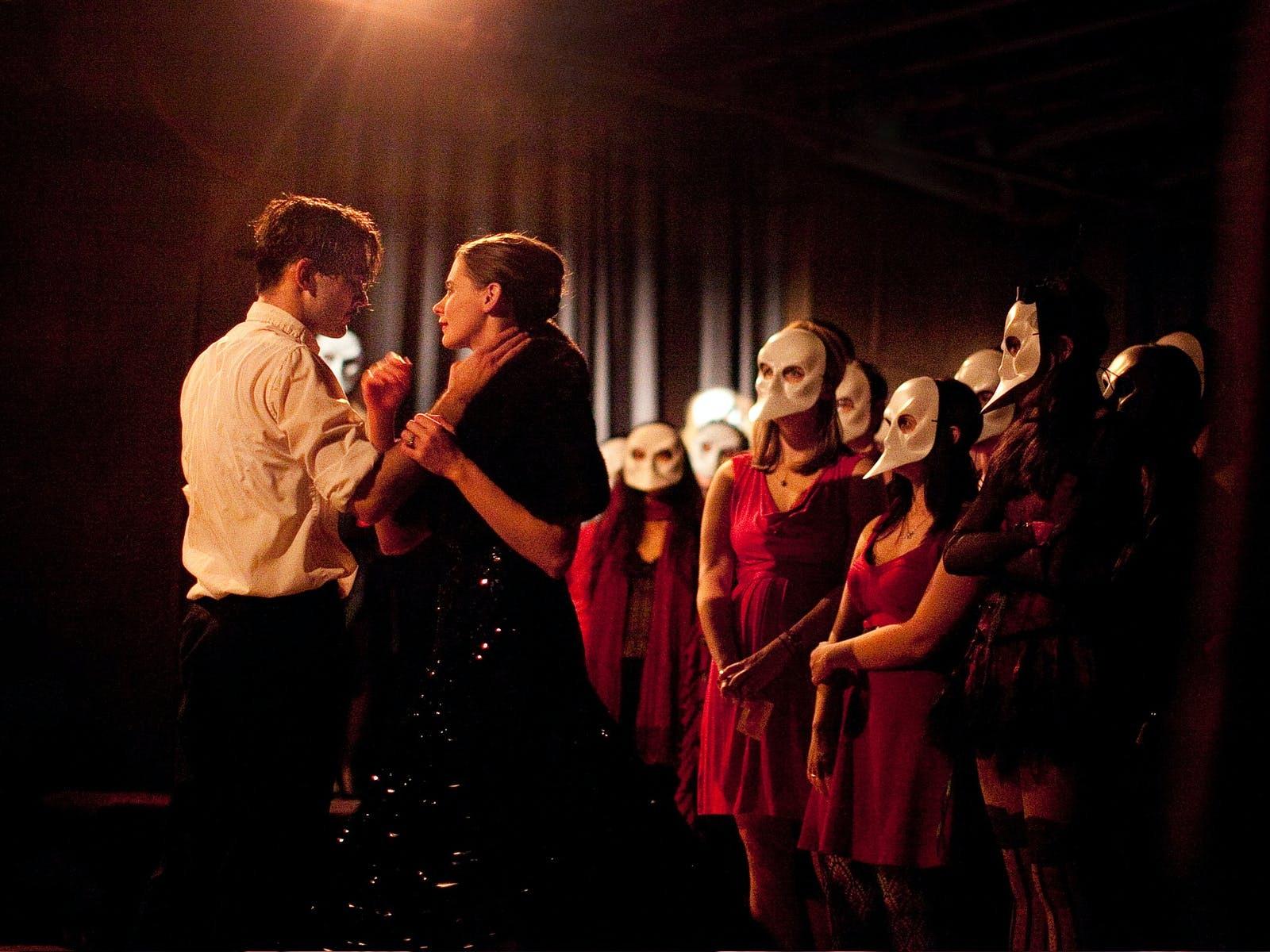
And after entering, spectators were given white masks and released into the building.
They could follow Macbeth.
Or Lady Macbeth.
Or a witch.
Or nobody.
They could open drawers, inspect documents, abandon a scene halfway through, climb another staircase and discover something completely different.
Punchdrunk’s Sleep No More had done something that sounds almost irresponsible from a director’s perspective: it surrendered control of where the audience looked.
Yet the production survived for almost fourteen years in New York, welcomed more than two million attendees, and gave its final McKittrick Hotel performance on January 5, 2025.
So the interesting question is not why audiences were allowed to wander.
It is this:
How do you direct hundreds of people when everyone is free to go somewhere different?
The Audience Lost Its Seats Before the Performance Even Began

Conventional theatre establishes audience behavior before the first cue.
Find your seat.
Face forward.
Remain relatively still.
Watch what the director has chosen to place inside the frame.
Sleep No More removed that agreement.
Punchdrunk describes the production as a version of Macbeth seen through a dark cinematic lens, with audiences moving freely through the story and constructing individual journeys.
That freedom fundamentally changes directing.
The production cannot guarantee that an audience member will see Lady Macbeth before encountering Macbeth.
It cannot guarantee they will witness a murder.
It cannot even guarantee that they will follow a performer.
Someone might spend several minutes alone inside an apparently empty room reading a letter. Another person may run after a character. Another may simply follow the largest crowd.
The audience is no longer sitting outside the mise-en-scène.
It has entered it.
The White Mask Was More Than a Costume
The white masks became Sleep No More’s most recognizable image. But visually identifying the audience was only one of their functions.
Once everyone wears essentially the same blank face, spectators become anonymous.
Individual facial reactions disappear.
Performers can distinguish audience from character instantly.
And audience members begin to resemble part of the scenography.
A crowd of ordinary people becomes a silent population of pale observers moving through the building.
The mask also changes behavior. There is psychological distance between the person’s everyday identity and the anonymous spectator moving through the McKittrick.
Punchdrunk combines this with another crucial rule: the audience remains silent.
Performers communicate predominantly through movement and choreography, while spectators watch without conventional verbal interaction.
The mask therefore solves several production problems simultaneously.
Costume.
Audience identification.
Behavioral permission.
Atmosphere.
And crowd composition.
It is a small object performing an enormous amount of directing work.
Nearly 100 Rooms Meant Nearly 100 Opportunities to Lose the Story

The McKittrick was designed with extraordinary scenic density.
Technical coverage of the production describes nearly 100 explorable rooms, with detail extending down to letterhead hidden inside office files and specific antiques integrated into choreography.
This creates an unusual contradiction.
The richer the environment becomes, the easier it is for visitors to stop following the performers.
A desk drawer can compete with Macbeth.
A handwritten letter can become more interesting than the scene happening down the corridor.
In most theatrical design, scenery supports performance. Here, scenery sometimes deliberately steals the audience away from it.
That means the building has to contain two different experiences simultaneously: performance when actors are present, and storytelling when they are not.
An empty room cannot simply feel like a room waiting for the next scene. It needs evidence of lives that continue beyond the audience’s view.
That is why scenic detail matters so much.
The audience is not merely looking at the set.
It is investigating it.
Every Drawer Became Part of the Script

Once spectators are permitted to touch the environment, scenic decoration becomes something more demanding.
A drawer cannot be empty simply because the audience was not supposed to open it.
A file cannot contain meaningless paper.
A suitcase cannot exist only because it photographs well.
Live Design documented how deeply the design extended: objects, paperwork and furnishings were considered throughout the environment, including material hidden inside drawers and offices.
This is environmental dramaturgy.
The script is no longer contained only in dialogue or choreography. It is distributed through objects.
A letter can reveal a relationship.
A photograph can suggest a history.
A medical instrument can change the meaning of a room.
A half-finished document can imply that someone left suddenly.
The visitor assembles fragments.
That makes props function differently from conventional theatre. A prop normally needs to survive scrutiny from several metres away. Here it may need to survive inspection from several centimetres away.
Macbeth Had to Be Rebuilt as Geography
Sleep No More combines Shakespeare’s Macbeth with the atmosphere of film noir and influences associated with Alfred Hitchcock’s Rebecca.
But the most radical adaptation is structural.
Shakespeare organizes Macbeth through scenes. Punchdrunk had to organize it through space.
Instead of:
Scene 1 → Scene 2 → Scene 3,
the audience encounters:
room → corridor → staircase → ballroom → shop → bedroom.
Narrative sequence becomes geographical movement.
Characters can occupy different parts of the building simultaneously. The audience therefore cannot receive the complete story.
And the production does not treat that as failure. Missing something is part of the design.
If one spectator follows Macbeth, another follows Lady Macbeth and another disappears into a different floor, each returns with information the others may not possess.
The production creates a powerful reason for conversation after the performance:
“What did you see?”
The Actors Had to Become Moving Signposts

Without a proscenium, performers acquire another job. They have to move audiences.
Maxine Doyle’s choreography does not only express character and emotion. It helps generate circulation.
A performer suddenly leaving a room creates a decision:
follow,
or stay.
If the actor runs, spectators run.
If the performer disappears through a doorway, the doorway becomes important.
If several characters converge in one room, audiences converge with them.
The performer therefore becomes a kind of mobile wayfinding system.
Punchdrunk credits Felix Barrett and Maxine Doyle as directors, Doyle as choreographer, and Felix Barrett, Livi Vaughan and Beatrice Minns as designers for the New York production.
In conventional theatre, choreography is usually evaluated by what bodies do inside space. Sleep No More adds another question:
What does the audience do because the performer moved?
That is choreography operating at architectural scale.
Sound Could Lead You Toward Something You Could Not See
If the audience can face any direction, lighting alone cannot always control attention. Sound becomes crucial.
Stephen Dobbie created the production’s sound design and composition.
The McKittrick’s soundtrack does more than establish period and atmosphere. It gives invisible events presence.
A spectator may hear something before discovering its source.
Music can suggest that a significant scene is developing elsewhere.
Sound leaking through a corridor can pull someone toward another room.
A change in intensity can alter the emotional meaning of architecture that has not physically changed.
This is especially valuable in immersive theatre because sound travels where sightlines cannot.
Walls can block performers.
Doors can hide scenes.
Floors separate characters.
But sound can cross those boundaries.
In a production where the audience has no map, sound can behave like one.
Darkness Was Not a Limitation. It Was Editing.

Sleep No More’s visual language depends heavily on darkness, pools of light and restricted visibility.
That atmosphere suits its film-noir world. But it also performs a practical directorial function.
A fully illuminated immersive environment exposes everything simultaneously. That weakens hierarchy.
Darkness removes information.
A doorway can disappear.
One object can become visible while another recedes.
A performer can emerge suddenly because the audience could not watch their approach.
This is essentially theatrical editing without a camera.
Cinema chooses what the audience sees by cutting the frame. Sleep No More cannot cut the spectator’s eyes. Instead, it controls what the environment allows those eyes to find.
Lighting becomes the edit.
The Show Could Repeat — but Your Night Could Not
One of the most elegant solutions to audience freedom was repetition.
Technical documentation describes the performance material as cycling multiple times during the experience, allowing spectators opportunities to encounter characters or scenes they had previously missed.
This creates a fascinating production structure.
The performers repeat.
The audience does not.
A visitor who sees something for the second time has changed position, knowledge and expectation.
Perhaps they follow a different character away from the scene.
Perhaps they notice an action that seemed irrelevant earlier.
Perhaps they finally understand an object discovered twenty minutes ago.
Repetition therefore does not necessarily produce repetition of experience. The same performance material can generate different narratives because the spectator has moved.
This is one reason Sleep No More encouraged repeat attendance. You could return to the same building and deliberately make different decisions.
The production remained.
Your route became the variable.
One-on-One Encounters Changed the Scale Instantly

A production spread across 100,000 square feet sounds enormous. But some of its most memorable experiences occurred at the opposite scale.
One spectator.
One performer.
One room.
Punchdrunk’s immersive language has long used intimate encounters in which individual audience members can be temporarily separated from the crowd.
The effect is powerful because it reverses the scale of the experience.
Seconds earlier, the spectator may have been one masked figure among dozens chasing a performer down a corridor. Suddenly the crowd disappears.
The production becomes private.
This is an important lesson in immersive pacing.
Scale does not need to increase continuously. Sometimes the strongest escalation is subtraction.
Remove the crowd.
Close the door.
Reduce the distance.
Make one person feel that the entire production has briefly selected them.
Freedom Created a Crowd-Control Problem
Audience freedom sounds romantic in artistic descriptions. Operationally, it is difficult.
If an exciting performer attracts too many followers, corridors become crowded. Staircases become circulation bottlenecks. A small room may receive more spectators than its scene can comfortably hold.
Fast-moving performers and moving audiences must coexist safely. And unlike conventional theatre, front-of-house staff cannot simply keep spectators seated.
The production therefore requires invisible operational management.
Capacity.
Flow.
Access.
Emergency routes.
Performer pathways.
Room occupancy.
Audience behavior.
All have to function without destroying the fiction of the hotel.
This is one of immersive theatre’s least glamorous but most important truths: the more freedom the audience feels, the more carefully that freedom usually has to be engineered.
The Hotel Was Fictional, but Its Wear Had to Feel Real

The McKittrick Hotel never operated as the 1930s hotel imagined by the production. The site was built from former warehouse and nightlife spaces in Chelsea.
Yet visitors needed to feel that the building possessed a past.
That required more than placing antique furniture inside rooms.
Surfaces needed age.
Objects needed relationships.
Documents needed history.
Rooms needed to suggest previous occupants.
Scenic design had to create time, not simply place.
This is one reason Sleep No More feels different from an attraction built around obvious theatrical sets.
The environment does not continually announce: “This is scenery.”
It behaves as though the audience arrived after events had already happened.
The spectator becomes an intruder into evidence.
Two Million People Were Each Promised a Different Show
By the time Sleep No More closed in New York on January 5, 2025, the production had welcomed more than two million attendees.
Its official description continued to make a remarkably difficult promise: guests decide where to go and what to see, making every journey unique.
That promise contains the central operational achievement.
The production had to be repeatable enough to run for years. But it had to feel unpredictable enough to remain personal.
Those goals normally conflict.
Repeatability wants standardization.
Immersion wants discovery.
Sleep No More placed the variation not primarily in the machinery, but in the spectator.
The building could reset.
The choreography could repeat.
The soundtrack could return.
The props could be restored.
Then a new audience entered and rearranged the experience simply by choosing different doors.
Production Logic — Don’t Direct the Audience. Direct Their Decisions.
Sleep No More did not actually abandon audience control. It changed the form of control.
The audience could choose where to go. But Punchdrunk designed the choices.
A performer runs through a doorway.
A light appears at the end of a corridor.
Music leaks from another floor.
A drawer invites investigation.
A staircase offers an unknown destination.
A crowd suggests that something important is happening.
An empty room offers solitude.
Each is a prompt.
The spectator believes: I chose this.
And they did. But the production created the conditions that made the choice attractive.
That is the difference between uncontrolled freedom and immersive direction.
The director no longer says: Look here.
The environment asks: Don’t you want to know what’s behind that door?
Editor’s Take — The Missing Scene Was Part of the Product
Traditional performance works extremely hard to ensure audiences do not miss important information.
Sleep No More built an experience where missing information created value.
You could not see everything. That produced frustration—but also curiosity.
Curiosity generated movement.
Movement generated discovery.
Discovery produced personal ownership of the experience.
And incomplete experience created a reason to return.
For IMMERSIVE LAB, that may be Sleep No More’s most important production lesson.
Immersive design does not always become stronger by giving audiences more. Sometimes it becomes stronger by making everything impossible to have at once.
Nearly 100 rooms existed.
Dozens of decisions waited.
Multiple characters moved simultaneously.
But one spectator possessed only one body and one route through the building.
The limitation was not a flaw in the production.
It was the engine of the production.
References & Further Reading
Punchdrunk — Sleep No More New York
The McKittrick Hotel — Sleep No More
Live Design — Stages of Sleep No More: The Space
MIT Media Lab — Sleep No More Immersive Theatre Research


