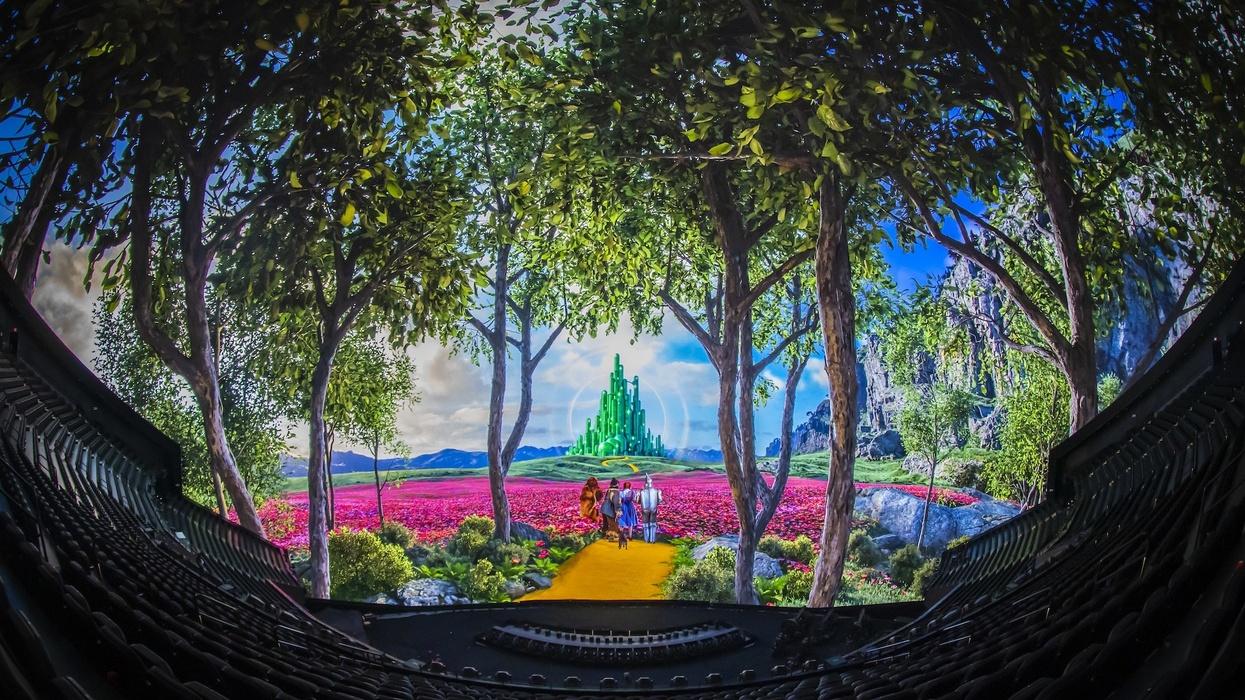
A 1939 Movie Was Never Supposed to Fill a 160,000-Square-Foot Screen
Inside The Wizard of Oz at Sphere, where an 86-year-old 4:3 film had to be reconstructed for a 16K environment that surrounds the audience
When The Wizard of Oz was photographed in 1939, its filmmakers composed Dorothy, Toto, the Scarecrow, Tin Man and Cowardly Lion inside an almost square 4:3 frame.
Eighty-six years later, that frame became a production problem.
Sphere Studios wanted the same film to occupy Las Vegas Sphere’s 160,000-square-foot, 16K × 16K interior display plane—a screen that rises from in front of the audience and continues above them. Simply enlarging the original image would leave most of that enormous visual field empty or destroy the composition through cropping.
So thousands of researchers, programmers, engineers, VFX artists, archivists and producers worked across Sphere Studios, Google Cloud, Google DeepMind, Magnopus, Warner Bros. Discovery and other partners to rebuild the film for a medium its original creators could never have anticipated.
The Wizard of Oz at Sphere opened on August 28, 2025.
The interesting production question is not whether AI can make an old movie larger.
It is much harder:
How do you expand a finished film beyond the boundaries its director originally chose—without making it stop feeling like that film?
The Original Frame Was Part of the Direction

A movie frame is not merely a container.
It decides what exists for the audience.
Victor Fleming and the original filmmakers determined where Dorothy stood within that rectangle, how much of the Yellow Brick Road could be seen, when another character entered the image and what remained outside it.
That is direction.
Sphere creates almost the opposite visual condition.
Its display surrounds the audience, meaning a character who once occupied a carefully composed section of a 4:3 image can become tiny if the original frame is simply placed within the larger canvas.
Enlarging it enough to fill the space creates another problem: much of the original image would disappear beyond the audience’s practical field of view.
The solution therefore required more than scaling.
The filmmakers had to reconsider the space around the original frame.
And that is where the project became unusual.
The Missing Image Did Not Exist

Imagine an original shot in which Dorothy appears beside the Scarecrow.
The camera pans.
The Tin Man moves outside the frame.
In 1939, that was perfectly normal.
The camera decides who exists in the shot.
But Sphere’s canvas can expose an enormous environment around the original composition.
Suddenly there is a question no restoration normally has to answer:
What is beside the image?
There is no film negative containing that information. The camera never photographed it.
Sphere Studios and its partners therefore used a technique described as outpainting—extending imagery beyond the original boundaries to build the larger visual environment required by Sphere.
This is fundamentally different from restoring damaged film.
Restoration asks: What was originally there?
Outpainting asks: What might have been there if the camera had been wider?
AI Had to Learn Oz Before It Could Expand Oz

Generic image generation would not have been enough.
Dorothy could not suddenly have a different face.
Toto could not become a slightly different dog.
Costumes, hairstyles, architecture, props and landscapes had to remain consistent with the 1939 production.
The project therefore used archival materials beyond the finished movie.
Google reports that the team gathered material including production photographs, scripts, set plans, illustrations and scores to help fine-tune the systems for the specific visual world of the film.
Google DeepMind and Google Cloud deployed specially tuned versions of technologies including Veo, Imagen and Gemini in the process.
This changes the role of an archive.
Normally an archive documents how a movie was made. Here, archival evidence became part of the machinery required to extend the movie.
A production photograph from 1939 was no longer merely history.
It could help determine what Oz should look like beyond the surviving frame.
First, 35mm Film Had to Survive 16K

Before inventing anything outside the frame, the team faced a more basic problem.
Resolution.
The original film was photographed on 35mm using the three-strip Technicolor process. Sphere’s interior display operates at 16K × 16K resolution.
Magnifying old film imagery to that scale exposes everything:
grain,
softness,
edge detail,
skin texture,
costume detail,
optical artifacts.
The project used super resolution, with AI-assisted processes reconstructing detail needed to present the historic footage at Sphere’s extreme scale.
But there is an important creative danger here.
Too little reconstruction and the image collapses when enlarged. Too much and Judy Garland stops looking like film photographed in 1939.
A restoration can become so clean that it erases the photographic character it was supposed to preserve.
The technical objective therefore cannot simply be: more detail.
It has to be: enough detail to survive the new medium without destroying the old one.
Then Characters Had to Exist Between Shots

Outpainting solves missing environment.
It does not solve every missing performance.
Traditional film editing frequently cuts between characters. One performer may be outside the frame while another is speaking. A camera pan can temporarily remove someone from view.
That works because cinema controls attention through editing.
Sphere complicates that grammar.
When the environment surrounds the audience, viewers may expect characters to continue existing within that expanded world.
The production therefore developed what Sphere calls performance generation—creating portions of performances for characters known to be present in a scene but not continuously visible because of the original camera framing and edits.
Google describes the process as interpolating between shots and frames to complete performances within the expanded composition.
This may be the project’s most provocative production decision.
The technology is no longer only restoring pixels.
It is reconstructing continuity of performance.
The Camera Could No Longer Own the Audience’s Eyes

Cinema has spent more than a century perfecting a powerful agreement.
The director chooses the shot.
The audience looks inside it.
Sphere weakens that agreement.
An audience member can look forward.
Or upward.
Or toward the edge of the surrounding image.
This means composition cannot depend entirely on one rectangular focal area.
But abandoning visual hierarchy would be equally disastrous.
If everything surrounding the audience demands attention simultaneously, the experience becomes exhausting.
The production therefore faces a contradiction unique to large immersive media:
create enough image to fill the environment while still telling people where the important story is happening.
Scale is not direction.
Resolution is not direction.
Immersion is not direction.
The larger the canvas becomes, the more carefully attention must be controlled.
The Yellow Brick Road Became an Architectural Device
Few images in cinema are better suited to immersive adaptation than the Yellow Brick Road.
In the original film, it guides characters through the composition.
Inside Sphere, it can perform another job. It can organize spatial attention.
A road naturally suggests direction.
Foreground leads to background.
Curves imply movement.
Landscape can extend around it without destroying the audience’s understanding of where the journey is headed.
That makes the Yellow Brick Road more than recognizable production design.
It becomes a navigation system for an enormous visual field.
This is a useful lesson for immersive content.
The strongest compositions often contain their own instructions.
A line.
A corridor.
A beam of light.
A horizon.
A moving figure.
Something must tell the eye: follow this.
The Tornado Was No Longer Allowed to Stay Inside the Movie
In a cinema, Dorothy’s tornado exists behind the screen.
Sphere changes the relationship.
The venue uses environmental effects including high-velocity wind arrays, atmospheric fog and haptic seating to extend events beyond the display surface.
The tornado therefore gains another layer.
The image shows instability.
Sound surrounds the audience.
Air moves through the auditorium.
Seats can transmit low-frequency physical sensation.
The scene begins crossing from representation into bodily experience.
This is an important threshold.
Once wind reaches the audience, the film is no longer contained entirely in pixels.
The auditorium has joined the scene.
167,000 Speakers Changed What “Film Sound” Could Mean

The visual scale attracts most of the attention, but the audio problem was equally unusual.
Sphere says its immersive sound system uses 167,000 individually amplified loudspeaker drivers, allowing sound to be precisely directed throughout the venue.
The original songs were remastered, while their orchestrations were re-recorded for the Sphere presentation.
This creates a fascinating production tension.
Audiences need to recognize music they have known for decades. But the room is nothing like the cinemas for which that music was originally mixed.
Sound can now possess extraordinary location, scale and physicality.
Sphere has described using infrasound and intentional reverberation during key moments, including the Wizard’s throne-room sequence.
The challenge is similar to the visual reconstruction.
Modernize the experience.
Do not erase its identity.
Oz Could Now Touch the Audience

The Wizard of Oz at Sphere became the venue’s first 4D production at this scale.
The production uses environmental effects and haptic seats, with Sphere also describing wind, fog, fire effects, scents and other sensory interventions in the current experience.
This changes the traditional hierarchy of film effects.
Originally:
Dorothy experiences the tornado.
The audience watches Dorothy experience the tornado.
Now:
Dorothy experiences the tornado.
The audience sees the tornado.
The auditorium produces wind.
The body receives vibration.
The environment participates.
That is no longer merely an expanded movie screen.
It is closer to show control synchronized to cinema.
But More Sensation Is Not Automatically More Immersion

A dangerous assumption in immersive production is that every available system should fire whenever possible.
Wind.
Haptics.
Fog.
Scent.
Fire.
Surrounding image.
Directional sound.
Use everything at once and the result may become less immersive, not more.
The audience starts noticing effects instead of story.
The correct question is not: What can Sphere do here?
It is: What should the audience physically feel at this precise moment?
A tornado justifies wind.
A threatening Wizard can justify infrasound.
A changing environment may support scent.
But restraint between those moments gives the next effect somewhere to go.
Immersion needs dynamic range just as lighting and music do.
If everything is maximum, nothing feels maximum.
The Most Difficult Creative Decision Was What Not to Invent

Generative technology creates an unusual temptation.
Once a production can extend a landscape beyond the original frame, why stop?
Why not add more Munchkins?
More buildings?
More creatures?
More movement?
More Oz?
Because technical possibility is not authorship.
Sphere says the production sought to remain faithful to the original film and filmmakers’ intent, while Warner Bros. worked with the project on continuity.
That makes limitation part of the creative process.
AI can propose an image. But somebody still has to decide whether that image belongs in The Wizard of Oz.
This is where the project remains fundamentally human.
The important creative act is not generation.
It is judgment.
A Restoration Normally Looks Backward. This One Had to Look Sideways.

Film restoration traditionally attempts to return audiences closer to an original work.
Repair damage.
Correct color.
Recover detail.
Preserve sound.
The Wizard of Oz at Sphere has a different task.
The original movie remains. The Sphere version is an adaptation into another medium.
It asks what happens when cinematic composition becomes environmental composition.
When a frame becomes architecture.
When soundtrack becomes spatial sound.
When weather enters the auditorium.
When missing areas around an image have to be constructed.
That distinction matters.
Calling the project simply a restoration understates what happened.
It is closer to media translation.
The source language is 1939 cinema.
The destination language is Sphere.
The Production Team Had to Protect Imperfection

There is another reason the project is difficult.
Old movies contain texture created by their technology.
Film grain.
Optical softness.
Painted scenery.
Practical makeup.
Studio lighting.
Physical miniatures and effects.
Those characteristics are not merely technical limitations.
They are part of how audiences recognize the film.
A modern system capable of generating extraordinary detail can accidentally reveal too much—or create detail that never belonged there.
At Sphere scale, a tiny face becomes enormous. Every decision becomes visible.
So fidelity cannot mean maximum sharpness.
It must mean preserving the relationship between detail and memory.
Sometimes the most accurate reconstruction may be the one that knows when not to clarify.
Thousands of People Worked to Make One Old Film Feel Continuous
Sphere says thousands of researchers, programmers, engineers, VFX artists, archivists and producers contributed to the transformation.
Google similarly describes collaboration among Google DeepMind, Google Cloud, Sphere Studios, Magnopus, Warner Bros. Discovery and teams across the film and technology industries.
The scale of that collaboration reveals something important.
Generative AI did not eliminate production.
It created new production problems.
Models required tuning.
Archive material needed research.
Outputs required evaluation.
Characters needed consistency.
Expanded environments needed art direction.
Traditional VFX remained part of the workflow.
Sound required reconstruction.
Environmental effects needed synchronization.
And every new image had to coexist with performances recorded more than eight decades earlier.
The automation did not remove human judgment.
It multiplied the number of places where judgment was required.
Production Logic — Don’t Enlarge the Picture. Rebuild the Relationship.
The obvious way to think about The Wizard of Oz at Sphere is:
small movie becomes enormous movie.
That misses the production problem.
The real transformation is a change in relationships.
Frame → environment
viewer → participant
soundtrack → spatial field
weather on screen → physical air
film restoration → media adaptation
off-screen space → generated environment
The production therefore could not simply enlarge Dorothy. It had to rebuild the relationship between Dorothy and the audience.
That is why super resolution alone would never have been enough.
A 16K version of the original rectangle would still be a rectangle.
Sphere demanded another grammar.
Editor’s Take — The Future of Immersive Content May Depend on Knowing Where the Original Ends
For IMMERSIVE LAB, the most important question raised by The Wizard of Oz at Sphere is not whether AI should be used in entertainment.
That question is already too broad.
The production problem is more precise:
When technology can create material the original artists never made, where should the new creator stop?
This project sits directly on that boundary.
Some pixels originate in 1939.
Others have been reconstructed.
Some environments extend beyond what the original camera captured.
Some character performances had to be completed across spaces and moments the original edit never showed.
Wind, haptics and environmental effects obviously did not exist inside Fleming’s film.
Yet the finished experience still asks audiences to believe they are watching The Wizard of Oz.
That means the most valuable skill in the next generation of immersive production may not be the ability to generate unlimited imagery.
It may be the ability to identify the invisible line between:
expanding a world
and
replacing it.
Sphere’s 160,000-square-foot screen makes that line enormous.
It does not make it any easier to find.
References & Further Reading
Sphere Studios — AI in The Wizard of Oz at Sphere
Google — How AI Helped Rebuild Oz for Sphere
Sphere — The Wizard of Oz at Sphere Experience
Sphere — The Iconic Sounds of Oz Come to Sphere


