Muse Turned Simulation Theory Into a Live Sci-Fi Universe
The Night a Rock Concert Became a Live Science-Fiction Film
On 22 February 2019, Muse opened the Simulation Theory World Tour at the Toyota Center in Houston. By the time the tour ended that October, it had travelled through more than 28 countries and played to more than one million people. But the most revealing fact about the production was not its size. It was that creative director Jesse Lee Stout had already been designing its world before the concert existed.
Stout had been involved with the album artwork, styling, photography and VR-related material. While those pieces were being developed, one idea kept returning: a spaceship. Eventually that spaceship stopped being an image. It became the stage.
The Stage Started With an Album Cover

Most concert productions begin after the music is largely finished. Simulation Theory developed differently. Muse had built an aesthetic universe around 1980s and 1990s science fiction, video games, cyber-noir and virtual reality. Stout’s job was not simply to design scenery for songs; he was responsible for maintaining that visual language across the wider album campaign.
That changed the design process. Instead of asking what the stage should look like, the team could ask what a stage inside this fictional universe would look like. The answer was not a realistic spaceship. It was the visual memory of one: neon outlines, geometric ramps, dark surfaces, hard linear lighting, electronic masks, a large central screen, and performers who sometimes looked less like dancers than characters generated by a computer.
The Screen Was Curved the “Wrong” Way
One of the most interesting decisions sat behind the band. The large upstage video screen was convex toward the audience. Stout had a specific reason: he did not want the audience constantly turning toward conventional side IMAG screens. The central screen needed to remain part of the scenic world while simultaneously carrying imagery and camera content. This meant video was no longer something attached to the set—it became the visual horizon of the set.
A long runway extended from the main stage into the audience, giving Matt Bellamy a route toward the crowd while the giant central image remained behind him. The geometry created two opposing forces: the screen pulled attention backward, the runway pushed the performer forward. The audience was placed between them.
Jesse Lee Stout Refused to Illustrate Every Lyric

This is where Simulation Theory separated itself from a conventional rock-video package. Stout deliberately avoided making every song’s visuals a literal interpretation of its lyrics. Instead, the songs existed inside the same fictional universe. That allowed the concert to behave more like a film: characters could return, objects could reappear, costumes could belong to the same world. Video could advance an atmosphere rather than explain a lyric. Lighting could establish location. The stage itself could become a recurring environment. The production had acquired something rock concerts rarely need: world-building.
The Dancers Weren’t Really Dancers
The additional performers were conceived as NPCs—non-player characters, borrowing terminology directly from video games. Choreographer Andrew Winghart developed tightly controlled robotic movements and geometric formations rather than conventional background dancing. Reflective costumes and illuminated masks pushed the effect further; the performers could appear human one moment and synthetic the next.
That mattered because three musicians alone could not physically populate the enormous fictional environment the production was creating. The NPCs solved the scale problem—they filled the runway, occupied the stage architecture, surrounded Bellamy, and gave the fictional universe inhabitants. Instead of hiring dancers and finding something for them to do, the production created characters and then choreographed their behaviour.
Lighting Became a Character
Lighting designer Sooner Routhier had previously designed for artists including The Weeknd, Depeche Mode and Halsey, but Simulation Theory was her first Muse tour. Stout described the show’s environment as “Cyber Noir.” Within that concept, lighting was not supposed to function merely as illumination—it had to become another character. Routhier responded with strong linear geometry: trusses could emerge from darkness, light traced ramps and scenic edges, beams created enormous perspective lines through the arena. Colors were bold and relatively uncomplicated. The idea was closer to cinematic production design than decorative concert lighting.
98 Robe Lights Became 124

The production had another problem: it had to exist in both arenas and stadiums. For arena performances, Routhier’s Robe package included 74 MegaPointes and 24 BMFL Spots—98 fixtures. The stadium configuration expanded the Robe count to 124 fixtures, including 72 MegaPointes, 30 BMFL Spots and 12 BMFL FollowSpot LTs.
The numbers themselves are less important than their locations. In arenas, 32 MegaPointes were deployed on the handrails surrounding the set, 22 along the thrust and B-stage, and 20 on truss towers positioned within the audience seating. That spread light beyond the traditional proscenium. The lighting system was invading the room. Muse wasn’t simply performing in front of the audience—parts of the production surrounded them.
24 Lights Followed People Without Human Operators Aiming Them
Above the B-stage were 24 BMFL Spots, all remotely controlled using a BlackTrax tracking system. This solved one of the least glamorous but most important problems in a visually dense show: keeping the musicians visible. Bellamy could move along the thrust, performers could occupy different elevations, video could become extremely bright, lasers could fill the air, scenic LED could outline the architecture—yet the audience still needed to see a human face. Tracking technology allowed the lighting system to react to performer position rather than depending entirely on fixed focus areas. The technology was sophisticated. Its purpose was extremely simple: don’t lose the person inside the spectacle.
Then They Added 227 More Sources of Light

The spaceship illusion did not come from moving lights alone. The tour used 176 Solaris Flare LR fixtures and 51 Solaris Flare Q+ fixtures as part of its visual system. Neon outlines made from Upstaging Sabers traced the sides of the trusses, while the brighter Flare LRs accentuated the truss lines—at the tip of each truss, the structure flipped up 45 degrees with three LRs side by side, representing the thrusters of the spaceship. The Flare Q+ fixtures sat inside ramps in the stage floor, functioning as glowing metal gratings and vents.
This is a crucial scenic trick. A normal concert truss is infrastructure. Outline its geometry with light and suddenly the audience starts reading its shape—infrastructure becomes architecture. Routhier said Stout wanted the lighting rig and stage to feel like a spaceship pulled from familiar 1980s and 1990s science-fiction imagery. They didn’t need to build a complete spaceship. They needed the audience’s brain to complete one.
The Band Wore Part of the Set
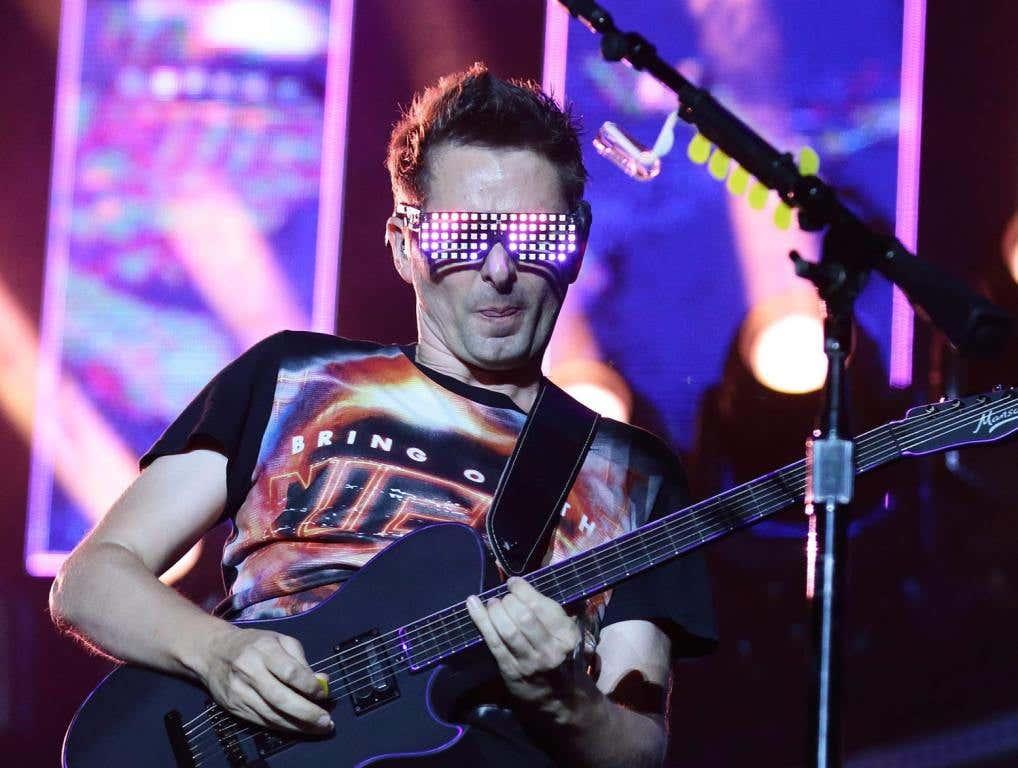
LED technology also migrated onto the performers. The production incorporated illuminated glasses, performer uniforms, props, Bellamy’s custom “power glove,” an LED-outlined piano and LED drums. That eliminated a traditional boundary: where did scenery stop—at the edge of the stage, at the screen, at the musician? In Simulation Theory, the same visual language could appear on a giant scenic element and then continue onto a performer’s body. The stage was not a background anymore. Everyone on it belonged to the same graphical system
The Lasers Were Designed for 360 Degrees

ER Productions handled the tour’s lasers and special effects, running custom power distribution across the main stage and 14 lighting towers positioned stadium left and stadium right. Their team described creating a 360-degree laser experience for the audience, using lasers both as lighting effects and as projected effects extending into the crowd.
That distinction matters. A laser aimed toward scenery produces an image. A laser sent through atmospheric space produces architecture—empty air acquires edges, planes appear above heads, perspective lines cross the stadium. The audience is no longer looking at the effect; they are sitting inside it. For a show concerned with simulated reality, this was particularly appropriate: the production was physically demonstrating one of its central ideas, that something which does not actually exist can still define the space around you.
And Then a Giant Creature Appeared
Near the climax, the fictional world produced its largest character. Fans came to know it as Murph—a huge inflatable robot skeleton, named by Stout as a nod to Murphy from RoboCop, designed to appear like a video-game “end boss” that the band ultimately defeats before rejoicing with the unification anthem “Knights of Cydonia.” The inflatable was built by Airworks Inflatables, using pressurized sections, ropes and pulleys operated by puppeteers to let Murph breathe, attack and open his mouth to reveal a powerful light hidden in his throat; two alternate versions, with an added belly section, could be swapped in for stadium shows requiring extra height. TAIT handled staging and automation, and ER Productions the lasers and special effects.
Murph changed the scale of the performance instantly. Until then, humans controlled the stage. Now something far larger appeared to occupy it—an old theatrical technique executed with modern touring technology: change the audience’s understanding of scale late in the show.
The Most Difficult Scenery Was Nothing at All

When the production moved into European stadiums, Stout wanted to preserve a stage with no conventional roof dominating the design, to maintain the integrity of the spaceship geometry. Technically, that created a new enemy: weather. The tour’s production manager later described an open-top, frontloaded show with no direct solution for weather protection—crews were simply out in the elements or not. Fixtures not necessarily designed for constant exposure had to be weatherproofed by the touring departments.
This reveals a production truth audiences rarely notice: removing architecture can be harder than adding it. A roof provides protection, rigging positions, cable routes, working structure and predictable shelter. Delete it for aesthetic reasons and the engineering does not disappear—the problems simply move somewhere else. The clean silhouette seen by the audience was therefore partly created by technical complications they never saw.
Video Was Being Created While the Show Was Happening
Silent Partners Studio and Hidden Road Studio produced video content and live visual effects, with Frame48 contributing interstitial material. A Disguise GX 2 media server drove video and real-time Notch content. That word—real-time—changes the nature of the screen. Traditional playback says: play this finished movie now. Real-time processing says: take what is happening now and transform it. The concert therefore occupied a space between cinema and live television. Some imagery was pre-produced, some came from cameras, some could be processed during the performance. The audience was watching Muse and, simultaneously, watching the fictionalized version of Muse being manufactured on the screen
The Concert Eventually Became an Actual Film
In August 2020, Muse released Simulation Theory: The IMAX Experience, directed by Lance Drake and built primarily around live footage filmed at London’s O2 Arena in September 2019, expanded into a narrative concert film about scientists investigating a paranormal anomaly. That sounds like a concert being adapted into cinema. But the direction of travel had actually started much earlier: album artwork informed the visual universe, the visual universe informed the stage, the stage behaved like a movie, and the movie then absorbed the stage. What began as an album campaign had become a circular production system—music, graphic design, costume, VR, scenery, lighting, choreography, video, concert, film—each medium feeding the next.
Editor’s Take
Simulation Theory is important because its departments were not simply coordinated—they were given the same fictional world to inhabit. Lighting designer Sooner Routhier did not have to invent an unrelated lighting language. The costume department did not have to invent an unrelated future. Video, choreography, lasers and scenery all inherited the same visual DNA. That is why the show could contain enormous amounts of technology without looking like a technology demonstration. The most sophisticated production decision happened before a fixture was hung: everyone was designing the same universe.
References & Production Sources
TPi — Robe Adds to Muse Simulation Theory Tour Lighting
PLSN — Muse Simulation Theory World Tour Production
TPi — TMB Gear Supports Lights, Lasers and Visuals on Muse World Tour
Muse Official — Simulation Theory Film
The next LIVE STAGE story goes in the opposite direction. Bruce Springsteen’s Born in the U.S.A. Tour asks what production looks like when the performer—not a giant scenic machine—has to fill the stadium.


