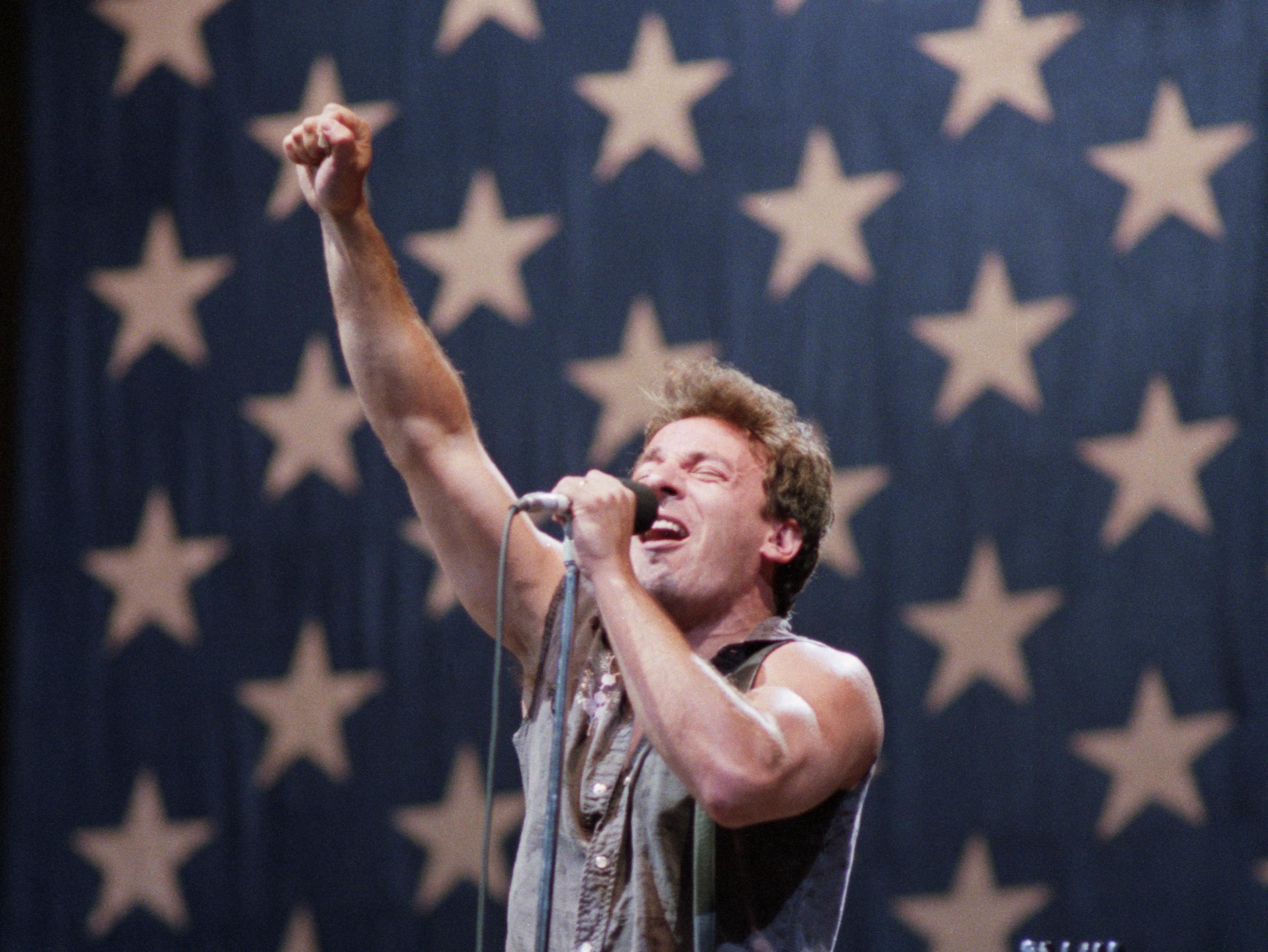
Bruce Springsteen Lit a Stadium With Zero Moving Lights
Hundreds of Lights, Zero Automation—and a Performer Who Wouldn’t Stand Still
When Jeff Ravitz designed the lighting for Bruce Springsteen’s Born in the U.S.A. Tour in 1984, his rig contained hundreds of PAR 64 lamps, roughly a dozen aircraft landing lights, Altman ellipsoidals and about twelve GAM ColorMax gel scrollers. What it did not contain was more surprising: automated moving lights. Ravitz later described the tour as having essentially zero lighting automation apart from the color scrollers.
A year later, that conventional lighting system was helping illuminate Springsteen in front of 83,000 people at the Los Angeles Memorial Coliseum. The production problem was therefore almost the reverse of today’s stadium concert. There was no enormous LED world to hide behind. No automated scenery constantly changing shape. No media-server universe. The principal scenic event was a man who could move almost anywhere, change the set at any moment and keep playing for hours. The technology had to make him look enormous.
One Color Could Require Eighteen Lights

Modern moving lights can change color, beam shape, position and pattern from a console. The Born in the U.S.A. rig could not. Ravitz recalls that producing a single full-stage color wash with sufficient impact might require 12 to 18 fixtures—perhaps eight from far upstage and another six to eight from midstage. Want six independent color washes? Multiply those fixtures by six. Then add specials for individual musicians, audience lighting, aircraft landing lights and ellipsoidals for pattern projection.
That is why the trusses became packed with conventional fixtures. The quantity wasn’t extravagance. It was the physical cost of choice. Today, one fixture may generate dozens of looks. In 1984, many of those looks required their own lamp.
The Lights Couldn’t Turn. Bruce Could.

That created an unusual relationship between performer and production. Springsteen’s concerts were not built around a singer remaining inside one carefully lit mark. The stage had to support a performer whose physical energy was fundamental to the show. So instead of asking a moving fixture to follow the performance, designers had to build enough coverage into the fixed rig that useful light already existed wherever the action went.
The distinction sounds technical, but it changes the visual language. A contemporary production can continually reshape itself around the artist. The Born in the U.S.A. production created a large illuminated territory and gave Springsteen room to occupy it. The performer supplied the movement.
The Audience Was Part of the Scenery

There is another reason Springsteen lighting requires more than illuminating musicians. He wants to see the crowd. Ravitz has explained that Springsteen treats the audience as an intrinsic part of the performance—a communal experience rather than a dark room facing a bright stage.
That philosophy is particularly important in a stadium. Turn every audience light off and the performer appears to stand in front of a black void. Illuminate tens of thousands of spectators and the apparent architecture of the concert suddenly expands to the walls of the venue. The crowd becomes visible scenery. For Springsteen, that is not merely a big finale trick. It changes the relationship of the room. The show is happening to everyone, not simply in front of everyone.
Then the Tour Outgrew the Arena
The Born in the U.S.A. Tour began at the St. Paul Civic Center on June 29, 1984. As the album exploded commercially, the scale of the venues changed with it. By 1985, the tour had reached major stadiums. At Giants Stadium in New Jersey, Springsteen and the E Street Band played a six-show stand. At the Los Angeles Memorial Coliseum, the final stretch included four performances, with 83,000 people attending the September 27 opening night of that run.
That transition changes almost everything for production. An arena gives a lighting department a building. A stadium often requires production to bring much more of its own architecture. Rigging positions become different. Throw distances increase. Weather enters the equation. The audience extends farther away. And a visual gesture that dominates an arena can disappear inside an enormous bowl. Springsteen had become a stadium act. The production now had to make the same performance language survive the enlargement.
The Stage Didn’t Need to Pretend to Be Anything Else
Compare this production with other stadium tours built around a fictional universe or moving scenic architecture. Springsteen’s stage did not need to become another place. It needed to remain recognizably a rock-and-roll stage. That is an important design decision. Scenic minimalism does not mean production minimalism. If you remove large narrative scenery, the remaining elements become more exposed. The lighting has to carry more visual responsibility. The musicians have to carry more visual responsibility. And the artist’s physical presence becomes disproportionately important. There is nowhere else for the audience to look.
Twelve Aircraft Landing Lights Made Perfect Sense

Among all those PAR lamps was a much stranger source: approximately twelve aircraft landing lights. The appeal is easier to understand when you stop thinking about them as aviation hardware and start thinking about what the audience sees. A powerful, direct white source has an entirely different visual character from a soft theatrical wash. It feels exposed. Physical. Industrial. That vocabulary suited a production that did not want to appear overly theatrical. The lights weren’t trying to make Springsteen’s stage disappear into fantasy. They reinforced the opposite idea: this is a band, on a stage, playing right now.
Twelve Color Scrollers Were a Small Revolution
The rig was not completely static. Ravitz recalls approximately twelve GAM ColorMax gel scrollers. Before widespread automated color mixing, changing the color of a conventional theatrical lamp generally meant placing a different colored filter in front of it. A gel scroller mechanized that process. A roll containing multiple filters could move in front of the lamp, providing several color choices without requiring a separate fixture for every one.
Twelve units sound almost insignificant beside today’s enormous pixel-mapped systems. In 1984, they represented something valuable: flexibility. But they did not eliminate the fundamental limitation of the system. Most fixtures still pointed where they had been focused. The concert’s visual variety had to come from combinations: intensity, color, timing, audience light, silhouette, and restraint.
The Show Could Approach Five Hours
Here is where the lighting problem becomes much more interesting. Ravitz recalls Springsteen performances from that era running more than four hours and, including an intermission, sometimes approaching five. Imagine programming that duration without today’s abundance of automated visual transformations. The obvious solution would be to use everything early and keep recombining it. Ravitz did something more disciplined. He held things back. He has explained that one challenge was reserving certain lighting looks so that something visually new could still appear around the three-hour mark.
That is an extraordinary production lesson. The scarce resource wasn’t electricity. It wasn’t fixtures. It was novelty. If every color, audience look and special is revealed in the first hour, the production has nowhere visually to go. A long Springsteen concert therefore required lighting design to think almost like dramatic writing. Not: what can we show now? But: what must we not show yet?
Darkness Was Part of the Inventory
That principle makes darkness valuable. When a production has hundreds of fixtures available, switching them all on is easy. Keeping them off until they matter is design. A quiet song can contract the apparent size of the venue. A limited pool of light can make a stadium briefly feel intimate. Then, when the full rig and audience lighting return, the building appears to expand again. Nothing physical moved. The architecture changed because the audience’s perception changed. This is how a production without moving scenery can still alter scale.
The Biggest Effect Could Be 80,000 Faces

The logic becomes clearest late in a show. After hours of controlled visual escalation, audience lighting can suddenly reveal the entire stadium. The effect does not introduce a new scenic object. It reveals something that was there all along: people, thousands of them. Springsteen’s longstanding desire to see and interact with the audience gives this lighting choice emotional as well as visual value. Ravitz has described the crowd as fundamental to the communal character of the concerts.
For an artist whose performance depends heavily on direct audience exchange, illuminating the crowd is effectively a two-way lighting cue. The audience sees itself. Springsteen sees the audience. And each side sees the other reacting. The venue becomes part of the performance.
There Was No Automation to Save a Bad Decision

Ravitz’s recollection of the tour is explicit: apart from the color scrollers, there was zero automation. That limitation increases the importance of preparation. A moving fixture focused badly can be repositioned. A conventional fixture hung high above a stage has already made many of its important decisions before the show begins. Where does it point? How wide is the beam? Which color is installed? Which musician or area does it cover? The lighting plot therefore becomes less like a collection of possibilities and more like an inventory of predetermined tools. The creativity happens in deciding when and how to combine them.
The Technology Aged. The Design Problem Didn’t.
Ravitz has remained Springsteen’s lighting designer since joining for the Born in the U.S.A. Tour in 1984—the first vendor he used was Tait Towers Lighting, before founder Mickey Tait sold off the lighting equipment shortly after the tour to focus on scenic construction. The equipment since has changed radically. Modern Springsteen tours use moving lights, sophisticated control, LED sources and far more flexible systems. But Ravitz describes the central challenge in remarkably consistent terms: contemporary audiences expect modern production values, while Springsteen and the E Street Band still need to feel fundamentally like a great rock-and-roll band rather than performers buried inside technology. That tension was already visible in 1984. Technology had to enlarge the performance without becoming the performance. Four decades later, that remains the job.
83,000 People Didn’t Need a Bigger Prop
On September 27, 1985, the tour entered its final four-show stand at the Los Angeles Memorial Coliseum. According to the Los Angeles Times, 83,000 fans attended that sold-out opening night—meaning more than 330,000 people passed through the turnstiles of the same venue that had hosted two Olympic Games, across the full four-show run. The set ran to more than two dozen songs.
There was no giant fictional city towering behind Springsteen. No 30-foot moon. No articulated video ceiling. No enormous inflatable monster. What filled the stadium was a different production system: a large conventional lighting rig, the E Street Band, a performer capable of turning the entire stage into his territory, and an audience that the lighting design deliberately allowed to become visible. The absence of scenic spectacle was not the absence of spectacle. The human scale was the spectacle.
Editor’s Take
The Born in the U.S.A. Tour exposes something modern concert production can easily obscure. A production system does not have to generate the event itself; sometimes its most important task is to make a performer readable at impossible scale. Hundreds of conventional lamps, aircraft landing lights and a handful of color scrollers sound primitive beside today’s automated stadium rigs. But Jeff Ravitz’s harder problem was timeless: how do you keep revealing new visual information three hours into a concert while never allowing the lighting to become more important than Bruce Springsteen? The answer was not more technology. It was visual discipline.
References & Production Sources
Live Design — Jeff Ravitz on Walking the Line for Springsteen
PLSN — Jeff Ravitz, LD for Bruce Springsteen and the E Street Band
Born in the U.S.A. Tour — Wikipedia
The next LIVE STAGE story follows a band that would eventually take the opposite route: Guns N’ Roses — Not in This Lifetime… Tour, where reunion-era stadium scale demanded a completely different kind of production machine.


