Guns N’ Roses Built an 80-Foot Machine for a 1990s Reunion
The Reunion Needed an 80-Foot Machine to Make the Past Look New
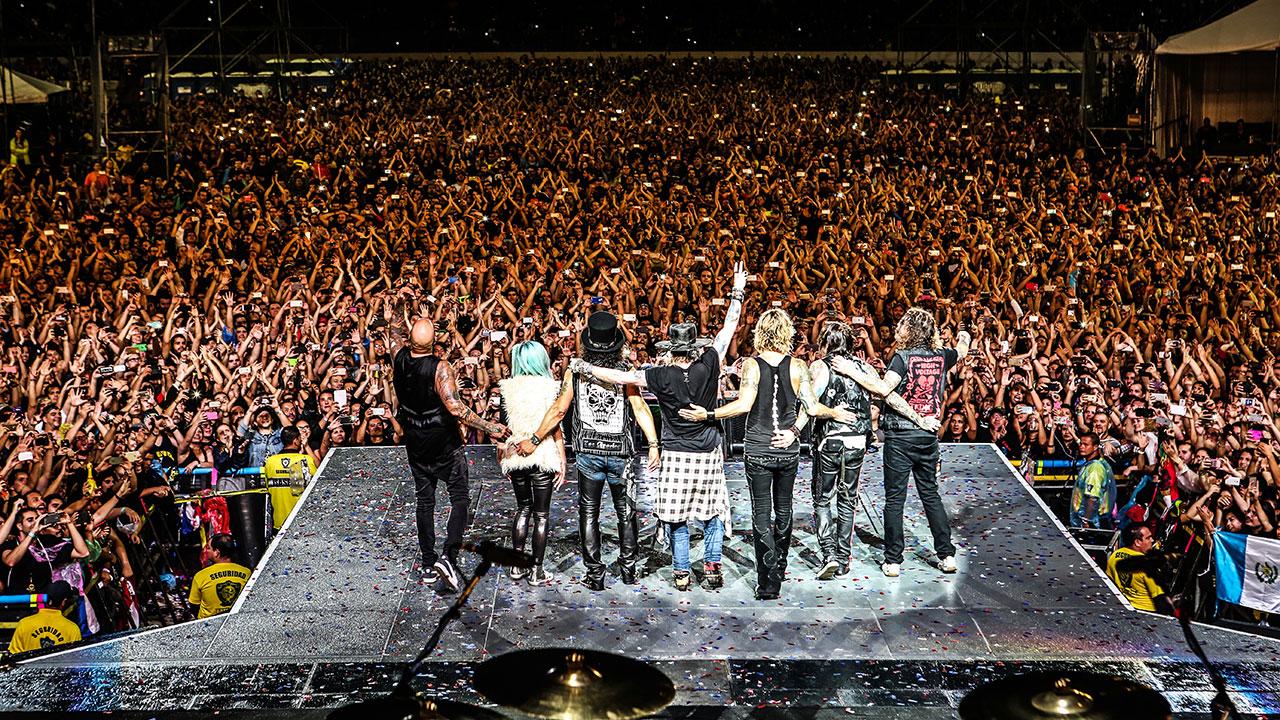
On June 23, 2016, Guns N’ Roses walked onto Ford Field in Detroit with a stage built around a peculiar contradiction. The audience had waited more than two decades to see Axl Rose, Slash and Duff McKagan together again. But production designer Phil Ealy—who had also worked as production designer and lighting director on the band’s enormous Use Your Illusion tour—could not simply rebuild a 1991 rock show.
TAIT’s solution included a 71-foot-wide main stage, LED staircases, LED fascia and amp stacks, a self-climbing piano lift, and an 80-foot automated video-track system capable of physically rearranging the video screens. The reunion was selling memory. The production had to make that memory look large enough for 2016.
The Designer Had Already Seen the Band at Its Most Excessive

Phil Ealy was not approaching Guns N’ Roses as a stranger. He had been production designer and lighting director during the sprawling Use Your Illusion period, when the band established the visual vocabulary many returning fans still associated with a Guns N’ Roses stadium show.
That history created an advantage—and a trap. Too little production and the reunion could feel diminished. Copy the old production literally and it could look dated. So Ealy’s starting point was not to reproduce the equipment of the early 1990s. It was to recover what he described as the feel of an old-school mega rock show, then combine it with contemporary technology. That distinction shaped almost everything that followed. The production did not need to pretend it was 1991. It needed to remind the audience why 1991 had felt enormous.
The Stage Was 71 Feet Wide—But It Wasn’t Just a Platform

TAIT built the main stage at 71 feet wide. Inside it were band risers, LED staircases constructed with TAIT P9 video tiles, illuminated fascia and LED amp-stack elements. This is important because video had escaped the conventional rectangle. Pixels existed in the architecture itself. A staircase could still function as a staircase while becoming a luminous surface. A fascia could define the physical edge of the stage and simultaneously participate in the visual composition.
The stage therefore had two identities. Structurally, it carried people and equipment. Visually, parts of that structure behaved like video. For a reunion built around familiar musicians rather than an elaborate fictional world, that was a useful compromise. The stage remained recognizably rock-and-roll. But it could change appearance without changing its fundamental architecture.
Then the Video Wall Started Moving

Behind the band was the production’s more radical piece of machinery. TAIT developed an 80-foot automated video track truss system fitted with power-transmission units for the Screenworks video displays. The screens could reorganize into configurations ranging from three to six columns, controlled through TAIT Navigator automation.
That meant the backdrop was not one fixed screen showing different pictures. Its physical composition could change. Three columns create one visual rhythm. Six narrower columns create another. Gaps introduce negative space. Separate screens can frame musicians. Join the visual surfaces and the stage acquires greater apparent mass. This was scenic automation disguised as video.
“November Rain” Required a Piano to Climb Out of the Stage

There is a problem with one of Guns N’ Roses’ most recognizable songs. A grand piano is not subtle. Leave it permanently onstage and it occupies valuable performance space for the rest of the concert. Roll it manually onto a stadium stage and the transition itself can become distracting.
TAIT built another solution: a self-climbing piano lift. For “November Rain,” the piano could emerge as part of the stage machinery, with TAIT Navigator controlling the lift as well as the automated video system. That gave the instrument a theatrical entrance without turning the entire concert into theatre. Before the song, the stage did not need a piano. Then suddenly it did. The machinery solved the transition. More importantly, it protected the song’s identity. The audience wasn’t merely waiting to hear the opening piano notes. They were waiting for the November Rain moment.
133 Fixtures Did the Same Job on Purpose
The 2016 lighting inventory reveals another design choice. Seven over-stage lighting pods were each loaded with 19 GLP impression X4 wash lights—133 units in total—alongside 73 Martin MAC III AirFX units, 34 Robe BMFL Spots, 25 BMFL WashBeams, 48 Martin Atomic LED strobes and additional fixtures.
Why use 133 units of one fixture? Because repetition creates architecture. A single light is an effect. Dozens of identical fixtures distributed systematically across a rig can create a visual structure. Large rock shows depend on this distinction. The audience at the rear of a stadium cannot necessarily appreciate a tiny piece of lighting detail. It can read a huge line, a huge wall, a repeated pattern, a field of beams. Ealy and programmer/director Rob Koenig were not trying to make every fixture demonstrate everything it could do. They were trying to produce what Ealy called big rock-show lighting.
Six Followspots Were Still Necessary

For all the automation, video and intelligent lighting, the production still needed one of concert lighting’s oldest solutions: followspots. The 2016 equipment list included six Robert Juliat Lancelot followspots. The reason becomes obvious when you consider the performers. Axl Rose moves. Slash moves. Duff moves. The stage contains stairs, risers, a thrust and multiple performance levels. Meanwhile, video is generating enormous brightness behind them. A sophisticated background can actually make the basic job of seeing a human performer harder. The larger the visual machine becomes, the more important controlled key light can become. Technology had modernized almost everything around Guns N’ Roses. But someone still needed to make sure the audience could see Slash when he stepped into a solo.
Video Had Two Jobs That Fought Each Other
Screenworks supplied the video system, while Steve Fatone directed video and Creative Works, led by Dan Potter, produced visual content. The system had to solve two very different problems. First: show the musicians to people far away. Second: create visual content that contributes to the show. Those goals can conflict. IMAG—live camera magnification—wants clarity. Creative content wants composition. A close-up of Slash’s hands may be perfect for a spectator 100 metres away but visually disruptive inside a carefully designed graphic sequence. Conversely, beautiful abstract content may do nothing for someone who paid to watch the reunion and can barely see the musicians. The moving-column system provided another variable. Video could be one large scenic statement at one moment and fragmented architecture at another. The screen did not always have to choose between television and scenery. Sometimes it could become both.
The Thrust Wasn’t There to Make the Stage Look Bigger

A stadium stage creates distance. The thrust attacks that distance physically. Extending performance space into the audience gives musicians another scale of interaction: instead of enlarging them digitally, production moves them closer. That is especially important for Guns N’ Roses. A Slash solo seen exclusively on a giant screen can be visually impressive. Slash physically standing farther into the crowd changes the emotional geometry of the venue. One solution is technological enlargement. The other is proximity. Great stadium production uses both.
The PA Had to Make a Stadium Feel Like a Rock Club
Clair Global supplied audio for the tour, with Caram Costanzo at front of house and separate monitor engineers handling Axl Rose and the rest of the band. That division hints at the complexity hidden behind a supposedly straightforward rock concert. The visual proposition was nostalgic. The audio expectation was not. An audience in 2016 did not want 1991 stadium sound reproduced for historical authenticity. They expected contemporary coverage, intelligibility and low-frequency impact. This is one of the recurring contradictions of reunion production: the memory can be old; the technical standard cannot.
The Roof Came Before the Design
There is a revealing detail in Ealy’s design process. Production manager Dale “Opie” Skjerseth already had a Stageco stage and roof system established for the stadium shows. So Ealy designed around it. This is how touring production differs from unrestricted concept art. A designer does not begin with infinite space. There is a roof. There are load limits. There are truck packs. There are video dimensions. There are sightlines. There is weather. There is a schedule. There is a budget. The creative design lives inside those constraints. Instead of treating the Stageco structure as an inconvenience, Ealy made it the framework into which lighting, video and scenic systems could be integrated.
Pyro Couldn’t Just Be “More Fire”
The production also carried pyrotechnics, supplied in the 2016 package by Stage & Effects Engineering. For Guns N’ Roses, pyro is almost expected. That creates the same problem KISS faced in its own farewell production: when an effect is expected, simply including it is not enough. Timing becomes more important than quantity. “Live and Let Die” provides the obvious opportunity because the music itself contains enormous dynamic punctuation. Pyro can therefore behave like another instrument. Explosion and musical impact become one event. The audience may remember the fire. Production remembers the cue.
The Show Had to Look Dangerous Without Becoming Disorganized
Consider everything sharing the same three-dimensional environment: automated video columns, lighting, followspots, pyrotechnics, musicians, LED stairs, the piano lift, camera positions, PA hangs, rigging, crew access. From the audience, Guns N’ Roses can look loose. That is part of the appeal. A rock show should not feel as if the musicians are performing inside a spreadsheet. But backstage, looseness has limits. A moving screen must know where it is. A lift must know where it stops. Pyro must know when it fires. A camera operator needs a route. A performer needs a clear path. The audience buys unpredictability. Production manufactures repeatability around it.
Then the Machine Had to Leave
TAIT describes its own touring philosophy in a revealing way: opening-night spectacle matters, but so does a quick, safe and efficient load-out. That second half is invisible to almost everyone with a ticket. At the end of a stadium show, the production cannot remain an impressive piece of architecture. It has to become freight. Video becomes cases. Lighting returns to racks. Scenery separates into transportable components. Cable is coiled. Automation is secured. The 71-foot stage disappears. Then the system travels and has to become a concert again. This cycle may repeat dozens of times. A beautiful stage that cannot tour efficiently is not a successful touring stage.
158 Shows Turned a Reunion Into an Industrial System
The tour eventually became far larger than a nostalgia event. By its conclusion in November 2019, Not in This Lifetime… had played 158 shows across six continents, sold 5,371,891 tickets and grossed $584.2 million, according to Billboard figures reported at the end of the run—making it the third-highest-grossing tour in Billboard Boxscore history.
Those numbers change how the production should be understood. A stage used once can afford certain inefficiencies. A system expected to cross continents for years cannot. Components need to survive repeated assembly. Programming has to adapt. Local infrastructure changes. Stadiums become arenas. Festival conditions appear. Transport rules change by territory. Replacement equipment has to be considered. The show is no longer merely a design. It is an operating system.
The Biggest Technology Was Trust
There is one final reason the production worked. The reunion itself was the headline. Fans were not buying tickets primarily to inspect an 80-foot automated video truss. They wanted to see three people occupying the same stage again. That placed an unusual responsibility on production. Too little and the reunion would feel undersized. Too much and the machinery could become the story. The solution was to modernize the familiar grammar of Guns N’ Roses rather than replace it: big stage, big lighting, huge video, pyro, a piano emerging for “November Rain,” Slash stepping forward with a guitar, Axl crossing the stage, Duff holding down the other side. The technology made the memory visible at stadium scale. It did not ask the audience to forget why they came.
Editor’s Take
The most interesting machine on Not in This Lifetime… was not the 80-foot automated video system or the self-climbing piano. It was the production’s ability to translate an old visual language into a new technical era. Phil Ealy already knew what a giant Guns N’ Roses show felt like because he had lived through the Use Your Illusion years. The challenge in 2016 was not to rebuild that stage—it was to identify which memories mattered and engineer modern equivalents. That is the real production lesson of a successful reunion: nostalgia should determine the emotion, not the technology.
References & Production Sources
Live Design — TAIT Delivers Full Stage Production for Guns N’ Roses Tour
PLSN — Guns N’ Roses 2016 Not in This Lifetime Tour
Billboard — Guns N’ Roses Wrap Not in This Lifetime Tour
The next LIVE STAGE story moves from reunion to reinvention: Harry Styles — Love On Tour, where an arena-scale relationship with the audience had to survive the move into stadiums.


