Harry Styles Had 5 Million Fans—The Stage Had to Feel Smaller
The Stadium Show That Tried to Make Five Million People Feel Close
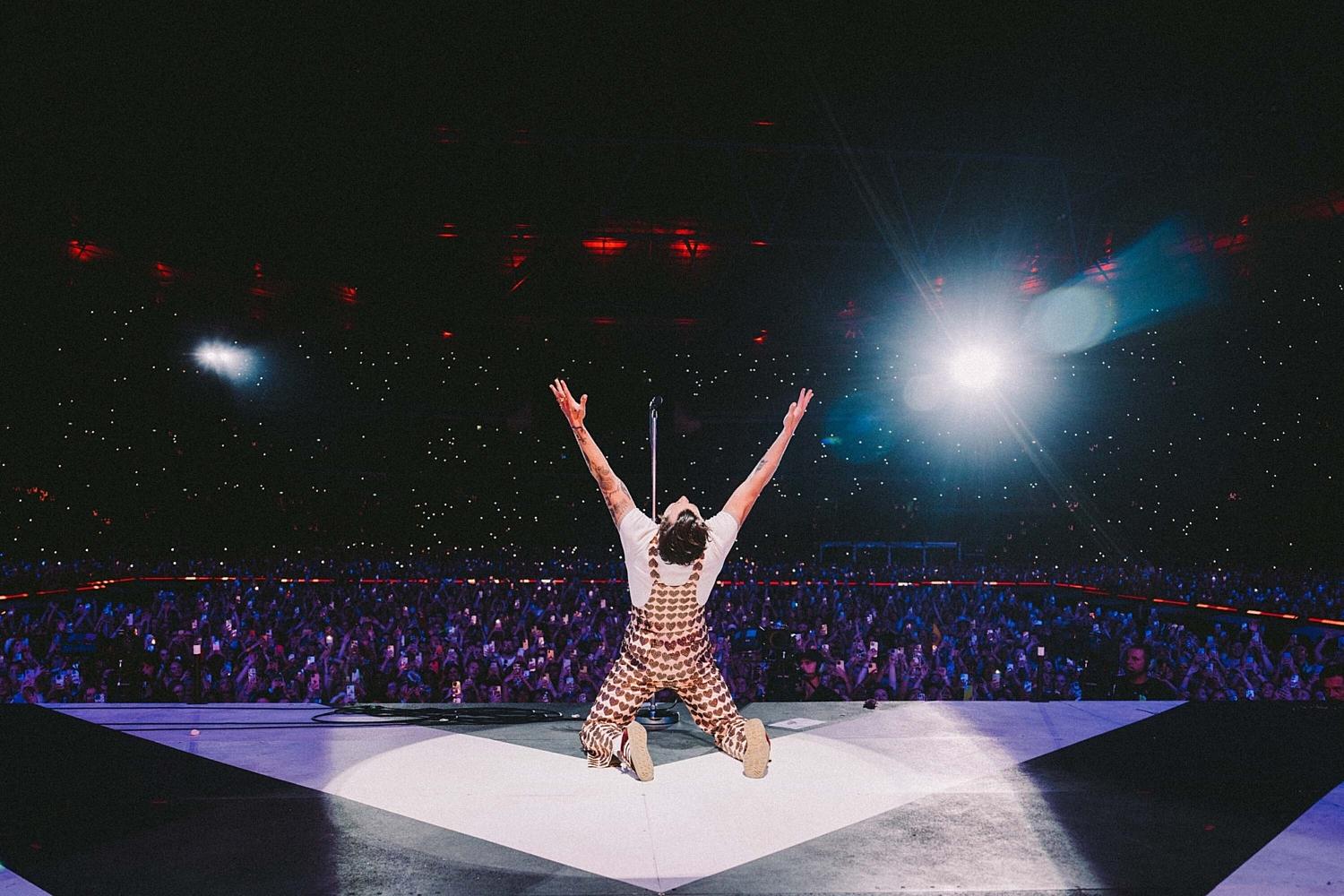
On the final night of Love On Tour, more than 100,000 people gathered at RCF Arena in Reggio Emilia, Italy. By then, the tour had played 173 dates and reached more than 5.04 million fans. It had sold out 20 nights at Madison Square Garden, 18 at the Kia Forum and broken an attendance record at Wembley Stadium.
Those numbers suggest a production designed around scale. But much of the technology behind Love On Tour was actually solving the opposite problem: how do you stop Harry Styles from disappearing inside his own success?
The First Version Put the Audience on Every Side

When Love On Tour finally began in September 2021 after its pandemic postponement, the North American production used an in-the-round configuration. That decision immediately changed the normal hierarchy of an arena concert. There was no comfortable permanent “back” of the stage. Harry Styles had spectators behind him, beside him and in front of him. The band also had to remain visually important from multiple directions.
TAIT supplied staging, Solotech handled rigging, lighting and video, and the creative team included production and lighting designer Baz Halpin of Silent House Studios and creative director Molly Hawkins. The stage was not designed to create distance. It was designed to destroy it.
Twelve PA Hangs Surrounded the Room
The visual problem was only half of it. An in-the-round audience also destroys the assumptions of a conventional left-right PA. For the residency-era production, Britannia Row deployed 12 PA hangs, with as many as 210 loudspeakers using L-Acoustics K2, KS28, KS21, Kara II, A15 and A10 systems.
That number reveals what 360-degree intimacy costs technically. Styles could turn toward another section of the audience and make the gesture look spontaneous. The sound system could not behave spontaneously. Every seating area needed controlled coverage. Timing mattered. Overlap mattered. Low-frequency behaviour mattered. The audience could surround the artist only because the audio design had already solved the geometry surrounding the audience.
1,784 LED Tiles Were Not Supposed to Become the Star

The 2021 video package listed 1,784 SACO S9 outdoor LED tiles, along with disguise media servers and a Grass Valley switching system. That sounds like the beginning of a gigantic digital spectacle. The creative direction went somewhere else.
Silent Partners Studio was asked to build a camera-driven visual world that emphasized the band as well as Styles. Rather than chasing hyper-digital effects, the team looked toward vintage cinematography and classic optical treatments. That choice is fundamental to understanding the show. The screens were large because the venues were large. But the images often tried to feel old. Warm. Graphic. Photographic. Human. The technology enlarged the performers without making them look like digital products.
The Cameras Were Told to Look Sideways

Concert IMAG normally obeys an obvious hierarchy. Lead singer first. Band second. Audience occasionally. Love On Tour deliberately weakened that hierarchy. Silent Partners says the creative team wanted cameras to highlight the musicians as much as Styles himself.
That is more consequential than it sounds. A stadium screen tells tens of thousands of people where to look. Hold Harry’s face on every screen all night and the band gradually becomes background. Cut to Sarah Jones, Mitch Rowland and the other musicians and the visual story changes. The show begins to look like a group of people making music together rather than one celebrity surrounded by employees. The camera direction was therefore part of the stage design. It controlled social distance.
The “Old” Camera Looks Were Actually Generated With New Software
There is an elegant contradiction inside the video system. The production wanted imagery that avoided feeling excessively digital. It achieved that with extremely digital tools. Silent Partners developed real-time effects through Notch, with parameters available to the show programmers so looks could respond to musical moments and be revised during rehearsals.
The team built a workflow using Notch Blocks in which multiple visual looks could live inside a structured real-time system. So what appeared to be vintage optical imperfection was supported by modern GPU processing. This is an increasingly important concert-production principle: technology does not have to look technological. The most advanced tool in the chain can be used to make an image feel less synthetic.
64 Moving Bars Helped Draw the Room
The 2021 lighting package included 64 Ayrton MagicBlade-FX units, 72 Clay Paky Scenius Unicos, eight Robe BMFL FollowSpots and 76 Solaris Flare Q+ fixtures across two variants. But fixture counts alone do not explain the visual strategy. An in-the-round production needs lighting that can define geometry without relying on a traditional front-facing scenic picture.
Linear fixtures are particularly useful because audiences do not merely see the light they produce. They see the line of the fixture itself. Repeated across the architecture, those lines help the eye understand the stage. Light becomes drawing. The venue is dark. Then geometry appears. Harry moves through it.
Eight Followspots Were Really About Freedom

The same equipment list identifies eight Robe BMFL FollowSpots. Their purpose was not simply to make Styles brighter. They bought him movement. A performer whose relationship with the crowd depends on walking, running, stopping and turning cannot constantly think about hitting one perfect lighting mark. The production system needs to absorb some of that unpredictability. Followspot infrastructure allows the artist to appear spontaneous while remaining photographically readable. That is one of the hidden jobs of concert technology: protect freedom without making freedom look programmed.
Then Harry’s House Changed the Tour
In May 2022, Styles released Harry’s House. The tour that had begun around Fine Line now had another album—and another visual identity—to accommodate. The production evolved accordingly, developing from the original in-the-round touring configuration into a series of residency shows following the album’s release.
The important point is not simply that songs changed. A successful long-running tour cannot remain frozen while the artist changes around it. New material affects pacing. Pacing affects lighting. New songs need video identities. Wardrobe changes the color palette. Residencies alter venue logistics. Audience expectations change as social media circulates thousands of clips from earlier nights. The show was becoming a living production rather than a finished object.
Twenty Nights in One Building Changed the Logic of Touring

Madison Square Garden hosted 20 sold-out Love On Tour performances. The Kia Forum run reached 18 nights. A residency changes the economics of production. Normally a touring system is designed around a brutal cycle: build, perform, tear down, transport, repeat. Stay in one building for multiple nights and the equation changes.
The expensive load-in can serve many performances. Equipment does not immediately return to trucks. Crew can refine the system in place. The production becomes temporarily architectural. That gives creative teams something touring crews rarely possess: time inside the same room.
Then the Room Became a Stadium
The final transformation was the most difficult. Love On Tour expanded into stadiums. A design that feels intimate in an arena does not automatically survive when tens of thousands more spectators are pushed farther away. Silent Partners’ 2023 stadium work retained Molly Hawkins as creative director, Silent House as production designer, Baz Halpin as producer, Eric Marchwinski in lighting direction/design, Tyler Santangelo in lighting programming and Larn Poland directing video.
The continuity mattered. The objective was not to replace Love On Tour with a different stadium spectacle. It was to scale the same personality.
Wembley Didn’t Need More Personality. It Needed More Reach.

In June 2023, Styles played a stand of shows at Wembley Stadium, part of six total Wembley performances across the tour’s two UK runs. Think about what that means for production. A facial expression is now invisible to most of the building without video. A gesture that works perfectly in an arena may vanish. The band becomes physically tiny. Even the stage can look small against the stadium architecture.
The usual temptation is to answer every problem with more: more scenery, more pixels, more lighting, more effects. Love On Tour instead depended heavily on magnifying behaviour that was already central to Styles’ performance. Movement. Band interaction. Audience conversation. Clothing. Color. Camera close-ups. The stadium system did not invent the personality. It distributed it.
The Loudest Thing in the PA Wasn’t Always the Band
There was another extraordinary technical variable. The audience. FOH reported crowd levels measured at 118 dB, and noted that FOH engineer Karl “Snake” Newton mixed from a remote location, helping him escape the extraordinary crowd noise while making critical mix decisions.
That single number changes how we should think about the sound design. The PA is not operating in silence. It is competing with tens of thousands of people singing and screaming. The louder the audience becomes, the harder it can be for an engineer to judge what the PA itself is doing from a conventional position inside that crowd. The emotional success of the concert becomes an acoustic problem. The better the audience responds, the more difficult the mix environment can become.
The Audio System Had to Keep Changing Rooms
Britannia Row supplied audio across the tour’s many shows over two years. Those rooms were not remotely alike. Arena. Stadium. Residency. Outdoor site. Different roof heights. Different seating bowls. Different local regulations. Different rigging positions.
The artist and songs remain recognizable. The acoustic environment does not. This is why a touring PA should not really be thought of as one fixed sound system. It is a collection of tools repeatedly reconfigured to produce a consistent result in inconsistent buildings. The audience buys the same tour. The audio department solves a new room. Every night.
The Show Understood Something Social Media Had Already Changed
Love On Tour became inseparable from the behavior of its audience. Feather boas. Handmade signs. Costumes. Fan projects. Dancing. Phone cameras. Clips circulating online almost immediately after each performance. By the 2023 stadium leg, coverage of the Cardiff show described audience members performing coordinated TikTok-inspired dances and a crowd loud enough to challenge the PA.
This matters from a production perspective. A contemporary concert no longer has one camera system. It has tens of thousands. Every spectator holding a phone becomes an unofficial camera operator. Lighting must survive phone exposure. Wardrobe becomes content. A runway creates vertical social-media clips. Audience reactions become part of the image. The concert is simultaneously designed for people inside the stadium and consumed by people who never entered it.
The Final Night Was Bigger Than Some Festivals
The tour concluded in Reggio Emilia in July 2023. The final performance drew more than 100,000 people. Yet the remarkable achievement of Love On Tour was not simply reaching that scale. Plenty of stadium productions can look enormous. The harder task was preserving the sense that Styles was still reacting to individuals.
Talking to signs. Moving toward sections of the crowd. Acknowledging the band. Allowing the cameras to notice other people. Letting the audience itself become visible. That is why the production cannot be understood only by counting LED panels or lighting fixtures. Its most important engineering problem was emotional distance.
Five Million People Were Never in the Same Room
This is the paradox behind the entire tour. More than 5.04 million people attended across its run. No performer can establish a genuinely intimate relationship with five million people at once. Concert production solves the problem by breaking that impossible number into individual nights. Then individual sections. Then individual camera shots. Then individual gestures.
A screen turns a distant face into a close-up. A thrust moves a performer physically closer. A PA hang makes a far seat acoustically viable. A followspot preserves a moving body. A camera cuts from the star to a musician. Audience light briefly reveals the people watching. None of these systems creates intimacy on its own. Together, they create the conditions in which intimacy can be performed at scale.
Editor’s Take
The most revealing thing about Love On Tour is that its technology repeatedly tried to disappear behind human behaviour. Real-time GPU processing imitated old optical effects. Huge LED systems showed faces rather than constantly demanding attention for themselves. Followspots existed so Harry Styles could move more freely. Twelve PA hangs existed so an audience surrounding the stage could hear consistently. Even the cameras were instructed to notice the band, not just the star. This was sophisticated production engineering serving an unusually simple objective: make the room feel smaller than it really is.
References
PLSN — Harry Styles Love On Tour 2021 Production Package
Notch — Harry Styles Love On Tour Real-Time Visual Workflow
FOH — Harry Styles Love On Tour Audio System
The next LIVE STAGE story turns that logic upside down: Take That — Progress Live, where the production deliberately wanted the humans to look tiny beside one of the largest moving figures ever taken on tour.


