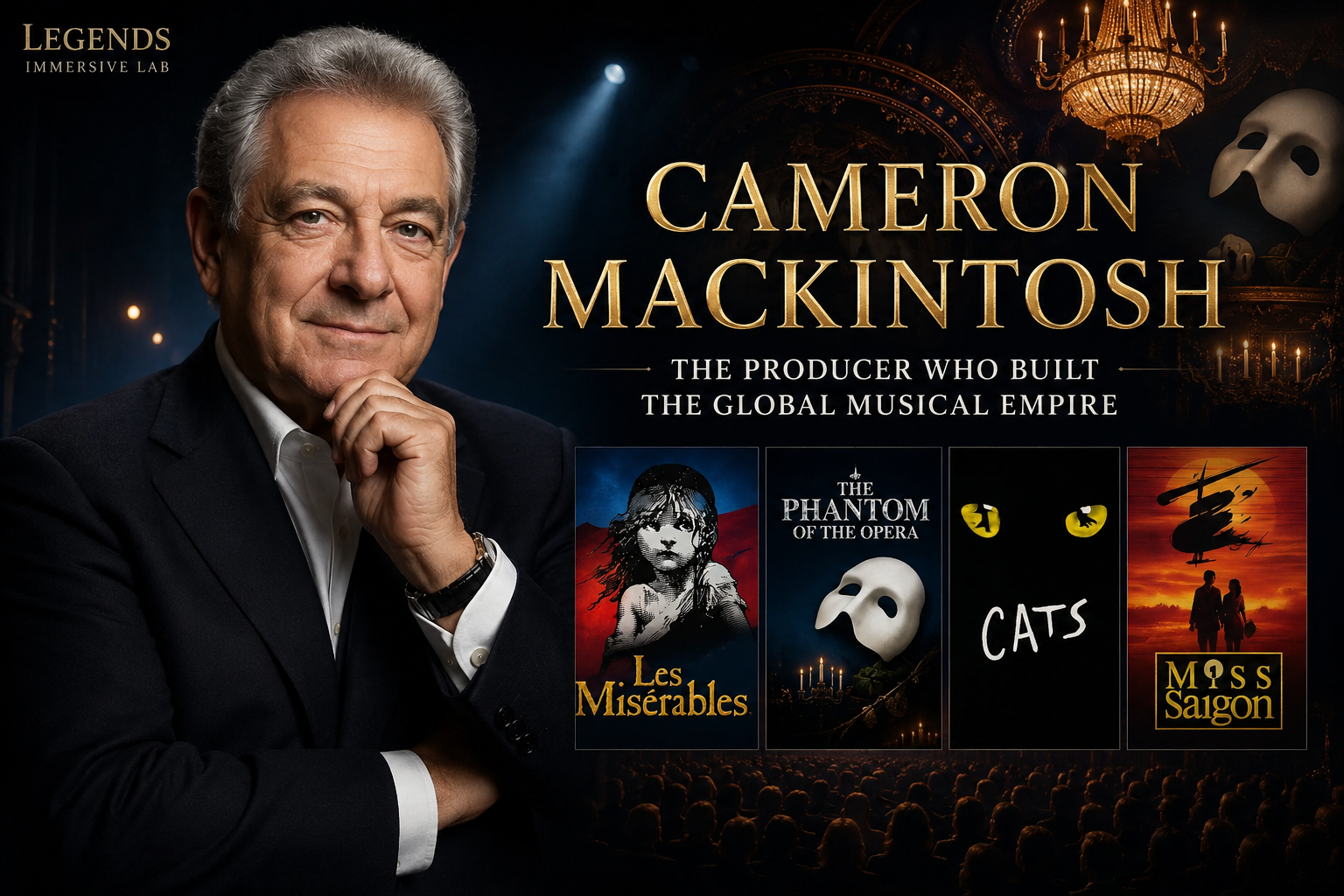
Cameron Mackintosh
The Producer Who Standardized the Global Musical
In 1990, at the height of his run of hits, The New York Times called Cameron Mackintosh “the most successful, influential and powerful theatrical producer in the world.”
That is a large claim to make about someone who never wrote a note of music or delivered a line on stage.
Mackintosh’s name sits behind Cats, Les Misérables, The Phantom of the Opera, Miss Saigon, and Mary Poppins—shows that, between them, have been seen by hundreds of millions of people. But the interesting question is not which shows he produced. It is what a producer actually has to build, structurally, for the same musical to run at full quality in London, New York, Seoul and Manila at the same time.
That is the problem Mackintosh spent his career solving.
The Boy Who Watched Salad Days

Cameron Anthony Mackintosh was born in Enfield, London, on 17 October 1946.
His parents came from two very different worlds that both, in their own way, pointed toward the stage. His father, Ian Robert Mackintosh, was a Scottish timber merchant and a jazz trumpeter. His mother, Diana Gladys Tonna, was a Maltese-French production secretary.
The decisive moment came at age eight, when he saw a production of the musical Salad Days. According to his own account, that single performance was what convinced him he wanted to become a theatre producer—not a performer, a producer, specifically.
That distinction matters. Most people who fall in love with a show at eight years old want to be in it. Mackintosh wanted to know how it got built.
He was educated at Prior Park College in Bath. In his teens, he worked as a stagehand, then became an assistant stage manager, before moving into producing during the 1970s.
Stagehand to Assistant Stage Manager to Producer

That career path—stagehand, then assistant stage manager, then producer—is not the typical route into commercial theatre production, where financiers and agents often move directly into producing without ever touching a rigging line or a cue sheet.
Mackintosh’s route meant he had already seen, from the inside, what makes a production fail on a given night: a missed cue, a broken set piece, a costume that doesn’t survive a quick change. That vantage point is different from a financier’s. A financier sees a budget line. A former stagehand sees the specific mechanical failure the budget line was supposed to prevent.
That background would matter enormously once his shows started running in dozens of cities he could not personally visit every night.
Cats: Producing a Show With No Plot

In 1981, Mackintosh produced Andrew Lloyd Webber’s Cats—a musical built from T. S. Eliot’s Old Possum’s Book of Practical Cats, with no conventional plot and no central protagonist in the usual sense.
The commercial risk was real, and widely acknowledged at the time: a show built around the premise of singing cats, with a poetry collection instead of a book, was not an easy commercial pitch.
Cats succeeded anyway, and went on to become one of the longest-running musicals in the world. For Mackintosh, it also established a working method he would repeat for the rest of his career: back an unconventional structure if the emotional and visual experience is strong enough to carry an audience who isn’t there for the plot.
Les Misérables Was Not an Immediate Hit

When Les Misérables, by Claude-Michel Schönberg and Alain Boublil, opened in London’s West End in 1985, the critical reception was mixed, and the production had what is usually described as a shaky start at the box office.
Mackintosh assembled the English-language production team—Schönberg, Boublil, lyricist Herbert Kretzmer, and directors Trevor Nunn and John Caird—to adapt Victor Hugo’s novel for an international stage audience rather than simplify it.
The production turned around largely through word of mouth rather than reviews. It is now the longest-running musical in the world and the second-longest-running production in West End history.
That trajectory—weak reviews, slow box office, then a turnaround driven by audiences rather than critics—is a pattern that shows up repeatedly in Mackintosh’s career. It suggests a producer who was willing to let a show run long enough for word of mouth to work, rather than closing early on a rough opening.
Phantom Became the Longest-Running Show on Broadway

Mackintosh reunited with Andrew Lloyd Webber for The Phantom of the Opera, which opened in London’s West End in 1986 before transferring to Broadway two years later.
The original London production is still running today and is the third-longest-running production in West End history. The Broadway production, which closed in 2023, became and remains the longest-running show in Broadway history.
What made Phantom distinctive from a production standpoint was not only its scale—the chandelier, the underground lake, the Victorian scenery—but Mackintosh’s insistence that every licensed production maintain the same technical and artistic standard the original London staging had set. A ticket buyer in Hamburg or Tokyo was meant to see the same show, executed to the same standard, as a ticket buyer in London.
That single decision—export the standard, not just the script—is arguably the most consequential thing Mackintosh did as a producer, more consequential than any individual hit.
Miss Saigon and the Physical Limits of Live Theatre

Miss Saigon, Schönberg and Boublil’s next musical after Les Misérables, opened in 1989 and became known for a full-size helicopter appearing to land on stage during the evacuation of Saigon.
That single technical effect is often cited as the moment the term “mega-musical” entered common use—a category of production defined by combining emotionally serious storytelling with engineering-scale stagecraft, rather than treating spectacle as decoration on top of a simpler show.
The production has remained in continuous demand for more than three decades. A new UK touring production, in association with Michael Harrison, opened in October 2025 to mark 35 years since the musical’s West End premiere—with Mackintosh noting in the tour’s announcement that the show has become one of the most popular musicals in Asian markets, with separate resident companies regularly playing in Korea, Japan, the Philippines and Singapore.
Production Perspective — What Mackintosh Actually Built

Before Mackintosh’s model became standard, a hit musical was often treated as an asset tied to a single theatre or a single city. Licensing a show internationally usually meant licensing the script and score, with local producers responsible for their own staging decisions.
Mackintosh’s productions worked differently. Licensing a Mackintosh title meant inheriting a production system: technical specifications, design standards, casting benchmarks and quality control that traveled with the show, not just the rights to perform it.
That distinction is why Les Misérables and The Phantom of the Opera could simultaneously hold the record for longest-running production in two different countries’ theatre histories—West End and Broadway—without either version being treated as the “real” one and the other a copy.
Modern international touring productions largely inherited this expectation: that a musical seen in one country should deliver a comparable artistic experience to the same musical seen in another. That expectation did not exist as an industry norm before producers like Mackintosh made it standard practice.
Still Producing, Six Decades In
Mackintosh was knighted in 1996 for services to musical theatre.
Nearly six decades into his career, he remains active rather than semi-retired. With Stephen Sondheim, he created three musical revues—Side by Side by Sondheim, Putting It Together, and Old Friends, the last of which starred Bernadette Peters and Lea Salonga in both the West End and on Broadway. In 2025, a new production of Oliver!, reimagined with director Matthew Bourne, was playing to sellout audiences in the West End. Around the same period, an arena-scale concert version of Les Misérables toured internationally to mark the show’s 40th continuous year of performance.
Few producers stay this actively involved with new productions and revivals of their own catalogue for this long. Mackintosh’s continued presence in casting, staging and touring decisions on shows now decades old is itself evidence of the long-term stewardship approach that separated him from producers who moved on once a hit was running on autopilot.
Production Takeaway
The easy version of Cameron Mackintosh’s story is that he produced several of the best-known musicals of the twentieth century.
The more useful version is narrower and more specific: he built the production infrastructure that let those musicals be performed at a consistent standard in dozens of countries at once, and then stayed involved in that infrastructure for decades rather than treating a hit as a finished, self-sustaining asset.
That is the part of his career that changed how the rest of the industry operates—not any single chandelier, helicopter or falling curtain, but the decision that a licensed production owed its audience the same quality as the original.
References & Further Reading
Cameron Mackintosh — Official Website (About)
cameronmackintosh.com
Cameron Mackintosh — Wikipedia (used for cross-checking only)
en.wikipedia.org
Cameron Mackintosh — IMDb Biography
imdb.com
Cameron Mackintosh — Internet Broadway Database (IBDB)
ibdb.com
Cameron Mackintosh — Miss Saigon 35th Anniversary Tour Announcement
cameronmackintosh.com
Playbill — Cameron Mackintosh Vault
playbill.com
Next in LEGENDS
Bob Fosse — The Choreographer Who Reinvented the Language of Dance
About LEGENDS
LEGENDS is an original IMMERSIVE LAB editorial series covering the people whose decisions changed how performances are made—composers, directors, producers, choreographers and designers whose work still shapes stages around the world today.
Image Credits
All photographs remain the property of their respective photographers and copyright holders. Use only images whose licences, official press permissions or other applicable rights permit publication.


