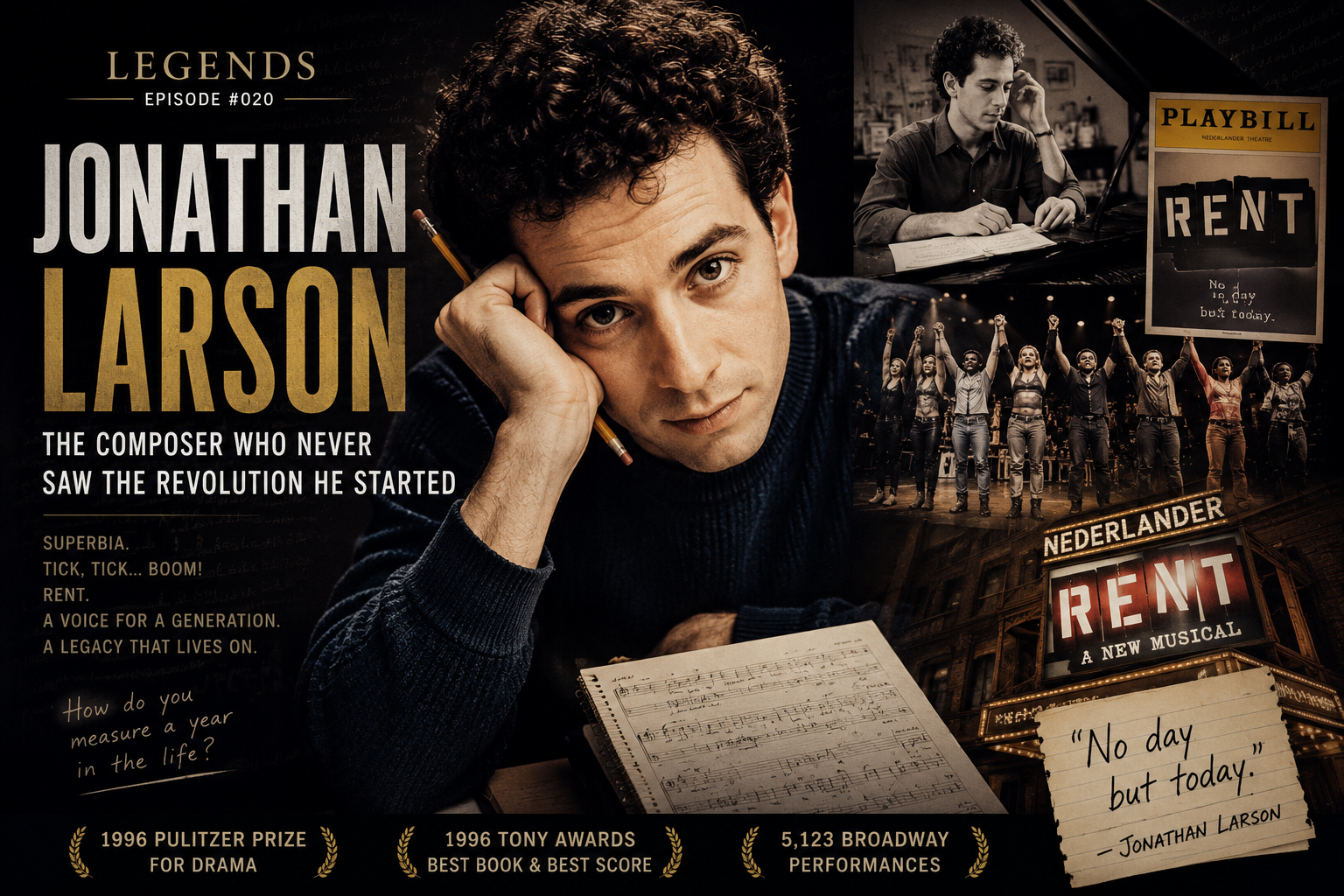
Jonathan Larson
The Composer Who Never Saw the Revolution He Started
Jonathan Larson spent years trying to write the musical that would change his life.
When it finally happened, he never saw what came next.
He never saw Rent move to Broadway.
He never heard a Broadway audience erupt at the end of “La Vie Bohème.”
He never watched thousands of people stand for “Seasons of Love.”
He never held the Tony Awards for Best Book and Best Original Score.
He never received the Pulitzer Prize for Drama that would carry his name.
Jonathan Larson died on January 25, 1996, at the age of 35, from an aortic aneurysm. Rent would have its first public performance at New York Theatre Workshop the following evening.
Three months later, it was on Broadway.
Then something extraordinary happened.
A musical about struggling artists, AIDS, addiction, sexuality, friendship, poverty and the fear of running out of time became one of the defining theatrical events of its generation.
Rent would play 5,123 Broadway performances between April 29, 1996 and September 7, 2008.
Larson had spent years asking whether his work would ever matter.
The answer arrived just after he was gone.
But his legend is not ultimately about tragedy.
It is about the work.
And about one composer’s determination to make Broadway sound like the world outside its doors.
White Plains — A Composer Looking Toward New York
Jonathan Larson was born on February 4, 1960, in White Plains, New York.
He belonged to a generation that had grown up hearing musical theatre alongside rock, pop and the changing sound of American popular culture.
That combination would eventually become central to his artistic identity.
Larson loved musical theatre.
But he also wanted it to change.
Broadway could be beautiful, sophisticated and spectacular.
Yet for a young writer living in New York during the 1980s and early 1990s, much of contemporary life seemed to be happening somewhere else.
Downtown.
In clubs.
In tiny apartments.
Among struggling artists.
Among people living through the AIDS crisis.
Among friends who could not afford rent.
Larson wanted those lives inside musical theatre.
Not cleaned up.
Not made safely theatrical.
Alive.
The Struggling Artist — Life Before the Breakthrough

The mythology of the struggling artist can sound romantic after success arrives.
Living through it is different.
Larson spent years writing while supporting himself with other work.
There was no guarantee that Broadway would eventually discover him.
There was only the next song.
The next draft.
The next workshop.
The next rejection.
And the next attempt.
This matters because Larson’s later writing about artists was not observational.
He knew the anxiety.
He understood what it meant to measure ambition against time.
To watch friends advance while your own career seemed suspended.
To wonder whether persistence was courage or delusion.
That question would eventually become the emotional engine of another Larson work:
tick, tick… BOOM!
But first came a much larger ambition.
Superbia — The Future That Didn’t Arrive

Before Rent, Larson spent years developing Superbia.
It was ambitious.
Futuristic.
Rock-driven.
And difficult to produce.
The Pulitzer biography records that Larson received a Richard Rodgers Development Grant in 1988 for the rock musical, which was staged at Playwrights Horizons.
The project did not become the commercial breakthrough he wanted.
For a young writer, that could have been devastating.
Years of work do not automatically produce a production.
Talent does not guarantee access.
Innovation does not guarantee an audience.
And Broadway does not reward persistence simply because persistence is admirable.
Yet Superbia was not wasted time.
It was training.
Larson was learning how to combine theatrical storytelling with contemporary music.
How to build characters through songs that did not sound like conventional Broadway numbers.
How to make rock function dramatically rather than simply decorate a musical.
The breakthrough had not happened.
The writer was becoming capable of creating it.
tick, tick… BOOM! — The Sound of a Clock

What happens when you believe you are supposed to become an artist—
but nothing seems to be happening?
Larson turned that anxiety into theatre.
His autobiographical rock monologue, eventually known as tick, tick… BOOM!, was performed at Second Stage Theatre, the Village Gate and New York Theatre Workshop.
At its center is an artist approaching thirty.
Time is moving.
Friends are choosing stability.
Careers are changing.
Relationships are under pressure.
And the artist keeps hearing an invisible clock.
Tick.
Tick.
Tick.
The subject feels painfully appropriate in retrospect.
But it would be a mistake to read the work only through knowledge of Larson’s death.
The clock was already familiar to artists everywhere.
How long do you keep trying?
When does persistence become irresponsibility?
What happens when your dream asks other people to wait for you?
What if the breakthrough never comes?
Larson did not have an easy answer.
He kept writing.
AIDS, New York and the Story He Needed to Tell

The New York surrounding Larson was being transformed by loss.
The AIDS epidemic was devastating communities.
Friends were becoming sick.
People were dying young.
Fear and stigma surrounded the disease.
At the same time, artists in neighborhoods such as the East Village were confronting poverty and rapid urban change.
Larson wanted to write about this world.
The Library of Congress now preserves his papers, including scores, lyric sketches, scripts, correspondence, research and production materials relating to Superbia, tick, tick… BOOM! and Rent. The collection specifically identifies AIDS-related songs and music among its subjects.
Larson’s great structural inspiration came from a work written more than a century earlier.
Giacomo Puccini’s La Bohème.
Young artists.
Poverty.
Love.
Illness.
Death.
Larson saw that the emotional architecture was still alive.
Only the city had changed.
Paris became New York.
Tuberculosis became HIV/AIDS.
Bohemian artists became filmmakers, musicians, performers and outsiders living around the East Village.
The opera was not simply modernized.
It was pulled into Larson’s own time.
Rent — Broadway Begins Downtown

Rent did not begin as a polished Broadway commodity.
It developed through years of rewriting and workshop work before reaching New York Theatre Workshop.
Larson wrote the book, music and lyrics. The Pulitzer record notes that Rent received the 1994 Richard Rodgers Award.
What emerged sounded different.
Electric guitars.
Rock vocals.
Voicemail messages.
Fragments of street noise.
Characters arguing about art, money, love, drugs, illness and survival.
There was theatrical tradition underneath it—but Larson refused to make that tradition sound preserved behind glass.
He wanted immediacy.
The musical’s central question was brutally simple:
How do you measure a life when you don’t know how much life remains?
That question would eventually produce the show’s most famous answer.
Not money.
Not achievement.
Not possessions.
Love.
January 25, 1996 — The Night Before
This is the part of Jonathan Larson’s story that is almost impossible to separate from Rent.
On January 25, 1996, Larson died suddenly from an aortic aneurysm. He was 35.
The timing was devastating.
His musical was finally ready to meet an audience.
The creator was gone.
The following evening, the company gathered at New York Theatre Workshop.
What should they do?
The circumstances made an ordinary performance seem almost unthinkable.
Yet the work existed.
And the people Larson had created were singing about exactly what everyone in the room was suddenly confronting:
Time.
Loss.
Love.
Death.
And the need to live now.
No fictional framing could protect the material from reality anymore.
Rent had become painfully literal.
Broadway — The Revolution Arrives Without Him
Rent transferred to Broadway’s Nederlander Theatre.
The first Broadway preview was April 16, 1996.
Opening night followed on April 29.
The response was enormous.
The show won the Tony Award for Best Musical.
Larson posthumously won Best Book of a Musical and Best Original Score.
Rent also won the 1996 Pulitzer Prize for Drama.
And then it kept running.
One year became another.
New performers entered the company.
Audiences returned.
Touring productions spread the musical far beyond New York.
By the time the original Broadway production closed in 2008, it had played 5,123 performances.
Jonathan Larson never attended one of them.
That fact is heartbreaking.
But it should not become the only reason we remember him.
Because Rent did something larger than create a tragic legend.
It changed who could imagine Broadway belonged to them.
No Day But Today — Why Rent Connected
Rent did not become important simply because it used rock music.
Rock musicals existed before Larson.
Nor was it the first musical to address difficult contemporary subjects.
Its power came from the combination.
Music.
Characters.
Moment.
Urgency.
The musical placed people living with HIV/AIDS at the emotional center of a mainstream theatrical event.
It presented queer relationships as essential parts of the story.
It allowed young artists to be selfish, loving, frightened, idealistic, angry and contradictory.
These were not symbolic figures standing outside ordinary life.
They were the community.
And the score refused to keep them at a polite distance.
“Life Support.”
“One Song Glory.”
“I’ll Cover You.”
“Without You.”
“What You Own.”
“Seasons of Love.”
The songs keep returning to time.
How much remains?
What should we do with it?
What is worth remembering?
The answer is not complicated.
No day but today.
Seasons of Love — 525,600 Minutes
Few Broadway songs have escaped their original production as completely as “Seasons of Love.”
The premise is mathematical.
A year contains 525,600 minutes.
But Larson transforms arithmetic into philosophy.
If time can be counted, can a life be measured?
In work?
In money?
In distance?
In suffering?
Or in love?
The simplicity is deceptive.
The song works because the question belongs to everyone.
You do not need to know the plot of Rent.
You do not need to have lived in the East Village.
You do not need to be an artist.
Eventually every human being confronts the same equation.
Time passes.
What gave it meaning?
That is why the song survived beyond the musical.
It became ceremony.
Memorial.
Celebration.
Graduation song.
Tribute.
A way of remembering people who are no longer present.
And inevitably, it became a way of remembering Jonathan Larson.
Editor’s Perspective — The Tragedy Is Not the Legacy
There is a danger in telling Jonathan Larson’s story.
The ending is so extraordinary that it can consume everything before it.
A young composer struggles for years.
He finally writes his masterpiece.
He dies immediately before success arrives.
Broadway embraces the show.
Awards follow.
The mythology almost writes itself.
But that version can reduce Larson to the man who died before Rent opened.
That is not enough.
His achievement was not dying at a dramatically cruel moment.
His achievement was writing the musical.
The drafts.
The discarded songs.
The failed projects.
The years spent learning why one scene worked and another didn’t.
The stubborn belief that musical theatre could absorb the sound and anxieties of his generation without ceasing to be musical theatre.
The tragedy explains why Larson did not experience the success.
It does not explain why the success happened.
The work does.
What Jonathan Larson Changed
Larson did not single-handedly invent contemporary Broadway.
No artist does.
But Rent became a bridge.
On one side was a Broadway tradition that Larson deeply admired.
On the other was a generation raised on rock and pop music that did not necessarily hear itself in conventional musical theatre.
Larson refused to choose between them.
He wanted both.
The dramatic architecture of musical theatre.
The urgency of contemporary music.
The emotional sweep of opera.
The messiness of downtown New York.
That synthesis mattered.
It demonstrated that Broadway could speak directly to younger audiences without treating them as a marketing demographic.
It could speak their musical language.
It could put their anxieties onstage.
It could let characters look and sound closer to people they actually knew.
And it could still deliver the emotional scale of a great musical.
The Work Continued Without Its Author

There is another remarkable aspect of Larson’s legacy.
The archive kept opening.
tick, tick… BOOM! was reshaped after his death and continued to find new audiences. IBDB records Larson’s music, lyrics and book credits for its later New York production.
His papers eventually entered the Library of Congress, where the surviving material includes manuscripts, musical sketches, lyric sheets, scripts, correspondence, photographs and extensive documentation of unfinished and produced work.
That archive has allowed scholars and artists to look beyond Rent.
Beyond the tragedy.
Beyond the mythology.
There was more music.
More experimentation.
More unfinished thinking.
In recent years, previously lesser-known Larson material has also been explored through The Jonathan Larson Project, drawing on songs connected with unproduced works and material cut from projects including Rent and tick, tick… BOOM!.
The story did not end in 1996.
The notebooks were still speaking.
Why This Legend Still Matters

Thirty years after Rent first reached audiences, its original company reunited in August 2026 to celebrate the musical and honor Larson’s legacy.
That longevity tells us something.
Musicals tied strongly to a particular historical moment can age badly.
References change.
Cities change.
Music changes.
Audiences change.
Yet the fundamental anxiety inside Larson’s work remains recognizable.
Young people still wonder whether they can afford to become artists.
Cities still become unaffordable.
People still lose friends too early.
Creators still fear that time is running out before their work finds an audience.
And almost everyone eventually discovers that plans can disappear without warning.
Larson wrote about urgency because he felt it.
His audience continues to feel it too.
A Lasting Legacy

Imagine the Nederlander Theatre in 1996.
A new audience walks through the doors.
Some may rarely attend Broadway musicals.
Then the band starts.
The voices arrive.
The characters argue.
They fall in love.
They make mistakes.
They become sick.
They lose each other.
They keep creating.
And somewhere behind every note is a composer who should have been there.
Jonathan Larson spent years wondering whether Broadway had room for the kind of musical he wanted to write.
Rent answered him.
Yes.
Not only was there room.
There was an audience waiting for it.
The cruelest part of the story is that Larson never heard that answer himself.
The beautiful part is that the answer never stopped.
It continued for 5,123 Broadway performances.
It continued through touring companies and new productions.
It continued through tick, tick… BOOM!
It continues whenever another young writer looks at musical theatre and decides its existing language is not enough.
Jonathan Larson’s career was painfully short.
His influence was not.
He spent his life racing against an invisible clock.
Then he created a work that asked millions of people what they would do with the time they had left.
He never saw the revolution he started.
Broadway has been living inside it ever since.
That is why Jonathan Larson belongs among the LEGENDS.
References & Further Reading
Jonathan Larson — Internet Broadway Database
Jonathan Larson — The Pulitzer Prizes
Rent — Original Broadway Production, IBDB
Jonathan Larson Papers — Library of Congress
Next in LEGENDS
Twenty legends.
Twenty different ways of changing entertainment.
Composers. Directors. Producers. Actors. Dancers. Performers who refused to remain inside the roles the industry gave them.
LEGENDS continues.
Next Legend — Coming Soon
Continue Exploring
Broadway Collection — The productions that transformed musical theatre.
LIVE STAGE — Legendary concerts, world tours and unforgettable live performances.
WORLD DISCOVERY — Extraordinary theatres, venues and cultural destinations.
THE SHOW X-FILES — The controversies, failures and breakthroughs hidden behind famous productions.
About LEGENDS
LEGENDS is an original editorial series from IMMERSIVE LAB, dedicated to the people who changed the language of entertainment.
We do not simply ask who became famous.
We ask:
What did they change?
Why did it matter?
And why can we still feel their influence today?
Because a career can end.
An idea can keep performing.
Image Credits & Copyright Notice
Representative artwork: © IMMERSIVE LAB.
Historical and editorial photographs should be sourced only from Public Domain archives, Creative Commons collections, or materials whose licensing explicitly permits the intended use.
Each third-party photograph should retain the photographer, archive and applicable license credit where required.
IMMERSIVE LAB does not claim ownership of third-party historical or editorial photographs.


