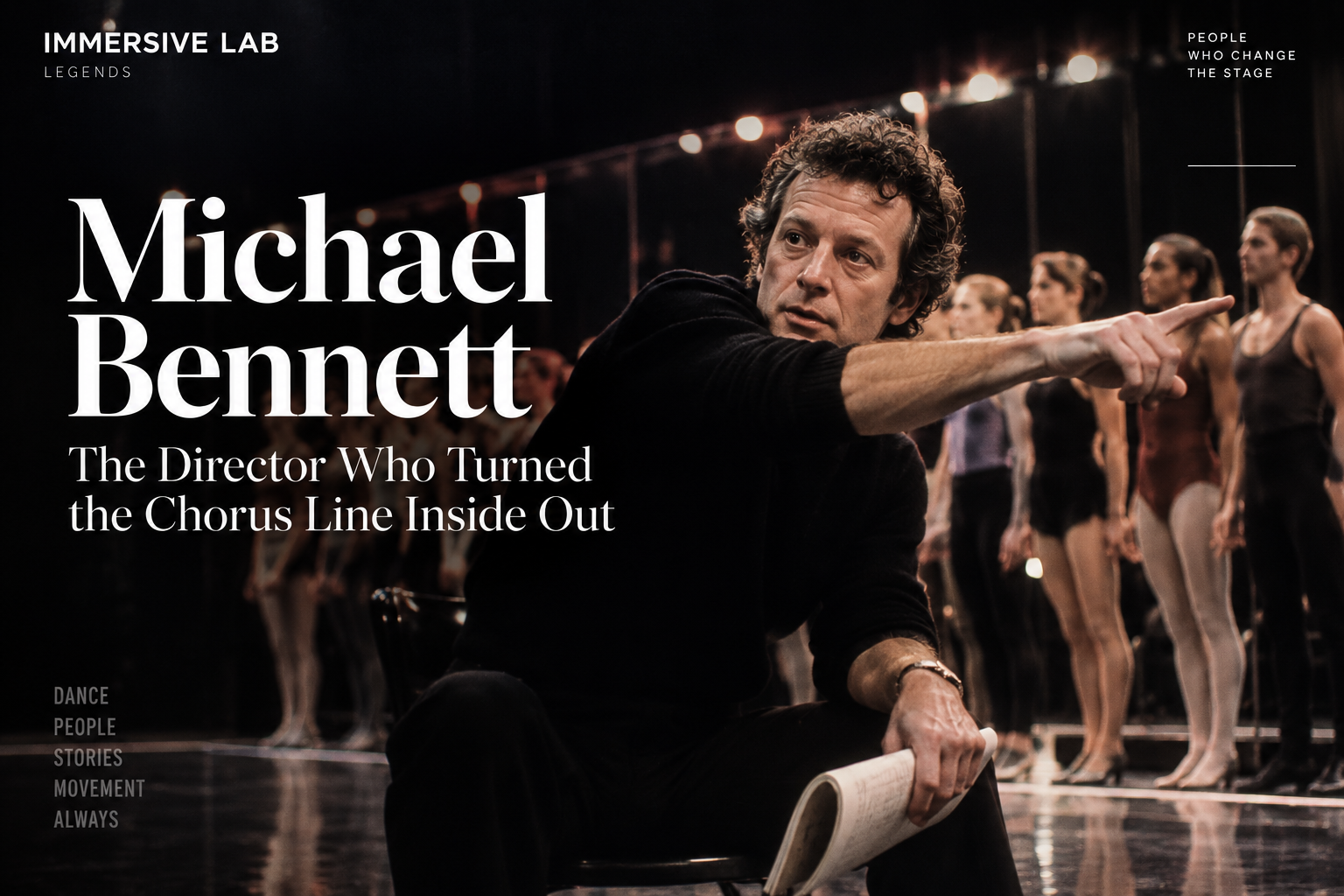
Michael Bennett
The Director Who Turned the Chorus Line Inside Out
Seventeen dancers stand across an almost empty Broadway stage.
No elaborate scenery protects them. No fictional village, palace or nightclub gives them somewhere to hide. Behind them is a wall of mirrors. In front of them, an unseen director decides who gets the job.
The people Broadway normally places behind its stars have become the entire show.
That inversion is the key to understanding Michael Bennett.
A Chorus Line did not begin with a conventional plot that later needed choreography. It grew from the experiences of dancers themselves. Bennett conceived, directed and choreographed the production, which began at the Public Theater before transferring to Broadway in 1975.
But the production raises a larger question:
What happens when a choreographer stops designing dances and starts designing the entire way an audience receives a story?
Bennett’s answer would reshape Broadway.
Before the Line — Learning the Stage From Inside the Ensemble
Michael Bennett knew what it meant to be one of the bodies behind somebody else.
Born Michael Bennett Di Figlia in Buffalo in 1943, he left high school at 15 to join a touring company of West Side Story. He later appeared on Broadway as a dancer in Subways Are for Sleeping before moving toward choreography.
That trajectory matters.
A performer inside an ensemble experiences Broadway differently from someone watching from the auditorium.
He learns where attention goes.
He understands how quickly a dancer can disappear inside a large formation.
He knows the precision required to make twenty people appear to move as one.
And he understands the strange contradiction at the center of ensemble performance:
individual excellence is often required to create collective anonymity.
Bennett would eventually turn that contradiction into theatre.
Before doing so, however, he learned how choreography could manipulate an audience’s attention.
Promises, Promises — Choreography as Visual Rhythm

By the late 1960s, Bennett had moved decisively into choreography.
Promises, Promises, which opened on Broadway in 1968, became an important breakthrough. His Broadway credits subsequently included musical staging for Company and choreography and co-direction on Follies.
These productions placed him inside a Broadway environment in which choreography could no longer simply function as a decorative break between dramatic scenes.
The musical itself was changing.
Scenes, songs, design and movement could overlap.
For a choreographer, that created a different problem:
How do you make movement carry dramatic rhythm rather than merely musical rhythm?
A dancer can move precisely to a beat.
A production has to move according to something larger.
It must know when to accelerate.
When to stop.
When to reveal.
When to overwhelm.
And when to leave the stage almost completely empty.
Bennett became increasingly interested in that larger machine.
Company and Follies — Learning to Direct the Audience

Working in the creative orbit of Harold Prince and Stephen Sondheim exposed Bennett to musicals whose structures did not depend on straightforward linear storytelling.
Company fragmented marriage and relationships into encounters and observations.
Follies placed memory, performance and reality on the same stage.
Bennett staged musical material for Company and co-directed and choreographed Follies. His later career shows what he appears to have absorbed from this period: choreography could operate inside the dramaturgy rather than alongside it.
This distinction is fundamental.
A choreographer asks:
How should these performers move?
A director asks:
What should the audience understand?
Bennett increasingly worked where those two questions collided.
Movement became a method for controlling information.
Formation could reveal hierarchy.
Distance could reveal isolation.
Repetition could create pressure.
A mirror could make a dancer confront both the audience and themselves.
Eventually, Bennett would construct an entire musical around these principles.
The Tape Sessions — Broadway Becomes the Source Material
The origin of A Chorus Line is unusual because the raw material was not initially a conventional script.
It was dancers talking.
Bennett developed the idea of creating a show about dancers’ lives and experiences. Archival material at the New York Public Library documents the subsequent development of the work and interviews with original participants; the Library describes the musical as growing from Bennett’s idea to create a show based on dancers’ experiences.
That changed the production problem.
Instead of asking actors to inhabit characters invented entirely beforehand, the creative team was transforming lived testimony into theatrical structure.
Real stories cannot simply be placed onstage unchanged.
They have to be selected.
Compressed.
Sequenced.
Musicalized.
Choreographed.
And shaped into an emotional progression that an audience can follow.
This is where Bennett’s role exceeded conventional choreography.
He was essentially editing human experience in three-dimensional space.
A Chorus Line — The Audition Becomes the Set
The central scenic idea of A Chorus Line is almost brutally simple.
A line.
Dancers.
An audition.
Mirrors.
The production removes much of the visual architecture audiences associate with a large Broadway musical.
That simplicity is deceptive.
When elaborate scenery disappears, performers inherit its responsibilities.
Bodies establish scale.
Spacing establishes geography.
Formation establishes composition.
Lighting establishes emotional focus.
And the line itself becomes an architectural object.
The Production Problem
A nearly empty stage leaves nowhere for weak composition to hide.
In a scenery-heavy production, architecture can frame performers.
Here, the performers are the architecture.
Every spacing decision becomes visible.
A dancer half a step out of alignment can alter the picture.
A performer breaking away from the line immediately attracts attention.
The absence of scenery therefore does not reduce the need for precision.
It increases it.
Bennett turned the audition line into one of Broadway’s most recognizable stage images because he understood something fundamental:
the simplest stage picture can carry enormous dramatic information when the audience understands its rules.
The Mirrors — When Scenic Design Becomes Psychology
Then the mirrors appear.
The famous mirrored panels of A Chorus Line are more than decoration. Accounts of the production credit scenic designer Robin Wagner, costume designer Theoni V. Aldredge and lighting designer Tharon Musser as part of the visual system surrounding Bennett’s staging.
The mirrors radically alter the audience’s relationship with the performers.
A dancer can be seen from multiple angles.
The line multiplies.
The stage suddenly appears deeper.
But there is also a psychological effect.
These are performers whose careers depend on being watched.
Now they are surrounded by their own reflections.
The audition becomes both public examination and self-examination.
This is a useful example of Architecture & Performance working together.
The scenic element does not merely establish location.
It changes the meaning of the choreography.
Without the dancers, the mirrors are just surfaces.
Without the mirrors, the dancers occupy a different psychological space.
Together they form the scene.
Cassie — What Happens When an Individual Refuses to Disappear?
Cassie creates one of the show’s central production contradictions.
She is an experienced dancer auditioning to return to the chorus.
But a chorus requires visual integration.
Cassie carries individuality.
Her presence therefore asks a question that exists at the heart of Broadway ensemble production:
How much individuality can remain when the job requires everyone to become part of the same picture?
Her solo material turns that conflict into movement.
When a performer dances alone on an otherwise exposed stage, there is nowhere for the audience’s attention to go except the body.
Lighting, musical phrasing and choreography must therefore work with extraordinary precision.
The performer becomes the entire scenic event.
Bennett understood how to use that exposure.
The audience is not simply watching a dance number.
It is watching someone demonstrate why she cannot easily disappear.
One — Building a Broadway Machine in Front of Us
Then comes the transformation.
For much of A Chorus Line, audiences have been encouraged to distinguish these dancers.
We learn their histories.
Their insecurities.
Their ambitions.
Their relationships with their bodies.
Their fears about employment.
Then the finale arrives.
Gold costumes.
Hats.
A synchronized chorus.
Individual identities visually collapse into a polished Broadway line.
This is not merely a spectacular ending.
It is the production’s final argument.
The audience has spent the evening learning that every chorus dancer contains an individual life.
Then Broadway’s machinery makes those individuals look interchangeable.
Contemporary recollections of the original production describe how the finale used classic chorus-dance vocabulary, including a wedge and kick line.
The number works because of what came before it.
If the same choreography appeared at the beginning, it would simply be spectacle.
At the end, it becomes meaning.
Bennett choreographed the audience’s perception before he choreographed the finale.
That is directing.
Lighting the Empty Stage
Minimal scenery also transfers enormous responsibility to lighting.
When architecture does not continually define new locations, light must help reshape space.
A large Broadway stage can feel intimate when most of it disappears into darkness.
Seconds later it can become enormous when the entire line is revealed.
That makes lighting part of the dramaturgy.
The original production’s visual identity involved lighting designer Tharon Musser, whose work interacted with the mirrored environment and Bennett’s staging.
This matters because choreography does not exist independently of visibility.
A perfectly designed movement means nothing if the audience cannot read it.
Lighting determines:
where the eye travels,
which performer temporarily becomes important,
when the ensemble becomes one image,
and when an individual emerges from it.
In A Chorus Line, light effectively edits the stage in real time.
Eight Performances a Week — Precision Becomes Production Management

There is another side of Bennett’s choreography that audiences rarely consider.
Once choreography becomes structurally essential to a production, it must survive repetition.
A Chorus Line opened at the Public Theater before moving to Broadway’s Shubert Theatre and remained on Broadway until 1990. NYPL records describe the Broadway run as lasting 15 years.
A production cannot preserve that level of precision through inspiration alone.
It requires systems.
Dance captains.
Stage management.
Rehearsal.
Replacement performers.
Spacing maintenance.
Musical consistency.
Technical cue preservation.
Knowledge has to be transferred from one company to another.
Baayork Lee, an original cast member who later became closely associated with maintaining and directing the show internationally, has spoken about preserving Bennett’s legacy; Playbill reported that she had directed dozens of productions around the world.
This is where choreography becomes production infrastructure.
A Broadway musical is not truly designed only for opening night.
It has to be designed to remain itself after the original creators leave the building.
Dreamgirls — The Stage Starts Moving Like a Camera

If A Chorus Line stripped Broadway down, Dreamgirls pushed Bennett toward another problem entirely.
The original Broadway production opened in 1981 with Bennett directing, choreographing and producing.
Here the challenge was speed.
The story moves through changing careers, performance venues, relationships and eras.
Traditional scenic transitions could repeatedly stop the dramatic momentum.
Bennett instead pursued a theatrical language in which scenes could flow rapidly into one another.
This points toward one of his most important production instincts:
the audience should not have to wait for the machinery of theatre to catch up with the story.
Scenery, lighting, performers and choreography must behave as one transition system.
A stage can therefore begin to function almost like cinematic editing.
Not because it becomes film.
But because the production controls how quickly the spectator receives new visual information.
The Director as Traffic Controller

This is where Bennett becomes particularly important to modern production practice.
Large musicals are networks of moving systems.
Performers move.
Scenery moves.
Lighting changes.
Costumes change.
Orchestra and sound move the emotional rhythm.
Stage management coordinates cues.
Backstage crews prepare what the audience will see seconds later.
The director cannot personally operate all those systems.
But the director must understand how their timing creates meaning.
Bennett’s background as a dancer gave him an unusually physical understanding of time.
He knew that half a second could matter.
A reveal can arrive too early.
A laugh can be covered by music.
A performer can reach a mark before the audience is ready to look there.
A scenic transition can drain energy from the previous moment.
Directing a musical therefore becomes partly an exercise in traffic engineering.
Bennett’s stages rarely feel as though choreography has simply been placed inside them.
The stage itself appears choreographed.
What Michael Bennett Actually Changed
Michael Bennett did not invent Broadway choreography.
Jerome Robbins had already demonstrated that choreography could carry dramatic meaning.
Bob Fosse developed a movement language so recognizable that individual gestures could identify his theatrical world.
Bennett’s distinction lies elsewhere.
He pushed the integration further toward total production structure.
In A Chorus Line, testimony became dramaturgy, choreography became character, mirrors became psychology, and the absence of scenery became scenic strategy.
In Dreamgirls, direction, choreography and transition became a continuous flow of information.
The important unit was no longer necessarily the dance number.
It was the entire theatrical event.
That shift has consequences for every production department.
A scenic designer cannot think only about scenery.
A lighting designer cannot think only about illumination.
A choreographer cannot think only about steps.
A director cannot think only about acting.
Everything meets at the moment the audience receives it.
The Production Lesson — Integration Is Invisible When It Works
The most sophisticated production systems often become hardest to notice.
If a transition feels effortless, the audience rarely thinks about how many people made it happen.
If a spotlight arrives exactly when a dancer breaks from the line, spectators follow naturally.
If scenery clears precisely as performers enter, nobody thinks about traffic.
If mirrors, costumes, lighting and choreography combine into one image, audiences remember the image rather than its departments.
That invisibility is not evidence that production is simple.
It is evidence that integration worked.
Michael Bennett’s greatest contribution can be understood through that principle.
He did not merely make dancers move beautifully.
He organized how an entire theatre moved around them.
The Human Cost Behind the Perfect Line
There is, however, an important tension inside Bennett’s work.
A Chorus Line celebrates dancers while simultaneously exposing the insecurity of their profession.
The show’s own text addresses the lack of security and the fear of what happens when a dancer can no longer dance.
That tension gives the production unusual force.
The precision we admire onstage requires bodies to submit to relentless repetition.
The perfect chorus line depends on individuals whose careers can be fragile.
The production therefore makes visible something Broadway spectacle often conceals:
the human labor underneath synchronization.
This may be the most enduring reason A Chorus Line remains such an important production to study.
It shows the machine.
Then it shows us the people inside it.
Why Michael Bennett Belongs in LEGENDS
Michael Bennett died in 1987 at only 44.
But measuring his importance by the length of his career misses the point.
His work changed the relationship between choreography and direction.
He understood that an audience does not experience departments separately.
Nobody watches lighting for thirty seconds, then choreography, then scenery, then acting.
The spectator receives all of them at once.
So Bennett designed them to behave as one theatrical language.
That is the question we began with:
What happens when a choreographer stops designing dances and starts designing the entire way an audience receives a story?
Michael Bennett’s answer was A Chorus Line.
Seventeen dancers.
A line.
Mirrors.
Light.
Human stories.
And eventually, one immaculate Broadway machine.
The stage looked almost empty.
The production thinking behind it was anything but.
References
IBDB — Michael Bennett Broadway Credits
New York Public Library — Michael Bennett / A Chorus Line Archive
New York Public Library — A Chorus Line Interviews, 1975
New York Public Library — The Creative Process / Baayork Lee
Playbill — One Singular Sensation
Continue Exploring
Explore the directors, choreographers, composers, producers and performers who changed not only what audiences saw onstage, but how Broadway itself was made.
About LEGENDS
LEGENDS is an IMMERSIVE LAB series examining the people who changed the language and production of live performance—not simply what they achieved, but how their ideas worked inside the theatre.
Studio: LEGENDS
Episode: #022


