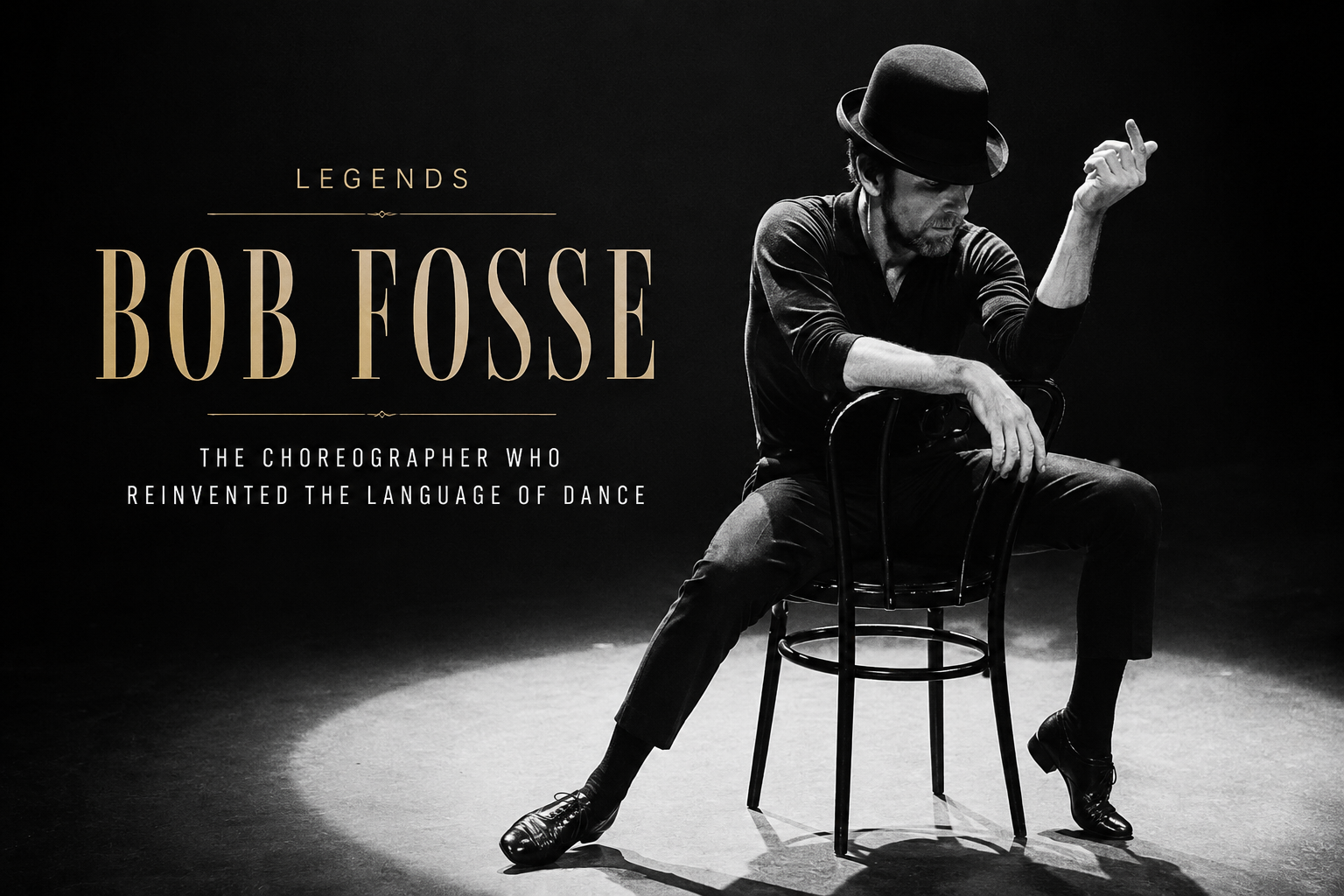
Bob Fosse
The Choreographer Who Reinvented the Language of Dance
Few choreographers have changed the language of musical theatre as profoundly as Bob Fosse.
While audiences around the world remember unforgettable productions such as Chicago, Cabaret, Sweet Charity, Pippin, and Dancin’, one extraordinary artist forever changed the way performers moved across the stage. His influence extended far beyond choreography. He created an entirely new visual language—one instantly recognizable through precision, attitude, isolation, and theatrical storytelling.
Unlike many choreographers who pursued technical perfection alone, Fosse believed movement should reveal personality. Every gesture carried meaning. Every pause created tension. Every glance toward the audience became part of the performance itself.
For more than three decades, Bob Fosse transformed Broadway, Hollywood, and the global performing arts. His choreography inspired generations of dancers, directors, performers, and creative teams, while his distinctive style continues to shape productions around the world.
Yet his significance extends far beyond memorable dance numbers.
He fundamentally changed how audiences experience movement on stage.
This is not simply the story of a celebrated choreographer.
It is the story of the visionary who reinvented the language of dance.
A Childhood Filled with Performance

Robert Louis Fosse was born on 23 June 1927 in Chicago, Illinois.
The youngest of six children, he discovered the world of performance at an unusually early age.
While many children played outside after school, young Bob spent much of his time dancing, performing, and entertaining audiences. His parents recognized his natural talent and encouraged formal dance lessons, exposing him to tap dance, vaudeville traditions, and musical performance.
By his early teenage years, Fosse was already performing professionally in local theatres and nightclubs.
Those experiences introduced him to the demanding realities of live entertainment.
He learned that audiences responded not only to technical ability but also to charisma, timing, confidence, and storytelling.
These lessons would remain at the center of his creative philosophy throughout his career.
Learning Through Experience

Unlike many artists who developed within prestigious dance academies, Bob Fosse built his career through practical experience.
He performed in touring shows, military entertainment programs, and Broadway productions, observing choreographers, directors, musicians, and actors from every possible angle.
Working as both performer and observer allowed him to understand how choreography functioned within the larger structure of theatrical storytelling.
He soon realized that dance should never interrupt a story.
It should become the story.
Rather than creating movement simply for visual beauty, Fosse designed choreography that revealed character, emotion, and psychological tension.
Every movement served dramatic purpose.
This philosophy would eventually distinguish him from every choreographer of his generation.
Finding His Own Style

During the 1950s, Broadway choreography was dominated by energetic athleticism and classical musical theatre traditions.
Fosse admired those achievements but refused to imitate them.
Instead, he began experimenting with movements that many initially considered unconventional.
Turned-in knees.
Rolled shoulders.
Angular arms.
Tilted hats.
White gloves.
Sharp hand gestures.
Controlled isolation.
Minimal facial expression.
These elements gradually combined into what audiences would later recognize instantly as the unmistakable Fosse Style.
Ironically, many of these characteristics developed because Fosse believed he possessed physical limitations as a dancer.
Rather than hiding them, he transformed them into artistic strengths.
What began as personal adaptation soon became one of the most influential choreographic languages in modern entertainment.
The Broadway Breakthrough

Bob Fosse’s reputation continued growing throughout the late 1950s as he choreographed productions including The Pajama Game and Damn Yankees.
Critics immediately noticed something different.
His choreography did not simply entertain.
It revealed personality.
Every movement appeared connected to character rather than spectacle.
Performers no longer looked like dancers executing combinations.
They became living extensions of the story itself.
Broadway audiences embraced this revolutionary approach.
Directors recognized that choreography could become dramatic storytelling rather than decorative entertainment.
The stage language of musical theatre had begun to change.
Sweet Charity Announced a New Era

By the mid-1960s, Bob Fosse was no longer simply choreographing productions.
He was defining them.
With Sweet Charity, he demonstrated complete creative confidence as both director and choreographer.
Every dance sequence reflected character psychology.
Every pause created dramatic tension.
Every visual composition served the emotional rhythm of the production.
Audiences were witnessing something entirely new.
Dance had become cinematic.
Movement had become storytelling.
Style had become narrative.
The greatest achievements of Bob Fosse’s extraordinary career were still to come.
Cabaret Changed the Rules of Musical Theatre

Every legendary career has one production that changes everything.
For Bob Fosse, that production was Cabaret.
Premiering on Broadway in 1966, Cabaret challenged nearly every convention of the traditional musical. Instead of presenting an idealized world filled with optimism, it immersed audiences in the uneasy atmosphere of pre-war Berlin, where politics, fear, entertainment, and human vulnerability collided.
Fosse understood that choreography could do more than entertain.
It could reveal truth.
The movement in Cabaret was seductive yet unsettling, elegant yet uncomfortable. Every gesture carried dramatic meaning, drawing audiences deeper into the emotional and political world of the story.
Rather than interrupting the narrative, dance became part of the narrative itself.
The production earned widespread critical acclaim and established Bob Fosse as one of Broadway’s most original creative voices.
More importantly, it demonstrated that choreography could become a powerful storytelling language capable of expressing ideas that dialogue alone could never communicate.
Pippin and the Art of Theatrical Spectacle
Following the success of Cabaret, Bob Fosse continued expanding his artistic vision.
In Pippin, he blended theatrical illusion, choreography, music, and staging into one seamless experience.
The musical embraced the concept of performance itself, inviting audiences to question the relationship between illusion and reality.
Fosse’s choreography reflected that philosophy.
Rather than relying upon large ensemble movement alone, he emphasized individual character, visual rhythm, and carefully controlled precision.
Every performer became part of an intricate theatrical composition.
His direction transformed dance into visual storytelling.
Many productions that followed borrowed this integrated approach, making choreography an essential dramatic element rather than an isolated performance sequence.
Chicago Became Timeless

Although Chicago received a respectable reception when it premiered in 1975, few people predicted that it would eventually become one of the most successful musicals in theatre history.
Inspired by real criminal cases from 1920s Chicago, the production examined celebrity culture, media manipulation, ambition, and public fascination with scandal.
Fosse’s choreography perfectly reflected those themes.
Minimal movement created maximum impact.
Every hat.
Every chair.
Every hand gesture.
Every pause.
Nothing appeared accidental.
His choreography stripped away unnecessary movement, leaving only gestures that served character and emotion.
Years later, the Broadway revival would become the longest-running American musical in Broadway history.
Its visual identity remains unmistakably connected to Bob Fosse.
Even audiences unfamiliar with his name immediately recognize his artistic language.
That is the mark of a true innovator.
Hollywood Recognition

Bob Fosse’s influence extended far beyond Broadway.
In 1972, he directed the film adaptation of Cabaret, starring Liza Minnelli.
The film became an international success and received eight Academy Awards, including Best Director for Fosse.
Winning Hollywood’s highest directing honor confirmed what Broadway had already understood.
His artistic vision worked equally powerfully on stage and on screen.
Remarkably, during 1973 Bob Fosse achieved an accomplishment that remains virtually unmatched.
Within the same year, he received the Academy Award, the Tony Award, and the Emmy Award.
Very few artists in entertainment history have achieved such extraordinary recognition across film, theatre, and television simultaneously.
Changing the Language of Dance
Perhaps Bob Fosse’s greatest achievement was not creating famous choreography.
It was creating an entirely new movement vocabulary.
Today, performers throughout the world immediately recognize the characteristics of the Fosse Style.
Turned-in knees.
Rolled shoulders.
Angular arms.
Tilted hats.
White gloves.
Controlled isolation.
Sharp rhythmic precision.
These elements have become part of the visual language of modern musical theatre.
His influence can be seen not only in Broadway productions but also in concerts, music videos, television performances, films, and dance competitions around the world.
Generations of choreographers continue studying his work because his movement remains both technically distinctive and emotionally expressive.
Editor’s Perspective
Many choreographers create memorable dances.
Bob Fosse created a recognizable artistic language.
That achievement places him among the most influential creative figures in entertainment history.
His choreography was never designed simply to impress audiences.
It revealed character.
It exposed emotion.
It created dramatic tension without requiring a single spoken word.
Even today, countless productions continue borrowing elements first introduced by Fosse decades ago.
His work reminds us that movement can communicate ideas just as powerfully as music or dialogue.
Few artists have changed an entire creative discipline so completely.
Bob Fosse unquestionably belongs among them.
A Lasting Legacy

Some choreographers create successful productions.
Some develop memorable dance styles.
The rarest visionaries permanently transform how future generations think about movement.
Bob Fosse did exactly that.
His artistic language continues influencing Broadway, the West End, Hollywood, international touring productions, and contemporary popular culture.
Long after the final curtain falls, his choreography continues moving audiences around the world.
Why This Legend Still Matters

Great choreography is never measured only by technical difficulty.
It is measured by its ability to tell stories that audiences never forget.
Bob Fosse demonstrated that movement could become emotion, character, and narrative all at once.
That is why dancers still study him.
That is why directors continue drawing inspiration from him.
And that is why Bob Fosse remains one of the greatest legends in entertainment history.
References & Further Reading
Readers wishing to explore Bob Fosse’s remarkable career in greater depth may find the following official and trusted resources valuable.
Official Bob Fosse Website
https://www.fosseverdon.com/
Internet Broadway Database (IBDB)
https://www.ibdb.com/broadway-cast-staff/bob-fosse-4299
The New York Public Library – Bob Fosse Collection
https://www.nypl.org/
Playbill Archive
https://playbill.com/
Next in LEGENDS
https://immersivelabkorea.com/julie-andrews-the-voice-that-made-the-world-believe-in-magic/
Every legend changes the world in a different way.
In the next chapter of LEGENDS, we meet another visionary whose choreography helped define the golden age of Broadway.
Coming Next
Continue Exploring
If you enjoyed this story, continue your journey through the world of theatre with IMMERSIVE LAB.
Broadway Collection
- Chicago
- Cabaret
- Pippin
- Sweet Charity
LIVE STAGE
Discover the world’s greatest concerts and unforgettable live performances.
THE SHOW X-FILES
The untold stories, mysteries, and remarkable moments behind the world’s biggest shows.
About LEGENDS
LEGENDS is an original IMMERSIVE LAB editorial series dedicated to the visionaries who transformed the world of entertainment.
From legendary composers and directors to groundbreaking producers, choreographers, designers, and innovators, each chapter explores the people whose ideas continue to shape stages around the globe.
Because great performances begin with extraordinary people.
Image Credits & Copyright Notice
All photographs featured in this article remain the property of their respective copyright holders.
Images are used for editorial, educational, and informational purposes only to document the history of musical theatre and its cultural significance.
If you are the copyright owner of any image used in this article and would like it to be credited differently or removed, please contact IMMERSIVE LAB, and we will respond promptly.
© IMMERSIVE LAB
This article is an original editorial feature created by IMMERSIVE LAB. Unauthorized reproduction or redistribution of the text is prohibited without permission.


