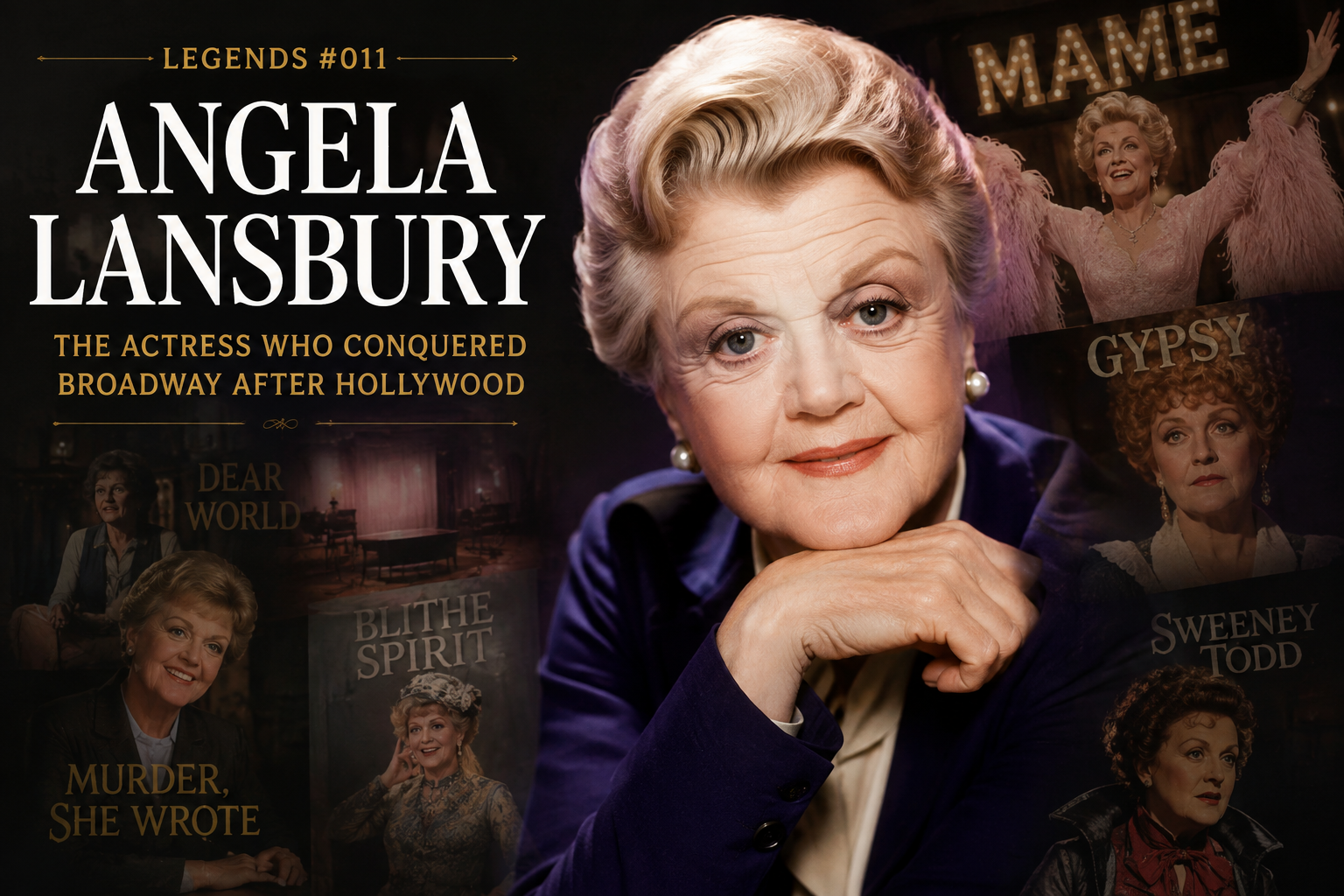
Angela Lansbury
The Actress Who Conquered Broadway After Hollywood
There are performers who become inseparable from one role.
Angela Lansbury achieved something far more difficult.
She became unforgettable again and again, in completely different worlds.
To movie audiences, she was the young actress whose very first film, Gaslight, earned her an Academy Award nomination. To millions of television viewers, she became Jessica Fletcher, the mystery writer at the center of Murder, She Wrote.
But Broadway knew another Angela Lansbury.
Broadway knew Mame Dennis.
It knew Mama Rose.
It knew Mrs. Lovett.
It knew Madame Arcati.
And long before television turned her into an international household name, Broadway had already discovered what made Lansbury extraordinary:
she could transform herself without ever disappearing.
Her theatrical career stretched across more than half a century and earned her five competitive Tony Awards, followed by a Special Tony Award for Lifetime Achievement in the Theatre in 2022.
But awards alone cannot explain Angela Lansbury.
Her real achievement was reinvention.
Again and again, just when audiences thought they understood who Angela Lansbury was, she walked onto another stage and proved them wrong.
Hollywood Discovered Her First
Angela Lansbury was born in London in 1925 and moved to the United States with her family during the Second World War.
Hollywood found her remarkably quickly.
Her screen debut came in George Cukor’s 1944 psychological thriller Gaslight. Lansbury was still a teenager when she played Nancy, the young maid whose presence adds another layer of tension to the increasingly disturbing household.
The performance earned her an Academy Award nomination for Best Supporting Actress.
A year later, The Picture of Dorian Gray brought another nomination.
Then, in 1962, The Manchurian Candidate produced a third.
It was an extraordinary beginning.
But success created a peculiar problem.
Lansbury possessed maturity far beyond her years, and Hollywood repeatedly used it. She was often cast as mothers, aristocrats, manipulative women and characters considerably older than she actually was.
The industry admired her ability.
It simply did not always know how large that ability really was.
The camera had discovered her subtlety.
Broadway would discover her scale.
Broadway Was Waiting
Lansbury made her Broadway debut in Hotel Paradiso in 1957.
More stage work followed, including A Taste of Honey and Stephen Sondheim and Arthur Laurents’ famously unconventional Anyone Can Whistle.
The latter closed quickly, but failure can sometimes reveal more about an artist than success.
Lansbury was entering a theatrical world where there were no retakes and no protective editing room.
A performance had to be constructed from beginning to end, night after night, in front of a living audience.
That environment suited her.
Still, nothing in those early appearances fully predicted what would happen in 1966.
At forty years old, after more than two decades as a respected professional actress, Angela Lansbury became a Broadway musical star.
The vehicle was Mame.
And Broadway would never look at her quite the same way again.
Mame — The Reinvention
Mame Dennis does not simply enter a room.
She changes its temperature.
Jerry Herman’s musical required an actress who could make extravagance feel effortless. Mame had to be glamorous without becoming distant, eccentric without becoming ridiculous, funny without losing emotional truth.
Above all, she had to possess theatrical authority.
Lansbury had it.
The transformation was remarkable because audiences who knew her primarily as a sophisticated character actress suddenly encountered a performer capable of commanding a huge Broadway musical.
She sang.
She danced.
She played comedy.
She carried emotion.
And she made the entire production seem to orbit around Mame’s refusal to live an ordinary life.
For her performance, Lansbury won the 1966 Tony Award for Best Actress in a Musical.
The victory was more than recognition for one role.
It represented a career being rewritten in public.
Hollywood had made Angela Lansbury respected.
Mame made her a Broadway star.
Dear World — Proving Mame Was No Accident
A breakthrough can become a trap.
Once audiences love a performer in a particular kind of role, the industry often asks for the same performance again.
Lansbury refused that path.
In 1969 she starred as Countess Aurelia in Dear World, Jerry Herman’s musical adaptation of The Madwoman of Chaillot.
The show itself never achieved the lasting popularity of Mame.
Lansbury’s performance did.
She won her second Tony Award for Best Actress in a Musical.
Three years after Broadway had discovered a new musical star, Lansbury proved that the discovery had not been an accident.
She could make eccentricity specific.
She could turn theatrical scale into character.
And increasingly, she could make audiences follow her into material that depended less on conventional glamour and more on contradiction.
That ability would become essential when she accepted one of the most demanding roles in the American musical-theatre canon.
Gypsy — Walking Into Broadway History
Mama Rose is not simply a great role.
She is one of Broadway’s ultimate tests.
Gypsy had already become part of musical-theatre mythology by the time Lansbury approached it.
Ethel Merman had originated Rose in 1959.
The score by Jule Styne and Stephen Sondheim contained songs already embedded in Broadway culture.
And Rose herself seemed almost impossibly large: mother, manager, dreamer, manipulator, survivor and frustrated performer.
The danger was obvious.
Anyone playing Rose would be compared with the women who came before.
Lansbury did not avoid the comparison.
She entered it.
After starring in the London production, she brought Gypsy back to Broadway in 1974.
And instead of imitating Merman’s legendary force, Lansbury searched for another Rose.
Her Rose could dominate a room, but the power was not the whole performance.
Underneath it was fear.
Fear of poverty.
Fear of failure.
Fear that her children might escape the life she had designed for them.
And perhaps most importantly, fear that the applause she claimed to want for everyone else was actually the applause she had always wanted for herself.
Everything Leads to Rose’s Turn
Gypsy spends an entire evening gradually dismantling Rose’s explanation of herself.
She says everything is for her children.
She says she is fighting for their future.
She says she understands what they need.
Then comes “Rose’s Turn.”
The excuses disappear.
The theatre becomes psychological space.
For a few extraordinary minutes, Rose confronts the ambition she has spent the musical projecting onto other people.
Lansbury understood the scene because her career had prepared her for both halves of it.
Film had taught her how to reveal darkness beneath composure.
Broadway had taught her how to enlarge emotion without making it false.
In Rose, those skills collided.
Her performance won the 1975 Tony Award for Best Actress in a Musical.
It was her third Tony.
But her most extraordinary Broadway creation was still ahead.
Sweeney Todd — When Comedy Met Horror
In 1979, Stephen Sondheim and Hugh Wheeler’s Sweeney Todd: The Demon Barber of Fleet Street arrived on Broadway under the direction of Harold Prince.
Len Cariou played the murderous barber.
Angela Lansbury played Mrs. Lovett.
On paper, the character is grotesque.
Mrs. Lovett discovers that Sweeney Todd is killing customers upstairs and turns the bodies into meat pies.
It is horrifying.
It is also extremely funny.
That contradiction is where Lansbury became indispensable.
A lesser performance might have divided the character into separate modes: comedy here, horror there.
Lansbury fused them.
Mrs. Lovett could be practical, ridiculous, lonely, flirtatious and terrifying within the same scene.
She did not behave as though she understood she was inside a masterpiece of dark musical theatre.
She behaved as though she were running a struggling pie shop and had suddenly discovered an unusually economical source of meat.
That practicality made the comedy sharper.
It also made the horror worse.
The Genius of Mrs. Lovett
Mrs. Lovett reveals something fundamental about Angela Lansbury’s acting.
She understood that an audience does not need to approve of a character in order to enjoy being with her.
That distinction is enormously important.
Lansbury allowed audiences to laugh with Mrs. Lovett.
Then the musical forced them to remember what they were laughing about.
The performance became one of the defining interpretations of the role.
In 1979, Lansbury won her fourth Tony Award for Best Actress in a Musical for Sweeney Todd.
Consider the sequence:
Mame.
Dear World.
Gypsy.
Sweeney Todd.
Four leading-actress Tony victories across characters who could hardly be more different.
A glamorous free spirit.
An eccentric countess.
A ferocious stage mother.
A murderous pie-shop owner.
By this point, Angela Lansbury had moved beyond versatility.
She had demonstrated something rarer:
the ability to make transformation itself recognizable as her signature.
Then Jessica Fletcher Walked Into the Room

In 1984, Lansbury entered another phase of her career.
Murder, She Wrote premiered on American television.
Jessica Fletcher was a mystery writer from the fictional town of Cabot Cove, Maine, who repeatedly found herself surrounded by murder.
The premise could have become absurd.
Lansbury made it comforting.
Jessica was intelligent without arrogance.
Warm without naivety.
Polite without weakness.
She could enter a room full of suspects and appear to be the least threatening person there.
Usually, she was also the person who understood the room best.
The series ran for twelve seasons and transformed Lansbury into an international television icon.
For millions of people, Angela Lansbury was now Jessica Fletcher.
The remarkable thing is that the role did not contradict her Broadway career.
It distilled part of it.
The same actress who had played Mrs. Lovett understood that sweetness and steel could exist simultaneously.
Jessica Fletcher simply used the combination for justice rather than meat pies.
Success Could Have Ended the Broadway Story
There is a point in many successful careers when returning to the stage becomes unnecessary.
Television had given Lansbury extraordinary visibility.
She had already won four Tonys.
Her place in entertainment history was secure.
She could have stopped.
Instead, after more than two decades away from Broadway, she returned in 2007 in Terrence McNally’s Deuce.
The decision says something important about her relationship with theatre.
A television episode can be preserved.
A film performance can be replayed decades later.
A stage performance disappears.
Every night it must be created again.
For an actor approaching the later decades of an extraordinary career, that risk might seem unnecessary.
For Lansbury, it remained irresistible.
Madame Arcati — Broadway Welcomes Her Home
In 2009, Lansbury appeared in Noël Coward’s Blithe Spirit as Madame Arcati, the eccentric medium whose séance accidentally brings a man’s dead wife back into his life.
The role was almost perfectly suited to the late-career Lansbury.
Madame Arcati needed eccentricity.
Physical comedy.
Authority.
Timing.
And absolute commitment to behavior that everyone else onstage might consider ridiculous.
Lansbury never treated her as a joke.
That was why she was funny.
At 83 years old, Angela Lansbury won the Tony Award for Best Featured Actress in a Play.
Her previous Tony victory had come thirty years earlier.
Thirty years.
Broadway itself had transformed during that interval.
The megamusical had risen.
Cats had come and gone.
Les Misérables and The Phantom of the Opera had reshaped international musical theatre.
Rent had brought another generation downtown.
Disney had become a Broadway force.
And Angela Lansbury returned to this changed theatrical landscape and won again.
She Was Never Only a Musical Star

The Tony Awards can make Lansbury’s theatrical career appear dominated by musicals.
That is only part of the story.
Her stage work crossed musical theatre, comedy and drama.
She returned in Deuce.
She played Madame Armfeldt in A Little Night Music.
She appeared in Gore Vidal’s The Best Man.
She returned to Blithe Spirit beyond Broadway as well.
The common thread was not genre.
It was craft.
Lansbury understood that film acting, television acting and stage acting require different scales.
A camera can detect the smallest change in the eyes.
A Broadway house requires energy to travel hundreds of feet.
A sitcom rhythm differs from Sondheim.
Coward differs from Herman.
Rose differs from Jessica Fletcher.
Lansbury adjusted without losing herself.
Five Competitive Tonys — And One Final Honor
Angela Lansbury’s Broadway achievements eventually became almost statistical mythology.
Five competitive Tony Awards.
Four of them for Leading Actress in a Musical.
One for Featured Actress in a Play.
Then, in 2022, the Tony Awards announced that she would receive the Special Tony Award for Lifetime Achievement in the Theatre, recognizing a stage career spanning more than six decades.
The honor arrived near the end of her life.
But it did not feel like an industry finally noticing her.
Broadway had noticed Angela Lansbury a very long time ago.
The award acknowledged something larger:
the extraordinary distance she had travelled without ever abandoning the craft that made the journey possible.
Director’s Perspective — Reinvention Was Her Greatest Role

It is tempting to call longevity Angela Lansbury’s greatest achievement.
It was not.
Longevity was the consequence. Reinvention was the achievement.
Hollywood character actress?
She became Mame.
Broadway musical star?
She became Jessica Fletcher.
Television institution?
She returned to Broadway.
Beloved elder stateswoman?
She walked onto a stage and became Madame Arcati.
Again and again, Lansbury entered a room in which audiences believed they already knew her.
Then she complicated the picture.
That is why her career feels so different from the conventional story of a star protecting a carefully constructed image.
Lansbury did not protect one image.
She accumulated lives.
What Angela Lansbury Changed
Lansbury’s career also challenged one of entertainment’s most persistent assumptions:
that a woman’s artistic possibilities inevitably shrink with age.
Her Broadway breakthrough in Mame came at forty.
Her Mrs. Lovett arrived in her fifties.
Her fifth competitive Tony arrived at eighty-three.
These are not merely impressive numbers.
They represent a different model of a performer’s life.
Age did not require Lansbury to imitate the woman she had been.
It gave her different tools.
Authority replaced youthful energy.
Precision replaced excess movement.
History itself became part of her stage presence.
The audience knew who she was.
She used that knowledge rather than fighting it.
Why Angela Lansbury Still Matters

Today, actors routinely move between film, television, streaming and theatre.
Angela Lansbury built an extraordinary version of that career long before such movement became commonplace.
But her legacy is not simply versatility.
It is respect.
She respected musical comedy.
She respected Sondheim.
She respected television.
She respected film.
She respected the audience.
Most importantly, she respected acting enough never to assume that previous success entitled her to the next performance.
Each role still had to be built.
Each night still had to work.
Each audience still had to believe.
That attitude explains why her career survived changes in fashion that destroyed countless others.
The Final Curtain
Angela Lansbury died on October 11, 2022, only days before her 97th birthday.
By then, her career stretched across an almost unimaginable span of entertainment history.
She had worked during Hollywood’s studio era.
She had become a Broadway musical star during the 1960s.
She had played one of Sondheim’s defining characters.
She had become one of television’s most recognizable figures.
And she had returned to Broadway in her eighties and won again.
Most artists become associated with a period.
Angela Lansbury seemed to move through periods.
The world around her changed.
The technology changed.
Audiences changed.
Broadway changed.
She kept acting.
A Lasting Legacy

Imagine an empty dressing room after the performance.
Across the mirror are photographs.
A young actress in Gaslight.
Mame Dennis throwing open the doors to a larger life.
Mama Rose standing alone after everyone else has left.
Mrs. Lovett smiling while something terrible cooks downstairs.
Jessica Fletcher quietly realizing who committed the murder.
Madame Arcati entering another séance with absolute confidence.
At first glance, those images appear to belong to several different careers.
That is the remarkable thing.
They do not.
They belong to one woman.
Angela Lansbury did not conquer Broadway because Hollywood failed her.
She did not return to Broadway because television had forgotten her.
And she did not continue performing because she needed another award.
She returned because acting was not a destination she had reached.
It was something she continued to do.
Again.
And again.
And again.
Hollywood discovered Angela Lansbury.
Television made her known around the world.
But Broadway revealed just how many different women could live inside one extraordinary actress.
That is why Angela Lansbury belongs among the legends.
Not because she remained famous for more than seventy years.
Because for more than seventy years, she never stopped becoming someone new.
References & Further Reading
Tony Awards — Official Website
Tony Awards
Internet Broadway Database (IBDB)
IBDB
Playbill
Playbill
The New York Public Library for the Performing Arts
NYPL for the Performing Arts
Library of Congress
loc.gov
Next in LEGENDS
Some legends changed Broadway by writing new music.
Some changed it by inventing new movement.
Angela Lansbury changed it through something more difficult to define:
the courage to become someone new every time the curtain rose.
Next Legend — Coming Soon
https://immersivelabkorea.com/angela-lansbury-broadway-after-hollywood/
Continue Exploring
Broadway Collection — Explore the productions that transformed musical theatre and the stories behind their creation.
LIVE STAGE — Discover legendary concerts, world tours and unforgettable live performances.
WORLD DISCOVERY — Step inside extraordinary theatres, performance venues and cultural destinations around the world.
THE SHOW X-FILES — Investigate the controversies, failures, risks and breakthroughs hidden behind famous productions.
About LEGENDS
LEGENDS is an original editorial series from IMMERSIVE LAB, dedicated to the people who changed the language of entertainment.
Composers. Directors. Producers. Choreographers. Performers. Designers. Visionaries.
LEGENDS does not simply celebrate famous careers.
It asks three questions:
What did they change? Why did it matter? And why can we still feel their influence today?
Because behind every unforgettable performance is someone who left the stage different from the way they found it.
Image Credits & Copyright Notice
Representative artwork: © IMMERSIVE LAB.
Historical and editorial photographs featured in this article should be sourced only from public-domain archives, Creative Commons collections, appropriately licensed resources, or official materials where editorial reuse is authorized.
Individual image credits and applicable licenses should be provided with the respective images where required.
Copyright in third-party photographs remains with the respective photographers, archives, institutions, studios or other rights holders.
IMMERSIVE LAB does not claim ownership of third-party historical or editorial photographs.
IMMERSIVE LAB
Hollywood gave her the camera.
Television gave her millions of living rooms.
Broadway gave her something different: a stage large enough to become anyone.
Mame. Rose. Mrs. Lovett. Madame Arcati.
And behind them all, Angela Lansbury.
The roles disappeared when the curtain fell.
The legend did not.
IMMERSIVE LAB — The Stories Behind the Stage.


