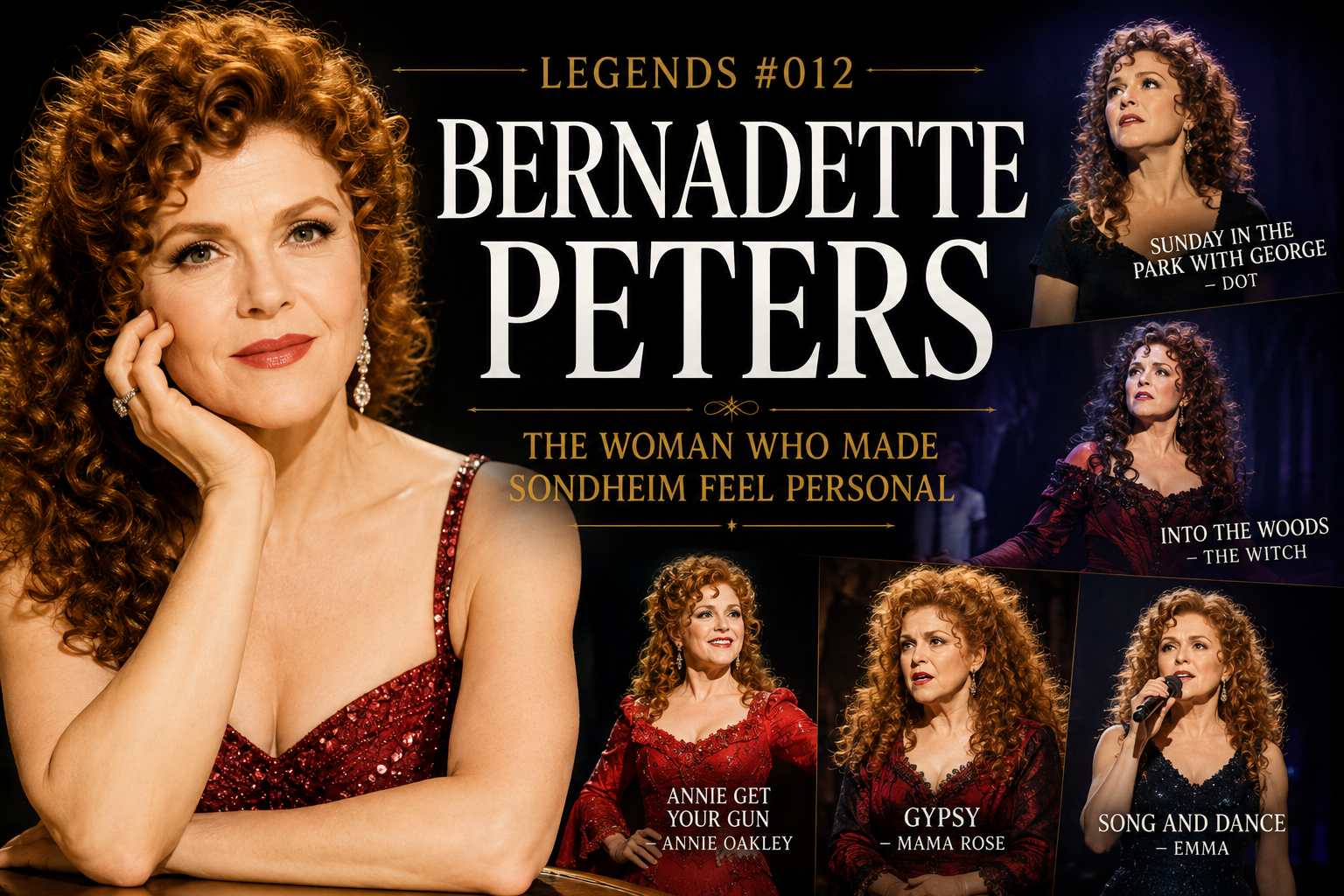
Bernadette Peters
The Woman Who Made Sondheim Feel Personal
There is a particular moment that happens when Bernadette Peters sings Stephen Sondheim.
The music does not become simpler.
The lyrics do not become less intelligent.
The architecture of the song remains exactly where Sondheim built it.
And yet something changes.
The mathematics disappear.
What remains is a human being trying to say something she may not fully understand herself.
That is one of Bernadette Peters’ rarest gifts.
Broadway has produced bigger voices.
More explosive dancers.
Performers whose personalities dominate a theatre the moment they enter.
Peters built her legend differently.
She made vulnerability powerful.
She could take a lyric packed with contradiction and make it sound as though the thought had occurred to the character for the first time.
That ability connected her permanently with the work of Stephen Sondheim—but her career is much larger than that relationship.
From Mack & Mabel to Sunday in the Park with George, Song and Dance, Into the Woods, Annie Get Your Gun, Gypsy and Follies, Peters became one of the defining musical-theatre performers of her generation.
And remarkably, her Broadway story began long before most people knew her name.
Broadway Before Adulthood
Bernadette Peters did not arrive on Broadway as an adult searching for a career.
She had already begun one.
Born Bernadette Lazzara in Queens, New York, she entered entertainment as a child and appeared professionally while still very young.
Her Broadway credits stretch back to childhood, including The Most Happy Fella in 1959 and Gypsy in 1961. Decades later, that second title would return to her life in an extraordinary way.
By the late 1960s she was appearing in productions such as George M! and by 1971 she was starring as Hildy in On the Town, earning a Tony nomination.
But early success does not automatically create artistic identity.
Peters was talented.
Beautiful.
Funny.
Distinctive.
Broadway still had to discover what only she could do.
Mack & Mabel — A Failure That Refused to Die
In 1974, Peters starred opposite Robert Preston in Jerry Herman and Michael Stewart’s Mack & Mabel.
She played silent-film star Mabel Normand.
The production lasted only a short time on Broadway.
Normally, that would be the end of the story.
It wasn’t.
Mack & Mabel became one of those strange Broadway shows whose reputation survived its original commercial failure. The score continued to be admired, and Peters’ Mabel remained an important early marker of the actress she was becoming.
She received a Tony nomination for the performance.
More importantly, Mabel revealed a quality that would define Peters for decades.
She could make sadness attractive without making it sentimental.
Her characters could be funny and wounded simultaneously.
The audience did not simply watch them suffer.
It wanted them to survive.
That emotional intimacy would eventually bring Peters into the orbit of the composer whose writing seemed almost designed to test it.
When Bernadette Met Sondheim
Stephen Sondheim did not write easy feelings.
His characters often understand themselves badly.
They rationalize.
Avoid.
Repeat.
Contradict themselves.
Then, somewhere inside a song, the truth slips out.
A performer approaching Sondheim only as music can miss the point.
The lyric is thought.
The rhythm is psychology.
A pause can matter as much as a note.
Peters understood this instinctively.
Their most important collaboration began with a painter, a woman named Dot and a masterpiece about the cost of creating something that might outlive you.
Sunday in the Park with George — Art Versus Love
In 1984, Peters originated the roles of Dot and Marie in Sunday in the Park with George, opposite Mandy Patinkin as George.
James Lapine directed and wrote the book; Sondheim wrote the music and lyrics. IBDB confirms Peters as the original Broadway Dot and Marie.
The musical begins with an audacious idea: imagine the lives behind Georges Seurat’s painting A Sunday Afternoon on the Island of La Grande Jatte.
But the painting is only the doorway.
The real subject is creation.
What does an artist sacrifice to make something extraordinary?
And what happens to the people who love someone incapable of looking away from the work?
Dot loves George.
George loves Dot.
But George also loves the act of seeing—and turning what he sees into art.
Peters had to make that conflict emotionally understandable.
She did not play Dot merely as the neglected lover of a genius.
She gave her appetite.
Humor.
Frustration.
Desire.
And the painful understanding that loving an artist does not guarantee that the artist knows how to love you back.
“Move On” — The Bernadette Peters Paradox
The second act of Sunday in the Park with George gives Peters another character: Marie, Dot’s elderly daughter.
And eventually comes “Move On.”
The song has become one of Sondheim’s defining statements about creation.
But what makes Peters’ relationship with the material so compelling is that she does not treat it like a manifesto.
She makes it intimate.
The idea is enormous:
Stop waiting for certainty.
Make the work.
Accept that others may misunderstand it.
Continue.
But in Peters’ hands, those ideas feel less like commandments than one person giving another permission to live.
That is the paradox.
Her voice can be unmistakably theatrical, yet her finest Sondheim performances often feel private.
The audience is thousands of people.
The emotion feels addressed to one.
Song and Dance — Alone on Broadway
Then came a completely different challenge.
Andrew Lloyd Webber’s Song and Dance opened on Broadway in 1985.
Peters played Emma in the first act, effectively carrying the dramatic portion of the evening through a one-woman song cycle.
There was nowhere to hide.
No large cast to redistribute attention.
No elaborate character network.
For the first half of the show, the audience lived largely through Emma.
The role won Peters the 1986 Tony Award for Best Actress in a Musical, her first competitive Tony victory.
It also demonstrated that the emotional precision audiences associated with Peters did not belong exclusively to Sondheim.
She could hold a Broadway theatre through character and song almost alone.
Into the Woods — The Witch Behind the Transformation
In 1987, Peters returned to Sondheim with Into the Woods.
She originated the Witch on Broadway.
At first, the musical appears to be a clever collision of fairy tales.
Cinderella.
Jack and the Beanstalk.
Little Red Riding Hood.
Rapunzel.
A Baker and his Wife.
Everyone wants something.
Everyone enters the woods.
And eventually many of them get exactly what they wished for.
That is when the real story begins.
Peters’ Witch stands at the center of one of the musical’s most important ideas:
getting what you want does not end the story.
Sometimes it begins the consequences.
The Witch Was Never Just a Villain
The Witch could easily become spectacle.
Costume.
Makeup.
Magic.
Transformation.
Peters found the mother inside her.
Her relationship with Rapunzel is possessive and damaging, but it is not emotionally empty.
The Witch believes she is protecting the person she loves.
That belief is precisely what makes her dangerous.
Songs such as “Stay with Me” and “Last Midnight” allow Peters to move between vulnerability and fury without making either emotion cancel the other.
And then there is “Children Will Listen.”
The lyric expands beyond the fairy tale.
Children observe what adults do.
Words leave consequences.
Care becomes control surprisingly easily.
The lesson does not arrive as a neat moral.
It arrives after damage has already been done.
That is Sondheim.
And it is exactly the kind of ambiguity Peters knew how to inhabit.
Annie Get Your Gun — The Star Steps Forward
For all her association with psychologically intricate material, Peters could also do something more traditional:
she could be a Broadway star.
The 1999 revival of Irving Berlin’s Annie Get Your Gun gave her the opportunity.
Peters played Annie Oakley opposite Tom Wopat’s Frank Butler. The production opened at the Marquis Theatre in March 1999 and ultimately ran 1,045 performances.
This was not Sondheim’s emotional maze.
It was classic Broadway entertainment.
“There’s No Business Like Show Business.”
“They Say It’s Wonderful.”
“Anything You Can Do.”
Peters had to balance comedy, romance and old-fashioned star presence while finding a contemporary human being inside a character created for another era.
She succeeded.
For Annie Oakley, Peters won her second Tony Award for Best Actress in a Musical in 1999.
The woman celebrated for subtle emotional interpretation could also simply walk to center stage and own it.
Then She Became Rose
In 2003, Bernadette Peters took on Mama Rose in Gypsy.
The casting was fascinating precisely because Peters did not appear to be the obvious Rose.
The role had become associated with formidable theatrical force.
Ethel Merman had originated it.
Angela Lansbury had won a Tony playing it.
Patti LuPone would later make it another defining role.
Peters brought a different instrument.
Instead of asking how she could become bigger, she explored where Rose might be smaller.
Lonelier.
More frightened.
More desperate.
The 2003 Broadway revival opened with Peters as Rose and earned her another Tony nomination.
Her interpretation demonstrated something essential about great roles.
They do not survive because every legendary performer repeats the previous legend.
They survive because each one discovers another person inside the same words.
Rose Without Armor
Peters’ natural vulnerability changed the temperature of Gypsy.
Rose remained controlling.
Ambitious.
Manipulative.
But the audience could sense the emotional panic beneath the behavior.
That makes “Rose’s Turn” particularly revealing.
When the machinery finally stops—when Rose can no longer pretend that everything she did was solely for her children—the character faces the desire she has displaced for years.
She wanted the stage too.
Peters did not need to turn Rose into a victim.
She simply allowed us to see the cost of her hunger.
That is harder.
Follies — When Time Becomes a Character

By the time Peters appeared as Sally Durant Plummer in the 2011 Broadway revival of Sondheim and James Goldman’s Follies, another element had entered her performances:
history.
Follies is already obsessed with memory.
Former performers return to the theatre where they once worked.
Their younger selves seem to inhabit the same space.
Old romances reappear.
Regret becomes almost architectural.
Peters’ Sally lives inside a fantasy of what might have been.
Her great song, “Losing My Mind,” is not simply about love.
It is about obsession turning memory into a prison.
A younger actress can understand the song.
A performer with decades of Broadway history can bring another layer to it.
Time itself becomes part of the performance.
Peters received a Drama Desk nomination for the production.
The Sondheim Interpreter — But Never His Museum
Calling Bernadette Peters a great Sondheim interpreter is accurate.
It is also incomplete.
She did not preserve his songs under glass.
She kept them alive by treating them as dramatic situations rather than sacred objects.
That distinction matters.
Sondheim’s reputation can intimidate performers.
The rhyme schemes are brilliant.
The structures are intricate.
The reputation is enormous.
Peters seems to approach the work from the opposite direction.
Who is speaking?
What does she want?
What is she unable to say directly?
Where does the thought change?
Once those questions are answered, the complexity stops looking academic.
It becomes behavior.
Broadway Came Back to Her — Again

Peters’ later Broadway career continued to demonstrate remarkable range.
She succeeded Catherine Zeta-Jones as Desirée Armfeldt in A Little Night Music in 2010.
She starred in Follies.
She later stepped into Hello, Dolly! as Dolly Gallagher Levi.
And in 2025 she returned to Broadway in Stephen Sondheim’s Old Friends, alongside Lea Salonga, in a revue devised by Cameron Mackintosh celebrating Sondheim’s work. IBDB records Peters among the Broadway production’s stars.
That return carries unusual emotional weight.
Peters is no longer simply an actress performing Sondheim.
She has become part of the living history of how his work reached audiences.
Yet even now, the danger would be nostalgia.
The better achievement is presence.
The songs still have to happen tonight.
More Than Awards

Bernadette Peters has won two competitive Tony Awards for acting: Song and Dance and Annie Get Your Gun. Her Broadway record also includes Tony nominations for On the Town, Mack & Mabel, Sunday in the Park with George, The Goodbye Girl and Gypsy.
In 2012, she received the Isabelle Stevenson Tony Award, recognizing her humanitarian work, including her involvement in Broadway Barks, the animal-adoption initiative she co-founded with Mary Tyler Moore.
Awards matter.
But Peters’ significance is easier to hear than count.
It exists in the way certain songs have become almost inseparable from the emotional memory of her performances.
Director’s Perspective — She Never Sang Above the Character

The easiest way to misunderstand Bernadette Peters is to focus on the voice.
It is distinctive.
Immediately recognizable.
Capable of delicacy and enormous theatrical intensity.
But the voice is not the point.
Listening is.
Peters often appears to be listening to the character while she performs her.
Listening to the thought.
Listening to what another person has said.
Listening to what the lyric has suddenly revealed.
That quality creates the illusion that a meticulously written Sondheim song is being invented in real time.
This may be why her performances can feel so vulnerable.
She does not appear to know the emotional destination before the character reaches it.
Of course, the actress knows.
The audience is allowed to forget.
That is craft.
What Bernadette Peters Changed

Peters helped demonstrate that musical-theatre power does not always require hardness.
Vulnerability can command a Broadway house.
Ambivalence can be dramatic.
A character does not have to resolve every contradiction before the final note.
And technical sophistication does not have to announce itself.
That lesson matters particularly in Sondheim.
His writing can tempt performers to show the audience how difficult it is.
Peters often did the opposite.
She made difficulty disappear.
What remained was Dot wanting George to see her.
The Witch terrified of losing Rapunzel.
Sally unable to escape a love that may exist more vividly in memory than reality.
Rose confronting the truth about her ambition.
Different women.
One extraordinary capacity for emotional exposure.
Why This Legend Still Matters

Broadway history is full of performers who were perfect for their moment.
Bernadette Peters became something rarer.
She became a bridge.
She connects the Broadway of Jerry Herman and classic musical comedy with the psychological complexity of Sondheim.
She connects traditional star performance with modern acting intimacy.
She connects productions audiences remember with songs new generations continue to discover.
And because her career began so young and continued for so long, she carries an unusual amount of Broadway history inside her own biography.
She did not merely watch the theatre change.
She changed with it.
A Lasting Legacy
Imagine an empty Broadway stage.
A single light.
No scenery.
No costume.
No orchestra yet.
Then a woman begins to sing.
Perhaps she is Dot.
Perhaps the Witch.
Sally.
Rose.
Annie.
The character changes.
The composer changes.
The decade changes.
But something remains.
A lyric stops sounding written.
It becomes a thought.
The thought becomes a feeling.
And suddenly thousands of people sitting in the dark believe they are overhearing something private.
That is Bernadette Peters’ gift.
Stephen Sondheim wrote some of the most intelligent songs musical theatre has ever produced.
Bernadette Peters reminded audiences that intelligence hurts, loves, regrets and hopes just like everyone else.
She did not make Sondheim simpler.
She made him personal.
And that is why Bernadette Peters belongs among Broadway’s LEGENDS.
References & Further Reading
Bernadette Peters — Internet Broadway Database
IBDB Profile
Tony Awards — Official Website
Tony Awards
Playbill
Playbill
The New York Public Library for the Performing Arts
NYPL for the Performing Arts
Next in LEGENDS
Some performers make a song impressive.
Others make it unforgettable.
Bernadette Peters did something rarer.
She made some of Broadway’s most sophisticated songs feel as though someone was telling you the truth for the first time.
Next Legend — Coming Soon
https://immersivelabkorea.com/audra-mcdonald/
Continue Exploring
Broadway Collection — Explore the productions that transformed musical theatre and the stories behind their creation.
LIVE STAGE — Discover legendary concerts, world tours and unforgettable live performances.
WORLD DISCOVERY — Step inside extraordinary theatres, performance venues and cultural destinations around the world.
THE SHOW X-FILES — Investigate the controversies, failures, risks and breakthroughs hidden behind famous productions.
About LEGENDS
LEGENDS is an original editorial series from IMMERSIVE LAB, dedicated to the people who changed the language of entertainment.
Composers. Directors. Producers. Choreographers. Performers. Designers. Visionaries.
We do not simply ask who became famous.
We ask:
What did they change? Why did it matter? And why can we still feel their influence today?
IMMERSIVE LAB
Sondheim gave Broadway the words.
Bernadette Peters found the heartbeat inside them.
Dot. The Witch. Sally. Rose.
Different women. Different desires. Different wounds.
But every time she began to sing, the distance between character and audience became smaller.
The song stopped being performance.
It became confession.
IMMERSIVE LAB — The Stories Behind the Stage.


