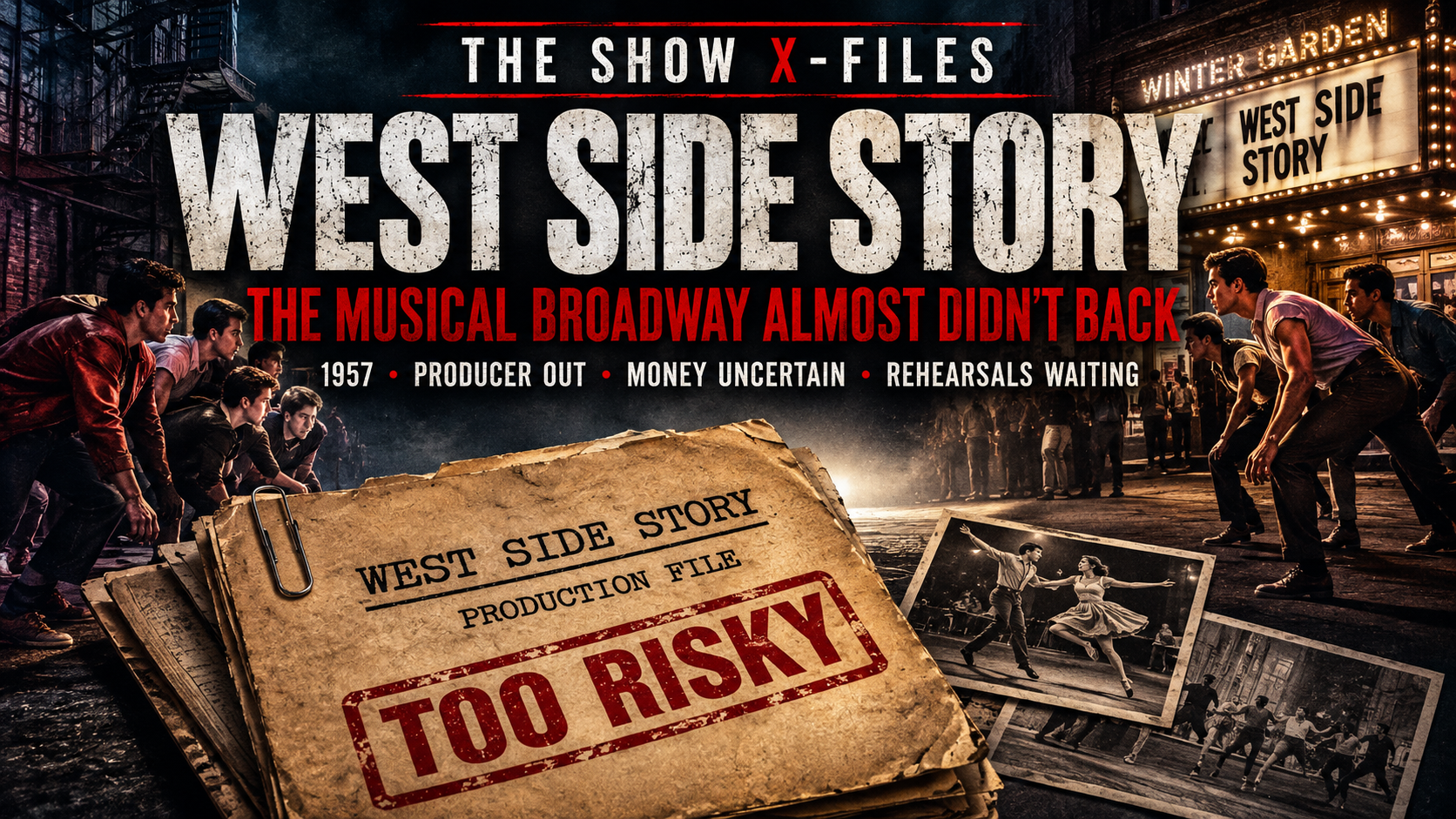
West Side Story: The Broadway Musical Producers Were Afraid to Back
Before It Became a Classic, Its Producer Walked Away — and Broadway Wasn’t Sure Anyone Wanted a Musical This Dark
CASE STATUS: SURVIVED
LOCATION: Winter Garden Theatre, New York
OPENING: September 26, 1957
CLOSING: June 27, 1959
ORIGINAL RUN: 732 performances
CONCEIVED / DIRECTED / CHOREOGRAPHED BY: Jerome Robbins
BOOK: Arthur Laurents
MUSIC: Leonard Bernstein
LYRICS: Stephen Sondheim
PRODUCERS: Robert E. Griffith and Harold S. Prince
Six Months Before Broadway, the Producer Wrote: “I Think We Are in Trouble.”
Today, the title West Side Story almost sounds safe.
It is taught. Revived. Recorded. Filmed. Performed around the world.
“Maria.” “Tonight.” “America.” “Somewhere.”
The score has become part of musical-theatre history.
But imagine encountering the project before any of that existed.
A Broadway musical about teenage gangs. Racial conflict. Street violence. An attempted sexual assault. Multiple deaths. A romantic lead who does not survive the final scene. Long stretches in which dance carries dramatic information normally delivered through dialogue. Music influenced by jazz, Latin rhythms and symphonic writing. And a creative team attempting to make choreography, music, lyrics and book operate almost as a single dramatic language.
This was not the obvious shape of a 1957 Broadway hit.
Then came the warning that could have ended everything.
Producer Cheryl Crawford, who had been attached to the project, was struggling with it. In April 1957 she wrote to Arthur Laurents:
“I think we are in trouble.”
She warned against relying on “blind luck.” Not long afterward, she withdrew.
This was not a critic rejecting the musical after opening night. This was the producer losing confidence before rehearsals had properly begun. Crawford’s correspondence is preserved in the Arthur Laurents collection at Brandeis University.
West Side Story had extraordinary creators. It had an ambitious concept. It had songs. It had choreography.
What it suddenly did not have was something much more basic: a secure path to Broadway.
So THE SHOW X-FILES #012 asks a different question from the usual West Side Story retrospective: How close did one of Broadway’s greatest musicals come to becoming a show nobody wanted to finance?
1. The Musical Had Already Failed Once — Before It Existed

The story actually began years earlier.
In 1949, Jerome Robbins approached Leonard Bernstein with an idea for a contemporary musical adaptation of Shakespeare’s Romeo and Juliet.
The conflict would initially involve a Jewish girl and an Italian Catholic boy on Manhattan’s Lower East Side, against the background of Easter and Passover.
One possible title was: East Side Story.
Arthur Laurents joined the project. But it stalled.
The creators had other commitments, and the religious conflict eventually seemed insufficiently fresh to sustain the concept.
Years passed. Then, in the mid-1950s, the idea returned in a different America.
Newspaper stories about juvenile gangs and racial tensions helped redirect the project. The geography moved west. The central conflict changed. The Jets and Sharks emerged.
East Side Story became West Side Story.
That transformation matters. The creators did not protect the original idea simply because it was theirs. They allowed reality to tell them: This version isn’t working anymore.
That willingness to destroy an idea in order to save its deeper purpose would become one of the show’s defining creative principles.
2. Then Stephen Sondheim Almost Wasn’t Part of It
Stephen Sondheim was still early in his Broadway career. And he did not initially dream of becoming someone else’s lyricist. He wanted to write his own music.
That hesitation makes sense. Joining West Side Story meant working alongside Leonard Bernstein—already a formidable musical figure—and writing lyrics for music Sondheim did not compose.
But Oscar Hammerstein II, Sondheim’s mentor, encouraged him to accept the opportunity. He did.
The decision created one of the most famous creative partnerships in musical-theatre history.
Yet even here the project was not comfortable. Bernstein’s musical instincts could be expansive and operatic. Sondheim worried about whether lyrics sounded believable coming from young street characters. Laurents was trying to make Shakespearean tragedy feel immediate rather than literary. Robbins wanted movement to become dramatic action.
Four exceptional creators were not automatically four compatible creators. West Side Story was being built through friction.
3. Broadway Musicals Were Not Supposed to Behave Like This
Consider the opening.
There is no conventional introductory scene explaining who everyone is. Instead: silence. A whistle. Finger snaps. Movement. Territory. One gang enters another gang’s space.
Before the audience receives a traditional exposition scene, choreography has begun explaining the world.
Jerome Robbins understood that the conflict could be communicated physically. The New York Public Library’s account of the production process notes that the creative team struggled with the opening until Robbins realized dance itself could establish the battle over territory.
This sounds obvious now because West Side Story helped make it imaginable.
In 1957, it was a gamble. Dance was not decoration between dramatic scenes. Dance was the dramatic scene.
A gesture could identify a character. A movement could establish allegiance. A sequence could escalate violence.
The choreography was not asking: “How can we make this musical exciting?”
It was asking: “What can movement tell the audience that dialogue cannot?”
That is a much more radical production question.
4. The Show Had Another Problem: It Was Dark
Broadway audiences certainly knew tragedy. But West Side Story was being marketed as a musical while refusing many of the emotional comforts associated with musical comedy.
The first act moves toward violence. Riff dies. Bernardo dies.
The second act does not restore order. Tony dies. Maria survives.
There is no conventional romantic payoff. No wedding. No triumphant reconciliation. No reassuring finale that tells the audience everything will be fine.
PBS’s Broadway history notes that contemporary reviews were generally positive, but the show’s tragic tone was off-putting to some audiences and observers.
This was a commercial question, not merely an artistic one.
Would people pay Broadway prices to watch young people destroy one another? Could songs coexist with murder without trivializing it? Could dance portray gang violence without romanticizing it? Could a musical leave audiences disturbed and still become popular entertainment?
Nobody could point to decades of West Side Story revivals as proof. There were no decades yet. The producers had to bet before history supplied the answer.
5. Cheryl Crawford Saw the Risk
Cheryl Crawford was not an amateur frightened by an unconventional idea. She was an experienced theatrical producer. That makes her doubts more significant.
The surviving correspondence shows serious concern about the project during 1957. Then she withdrew shortly before the Broadway production moved into rehearsal.
From today’s perspective, it is tempting to treat this as a legendary producer failing to recognize a masterpiece. That interpretation is too easy.
Crawford was seeing genuine risks. The show was expensive and demanding. Its tone was dark. Its score was unconventional. Its creators had strong and sometimes competing artistic ideas. Its casting requirements were unusual. Its choreography demanded extensive rehearsal. And investors still had to be persuaded that audiences would buy tickets.
The mistake would be assuming that because West Side Story eventually succeeded, financing it was obviously rational beforehand.
It wasn’t. A masterpiece can still look like a bad investment before opening night.
6. The Backers Didn’t Know What They Were Buying

Theatre is strange financially. Investors must commit money before the product is complete. They cannot watch the finished show first. They hear songs. Read scripts. See presentations. Study the creative team. Listen to producers. And then make a decision about something that does not yet fully exist.
West Side Story made that process particularly difficult.
How do you demonstrate choreography that depends on a full company before the full production exists? How do you explain the emotional effect of Bernstein’s score without its orchestration? How do you prove that gang warfare can become musical theatre without looking absurd? How do you sell a tragedy when Broadway is filled with safer alternatives?
The show needed money precisely because it needed production resources to prove the idea worked. But investors wanted proof before supplying the money.
That is the classic experimental-production paradox: The show must exist before people believe in it, but it needs their money before it can exist.
7. Stephen Sondheim Made the Phone Call
When Crawford withdrew, Sondheim contacted his friend Harold Prince.
Prince and his producing partner Robert Griffith were in Boston working on another production. Sondheim told Prince what had happened. The show had effectively lost its producer.
Prince already knew some of the score. He became interested.
This was not an automatic rescue. According to later accounts, Prince sought advice from veteran director-producer George Abbott. The advice was essentially: stay away. The project looked dangerous.
Prince did the opposite. He and Griffith came aboard, with Roger L. Stevens also connected to the production arrangements. The official Broadway record credits Robert E. Griffith and Harold S. Prince as producers.
That decision changed theatre history. But what makes it important to X-FILES is not hindsight. Prince did not know he was rescuing a classic. He was accepting a risk another capable producer had decided was too great.
8. The Budget Had to Serve the Experiment
Taking over did not magically remove the financial problem. The production still had to be mounted.
Robbins’ choreography demanded unusual rehearsal commitment. Dance could not be added at the end. It was the architecture of the show.
Prince recognized that if the production compromised the choreography too severely, it might destroy the very thing that made West Side Story different.
So the production had to find savings elsewhere while protecting enough rehearsal time for Robbins’ work.
This is a useful production lesson. Budget control is not simply cutting every department equally. Good producing identifies the element that carries the project’s unique value and protects it.
For West Side Story, choreography was not optional spectacle. It was storytelling infrastructure. Cutting rehearsal there might have saved money while destroying the product.
9. Jerome Robbins Was Building Two Gangs — Even Offstage
Robbins wanted the Jets and Sharks to feel like genuine rival groups. He pursued that distinction intensely during rehearsal.
The companies were kept apart. Different identities were reinforced. Individual dancers developed specific gestures and physical characteristics.
The rehearsal room itself became an extension of the dramatic world.
This method produced results. It also contributed to an extraordinarily demanding creative environment.
West Side Story‘s rehearsals were not simply about learning steps. Performers had to sing. Dance. Act. Fight. Maintain complex rhythms. And make stylized movement feel emotionally real.
The production needed performers capable of moving between disciplines that Broadway often treated separately.
The cast was not being asked to execute choreography around the drama. They were being asked to act through choreography.
10. The Stage Became a Battleground
This is where West Side Story becomes especially important to IMMERSIVE LAB.
The production did not create spectacle primarily through massive scenery. It created spectacle through human movement and spatial control.
Look at the basic scenic language. Fences. Fire escapes. Urban structures. Open stage space. The environment was recognizable.
But the performers constantly transformed it. A street became territory. A dance became confrontation. A gymnasium became a battlefield disguised as a social event. A rumble became choreography and then murder.
This is immersive thinking before the term became fashionable.
The audience did not merely hear that the Jets and Sharks hated each other. They watched the distance between bodies. They saw who occupied which part of the stage. They felt rhythm become threat.
The production transformed space into narrative information.
That may be one of the most important reasons West Side Story survived its risky subject matter. Its innovation was not merely intellectual. Audiences could physically feel it.
11. Even the Score Looked Dangerous
Bernstein’s music is now so familiar that its difficulty can disappear. But the score combines musical languages that do not behave like conventional Broadway comfort food.
Jazz. Latin rhythms. Classical writing. Dance music. Complex meters. Dissonance. Recurring musical ideas.
The music could be lyrical one moment and aggressive the next.
“Maria” reaches toward romantic transcendence. “America” turns rhythm into argument. “Tonight” expands individual stories into ensemble counterpoint. “Cool” turns suppressed violence into physical rhythm.
The score was not simply a collection of songs waiting for applause. It was helping organize the drama.
That made the show musically thrilling. It also made it harder to categorize. And Broadway financing likes categories because categories help predict audiences.
West Side Story was asking investors to finance something whose future category did not yet exist.
12. Washington Changed the Case
Then something happened that every troubled production hopes for. The audience arrived.
West Side Story began its pre-Broadway engagement in Washington, D.C., in August 1957. The response was strong.
The experiment started producing evidence. The creative team had spent years asking whether the mixture could work. Shakespeare. Gang violence. Ballet. Broadway. Jazz. Latin musical language. Tragedy. Romance.
Now audiences could finally experience those elements together rather than hearing them explained in a backers’ room.
Bernstein wrote enthusiastically about the response and what the production might prove if New York reacted similarly. The official West Side Story archive preserves his 1957 correspondence and the production history.
This is another production principle: Some ideas cannot be properly judged in fragments.
A song may sound strange without staging. Choreography may look abstract without dramatic context. Scenery may seem sparse without performers. Experimental work sometimes requires the complete system before its logic becomes visible.
West Side Story finally had that system.
13. September 26, 1957

The curtain rose at Broadway’s Winter Garden Theatre.
The project that had stalled for years was finally real. The project whose producer had withdrawn was now open. The project investors had struggled to understand could finally be judged by audiences and critics.
And the reaction was strong. Critic Walter Kerr’s review emphasized the extraordinary impact of Robbins’ movement and the production’s violent energy.
But here is where hindsight again distorts the story.
West Side Story was not immediately crowned the uncontested greatest musical of its season.
At the 1958 Tony Awards, it won for choreography and scenic design. It did not win Best Musical. That award went to The Music Man.
Think about the contrast. The Music Man was warm, comic and broadly accessible. West Side Story was violent, tragic and formally experimental.
Broadway had not unanimously decided which represented the future. History would keep debating the question long after the awards ceremony ended.
14. 732 Performances Changed the Risk
The original Broadway production ultimately ran 732 performances, closing June 27, 1959.
That number matters. Not because 732 performances automatically make something great. But because it proved something commercially important.
Audiences would attend a musical this dark. Dance could carry narrative. Tragedy could coexist with Broadway musical form. Contemporary social conflict could occupy a major commercial stage. A production did not have to become lighter simply because investors were nervous.
West Side Story did not eliminate Broadway risk. It expanded what producers could imagine surviving that risk.
15. Then Hollywood Made It Look Inevitable

The 1961 film adaptation transformed the cultural scale of West Side Story. The film became a major success and won 10 Academy Awards, including Best Picture.
From that point onward, the show’s survival story became harder to see.
Success rewrites memory. Once a work becomes canonical, people begin assuming its greatness must always have been obvious.
But classics do not enter rehearsal rooms wearing labels that say: CLASSIC.
They arrive as scripts. Budgets. Arguments. Deadlines. Casting problems. Unfinished songs. Producer doubts. Investor meetings.
West Side Story had all of them. Its later fame does not erase the uncertainty. It proves the uncertainty was worth surviving.
16. But There Is Another X-File Inside West Side Story
A modern investigation cannot simply celebrate innovation and stop there.
West Side Story‘s representation of Puerto Rican identity has generated decades of discussion and criticism.
The original creative team was largely composed of white American theatre artists constructing a story about racial and ethnic conflict. Casting practices of the period also differed significantly from expectations today.
The National Theatre’s historical project notes that the show’s treatment of Puerto Rican characters has remained controversial, including questions of stereotypes and casting.
This does not erase the production’s theatrical achievements. Nor should achievement erase those questions. Both can be true.
West Side Story revolutionized musical storytelling. And later generations can examine whose experience was being represented, who was doing the representing, and how those choices shaped what audiences saw.
A classic survives not because questions stop. Sometimes it survives because new generations keep asking different ones.
17. What Was the Actual Gamble?
It is tempting to say the gamble was the subject. Gang violence. Race. Death.
But that is only part of it. The deeper gamble was integration.
Every department depended on every other department.
If Robbins’ choreography failed, the drama weakened. If Bernstein’s music overwhelmed the characters, the street realism weakened. If Laurents’ book became too literary, the immediacy weakened. If Sondheim’s lyrics sounded too sophisticated, character credibility weakened. If performers could dance but not act, the gangs became decorative. If they could act but not dance, Robbins’ entire dramatic architecture collapsed.
West Side Story had fewer places for weakness to hide because its disciplines were interconnected.
That made production difficult. It also made the finished work unusually powerful.
18. The Show That Almost Couldn’t Be Sold Changed What Could Be Sold
This is the paradox at the center of FILE #012.
The characteristics that frightened potential backers were largely the characteristics that made West Side Story historically important.
Too dark. Too violent. Too much dance. Too musically ambitious. Too difficult to categorize.
Those were not simply defects that producers eventually overcame. They were the proposition.
If the team had systematically removed everything that looked financially dangerous, West Side Story might have become easier to fund. It also might have stopped being West Side Story.
This is where producing becomes more than financial control. A producer must distinguish between risk caused by weakness and risk caused by originality.
They look surprisingly similar before opening night.
THE X-FILES VERDICT
Was West Side Story considered a safe Broadway proposition in 1957? NO. Its tragic story, difficult score, dance-centered storytelling and commercial uncertainty made it a challenging project to finance.
Did an original producer withdraw? YES. Cheryl Crawford left the production shortly before rehearsals. Her surviving correspondence documents serious concerns about the project.
Was the production then rescued? YES. Harold Prince and Robert E. Griffith became the Broadway producers, with Roger L. Stevens involved by arrangement.
Did West Side Story immediately dominate the Tony Awards? NO. It won Best Choreography and Best Scenic Design but lost Best Musical to The Music Man.
Was the original production commercially viable? YES. It ran 732 performances.
So what nearly failed? Not one technical system. Not one disastrous performance. Not one accident. West Side Story nearly encountered a different kind of failure: Broadway might simply have decided the experiment was too risky to finance.
CASE CLOSED?
Imagine the alternate history.
Cheryl Crawford withdraws. Nobody replaces her. The money never comes together. The rehearsal room never opens. Robbins never gets enough dancers onto the floor to prove his concept. The whistle never sounds at the Winter Garden.
There is no original Broadway cast. No 732 performances. No 1961 film in the form history knows it. No generations of revivals built upon the original production.
The songs may survive in some form. The creators certainly continue their careers. But West Side Story as a theatrical event never becomes West Side Story.
That alternate history was not impossible. For a brief moment in 1957, it was close enough to be frightening.
And that may be the most useful lesson of the entire case.
Audiences usually encounter innovation after somebody has paid for the risk. They see the finished stage. They do not see the producer who walked away. The investors who said no. The rehearsal costs. The arguments. The version abandoned eight years earlier. The phone call that found another producer. The budget that had to protect the right thing. The creators who could not yet prove their idea would work.
Today, West Side Story looks inevitable.
In 1957, it wasn’t.
Before Broadway could call it a classic, somebody had to decide it was worth the possibility of failure.
EDITOR’S ANALYSIS
The previous X-FILES cases examined productions that failed after operational warning signs accumulated.
West Side Story presents the opposite problem. What happens when warning signs may actually be evidence of innovation?
A producer cannot simply eliminate risk. If that were the goal, genuinely new work would rarely reach the stage.
The producer’s job is to identify the nature of the risk.
There are avoidable risks: unsafe infrastructure, unrealistic schedules, missing finance, weak command structures, unsecured contracts. Those should be reduced.
Then there are creative risks: an unfamiliar format, a difficult subject, new technology, unusual staging, a storytelling language audiences have not encountered before. Those cannot always be removed without destroying the project’s reason for existing.
West Side Story demonstrates the difference. Its production required financial discipline. But the solution was not to turn the tragedy into a cheerful musical comedy. The solution was to build a production system capable of supporting the difficult idea.
That distinction connects directly with contemporary immersive entertainment.
A projection system is not innovative because it is expensive. A giant LED wall is not innovative because it is large. A new venue is not innovative because nobody has built one there before.
Innovation exists when an unfamiliar production choice communicates something better than the conventional alternative.
Robbins’ choreography did exactly that. The Jets and Sharks did not need a narrator to explain their territorial conflict. Their bodies explained it.
That is why FILE #012 belongs in WHEN THE SHOW ALMOST FAILED.
West Side Story did not almost fail because its creators lacked ideas. It almost failed because the idea was difficult to prove before somebody funded the stage on which it could prove itself.
References & Further Reading
Library of Congress — West Side Story: Birth of a Classic
Birth of a Classic
Brandeis University — Arthur Laurents Correspondence
Arthur Laurents Collection
Internet Broadway Database — Original Broadway Production
West Side Story Original Broadway Production
Next in THE SHOW X-FILES
https://immersivelabkorea.com/rebecca-broadway-musical-phantom-investor/


