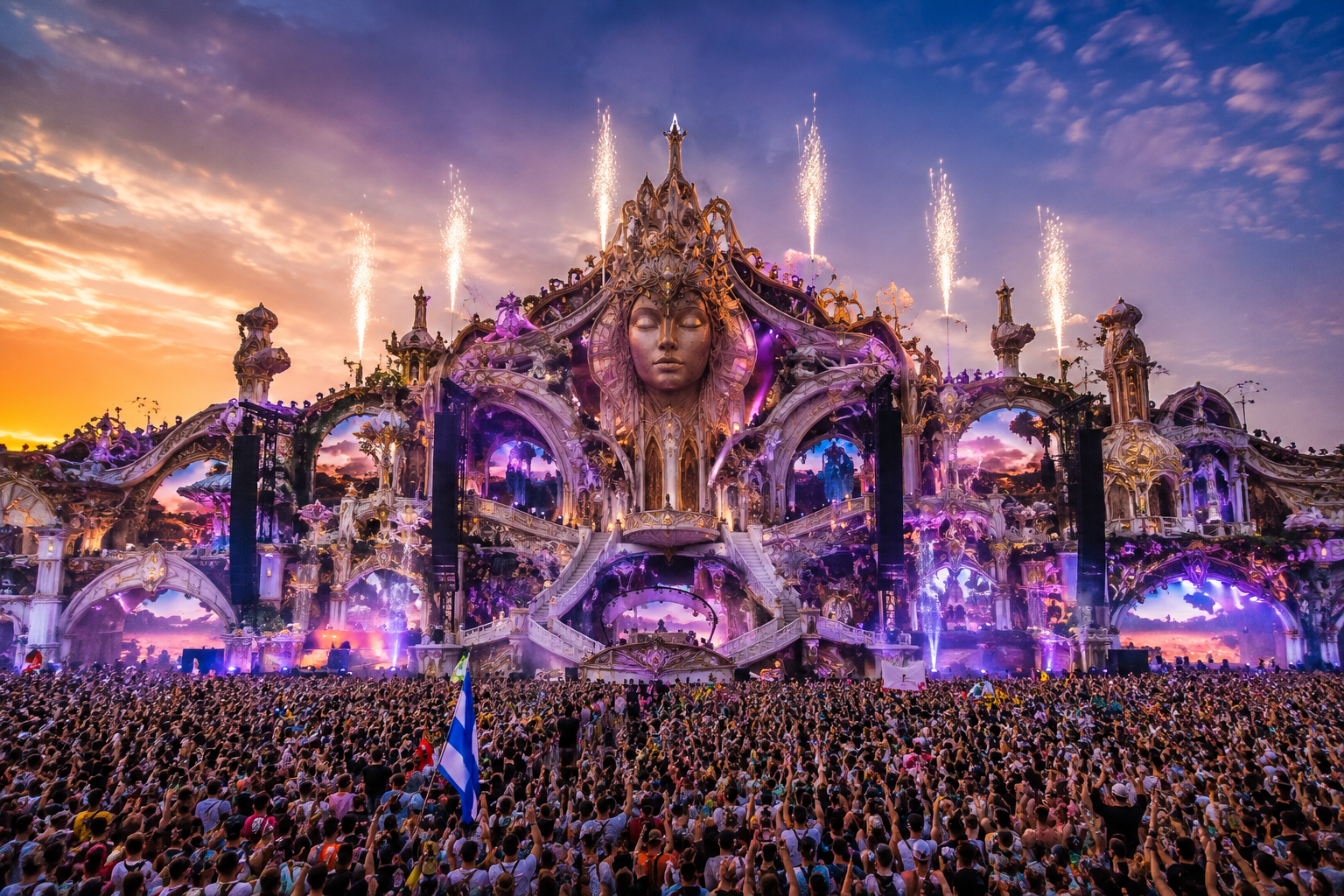
Tomorrowland Doesn’t Build a Stage. It Builds a World.
How Does a Festival Turn Storytelling Into a 43-Meter-High Production Machine?
Before a single DJ stepped onto Tomorrowland’s Mainstage in Belgium in 2026, the production team had already spent more than two years creating the world behind them.
Then came 54 days of construction.
When the structure finally stood inside De Schorre in Boom, Belgium, it measured 43 meters high and 140 meters wide. Hidden inside and across its enormous scenic architecture were 2,400 LED tiles, 232 speakers, 1,200 conventional lighting fixtures plus another 300 custom-designed fixtures, 56 lasers, 38 fountains, two waterfalls and six stage lifts for performers.
And at the centre of everything was a monumental face.
This was Consciencia, Tomorrowland’s 2026 Mainstage.
Those numbers are impressive.
But they are not the most interesting part.
The real production question is harder: how do you make thousands of lights, speakers, screens, fountains, performers and scenic elements feel like parts of one world rather than an enormous collection of effects?
Tomorrowland’s answer begins long before anyone designs the lighting rig.
It begins with a story.
The Stage Starts Before the Stage Exists

Most festival stages can be understood from the outside in.
A structural system is established. Video surfaces are positioned. Lighting and audio requirements follow. Scenic elements then create identity around that technical framework.
Tomorrowland increasingly works in the opposite direction.
For 2026, Consciencia was conceived as a world built around six emotions: Wonder, Love, Anger, Joy, Desire, Sadness.
Each emotion became its own province within a fictional universe.
Wonder was represented through clouds that change with emotion. Joy through flowers and bees. Desire through birds and feathers. Love through butterflies. Anger through rock and stone. Sadness through sand, deserted beaches and fading colour.
At the centre stood Amutaz, a monumental face carrying all six emotions. Staircases and bridges spread outward from that figure, turning the narrative into architecture.
This distinction matters.
A theme can be decoration. A narrative can become a design system.
If “fantasy” is simply the theme, almost any dragon, castle, flower or sculptural object can be added. But once individual parts of the stage represent specific ideas, designers have constraints.
The scenic department cannot work independently from the story. Lighting cannot simply choose whatever looks spectacular. Video content cannot exist in another visual universe. Performance entrances must happen somewhere. Water effects need architectural reasons to exist.
Suddenly, storytelling is doing something practical: it is coordinating departments.
What Happens When the Scenic Design Is 140 Meters Wide?

At 140 meters, Consciencia was wider than many conventional performance buildings.
Scale creates an unusual problem.
The audience cannot read a structure that large in the same way they read scenery in a theatre. Small details disappear. Faces become shapes. Textures become surfaces. And people standing onstage can become visually insignificant.
Tomorrowland therefore works across several visual scales simultaneously.
From far away, the audience reads the silhouette. Closer in, they discover individual provinces, faces, bridges and sculptural details. Video and lighting introduce another layer that becomes increasingly dominant after sunset. Performers create human-scale movement inside the architecture.
This is why scenic engineering and creative direction cannot be separated at this scale.
A beautiful object in a workshop is irrelevant if it disappears from the audience’s viewing distance. Every element must survive the scale of the field.
2,400 LED Tiles Are Not the Scenery

One of the easiest mistakes in modern stage design is to assume that more LED automatically creates greater immersion.
Tomorrowland’s Mainstage demonstrates another approach.
Consciencia contained 2,400 LED tiles, but the screens were not designed to visually replace the scenic structure. They existed inside a much larger physical environment.
That changes the role of video.
Instead of saying: “Here is the screen. Watch it.”—the design can say: “Here is the world. Video is one of the materials inside it.”
That is a fundamental difference from the Quasar stage we examined at Coachella.
At Quasar, enormous digital surfaces effectively became scenic architecture. At Tomorrowland, physical scenic architecture remains dominant and video is integrated into it.
Neither approach is inherently better. They solve different production problems.
Quasar needed a visual environment capable of evolving through extended electronic sets. Tomorrowland needs hundreds of artists to enter an existing narrative universe without destroying its identity.
The architecture therefore becomes the constant. The performer changes. The world remains.
1,500 Lighting Fixtures Still Need a Reason to Exist

The lighting specification is even more revealing.
Tomorrowland says Consciencia incorporated 1,200 lighting fixtures plus 300 custom-designed fixtures.
The raw quantity tells us almost nothing about whether the design works.
The production challenge is hierarchy.
With a structure 43 meters high, lighting has several jobs simultaneously. It must reveal scenic architecture. It must illuminate performers. It must support camera images. It must create large aerial compositions visible across the field. It must interact with LED content. It must maintain the visual identity of the fictional world. And it must still deliver the explosive musical cues expected from electronic dance music.
If everything fires at maximum intensity all the time, the production loses one of its most valuable tools: contrast.
A drop only feels enormous when something existed before it.
Darkness is therefore part of lighting design. Restraint is part of spectacle.
Tomorrowland’s challenge is not whether 1,500 fixtures can make the stage bright. Of course they can. The challenge is whether the system can make the same architecture feel emotionally different over many hours of programming.
Then Add 56 Lasers, 38 Fountains and Two Waterfalls

At this point, the design could easily collapse into an effects demonstration.
But effects only become meaningful when they occupy different layers of the composition.
Lasers operate in air. Fountains introduce vertical motion. Waterfalls create continuous physical movement. LED provides animated surface. Lighting reveals physical form. Scenery gives the image permanent architecture. Performers add human scale. Sound supplies the temporal structure connecting everything.
Consciencia’s 38 fountains, two waterfalls and 56 lasers therefore should not be understood as separate attractions.
They are different visual instruments.
The production problem resembles orchestration. If every instrument plays constantly, the audience stops hearing individual voices. The same thing happens visually.
The spectacular moment is not created by activating everything. It is created by deciding when not to.
Six Stage Lifts Reveal Something the Audience Cannot See
One specification is easy to overlook: six stage lifts for dancers and show performances.
Those lifts reveal that the Mainstage is not merely an elaborate DJ background. It is a performance machine.
Vertical movement allows performers to emerge from architecture rather than simply walk onto it.
But every moving stage system introduces another layer of production responsibility. Where does the performer wait? How is access controlled? What happens beneath the deck? Where are the safe zones? How are movements cued? What happens if a lift fails? How does choreography interact with scenic automation? How is the system reset between sequences?
The audience sees an entrance lasting seconds. Production sees a chain of engineering, cueing, choreography and safety decisions.
This is exactly where spectacle becomes infrastructure.
232 Speakers: The Scenic Design Has an Acoustic Problem
There is another complication when scenic architecture becomes this dominant.
Sound still has to win.
Consciencia incorporated 232 speakers, according to Tomorrowland’s official production figures.
Large scenic structures can create difficult conditions for audio design. The system must cover a huge audience area while remaining integrated with a visual architecture that was not created solely around loudspeaker placement.
This creates one of live production’s recurring negotiations: what the audience should see versus what the audience needs to hear.
A loudspeaker array positioned solely for acoustic performance may interrupt the visual composition. Hide too much audio infrastructure and coverage can suffer.
Tomorrowland therefore illustrates something that spectacular photographs rarely reveal.
Every major live production is a compromise between departments. The success of the final image depends partly on making those compromises invisible.
The Most Important Department May Be the One the Audience Never Sees

Tomorrowland does something particularly interesting with its creative pipeline.
It keeps much of it inside the organization.
For Consciencia, Tomorrowland says the process ran from initial sketches through 3D modelling, sculpting and production, with design handled by its internal 3D department and execution by the Tomorrowland Atelier. The creative process lasted more than two years.
This is not new for the festival. The 2024 LIFE Mainstage followed the same in-house philosophy, from concept and 3D development through sculpture, décor production, construction and installation.
That organizational structure may explain more about Tomorrowland’s visual identity than any individual lighting fixture.
When concept design and physical fabrication remain closely connected, feedback can travel both directions. A sculptural idea can encounter an engineering problem. The workshop can identify a fabrication limitation. The 3D team can revise geometry. Creative direction can decide whether the change damages the narrative. Production can test whether it can actually be installed.
This loop is extremely valuable. Because the greatest enemy of ambitious scenic design is often the gap between what was imagined and what can actually be built.
Fifty-Four Days to Turn a Model Into a Building

After more than two years of development, Consciencia required 54 days of construction at the festival site.
That number changes how we should look at the finished photograph.
The Mainstage is not an object delivered by truck. It is effectively a temporary building.
Construction sequencing becomes part of production design. Structural elements must arrive before scenic finishes. Rigging and technical infrastructure require access. LED needs support and service routes. Lighting must be installed and focused. Audio systems need deployment and testing. Water systems require plumbing and control. Automation needs commissioning. Show control has to communicate with multiple systems.
Then artists and performers need rehearsals.
All of this happens while an enormous festival site is simultaneously being prepared around it.
A stage of this scale is therefore not merely designed. It is scheduled. And schedule is one of the least glamorous but most important creative tools in live production.
A brilliant design that cannot be completed before doors open is not a brilliant production design. It is an unfinished idea.
Tomorrowland Has Been Testing This System for Years
Consciencia becomes even more interesting when placed beside previous Mainstages.
In 2023, the Adscendo Mainstage stood 43 meters high and 160 meters wide. Tomorrowland reported roughly 740 square metres of video surface, 1,050 lamps, 230 speakers and subs, 30 lasers, 48 fountains and about 50 days of construction.
In 2024, LIFE measured 36 meters high and 160 meters wide, with more than 1,600 square metres of video surface, 1,054 lamps, 230 speakers and subs, 1,100 custom LED lights, 43 fountains and four waterfalls.
The important point is not which year was bigger.
It is that Tomorrowland has created a repeatable production methodology capable of generating completely different scenic worlds.
That is much harder than designing one spectacular stage.
A single successful design can be an exceptional project. A system capable of producing a new world repeatedly becomes an institutional capability.
Production Perspective: Tomorrowland’s Real Product Is Not the Mainstage
This is where the numbers finally become meaningful.
The Mainstage is not Tomorrowland’s real product. World-building is.
The festival has developed an internal production system in which narrative can move through concept art, graphic design, 3D modelling, sculpture, fabrication, architecture, lighting, video, effects, performance and finally audience experience.
That also explains why the story begins before visitors arrive.
For Consciencia, Tomorrowland introduced the universe through a cinematic trailer, a fantasy novel and other creative material before the festival opened. The theme was also designed to continue beyond Belgium into Thailand and Brazil.
This turns scenic design into something larger.
The audience does not first encounter the story when they see the stage. They arrive already carrying pieces of it. Then the physical environment completes the transformation.
400,000 People Enter the Same Fiction

Across two weekends in 2026, Tomorrowland Belgium welcomed 400,000 attendees from more than 200 countries.
That introduces the final production layer: the audience.
Immersive design is sometimes discussed as though immersion is something technology does to people. More screens. More projection. More effects. More sensors.
But Tomorrowland demonstrates another possibility.
Immersion can come from shared agreement.
Hundreds of thousands of people accept the visual language. They dress for it. Photograph it. Move through it. Share it. Wait for its reveals.
The audience begins to reinforce the fiction themselves.
At that point the production no longer ends at the edge of the stage. It extends into the crowd.
And the Audience Is No Longer Only in Belgium
The physical audience was only one part of the 2026 production.
Tomorrowland reported that its global livestream generated 233 million views across YouTube, TikTok, Facebook, Instagram and other platforms, up from 193 million the previous year.
This means the Mainstage now has two simultaneous architectural responsibilities.
It must work for the person standing in De Schorre. And it must work inside a rectangular camera frame.
Those are not identical audiences.
The festival visitor experiences scale physically. The online viewer experiences composition. The visitor can choose where to look. The broadcast director chooses for the remote audience.
A successful contemporary festival stage therefore needs to survive both experiences. The scenic architecture must be monumental enough to dominate a field—but detailed enough to remain interesting in a close camera shot.
Why Tomorrowland Feels Different
The answer is not 56 lasers. It is not 38 fountains. It is not 2,400 LED tiles. And it is certainly not because the stage is large.
Large stages are common.
Tomorrowland’s more valuable achievement is organizational.
It has built a production pipeline capable of translating an imaginary world into physical infrastructure.
Story becomes geometry. Geometry becomes engineering. Engineering becomes scenery. Scenery becomes a lighting surface. Lighting becomes emotion. Automation becomes performance. Sound gives the entire machine time. And the audience completes it.
That is why looking only at photographs of Tomorrowland misses the most interesting part.
The finished Mainstage is merely the visible evidence of a much larger production system.
A Stage That Has to Become Something Else Next Year
There is one final contradiction.
Tomorrowland spends more than two years developing a world that exists physically for only a tiny fraction of that time.
Then it has to move on. Another story. Another architecture. Another production problem.
That temporary nature could be considered wasteful creatively.
Instead, Tomorrowland has turned it into part of its identity.
The audience expects revelation. They do not only ask: who is playing? They ask: what will the world look like this year?
Few festivals have made scenic production itself such an important part of audience anticipation.
And that may be Tomorrowland’s most important production achievement.
It has transformed the stage from infrastructure supporting the festival—into one of the reasons people want to experience the festival at all.
Production Takeaway
Tomorrowland offers a useful lesson for any large-scale immersive project.
Do not begin by asking what technology you can install. Begin by asking what world the audience is supposed to enter. Then determine what scenic engineering, lighting, video, sound, automation and effects are actually required to make that world believable.
Technology without a design system creates equipment. Technology serving a coherent idea creates experience.
Consciencia required extraordinary quantities of technology. But its most important piece of production equipment may have been something that never appeared on the technical specification: a story strong enough to tell every department what they were building.
Continue Exploring WORLD DISCOVERY
WORLD DISCOVERY examines how architecture, technology, production and creative direction transform physical spaces into extraordinary audience experiences.
Next in WORLD DISCOVERY
https://immersivelabkorea.com/cirque-du-soleil-cosm-shared-reality/
About WORLD DISCOVERY
WORLD DISCOVERY is an IMMERSIVE LAB series exploring the hidden production ideas behind remarkable spaces and live experiences around the world.
Explore More from IMMERSIVE LAB
Explore LIVE STAGE for the production systems behind major concerts, THE SHOW X-FILES for the failures, risks and hidden problems behind live entertainment, and LEGENDS for the creators who changed how performances are made.
Editorial Note
This article is based on publicly available Tomorrowland production materials. Technical specifications are drawn primarily from Tomorrowland’s official 2026 production information and contemporary trade press coverage. Production analysis represents IMMERSIVE LAB’s editorial interpretation and does not imply participation in the production.
References & Further Reading
EDM.com — Tomorrowland Unveils Most Ambitious Mainstage Ever: Consciencia
Creative Boom — Tomorrowland 2026’s Stunning Designs
EDM House Network — The Evolution of Tomorrowland’s Mainstage From 2005 to 2026
Beatportal — Tomorrowland 2026: The Biggest Moments
IQ Magazine — Record 233 Million Tune In to Tomorrowland Livestreams
EDM Identity — Tomorrowland Unveils New Breathtaking ‘LIFE’ Mainstage
Image Credits
All photographs remain the property of their respective photographers and copyright holders. Use only images whose licences, official press permissions or other applicable rights permit publication.


