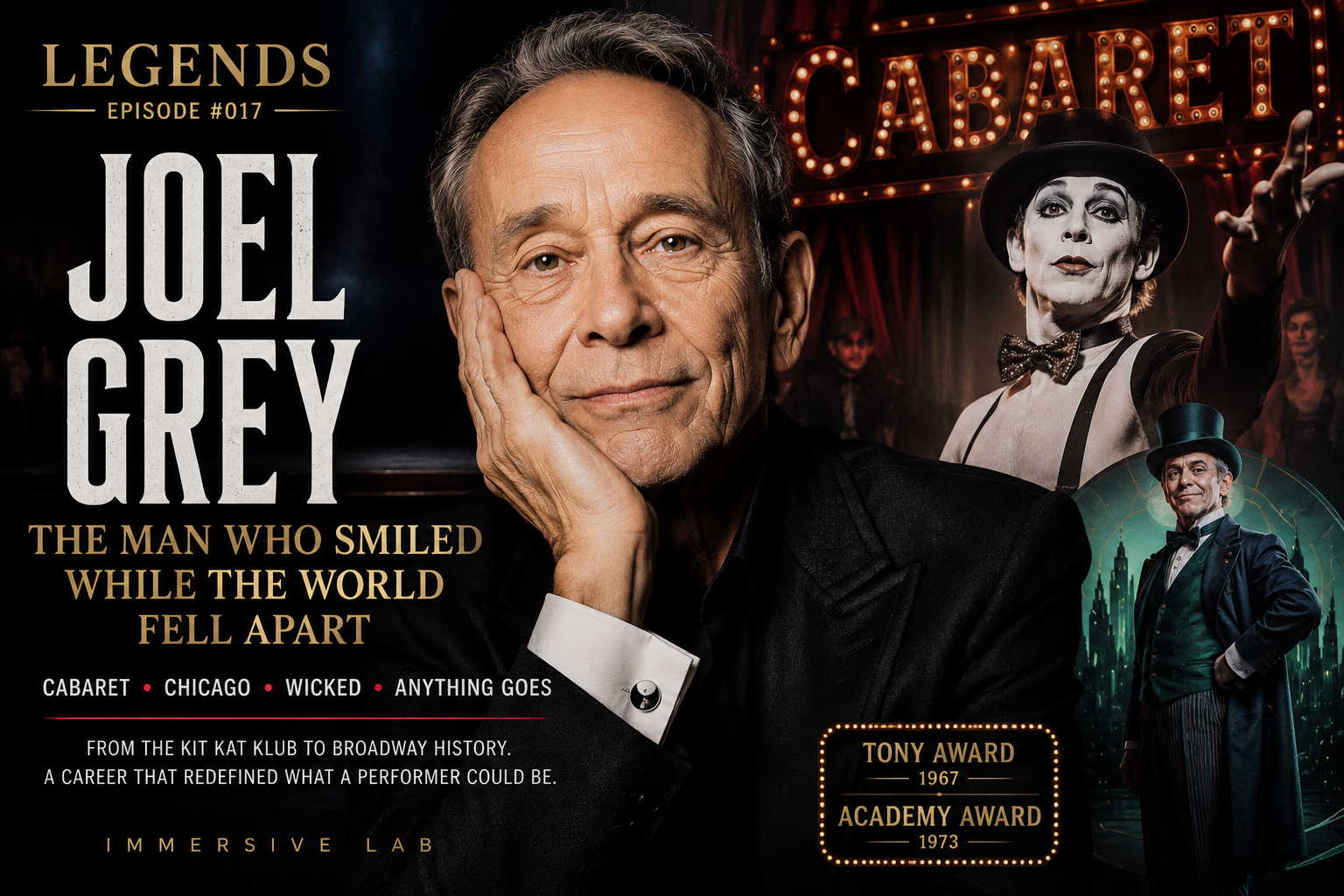
The Man Who Smiled While the World Fell Apart
Joel Grey
The Man Who Smiled While the World Fell Apart
The smile comes first.
Bright.
Inviting.
Almost childish.
Then the eyes tell you something else.
Something is wrong.
When Joel Grey stepped onto the Broadway stage as the Master of Ceremonies in Cabaret in 1966, he did not look like the conventional leading man of the American musical.
He did not need to.
Within minutes, he had created something more unsettling: a performer who seemed to welcome the audience into a party while quietly revealing the nightmare gathering outside its doors.
“Willkommen.”
Welcome.
The word should make us comfortable.
In Grey’s hands, it eventually became a warning.
That contradiction would define one of the most memorable performances in musical-theatre history. Grey won the 1967 Tony Award for Best Featured Actor in a Musical for the role, then played the Emcee again in Bob Fosse’s 1972 film adaptation and won the Academy Award for Best Supporting Actor.
But Joel Grey’s story did not begin with Cabaret.
And remarkably, it did not end there.
Across more than seven decades, Grey moved from child performer to Broadway star, Hollywood actor, photographer and director.
George M!
Goodtime Charley.
The Grand Tour.
Chicago.
Wicked.
Anything Goes.
The Normal Heart.
And still, whenever Joel Grey’s name is mentioned, that white-faced figure from the Kit Kat Klub seems to step out of the darkness.
Why?
Because Grey did something extraordinarily difficult.
He made entertainment itself feel dangerous.
Before the Emcee — A Child of Show Business
Joel Grey was born Joel Katz in Cleveland, Ohio, on April 11, 1932.
Performance was already part of the family.
His father, Mickey Katz, was a musician, comedian and entertainer, and Grey entered show business young. Masterworks Broadway records that after graduating from Beverly Hills High School in 1950, he headed east and made his Broadway debut the following year in Borscht Capades, performing under the name Joel Kaye.
Broadway did not immediately make him a star.
Grey worked.
He learned.
He replaced other performers.
He appeared in Come Blow Your Horn, took over as Littlechap in Stop the World — I Want to Get Off, and briefly replaced in Half a Sixpence. His Broadway record shows a career being assembled piece by piece rather than through one instant breakthrough.
That distinction matters.
Because before Joel Grey created one of Broadway’s most original characters, he spent years performing roles other people had created.
He was waiting for something that belonged to him.
In 1966, it arrived.
Cabaret — Welcome to the Kit Kat Klub

Cabaret opened at Broadway’s Broadhurst Theatre on November 20, 1966.
Music by John Kander.
Lyrics by Fred Ebb.
Book by Joe Masteroff.
Direction by Harold Prince.
And Joel Grey as the Master of Ceremonies.
The production was set against Berlin as the Weimar era moved toward Nazi rule. Yet instead of presenting history only through conventional scenes, Cabaret created another world inside the story:
The Kit Kat Klub.
Grey ruled it.
His Emcee welcomed the audience, introduced performers, joked, danced, flirted and seemed to exist somewhere between character and commentator.
He was part of Berlin.
And somehow outside it.
Masterworks’ history of the original cast recording notes that the Emcee was not initially part of the developing show in the form audiences came to know. The character expanded during creation, and Harold Prince ultimately suggested Grey for the role.
That decision changed Grey’s life.
It also helped change Cabaret.
The Smile That Became a Warning

The brilliance of Grey’s Emcee was contradiction.
He could be funny without becoming safe.
Charming without becoming trustworthy.
Sexual without fitting comfortably into conventional categories.
Childlike and sinister almost simultaneously.
Most importantly, Grey understood that the Emcee did not need to explain the politics of Germany.
He could embody the atmosphere.
As the outside world became darker, the Kit Kat Klub’s entertainment changed meaning.
The same smile could suddenly look grotesque.
The same joke could become cruel.
The same invitation could feel like complicity.
That is one reason the role became so powerful.
Grey did not simply play a nightclub host.
He became the face of a society entertaining itself while catastrophe approached.
The original production won the 1967 Tony Award for Best Musical, Harold Prince won for direction, and Grey won Best Featured Actor in a Musical.
Grey had finally originated the role he had been waiting for.
Broadway would never forget it.
George M! — Proving He Was More Than Cabaret
Success creates another problem.
Once an actor creates an iconic character, audiences can stop seeing the actor.
They see the character.
For Grey, the danger was obvious.
The Emcee could have swallowed everything that followed.
Instead, in 1968 he took on almost the opposite kind of performer.
George M. Cohan.
George M! celebrated one of the foundational figures of American popular theatre—a flag-waving showman associated with an exuberant, unmistakably American theatrical tradition.
Grey played the title role and earned a Tony nomination for Best Actor in a Musical.
Think about the contrast.
The sexually ambiguous, unsettling figure of decadent Berlin.
Then an embodiment of American theatrical confidence.
Grey could not rely on one persona.
He had to transform.
That ability would become one of the great constants of his career.
Cabaret on Film — The Emcee Returns

Then came the extraordinary second life of the role.
Bob Fosse directed the 1972 film adaptation of Cabaret.
Liza Minnelli became Sally Bowles.
Joel Grey returned as the Emcee.
This mattered because cinema could easily have destroyed what made the performance work.
The stage allows exaggeration.
A theatre audience watches from a distance.
Film does the opposite.
The camera approaches.
A raised eyebrow becomes enormous.
A smile can fill the screen.
Grey adjusted.
Instead of simply reproducing the Broadway performance, he allowed the camera to discover the Emcee.
Now the face became even more important.
The makeup.
The eyes.
The mouth.
The tiny shifts between delight and menace.
Grey won the Academy Award for Best Supporting Actor for the film, giving him the rare distinction of receiving major Broadway and Hollywood honors for the same character.
Yet the greater achievement was artistic.
The Emcee survived the journey from stage to screen.
He may even have become more disturbing.
Goodtime Charley — After the Oscar

An Oscar can become a summit.
Grey kept climbing.
In 1975 he starred in Goodtime Charley, playing Charles VII opposite Ann Reinking’s Joan of Arc.
The musical did not become another Cabaret, but Grey’s performance earned him another Tony nomination for Best Actor in a Musical.
Then came The Grand Tour in 1979.
Grey played S. L. Jacobowsky in Jerry Herman’s musical, set against the upheaval of wartime Europe.
Again, he received a Tony nomination.
This portion of his career is important precisely because the shows did not become cultural phenomena on the scale of Cabaret.
A legendary career cannot be measured only by masterpieces.
Actors continue through changing fashions.
Changing composers.
Changing audiences.
Hits.
Failures.
Revival.
Reassessment.
Grey kept working.
Cabaret Again — Can You Return to a Ghost?
More than twenty years after originating the Emcee, Grey returned to Cabaret in the 1987 Broadway revival.
This could easily have become nostalgia.
The famous actor returning to the famous role.
Applause before he had done anything.
But time changes a performance.
The young man who had first welcomed audiences into the Kit Kat Klub was now older.
The world knew where the story ended.
And Grey himself carried the history of the role with him.
IBDB records him again as the Emcee in the 1987 revival, with his performance earning a Drama Desk nomination.
The fascinating question was no longer simply whether Grey could recreate the Emcee.
It was whether the Emcee could survive Joel Grey’s own history.
He did.
Great roles sometimes belong to theatre.
Rarely, theatre allows one performer to become inseparable from them.
Chicago — Becoming Invisible
Then Grey performed another transformation.
In the 1996 Broadway revival of Chicago, he originated Amos Hart.
Amos is almost the opposite of the Emcee.
The Emcee demands that we look.
Amos expects that nobody will.
He is ignored.
Underestimated.
Emotionally abandoned.
A man so invisible that his defining musical moment is built around the idea that no one notices him.
Grey’s performance earned the Drama Desk Award for Outstanding Featured Actor in a Musical.
This may be one of the clearest demonstrations of his range.
The performer who once controlled an entire theatre simply by smiling could now create power by disappearing.
Great acting is not always about commanding attention.
Sometimes it is about making an audience feel the pain of someone who cannot get any.
Wicked — From the Emcee to the Wizard

In 2003, another generation of Broadway audiences discovered Joel Grey.
This time he was the Wonderful Wizard of Oz in the original Broadway company of Wicked.
Grey performed the role from the production’s previews in October 2003 through July 2004.
The casting carried an almost perfect theatrical irony.
The Emcee in Cabaret had represented the seductive face of a society becoming dangerous.
The Wizard in Wicked represented another kind of manufactured authority.
Charm.
Image.
Performance.
Power.
A man presenting an identity to the public while hiding what exists behind it.
Decades separated the two roles.
Yet both relied on something Grey understood instinctively:
Power often performs.
The costume changes.
The world changes.
The lesson does not.
Anything Goes — Still Playing

Grey was approaching eighty when he returned to Broadway in the 2011 revival of Anything Goes as Moonface Martin.
The production starred Sutton Foster and became one of the major musical revivals of the season, winning the Tony Award for Best Revival of a Musical.
Grey did not need another Broadway role to establish his legacy.
That is precisely why the appearance mattered.
He was still there.
Still playing.
Still responding to an audience.
Still participating in the living form that had shaped his life.
A performer who had made his Broadway debut in 1951 was appearing in a major Broadway revival sixty years later.
Few careers allow us to see Broadway history across such a span.
Joel Grey’s does.
The Normal Heart — The Actor Becomes the Director
But Grey’s late career contains another important chapter.
Direction.
In 2011, Grey co-directed the Broadway production of Larry Kramer’s The Normal Heart.
This was not musical comedy.
No Kit Kat Klub.
No Oz.
No tap-dancing Broadway nostalgia.
Kramer’s play confronts the early AIDS crisis with anger, grief and political urgency.
Grey received a Tony nomination for Best Direction of a Play, while the production won the Tony for Best Revival of a Play. His Broadway record also lists a Drama Desk Award for his direction.
Grey had moved from being the person audiences watched to helping determine how audiences watched others.
It was a major evolution.
And it was not the last.
Fiddler in Yiddish — Returning to Something Older

Later, Grey directed a celebrated Yiddish-language production of Fiddler on the Roof.
The choice carried deep resonance.
Grey was born Joel Katz.
His father Mickey Katz was famous for performances rooted in Jewish-American and Yiddish musical culture.
Now, late in his career, Grey was directing one of the defining Jewish stories of musical theatre in Yiddish.
His Broadway record notes a 2019 Drama Desk nomination for Outstanding Director of a Musical for the production.
A career that had traveled through Berlin, Broadway, Hollywood, Chicago and Oz had found another route back toward cultural memory.
That journey makes Grey difficult to reduce to one role.
Even when that role is the Emcee.
The Photographer Behind the Performer
There is another Joel Grey.
The photographer.
For years Grey photographed the world around him, eventually publishing and exhibiting his work.
This may initially seem separate from acting.
It isn’t.
Actors observe.
Photographers observe.
Both notice details other people pass.
A face.
A gesture.
A strange object.
A fragment of architecture.
A moment about to disappear.
Grey’s acting had always depended on unusual precision.
The Emcee did not require enormous gestures every second.
Sometimes one look was enough.
Photography extended that instinct into another medium.
Instead of standing inside the frame, Grey could decide what belonged inside it.
Editor’s Perspective — The Most Frightening Thing Was the Smile
There are villains who announce themselves.
Grey’s Emcee was more disturbing.
He welcomed you.
That distinction explains why the performance remains so powerful.
The audience enters the Kit Kat Klub wanting entertainment.
Grey gives it to them.
Music.
Sex.
Comedy.
Movement.
Pleasure.
Then the historical world begins shifting.
And slowly we understand that the entertainment has not been separate from the story.
It has been interpreting it all along.
The smile changes because we change.
What looked playful now looks cruel.
What looked decadent now looks desperate.
What looked harmless now seems complicit.
Grey understood something profound about performance:
The same gesture can mean two completely different things depending on what the audience has learned.
He did not need to change the smile.
History changed it for him.
What Joel Grey Changed
Joel Grey demonstrated how powerful a supporting role could become when performance, direction, design and dramatic concept aligned perfectly.
The Emcee was not the conventional protagonist of Cabaret.
He did not need to be.
He could frame the entire world.
Comment upon it.
Distort it.
Reflect it.
Grey also showed that theatrical size is not the same thing as physical size.
He could dominate a stage through precision.
A glance.
A pause.
A carefully controlled hand.
A grin held slightly too long.
Later roles revealed the opposite skill.
Amos Hart could disappear.
The Wizard could disguise power as charm.
Grey could move from theatrical excess to painful invisibility without losing specificity.
That is not simply versatility.
It is control.
Why This Legend Still Matters
In 2023, Joel Grey received the Tony Award for Lifetime Achievement in the Theatre.
It was an appropriate recognition for a career that had already crossed extraordinary territory.
Actor.
Singer.
Dancer.
Film performer.
Photographer.
Director.
Broadway history itself seemed to run through his résumé.
But the reason Grey belongs in LEGENDS cannot be contained in an awards list.
His importance lies in the images that remain.
The white face emerging from darkness.
The raised eyebrow.
The invitation.
The grin.
The invisible husband in Chicago.
The Wizard hiding behind the mythology of Oz.
The director standing outside the performance and shaping what others will see.
Grey repeatedly returned to one of theatre’s oldest questions:
What is real—and what are we performing for one another?
A Lasting Legacy

Imagine the Kit Kat Klub before the show begins.
Empty tables.
Dark stage.
No orchestra.
No Sally Bowles.
No audience.
Then someone appears.
Small figure.
White face.
Dark eyes.
A smile.
“Welcome.”
At first, it seems like an invitation into another world.
By the end, we understand that we were never outside that world.
That was the brilliance of Joel Grey’s Emcee.
He did not simply entertain the audience.
He implicated it.
And then Grey did something equally difficult.
He spent the rest of his career proving that he was more than the role that made him immortal.
George M. Cohan.
Charley.
Jacobowsky.
Amos Hart.
The Wizard.
Moonface Martin.
Actor.
Director.
Photographer.
Artist.
More than seventy years after his Broadway debut, the record of Joel Grey’s career is not simply the story of longevity.
It is the story of reinvention.
But somewhere inside all those transformations, the Emcee is still smiling.
Perhaps that is appropriate.
Because some performances end when the curtain falls.
Others remain in the culture so long that we forget there was ever a time before them.
Joel Grey created one of those performances.
And then he built an entire life beyond it.
That is why Joel Grey belongs among the LEGENDS.
References & Further Reading
Internet Broadway Database — Joel Grey
Masterworks Broadway — Joel Grey
Cabaret — Original Broadway Production
Cabaret — Original Broadway Cast Recording
Next in LEGENDS
https://immersivelabkorea.com/barbra-streisand/
He could make an entire theatre laugh with a smile.
Then, without changing that smile, make the same audience uncomfortable.
That was Joel Grey’s magic.
Next Legend — Coming Soon
Continue Exploring
Broadway Collection — The productions that transformed musical theatre.
LIVE STAGE — Legendary concerts, world tours and unforgettable live performances.
WORLD DISCOVERY — Extraordinary theatres, venues and cultural destinations.
THE SHOW X-FILES — The controversies, failures and breakthroughs hidden behind famous productions.
About LEGENDS
LEGENDS is an original editorial series from IMMERSIVE LAB, dedicated to the people who changed the language of entertainment.
We do not simply ask who became famous.
We ask:
What did they change?
Why did it matter?
And why can we still feel their influence today?
Because some performers play unforgettable characters.
A few change what audiences believe a character can do.
Image Credits & Copyright Notice
Representative artwork: © IMMERSIVE LAB.
Historical and editorial photographs used in this article should be sourced only from public-domain archives, Creative Commons collections, appropriately licensed materials, or official resources whose terms permit the intended use.
Individual credits and licenses should be attached to each third-party image where required.
Copyright in third-party photographs remains with the respective photographers, archives, institutions, producers or rights holders.
IMMERSIVE LAB does not claim ownership of third-party historical or editorial photographs.


