The Night a 70-Story Skyscraper Became a Screen
On April 5, 1986, workers in downtown Houston had already done something almost absurd to a skyscraper: they stretched enormous sheets of sailcloth across the mirrored exterior of the unfinished Heritage Plaza building.
It was not construction protection. The building was being converted into a projection screen.
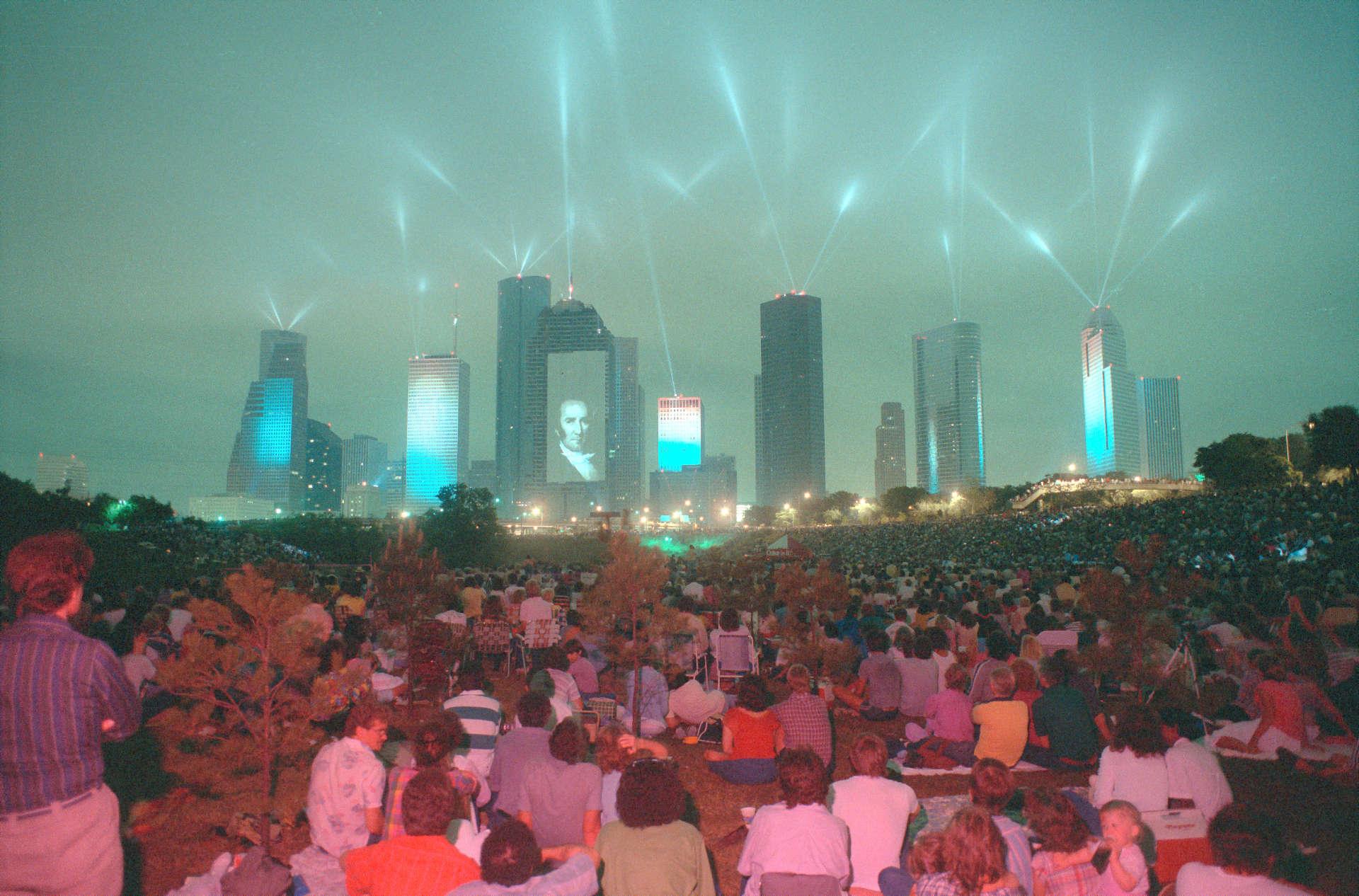
Hours later, images, lasers and light climbed as high as 70 stories across Houston’s skyline while fireworks launched from surrounding rooftops. Jean-Michel Jarre performed below, but the conventional stage was no longer the largest object in the show. The city was.
Houston: A City in Concert Began With a Different Definition of “Stage”

Houston: A City in Concert—also widely known as Rendez-Vous Houston—was created to mark Houston and Texas’s sesquicentennial celebrations and NASA’s 25th anniversary. Jarre’s official archive dates the performance to April 5, 1986 and describes the entire Houston skyline as the backdrop for the event.
That description almost understates what happened. The skyline did not simply sit behind Jarre. Buildings became projection surfaces. Rooftops became pyrotechnic positions. The sky became a lighting volume. Urban streets and freeways became audience areas. The architecture itself became scenic material.
For a production designer, that changes everything. A normal concert asks: how large should the stage be? Houston asked: how much of a city can become the stage?
The Skyscrapers Were Not Designed to Be Projection Screens

Glass office towers are excellent at being office towers. They are terrible projection surfaces. Reflective façades break up images. Windows create inconsistent brightness. Architectural geometry distorts content. Different materials return different amounts of light.
So the production physically modified the city. Houston Chronicle photographs document workers covering the unfinished Heritage Plaza façade with a huge piece of sailcloth, creating a surface capable of receiving projected imagery.
That is a crucial production detail. The famous photographs make the projections appear almost inevitable—as though somebody simply pointed powerful projectors at buildings. They weren’t. Before the image could become enormous, the architecture had to become suitable for an image.
An Image Could Now Become 70 Stories High
Once those surfaces existed, conventional screen scale disappeared. The Houston Chronicle records visual images and laser effects reaching as high as 70 stories on downtown skyscrapers. Among the projected images were Texas iconography, Sam Houston, Jarre himself and, significantly, the crew of the Space Shuttle Challenger.
Think about the visual hierarchy. On a conventional stage, an image might be 10 or 20 metres high. Here the building determined the image scale. A human face could become architecture. A symbol could occupy dozens of floors. A city that spectators already knew suddenly behaved like media.
Then the Rooftops Started Firing

Projection alone would have created an extraordinary show. Jarre wanted the skyline itself to perform. Contemporary reporting describes fireworks erupting from the buildings while searchlights and lasers crossed the sky. Le Monde, reporting immediately after the event, described 16,600 pyrotechnic charges distributed among 2,300 mortars on 11 buildings.
That meant the city contained multiple performance layers simultaneously. At street level: music and musicians. On the façades: projected imagery. On the rooftops: pyrotechnics. Above the buildings: searchlights and lasers. Above all of that: the Houston sky. The vertical composition extended hundreds of metres.
This was not a large concert stage. It was an urban-scale cue stack.
2,000 Lights Had to Make Architecture Perform
The same contemporary Le Monde account reported approximately 2,000 lighting units illuminating an urban scenic field roughly 800 metres wide, with lighting design credited to Jacques Rouveyrollis.
At this scale, lighting performs a different job from arena lighting. You are not simply key-lighting an artist. You are establishing the boundaries of a city-sized composition. One tower must remain visible while another disappears. A building façade must support projection. Searchlights must extend the composition vertically. Pyrotechnics must not visually obliterate everything beneath them. And spectators several kilometres away must still understand where to look.
The problem becomes closer to architectural lighting than conventional concert lighting.
The Show Had Two Scores

One of the most revealing accounts of the production describes two synchronized scores: one for music, one for light. The visual sequence was storyboarded and timed second by second in a process compared with filmmaking.
That approach was essential. A musician can extend a phrase. A spotlight operator can sometimes compensate. A rooftop pyrotechnic sequence distributed across multiple buildings cannot casually improvise. Once a city-sized sequence begins, hundreds of technical events have dependencies.
Projection. Lighting. Laser. Fireworks. Music. Television. The larger the production becomes, the less room there is for departments to behave as separate shows. Synchronization becomes the show.
The Laser Harp Almost Didn’t Work
Against the enormous skyline, Jarre introduced something much smaller that became one of his signature performance devices: the laser harp. Instead of strings, vertical laser beams formed the instrument. When Jarre interrupted individual beams with his hands, the system triggered musical notes.
UPI reported that rain damaged the instrument on the night before the concert. It was repaired only five minutes before Jarre played it.
This is precisely the kind of detail spectacular-production photographs hide. The skyline looked monumental. The machinery looked futuristic. But one of the evening’s defining technologies nearly failed because it got wet. Scale never eliminates vulnerability. Sometimes it multiplies it.
Then Challenger Changed the Meaning of the Concert

The Houston project had been connected with NASA before the Space Shuttle Challenger disaster of January 28, 1986. Astronaut Ron McNair was a friend of Jarre’s and an accomplished saxophonist. The plan was extraordinary: McNair was to record a saxophone part in orbit for Jarre’s music. He died with the other six Challenger crew members before that could happen. The Houston concert therefore acquired a memorial dimension that had not been part of its original emotional design.
Jarre’s official account specifically identifies McNair and the Challenger tragedy as central to the event’s meaning.
A Saxophone Solo Suddenly Had to Carry a City
The composition became “Last Rendez-Vous (Ron’s Piece).” In Houston, saxophonist Kirk Whalum, a friend of McNair’s, performed the part. UPI reported that this was the first public performance of the piece following McNair’s death.
Around that musical moment, imagery of the Challenger crew appeared on the city’s architecture. Houston Chronicle archives preserve photographs of their image projected onto Heritage Plaza. This transformed projection from spectacle into memorial.
The same technology that moments earlier could display Texas symbols or animated imagery could suddenly carry seven faces. The scale did not make the moment impersonal. It made remembrance public.
The City Was Also the Auditorium

There was another architectural problem. Where do you put the audience when the stage is downtown Houston? The answer was: almost everywhere. People gathered on streets, embankments, bridges and freeway approaches. Houston Chronicle photographs show spectators sitting on overpasses and filling areas west of downtown while waiting for the performance.
UPI reported crowds extending four to five miles west of downtown.
This destroys the normal geometry of a concert venue. There is no single seating rake. No controlled viewing distance. No consistent viewing angle. No roof. No unified acoustic environment. One spectator might see the skyline almost frontally. Another might see it obliquely from kilometres away. The show therefore had to communicate through enormous gestures.
Small scenic detail was useless.
The Audience Number Depends on Which Record You Read
The attendance figure requires some care. Contemporary UPI reporting said police estimated more than one million people watched the event. Houston Chronicle retrospectives generally cite approximately 1.3 million. Jarre’s current official concert page displays 1.5 million in its event data while its descriptive text says around 1.3 million.
Rather than pretending these figures are identical, the useful conclusion is narrower: the audience was on the order of well over one million people, with 1.3 million becoming the figure most commonly associated with the event. Jarre’s biography says the Houston attendance earned him his second Guinness record. For production purposes, whether the exact historical estimate is 1.0, 1.3 or 1.5 million does not change the central problem.
There was no conventional PA system or video wall capable of treating that audience like an arena crowd.
Sound Had to Travel for Kilometres
Le Monde reported a 150-kilowatt sound system intended to cover more than five kilometres. That number immediately reveals why the visual production was so important.
At extreme distance, sound and image stop behaving like they do in an arena. The speed of light is effectively instantaneous at concert scale. Sound is not. A spectator more than a kilometre from the source experiences significant acoustic delay relative to what is visible on a building. At several kilometres, that separation becomes impossible to ignore.
The event therefore could never provide every spectator with the same tightly synchronized sensory experience. Instead, the skyline itself supplied a visual event large enough to remain meaningful even when acoustic conditions varied dramatically.
The Show Was Also Being Built for Television

A city-scale concert creates another audience: the camera. The live spectator chooses where to look. Television does not. A director has to turn an 800-metre-wide visual environment into a sequence of frames. Contemporary production records credit Bob Giraldi with directing the filmed presentation, while archival production credits document a substantial television and technical team.
The challenge is obvious. A wide shot explains scale but makes Jarre tiny. A close-up shows Jarre but eliminates the city. A projection shot shows content but may lose the fireworks. A fireworks shot may lose the musicians. Television therefore had to reconstruct the live event rather than merely document it.
The broadcast became a second version of the concert.
300 to 400 Technicians Worked for More Than Eight Months
UPI’s report the following day quoted Jarre saying that a crew of approximately 300 to 400 technicians had worked on the project for more than eight months. That number helps explain what the audience could not see.
Every participating building required coordination. Projection positions had to be determined. Lighting installed. Pyrotechnics placed. Power distributed. Communications established. Permissions secured. Musicians rehearsed. Television positions planned. Traffic and crowds managed.
The skyline may have looked like one object from a distance. Production had to treat it as hundreds of separate systems.
The Budget Was Reported Differently Too

Contemporary sources also disagree slightly on cost. UPI reported approximately $3–4 million and said funding came from Houston, Air France and other contributors. Le Monde reported approximately $5 million. Those figures should therefore be treated as contemporary estimates rather than one definitive audited budget.
But both tell us the same thing: this was not simply an artist touring an oversized production. It was a civic-scale event requiring institutional participation. A city had effectively become a production partner.
Houston’s Economic Crisis Was Part of the Backdrop Too
There was another context behind the illuminated skyline. Houston was struggling through the consequences of the mid-1980s oil downturn. Houston Chronicle later described collapsing oil prices, job losses, housing stress and pressure on city finances. UPI reported immediately after the show that the event was also intended to raise the spirits of a city hit by falling oil prices and drilling activity.
This gives the skyline transformation another meaning. For one night, buildings associated with Houston’s economic power became enormous luminous surfaces. The architecture did not disappear. Its meaning temporarily changed.
The Weather Didn’t Care About the Storyboard
Clouds hung low enough to obscure the tops of some buildings. Rain had already damaged the laser harp. Outdoor production had once again introduced a collaborator nobody could cue: weather.
But low cloud can also make powerful light visible. Searchlights and lasers that might otherwise disappear into clear darkness can suddenly reveal their beams against moisture in the atmosphere. The same weather that threatens equipment can enhance the image. Outdoor production is full of these contradictions. The environment is simultaneously the problem and part of the scenery.
There Was No Proscenium to Hide the Technology
A theatre hides much of its machinery. Houston could not. Projection positions existed across the city. Lighting came from rooftops and remote locations. Fireworks sat on buildings. The sound system occupied urban space. The audience could look almost anywhere.
The solution was not to hide every technical device. It was to make the overall image so enormous that individual pieces of technology became visually subordinate. This is one of the fundamental principles of monumental spectacle. You do not necessarily conceal the machinery. You overwhelm its scale.
The Most Important Scenic Element Already Existed
No touring company could have fabricated the Houston skyline. That was precisely why Jarre’s idea worked. The most expensive scenic object was already standing. His production changed its function.
Office tower → projection screen. Roof → fireworks platform. Street → auditorium. Sky → lighting canvas. City → stage.
This is radically different from bringing a large set into a city. The city itself becomes site-specific scenic material. And because the architecture cannot tour, the show cannot simply be copied somewhere else.
That Led Directly to Lyon
Later in 1986, Jarre created another city-scale performance in Lyon, his home city. His official biography places the Lyon event after Houston and records another enormous public turnout. The principle survived even though the architecture changed.
That is significant. Jarre was not designing one reusable stage. He was developing a method: study the city, identify its architecture, convert that architecture into media, then compose music, light, projection, laser and fireworks around it. The venue did not receive the production. The venue generated the production.
Forty Years Later, the Idea Is Still Easy to Understand
In April 2026, Jarre’s official channel marked the concert’s 40th anniversary by returning to the same essential description: the city itself became the stage. That longevity matters.
1986 projection technology is primitive compared with today’s media servers, laser projectors, real-time rendering engines, drones and LED façades. But the concept does not feel primitive. Why? Because the strongest idea was never the equipment. It was scale through context. A bigger projector is technology. Turning a skyscraper into an image is an idea.
Houston Did Not Need a Bigger Screen
This is where Houston: A City in Concert remains particularly relevant to contemporary production. Today’s instinct is often to solve scale with more LED. Larger screen. Higher resolution. More pixels. More brightness.
Houston approached the problem differently. It asked what was already present that could carry the image. The answer was architecture. That approach produced something even the largest touring LED wall struggles to achieve: the audience could recognize the place and watch it transform simultaneously. Houston was still Houston. But for 90 minutes, it behaved differently.
Editor’s Take — IMMERSIVE LAB
Houston: A City in Concert is often remembered through its numbers—more than a million spectators, skyscraper-scale projections, thousands of lights and pyrotechnics distributed across downtown. But the production lesson is simpler. Jean-Michel Jarre did not enlarge a concert stage until it matched the city; he removed the boundary between the concert and the city. The sailcloth stretched across Heritage Plaza may be the most revealing piece of technology in the entire show. Before projection mapping became everyday vocabulary, a real skyscraper had to be physically converted into a screen. Once that happened, architecture, light, music and civic space could operate as one composition. The strongest large-scale production does not always require building the largest object. Sometimes it requires seeing the largest object already there—and giving it a new job.
Next in LIVE STAGE: Eagles — Live at Sphere, where the building itself again becomes part of the production—this time through one of today’s most advanced permanent concert environments.
References & Further Reading
Jean-Michel Jarre Official — Houston: A City in Concert — official event archive: date, purpose, skyline projections, Challenger context, musicians and attendance information.
Jean-Michel Jarre Official — Biography — official retrospective documenting the Houston production, NASA collaboration and Guinness recognition.
Houston Chronicle — Rendez-Vous Houston — extensive archive documenting the sailcloth installation, 70-story projections, fireworks, crowds and surviving production photographs.
UPI Archives — April 6, 1986 — contemporary report covering the audience estimate, 90-minute running time, laser harp failure, eight-month production period, 300–400 technicians and reported budget.
Le Monde — April 8, 1986 — contemporary reporting on the lighting, urban scale, pyrotechnic system, sound coverage and production cost estimate.
Wikimedia Commons — Rendezvous Houston — reusable historical photograph of the actual April 5, 1986 performance.


