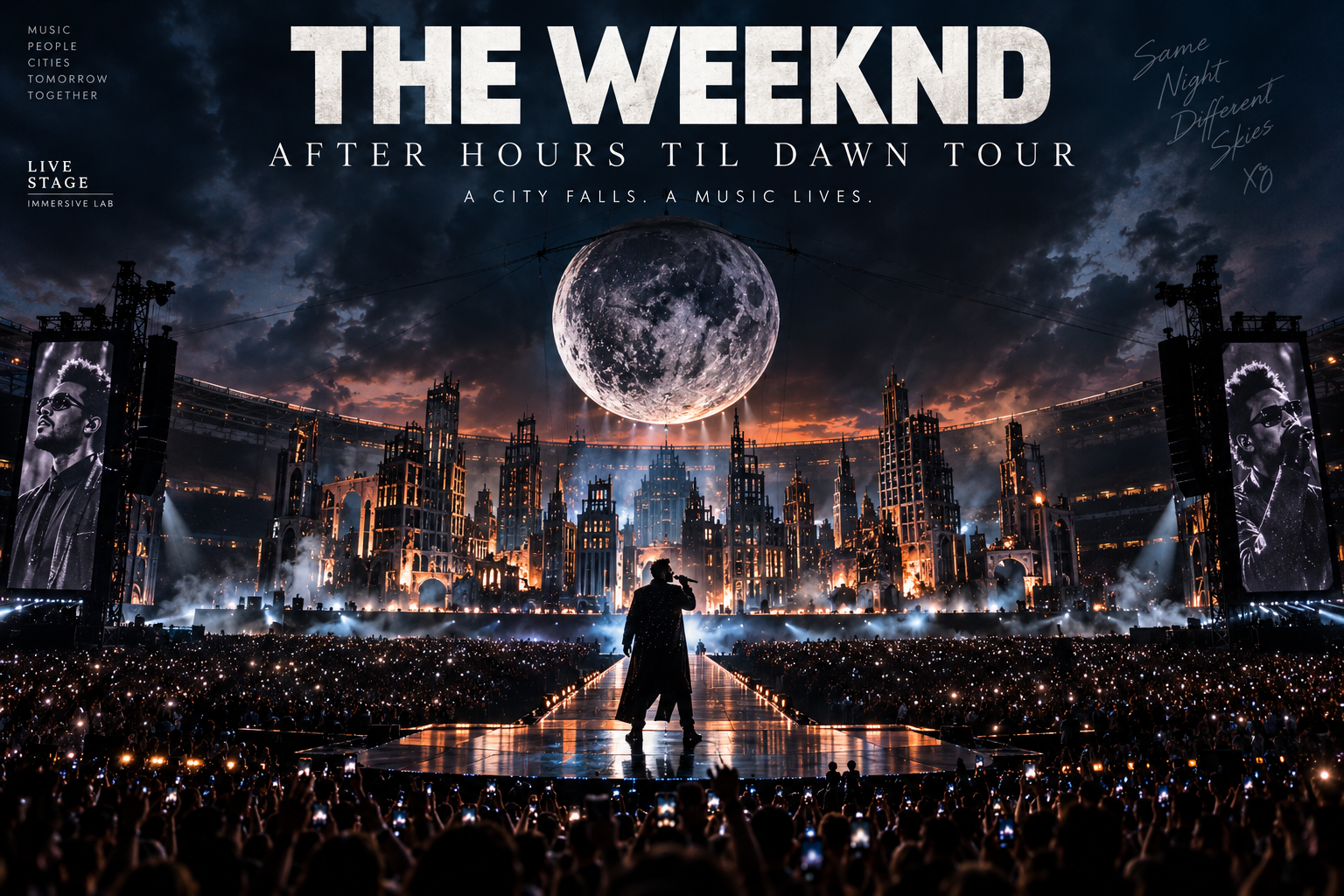
THE WEEKND — AFTER HOURS TIL DAWN TOUR
How Do You Turn a Stadium Concert Into a Dystopian City?
A stadium stage usually represents somewhere else. A palace. A spaceship. A nightclub. A fantasy landscape.
The Weeknd’s After Hours Til Dawn Tour tried something more difficult. It built a place that seemed to have already lived—and then been destroyed.
Across one end of the stadium stood 17 damaged buildings, fragments of a post-apocalyptic metropolis. Behind them stretched an enormous video surface extending the physical ruins into a digital horizon. A runway carried The Weeknd away from that city and deep into the audience. Above another stage floated an enormous moon.
It looked cinematic. But this wasn’t a film set. Tomorrow morning, much of it had to become cargo.
That creates the production question at the heart of the show: how do you build an entire dystopian city large enough to dominate a stadium—and still make it behave like a touring system?
The answer required scenic engineering, lighting, video, automation and logistics to operate less like separate departments and more like parts of one piece of architecture.
The City Was Not a Backdrop

Production designer Es Devlin and scenic design producer Jason Ardizzone-West could have created the skyline entirely with LED. They didn’t.
For the 2022 North American production, TAIT fabricated 17 custom scenic buildings—including a replica of Toronto’s CN Tower—several incorporating performer lifts and platforms. The structures were physically carved, hard-coated, painted and finished to look damaged and eroded.
That distinction matters. Digital scenery can create almost unlimited scale. Physical scenery creates something video struggles to reproduce: depth. Light can strike an actual edge. A performer can disappear behind a real structure. Shadows behave naturally. Dancers can occupy different planes. And when the camera moves, parallax immediately tells the eye that the city has volume.
The ruined skyline therefore wasn’t decoration sitting in front of the video wall. It became the physical foreground of a much larger fictional world.
Seventeen Buildings Had to Become Touring Equipment
Here is where scenic design collided with production reality.
A convincing ruined building wants irregular edges, texture, mass and complexity. Touring scenery wants almost the opposite: predictable dimensions, repeatable connections, low weight, fast assembly, efficient packing, durability.
TAIT therefore wasn’t simply asked to manufacture sculptures. It had to turn 17 pieces of architecture into road equipment, all designed for rapid assembly and touring. Several structures also contained performer lifts and platforms, meaning the scenery had another identity hidden inside it.
To the audience: a ruined city. To the production crew: scenery + structure + machinery + performer access + safety system.
That is the first important production lesson of After Hours Til Dawn. The more convincingly scenery pretends to be architecture, the more carefully it has to behave like engineering.
Under the Ruins Was Another Stage

The apparent city couldn’t simply sit on an ordinary deck. TAIT built three expansive Mag Deck stages and two LED-lined runways to support the weight of the scenic structures.
Stageco’s documentation describes the production as three connected performance areas: the main stage containing the ruined skyline, a catwalk leading toward a quadrangular stage featuring the inflatable moon, and a further connection into a circular stage.
This geometry changed the show. The Weeknd did not remain trapped against a giant video wall. He could leave the city, travel through the audience, perform beneath the moon, appear surrounded by spectators rather than scenery.
The runway therefore wasn’t simply an extension. It created narrative distance. The further he moved from the skyline, the more the enormous city became an environment behind him rather than a traditional concert set.
The Screen Had to Make a Physical City Feel Endless

Behind those buildings sat one of the largest visual components in the production. Stageco documents the 2022 screen structure at approximately 55 metres wide by 15 metres high—roughly 180 feet across.
The important part wasn’t simply its size. It was its relationship with the physical scenery. The LED content, created with video designer Polina Zakh and visual studio Sila Sveta, could continue streets, buildings, atmosphere and sky beyond the actual set.
Physical city in front. Digital city behind. Lighting between them. When those layers aligned correctly, the eye stopped asking where scenery ended and video began. That is much more sophisticated than putting spectacular graphics on a giant screen. The screen became an extension of architecture.
Video Could Not Look Like a Television
This creates a subtle design problem. Make a stadium LED wall bright enough and it can easily overpower everything standing in front of it. The physical buildings would become silhouettes. The performers could become tiny. The audience would start watching the screen rather than inhabiting the environment.
The visual team therefore needed the LED surface to behave as atmosphere, landscape and narrative space—not simply as the biggest luminous object in the stadium. This is where scenic design, video and lighting became inseparable. The screen established the horizon. The buildings gave it depth. Lighting connected the two. Neither system could fully create the illusion alone.
Lighting Had to Make Fake Ruins Look Real

Lighting designer Jason Baeri faced an unusual task. Normally concert lighting primarily reveals performers and creates musical energy. Here, lighting also had to convince tens of thousands of spectators that newly fabricated scenery had been standing inside a dying city for years.
For the 2022 production, 84 CHAUVET Professional COLORado PXL Bar 16 fixtures, provided by Solotech, were deployed among a much larger rig. Baeri explained that roughly half were used to uplight the buildings, showcasing the detail Devlin and Ardizzone-West had carved into the structures, while the other half accented the C-stage to help carry its depth and shape.
The ruined structures were often illuminated in dark, brooding tones suggestive of smouldering ruins. That changed their perceived material. Texture became deeper. Edges became harsher. Shadow created apparent damage. A freshly manufactured scenic object could suddenly look burnt, abandoned and dangerous.
This is scenic lighting doing something beyond visibility. Light became part of the aging process.
Weatherproof Fixtures Solved Another Problem
The production was outdoors. That means rain, wind, temperature changes and exposure are not exceptions. They are part of the specification.
Solotech’s outdoor stadium lighting and video package was built with environmental protection in mind—fixtures needed suitable IP ratings and enough structural integrity to cope with wind and changing stadium conditions across the touring schedule.
This is an important production distinction. A fixture can produce exactly the visual effect a designer wants and still be the wrong touring fixture. For a stadium tour, creative suitability and operational suitability must coexist. A beautiful lighting concept that fails after heavy rain isn’t a beautiful lighting concept anymore.
Then They Hung a Moon Over the Audience

The ruined city gave the show scale. The moon gave it an icon.
A 30-foot-diameter inflatable moon hovered over one of the performance areas throughout the show. But even this apparently simple scenic object required machinery. TAIT provided the catenary line system and a specially designed cart used to inflate and position the moon—adding what the company describes as a surreal dimension to the performance.
This is exactly the kind of production detail an audience is not supposed to think about. They see: moon. The crew sees: rigging points, cable geometry, inflation, positioning, wind, clearance, control and repeatability. The better those systems work, the more impossible the object appears.
Why the Moon Worked
The moon was effective partly because it was so visually simple. Around it, the production was extraordinarily dense: ruined architecture, giant LED imagery, hundreds of lights, dancers, lasers, pyrotechnics, multiple stages.
Then above all that complexity sat one recognizable circle. The visual hierarchy was immediate. It could be seen from distant seats. It created a destination along the runway. And it gave the stadium a second visual center away from the main stage.
That is important. Large-scale production is not only about adding detail. Sometimes the strongest object is the one that can be understood from 150 metres away.
Lasers Turned Empty Air Into Scenery

The stage did not stop at the physical architecture. Pangolin documents a laser system using KVANT 25W BeamBrush equipment controlled through Pangolin BEYOND, with Tyler Barbone serving as laser programmer and operator for the production.
Lasers allowed the visual world to leave the stage entirely. Beams crossed above spectators. Perspective lines stretched through stadium air. The space between stage and audience suddenly became drawable.
That matters particularly in a production with such a long runway. A conventional scenic element cannot easily fill tens of metres of open stadium floor without obstructing spectators. Light can.
The show therefore had several kinds of scenery: physical scenery created mass, video created distance, lighting created atmosphere, lasers created volume. The stadium itself became the final scenic surface.
The City Also Had to Move Fast
None of these ideas matter if the production cannot reach the next stadium. And this is where After Hours Til Dawn becomes especially revealing.
Stageco didn’t tour the North American staging as one system moving sequentially from city to city. It used three leapfrogging systems during the first leg. One structure could be dismantled while another was already being prepared elsewhere. Each system required a substantial fleet of trailers of black steel and its own dedicated construction crew.
Think about what that means. Before the scenic city arrives, a second invisible city must already exist: steel, ballast, support structures, video support, PA support, sub-deck, access systems. Only after that infrastructure exists can the dystopian city appear.
Three Stages Were Really Three Distances

The production’s three-stage arrangement also solved a problem every stadium artist faces: distance from the audience.
At the main stage, The Weeknd existed inside the cinematic world. Along the runway, he entered the crowd. At the satellite performance areas, spectators who had been physically distant suddenly found the performer much closer.
This created different scales of experience during the same concert. From the upper tiers: a giant moving composition. From the floor: an architectural environment. Near the runway: a human performance. The stage plan therefore wasn’t only scenic geometry. It was audience-experience engineering.
The Buildings Were Not Supposed to Look Expensive
This may be one of the strangest aspects of the production. A huge amount of money, fabrication skill and engineering effort went into making scenery look ruined.
That reversal is important. Normally production value announces itself through polish: perfect LED, chrome, precision, symmetry, brightness. After Hours Til Dawn frequently did the opposite. Its buildings were eroded. Surfaces appeared burnt. The city looked damaged. Darkness swallowed detail.
The production’s technical precision was being used to manufacture imperfection. And that is difficult. Random-looking destruction still has to fit onto trucks. A broken edge still has to survive repeated handling. A damaged-looking platform still has to safely carry performers. A ruined building still has to connect correctly every night. Chaos had to be repeatable.
The 2023 Tour Didn’t Simply Copy 2022
The production evolved. For the European and South American leg, TAIT notes changes including a chrome refinish and a custom skyline backdrop spanning the main-stage width.
The visual language therefore shifted rather than freezing after opening night. Later iterations also incorporated a giant chrome robotic figure based on the work of Japanese illustrator Hajime Sorayama, with TAIT engineering automation for the sculpture and its own TAIT Navigator Automation Platform controlling multiple show elements throughout.
This is another useful way to understand a world tour. It isn’t always one finished production travelling for years. It can behave like software. The underlying architecture remains recognizable while scenic systems, imagery, automation and visual language evolve between legs.
Production Logic — The City Was Actually Five Systems
Stand in the audience and the After Hours Til Dawn stage appears to be one enormous environment. Technically, it isn’t. It is several systems carefully disguised as one.
Scenic engineering creates the physical ruins. Video extends them beyond their real dimensions. Lighting gives those ruins atmosphere and perceived age. Automation and rigging create impossible objects such as the moon and moving scenic elements. Touring infrastructure makes the entire illusion repeatable in another city.
Remove any one of them and the world becomes less convincing. This is the production achievement. Not the biggest screen. Not the most fixtures. Not the tallest building. Integration.
What the Audience Never Sees

Before The Weeknd walks through his dystopian city, another performance has already happened. Construction crews have assembled the stadium infrastructure. A sub-deck has been prepared for heavy scenic loads. Seventeen fabricated buildings have been installed. Platforms and performer lifts have been checked. A massive video surface has been commissioned. Hundreds of outdoor-rated lighting fixtures have been addressed and tested. PA structures, automation and rigging have been verified. The moon system has been prepared. Lasers and effects have been programmed. Runways and multiple performance zones have been made safe. And somewhere ahead of the tour, another structural system may already be rising in the next city.
The audience enters after most of that work is invisible. That is exactly how it should be. They are not supposed to see a touring system. They are supposed to enter another world.
The Answer Wasn’t to Build a City
We began with a question: how do you build an entire dystopian city large enough to dominate a stadium—and still make it tour?
The answer is that you don’t really build a city. You build systems that agree to look like one. Seventeen scenic structures provide physical depth. A giant video surface creates an unreachable horizon. Lighting changes manufactured surfaces into ruins. Lasers expand architecture into open air. Automation makes impossible objects appear effortless. Multiple stages bring the performer into different relationships with the audience. And leapfrogging structural systems keep the illusion moving from stadium to stadium.
The audience sees destruction. Behind it is extraordinary order. That may be the defining production paradox of After Hours Til Dawn: the more chaotic the world looked, the more precisely it had to be engineered.
References & Further Reading
TAIT — The Weeknd: After Hours Til Dawn Tour
Stageco — The Weeknd: After Hours Til Dawn 2022
CHAUVET Professional — Jason Baeri Evokes Moods in After Hours Til Dawn
Es Devlin — The Weeknd: After Hours til Dawn Stadium Tour
Pangolin — After Hours Til Dawn Tour Lasers
Next Episode
LIVE STAGE #025 — Prince — Super Bowl XLI Halftime Show
© IMMERSIVE LAB | LIVE STAGE Studio
From K-Pop to the world’s biggest concerts — bringing every unforgettable live performance to life.


