The Concert Designed for a Screen That Wasn’t on the Stage
In April 2017, production designer LeRoy Bennett explained one of the more unusual requirements behind Bruno Mars’ new tour. The lighting had to look good on a phone camera.
That wasn’t an incidental benefit. Bennett said the bold, clean visual language of the show mattered because Bruno cared about how the concert would appear on social media. It is an unusually revealing production detail.
The 24K Magic World Tour was built for arenas filled with thousands of people—but part of its design was also being judged through millions of tiny screens. And the solution was not to build the biggest LED wall possible. It was almost the opposite.
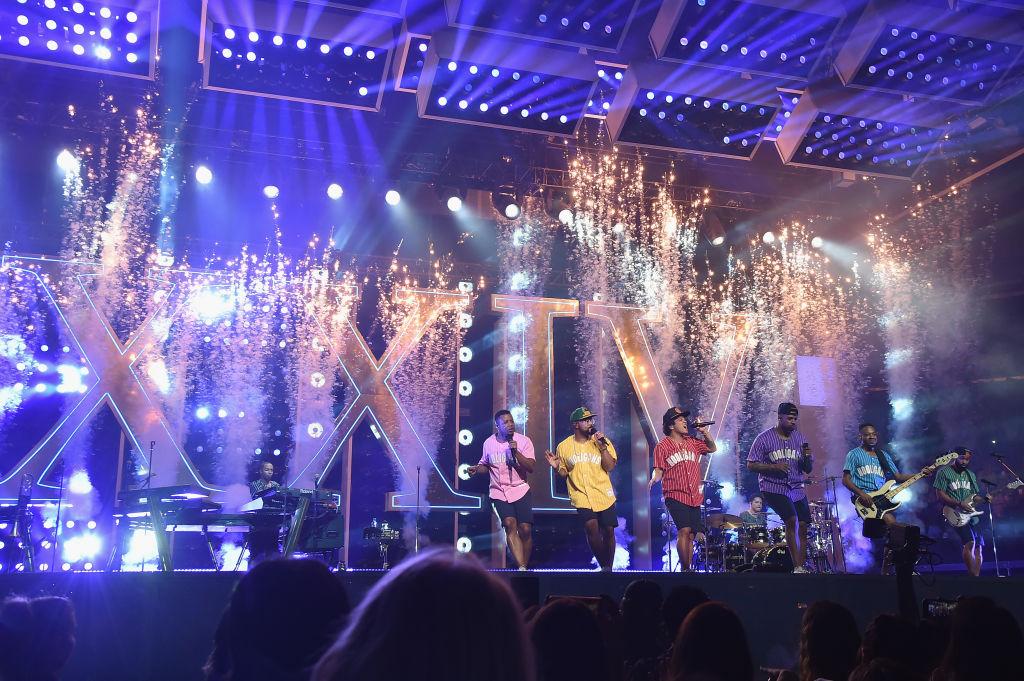
Bruno Mars and his production team looked backward—to walls of PAR cans, 1980s touring rigs, 1990s R&B and hip-hop aesthetics—and rebuilt those references with modern automation, video and more than a thousand lighting fixtures. The question behind the production therefore wasn’t simply how to make Bruno Mars look bigger. It was how to make an arena show feel like an old-school live band performance—and still make every frame instantly readable in the smartphone era.
1,100 Lights — But the Reference Was Decades Old

The tour opened at Sportpaleis in Antwerp on March 28, 2017. By then, Bruno’s production team had developed a visual vocabulary that deliberately resisted the futuristic appearance common to many arena productions.
Lighting designer Cory FitzGerald said the new album was heavily influenced by 1990s R&B and hip-hop. Their visual references included huge arrays of PAR cans—walls, ceilings and moving pods of lights—as well as imagery from The Jacksons’ Victory Tour and Queen’s arena productions.
That creates an interesting contradiction. The audience was watching a 2017 production, but many of its visual cues were designed to trigger memories of concert technology from decades earlier. The trick was that the equipment underneath those references was anything but old.
Before rehearsals, the entire lighting rig was digitally replicated using LightConverse and grandMA3D. That virtual system contained more than 1,100 fixtures and 25 automated lighting pods, allowing the production team to test movement and potential rigging conflicts before putting the physical system into operation. The nostalgia was visual. The engineering was contemporary.
Why Did 795 Identical Lights Make Sense?

One number immediately separates this production from an ordinary arena lighting package: 795. That was the reported number of Robe Spikie fixtures touring with the production—the largest quantity of a single fixture type used on one touring show, according to Robe.
But the interesting question isn’t why the production needed so many lights. It’s why it needed so many of the same light. Individual moving lights create effects. Hundreds of identical lights create surfaces—walls, patterns, grids, ceilings, chases, blocks of color. Instead of asking the audience to notice individual fixtures, the design could make an entire section of the arena appear to move.
This was particularly effective for Bruno Mars because the production did not want lighting to feel like decoration around a singer. The band itself was highly rhythmic. The choreography was rhythmic. The lighting therefore needed to behave rhythmically as well—hundreds of fixtures responding as one enormous visual instrument.
The Ceiling Could Move
Then the grid stopped behaving like a ceiling. The production incorporated multiple automated lighting structures capable of changing position during the performance—a problem audiences would never see. Packing hundreds of fixtures onto moving structures meant the designers were simultaneously fighting for physical space.
Cory FitzGerald described the rig as an extremely tight squeeze: the team wanted as many fixtures as possible inside each pod while also trying to fit as many moving pods as possible onto the automation system, holding repeated meetings to maximize the design without creating collisions or rigging complications. That is where concert design stops being drawing and becomes engineering—the audience sees a ceiling descending toward Bruno Mars; the production department sees coordinates.
Fifteen Columns Were Hanging From 72 Motors

The scenic architecture also moved. Bennett’s design included 15 L-shaped columns supported by 72 motors, with movement controlled through a TAIT Navigator automation system. This allowed the visual architecture behind the band to change depth rather than simply changing content.
That distinction matters. An LED screen can show a different image instantly. Physical scenery changes the geometry of the room. When the columns moved, the audience’s perception of the performance space moved with them—compressed, then open, then deeper, then flatter. The production wasn’t continually replacing scenery; it was continually rearranging the same architecture, an efficient touring idea because one physical system can generate multiple scenic environments.
Then Eight Pieces of the Floor Started Rising
Another transformation occurred underneath the performers: eight motorized platforms that could rise to different heights, revealing LED surfaces as they moved. The lifts weren’t included simply for a spectacular mechanical moment—they addressed sightlines. In an arena, the same performance has to work for someone near the stage and someone looking down from the upper bowl. Raising musicians gives the band vertical hierarchy without requiring a permanent multi-level stage.
The Big Screen Was Designed to Disappear

There was video in the show, but Bennett did something important with it: the screen didn’t always look like a screen. An LED surface could fly into position in front of the scenic columns and provide live images of Bruno and the band for spectators farther from the stage. When it wasn’t needed, the architecture and lighting could dominate again.
This avoided one of the easiest traps in modern arena production: letting IMAG—the live camera image—become the scenery for the entire concert. 24K Magic treated video more like another instrument. Bring it forward when necessary. Remove its visual dominance when it isn’t.
The Phone Changed the Lighting Design
The design used 48 Vari-Lite VL6000 Beams mounted on vertical trusses and 53 VL4000 BeamWash fixtures for backlight, sidelight and large saturated effects. Bennett compared the VL6000’s large, raw-looking beam to an old Vari-Lite VL4 taken to an extreme—not simply a technical preference, but a look that supported the retro language of the stage while producing a modern high-output beam.
A concert designer traditionally thinks about several viewpoints: the performer, the audience, the camera, the balcony, the side seats. By 2017 another viewpoint had become unavoidable—the phone. Thousands of spectators were effectively carrying cameras with limited dynamic range, frequently recording from difficult distances. Complicated low-contrast looks could disappear; strong shapes, bold colors, large beams and high-contrast silhouettes survived.
Bennett has said the bright light and vibrant colors of the VL6000 were chosen in part because they “look great on phone cameras.” This means the audience wasn’t merely consuming the production—they were becoming part of its distribution system. Lighting had become marketing infrastructure.
The Audio System Had the Opposite Job
Visually, the show wanted transformation. Audio needed consistency. The tour used Clair Global’s Cohesion PA system, with Chris Rabold at front of house and Ramon Morales on monitors—both working on DiGiCo SD7 consoles.
Bruno Mars presents an interesting mixing problem: this isn’t a solo vocalist standing over backing tracks. The Hooligans are part of the performance identity. Vocals, horns, bass, guitars, keyboards, drums and audience energy all have to coexist while preserving the rhythmic precision that makes the show feel effortless. The visual production could change shape above the band. The mix could not lose its center.
The Show Was Built Inside a Smaller Box
Production manager Joel Forman has described Bennett’s set as visually connecting the stage with the overhead production, defining a performance environment large enough for an arena while concentrating attention into a small box around Bruno.
This is almost the reverse of the usual arena instinct, which often tries to expand—bigger screen, wider stage, longer runway, more scenery. 24K Magic needed to make a huge building feel smaller, because funk works through relationships: Bruno and the band, musician and musician, dance move and beat, call and response. Bennett’s architecture gave Bruno enough scale for the arena without destroying the impression of a band playing together.
The Most Modern Thing About 24K Magic Wasn’t the Technology
It would be easy to describe the tour as a collision between retro design and modern machinery. But that misses its most important production idea: the tour understood that the definition of an arena audience had changed. The people in the building were still the primary audience, but they were also photographers, videographers, editors, publishers, distributors. A lighting cue could be seen live by 15,000 people and then appear repeatedly on phones far beyond the venue.
Bennett and FitzGerald did not respond by turning the concert into a giant social-media screen. They designed physical images strong enough to survive being reduced to one—a huge beam, a wall of identical lights, a descending ceiling, a clean silhouette, a tightly framed band. Those images worked in the arena precisely because they also worked when compressed into a small rectangle. The production looked backward to learn how to survive the future.
Editor’s Take

The 24K Magic World Tour is useful for designers because it challenges the assumption that technological progress must always be visible. Hundreds of automated fixtures, dozens of motors, moving architecture and sophisticated control systems were hidden behind a visual language audiences could understand immediately. The most valuable lesson isn’t to copy its retro lighting—it’s to recognize that complex engineering and visual complexity are not the same thing. Sometimes the harder production problem is using more technology while allowing the audience to perceive less of it.
References & Production Sources
LeRoy Bennett — 24K Magic: Upgrading the Classic
PLSN — Robe Funks it Up with Bruno Mars
Front of House — Bruno Mars 24K Magic Tour audio production
The next LIVE STAGE investigation moves from an arena built like a party to a farewell tour designed around an entirely different problem: how do you give an artist’s fifty-year career a visual ending? — Elton John, Farewell Yellow Brick Road.


