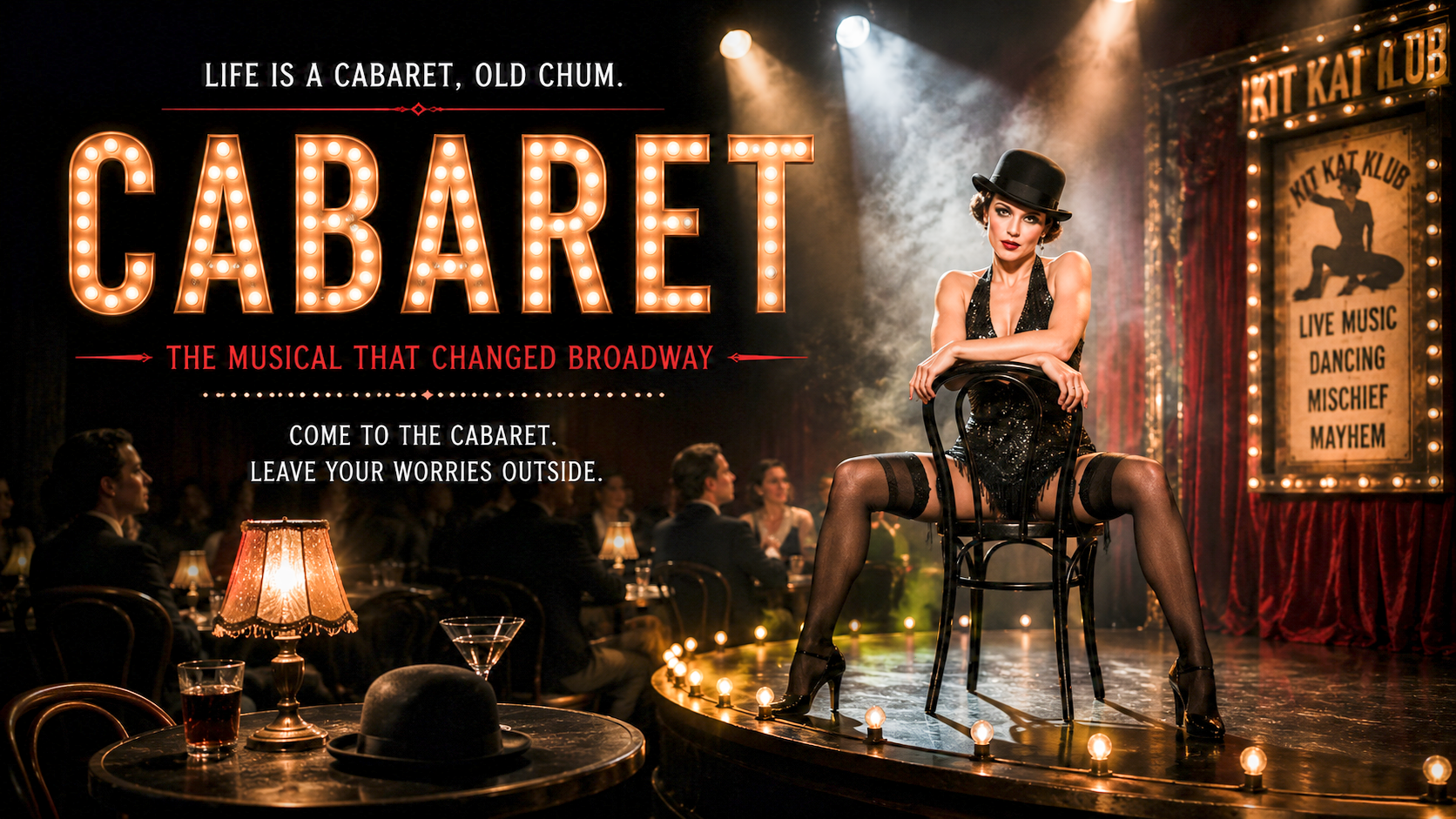
Why Cabaret Still Holds a Mirror to Society

There is a moment before Cabaret truly begins.
The audience settles into their seats.
The lights slowly fade.
Then, from somewhere beyond the darkness, a voice breaks the silence.
“Willkommen… Bienvenue… Welcome.”
The Emcee doesn’t simply greet the audience.
He invites them into another world.
A world filled with dazzling music, seductive performances, laughter, and champagne.
For a brief moment, everything feels carefree.
Yet beneath the glitter of the Kit Kat Club, something darker quietly waits.
That unsettling contrast is what has made Cabaret one of Broadway’s most extraordinary musicals for more than half a century.
A Musical That Refuses to Age

Premiering in 1966, Cabaret is set in Berlin during the final years of the Weimar Republic, just before the rise of Nazi Germany.
On paper, it is a period musical.
On stage, it feels startlingly contemporary.
The production is not simply about history.
It is about how ordinary people respond when society begins to change around them.
Some look away.
Some remain silent.
Some continue dancing, hoping the music will never stop.
That uncomfortable honesty is precisely why every new generation discovers Cabaret as though it were written for its own time.
More Than Entertainment

Many Broadway musicals ask audiences to escape reality.
Cabaret does the opposite.
It welcomes the audience with glamour, humour, and unforgettable songs.
Then, almost without warning, it asks difficult questions.
How easily do we ignore the warning signs around us?
What happens when entertainment becomes a distraction from reality?
And how much responsibility does every individual carry when history begins to change?
These questions quietly unfold throughout the performance.
By the time the curtain falls, the audience is no longer watching a story set in 1930s Berlin.
They are reflecting on their own world.
When the Stage Becomes a Warning
As Cabaret unfolds, something remarkable begins to happen.
The laughter grows quieter.
The applause becomes more restrained.
Almost without realizing it, the audience stops watching the Kit Kat Club as a place of entertainment and begins to see it as a reflection of society itself.
Every performance inside the club feels joyful on the surface.
Yet behind every smile lies an uncomfortable truth.
The Emcee never tells the audience what to think.
Instead, he smiles.
He sings.
He dances.
And somehow, that silence becomes more powerful than any speech.
That quiet transformation is one of the greatest achievements in modern musical theatre.
A Stage That Breathes With the Audience
Unlike productions built around massive scenery changes, Cabaret relies on intimacy.
The Kit Kat Club feels almost within arm’s reach.
Lighting spills into the audience.
Performers move with unsettling confidence.
At times, it becomes difficult to know where the performance ends and reality begins.
This is immersive theatre in its purest form.
Not because the audience participates.
But because they can no longer remain emotionally detached.
Every laugh gradually turns into self-reflection.
Every song carries another layer of meaning.
By the final scene, silence speaks louder than applause.
The IMMERSIVE LAB Perspective
From a creative director’s perspective, Cabaret demonstrates that the most powerful stage design is often psychological rather than physical.
The production uses space with remarkable restraint.
Lighting creates emotional tension instead of visual spectacle.
Music entertains while quietly revealing uncomfortable truths.
Every costume, movement, and pause serves a single purpose:
To blur the line between observer and participant.
Today’s immersive productions often focus on technology to create impact.
Cabaret reminds us that atmosphere, performance, and honest storytelling remain the strongest immersive tools available.
The audience does not simply watch history unfold.
They become witnesses to it.
Final Thoughts
More than sixty years after its Broadway debut, Cabaret continues to challenge audiences around the world.
It is not remembered because of its famous songs alone.
It endures because it asks questions that every generation must answer for itself.
Can entertainment distract us from reality?
Can silence become a choice?
And how easily can ordinary lives be changed by extraordinary times?
Few musicals leave audiences with more difficult questions.
Even fewer leave such unforgettable memories.
Director’s Note
As a creative director, I believe Cabaret is one of Broadway’s greatest examples of emotional stagecraft.
Its brilliance lies not in overwhelming the audience with spectacle, but in quietly drawing them closer until they recognize themselves within the story.
Great theatre does more than entertain.
It invites reflection.
Cabaret has been doing exactly that for nearly six decades.
References & Further Reading
Cabaret — Concord Theatricals
Cabaret
Tony Awards — Official Website
Tony Awards
Internet Broadway Database (IBDB)
IBDB
Playbill
Playbill
🏆 Editor’s Choice
Cabaret proves that the greatest musicals are not always the loudest.
Its intimate staging, unforgettable performances, and fearless social commentary continue to inspire theatre makers across generations.
It is a production that deserves to be experienced, not simply remembered.
⭐ IMMERSIVE LAB Rating
🎭 Story ⭐⭐⭐⭐⭐
🎵 Music ⭐⭐⭐⭐⭐
🎭 Performance ⭐⭐⭐⭐⭐
🎨 Stage Design ⭐⭐⭐⭐⭐
💡 Social Impact ⭐⭐⭐⭐⭐
🎬 Director Recommendation ⭐⭐⭐⭐⭐
Overall Rating
⭐⭐⭐⭐⭐ 5.0 / 5
EP16 Cabaret
Continue Exploring Broadway
→ Next Article
Why Sweeney Todd Became Broadway’s Darkest Masterpiece
Sweeney Todd (EP17)
You May Also Enjoy
Rent
Chicago
Moulin Rouge!


