La Forge aux Étoiles: When a 7,000㎡ Lake Becomes a Stage
How Do You Build a Performance When There Is Almost No Floor?
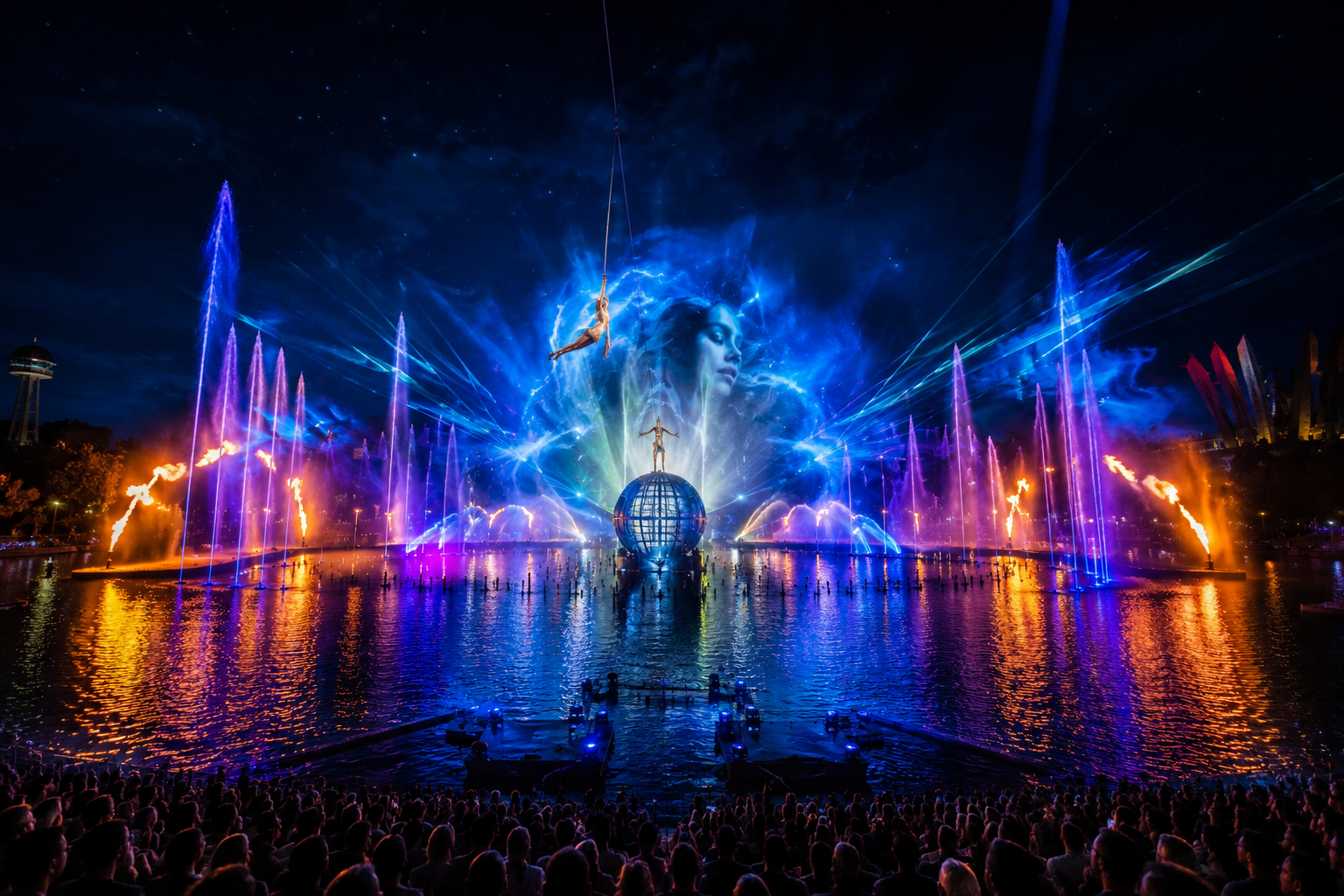
A performer hangs above a dark lake.
Below, fountains erupt from the water. Fire suddenly burns across the scene. Lasers cut through the mist. Images appear where there was no screen a moment before.
Then everything disappears.
The lake becomes dark again.
This was La Forge aux Étoiles, the large-scale nighttime production created by Cirque du Soleil for Futuroscope in Poitiers, France.
The show ran from 2016 to 2020, transforming a lake of more than 7,000 square metres into a performance environment for thousands of spectators each night.
But from a production perspective, its most interesting feature was not simply its size.
It was the absence of something every theatre normally depends on:
a stage floor.
So how do you create scenery, entrances, movement, scale and visual transformation when most of your performance area is water?
The answer is to stop treating the lake as empty space.
The Lake Was Not the Background

In many outdoor shows, water sits behind the performance.
It reflects lighting.
It provides atmosphere.
It becomes scenery.
La Forge aux Étoiles approached the relationship differently.
Cirque du Soleil describes the production as taking place on a lake of more than 7,000㎡ that was transformed each evening into a monumental stage using acrobatics, original music, fountains, video projection, lasers, fire and holographic effects.
That distinction matters.
The production did not simply place a conventional stage beside a lake.
The lake was the stage.
Once that decision is made, nearly every conventional production problem changes.
Where does scenery stand?
Where can performers appear?
Where can equipment be hidden?
How do you create visual depth?
How do you move the audience’s attention across thousands of square metres?
And perhaps most importantly:
How do you make something as flat and dark as water feel theatrical?
Water Solves One Problem and Creates Ten More
Water is visually extraordinary.
Technically, it is difficult.
A conventional stage gives production designers reliable coordinates.
A scenic unit placed at stage left remains at stage left.
A lighting fixture can be focused against a predictable surface.
Projection has a defined target.
Performers have floors, stairs and backstage routes.
A lake provides almost none of those things naturally.
It moves.
It reflects.
It absorbs light.
It creates moisture.
Its surface cannot support conventional scenery without additional engineering.
And the audience is looking across a large horizontal plane rather than toward a traditional proscenium.
That means the production cannot depend on one visual system.
It needs several systems working together.
La Forge aux Étoiles used exactly that approach.
Water + projection + fountains + laser + fire + aerial performance + music.
Each medium solved something another medium could not.
A Fountain Can Become Scenery

A fountain is usually considered an effect.
Here, it can perform the function of scenic architecture.
Think about what scenery normally does.
It gives the stage height.
It creates boundaries.
It changes composition.
It reveals and conceals.
It helps direct attention.
A programmable fountain can do many of the same things.
Water rises and a vertical structure suddenly exists.
The jets disappear and the structure vanishes.
A wall can appear without being rolled onto the stage.
An arc can frame a performer.
A sequence of fountains can expand the apparent width of the composition.
And unlike physical scenery, water can transform almost instantly.
Cirque du Soleil specifically identifies monumental fountains as one of the central technologies used to turn the Futuroscope lake into a living stage.
That means the fountains were not simply decoration.
They were part of the show’s scenic vocabulary.
The Most Valuable Scenic Element Was Empty Space
This sounds contradictory.
But the enormous dark area above the lake was one of the production’s greatest assets.
A theatre already contains visual information.
Walls.
Curtains.
Rigging.
Architecture.
Seats.
A dark outdoor lake provides far less.
That gives designers something valuable:
negative space.
Against darkness, a single illuminated object can become enormous.
A suspended performer appears isolated.
A fountain suddenly defines scale.
A laser becomes visible through atmosphere.
Fire creates an immediate focal point.
Projection can appear without the audience constantly comparing it with conventional scenery.
The show could therefore create images and then erase them.
That ability to return to darkness is essential.
Because spectacle becomes more powerful when it is allowed to disappear.
Projection Without a Conventional Screen

Projection presents an obvious challenge on water.
You cannot simply project a detailed image onto the surface of a lake and expect it to behave like a cinema screen.
The production therefore needed to create temporary visual surfaces within the environment.
Cirque du Soleil’s own documentation describes video projections and holographic effects as part of the show’s visual system.
The important production idea is not the terminology.
It is the separation between the physical stage and the image surface.
A projection surface can appear inside the environment only when required.
An image can exist.
Then disappear.
The audience is no longer constantly aware of a permanent rectangular display.
This is fundamentally different from placing a large LED wall beside the water.
The technology can remain visually subordinate to the illusion.
The Screen Can Disappear
This is one of the most powerful principles in immersive production.
If the audience can always see the display technology, they understand where the image comes from.
There is a screen.
Therefore there is video.
But if the projection surface becomes difficult to perceive in darkness, the relationship changes.
The audience sees an image suspended within the environment.
The technology has not actually disappeared.
Its visual evidence has.
That is an important distinction.
Cirque du Soleil has always relied heavily on physical performers and tangible theatrical imagery.
At Futuroscope, digital imagery could expand that vocabulary without forcing the entire production to become a giant video screen.
Technology was being used to create space rather than merely display content.
Fire Works Because Water Is Everywhere

Then comes one of the oldest theatrical effects imaginable.
Fire.
On an LED screen, fire is an image.
On this lake, fire is physical.
It produces light.
Heat.
Reflection.
Movement.
Smoke.
And unpredictability.
More importantly, it exists beside water.
The contrast between those two materials creates immediate theatrical tension.
Cirque du Soleil lists fire and pyrotechnic elements among the effects used within the lake production.
From an audience perspective, the combination feels almost impossible:
water is the dominant environment,
yet suddenly fire occupies it.
That contradiction requires no explanation.
The audience understands it instantly.
Lasers Give the Lake a Ceiling

A lake is horizontal.
That can become visually limiting.
The audience’s attention naturally stays close to the waterline.
Lasers help solve this.
A laser does not need a conventional scenic surface to define space.
With sufficient atmospheric conditions, its beam itself becomes visible.
Suddenly the production has lines extending above the lake.
The stage acquires height.
Fountains create vertical movement from below.
Lasers define geometry above.
Aerial performers can occupy the space between them.
Projection creates another visual plane.
Now the performance is no longer happening on water.
It is happening inside a three-dimensional volume.
This is the difference between decorating a lake and designing a stage.
Cirque Still Needed a Human Body

With fountains, lasers, projections, fire and holographic imagery available, it would have been easy for the technology to become the entire show.
Cirque du Soleil did something important instead.
It kept a human performer at the centre of the narrative.
The company’s current project documentation describes the story as being carried by a single performer, moving through poetic tableaux that support the narrative.
The story follows Nebula, a young girl, and The Giant, a cosmic being searching for his origins, exploring friendship, discovery and connection.
That creative choice solves a major problem in large-scale spectacle.
Technology can create scale.
It cannot automatically create emotional focus.
The performer gives the audience somewhere to look.
Scale Is Meaningless Without Focus
Imagine 7,000㎡ of simultaneous visual activity.
Fountains everywhere.
Lasers everywhere.
Projection everywhere.
Fire everywhere.
The result might be technically impressive.
But dramaturgically, it would be chaos.
Large-scale production therefore requires hierarchy.
At any given moment the audience needs to understand:
Where should I look?
Sometimes the answer is the performer.
Sometimes it is an aerial object.
Sometimes it is a projected image.
Sometimes it is the entire lake.
This is where lighting, music, movement and effects become more than independent departments.
They become tools for controlling attention.
A show of this scale is not simply about filling space.
It is about deciding when not to fill it.
The Audience Sees One Show. Production Sees Many Systems.

This is where La Forge aux Étoiles becomes especially interesting.
To the audience, the experience is continuous.
A scene transforms into another scene.
But technically, different systems are taking turns carrying the visual narrative.
At one moment:
projection may dominate.
Then fountains.
Then a performer.
Then lasers.
Then fire.
Then darkness.
Then several systems combine for a climax.
The illusion of one unified performance depends on departments that operate very differently.
Water effects have their own timing.
Video has frames.
Lighting has cues.
Lasers have programming.
Fire and pyrotechnics introduce additional safety requirements.
Performers require their own choreography and operational conditions.
Music provides another timeline.
The audience should never feel those boundaries.
Synchronization Is the Invisible Scenic Design
This is why synchronization matters more than the quantity of equipment.
Imagine a fountain rising slightly too early.
The projection has not completed its transition.
The performer has not reached position.
The music has not reached the accent.
Nothing is technically broken.
But the theatrical moment is.
Now imagine the same systems landing together.
Music rises.
Projection transforms.
Water erupts.
Lighting expands.
Fire appears.
The audience experiences one event.
That is not merely programming.
It is temporal scenic design.
The scenery is being built with timing.
The Real Stage Exists in Time
A traditional scenic structure remains physically present.
La Forge aux Étoiles could create much of its visual architecture temporarily.
A fountain exists for seconds.
A laser shape exists for seconds.
A projected figure exists for seconds.
Fire exists for seconds.
An aerial performer crosses a visual plane and leaves.
Then darkness returns.
This means the stage is not only spatial.
It is temporal.
Its architecture is constantly being assembled and dismantled through cues.
The audience never sees a stagehand move scenery.
Yet the stage changes continuously.
Production Perspective: Water Changes Everything
From a production standpoint, using a lake as the primary performance environment creates a very different risk profile from using a theatre stage.
Equipment has to coexist with water and outdoor conditions.
Performance positions require carefully controlled access.
Fire and pyrotechnic effects introduce another layer of safety.
Projection must contend with ambient conditions.
Fountains need repeatable timing.
Large visual distances affect sightlines.
Outdoor sound must cover a broad audience area.
And every system has to function repeatedly as part of a theme-park operation.
That final point is especially important.
This was not a one-night festival performance.
It was a recurring nighttime attraction.
Cirque du Soleil describes the project as designed to host thousands of spectators each evening and to become a signature experience capable of extending the time visitors remained at Futuroscope.
That changes the production objective.
The system cannot merely work once.
It has to work again.
And again.
And again.
A Theme-Park Show Is an Industrial Performance
This is where large-scale attraction production differs from many touring shows.
Repeatability becomes part of creativity.
Every spectacular moment must also become an operational procedure.
Cue sequences need consistency.
Equipment needs maintenance access.
Effects need resetting.
Performance conditions need monitoring.
Audience entry and exit have to integrate with park operations.
Weather can affect outdoor performance.
Technical failures require contingency planning.
The romantic image is a magical lake.
Behind it is a machine designed for repetition.
That does not make the experience less artistic.
It makes the engineering more important.
Why Futuroscope Needed a Show Like This
The project also reveals something about the economics of experience design.
Cirque du Soleil says the objective was not simply to create entertainment.
The production was intended to provide a signature nighttime experience, extend visitors’ time at the park and strengthen Futuroscope’s position as an entertainment destination.
That is a significant distinction.
A nighttime spectacular can change how a visitor uses an entire destination.
Without a major evening attraction, visitors may leave earlier.
Create a show worth waiting for and the daily rhythm changes.
People remain.
They eat.
They shop.
They gather.
Then thousands move toward a shared final experience.
The production becomes part of the park’s operating strategy.
The Stage Was Also a Business Tool
This is something IMMERSIVE LAB considers important.
Large entertainment technology is rarely justified by spectacle alone.
The production needs a reason to exist.
At Futuroscope, the lake already existed.
The evening time slot existed.
The audience already existed.
The challenge was to transform those assets into another experience.
Instead of constructing a conventional indoor theatre, the production transformed an existing public space into a nighttime venue.
Cirque du Soleil explicitly presents the project today as an example of how a large-scale entertainment production can increase visitor dwell time and support additional evening revenue.
The 7,000㎡ lake therefore became more than a stage.
It became an operating asset.
Then the Show Disappeared
La Forge aux Étoiles began in 2016.
Futuroscope’s own historical timeline records that year as the introduction of its new Cirque du Soleil nighttime show.
Cirque du Soleil’s current project page dates the production from April 9, 2016 to October 29, 2020.
Futuroscope later introduced a new outdoor nighttime production, La Clé des Songes, created with ECA2, in 2021.
But the disappearance of La Forge aux Étoiles reinforces the idea at the centre of this story.
The lake was never permanently transformed.
The architecture of the experience existed largely through technology, performance and time.
When the systems stopped—
the lake became a lake again.
How Do You Turn a 7,000㎡ Lake Into a Stage?

Not by covering it with scenery.
You use the properties already there.
The water becomes reflection.
Fountains become moving architecture.
Projection creates temporary imagery.
Lasers construct space above the surface.
Fire introduces physical contrast.
Aerial performance gives the composition height.
Music creates the timeline.
A human performer gives the audience emotional focus.
And darkness allows all of those things to disappear.
The most important production decision is therefore not what to put on the lake.
It is understanding what the lake can already do.
Production Takeaway
La Forge aux Étoiles demonstrates a principle that applies far beyond theme parks:
a stage does not need to be a platform.
A stage is any environment in which production systems can control the audience’s attention.
Sometimes that environment is a theatre.
Sometimes a stadium.
Sometimes a building.
And sometimes it is more than 7,000㎡ of water.
The engineering challenge is different.
The artistic objective is the same.
Make the audience stop seeing the infrastructure.
Make them stop thinking about projectors, pumps, lasers, control systems, safety zones and cue sequences.
Make them see a world.
For a few minutes every night at Futuroscope, Cirque du Soleil did not place a show beside a lake.
It taught the lake how to perform.
Continue Exploring WORLD DISCOVERY
WORLD DISCOVERY explores the places where architecture, performance, technology and audience experience become inseparable.
Next in WORLD DISCOVERY
To Be Announced
The next destination will continue our search for spaces where the stage is not simply constructed—but discovered.
About WORLD DISCOVERY
WORLD DISCOVERY is an IMMERSIVE LAB series examining how extraordinary spaces around the world become performance experiences through architecture, technology, art and production.
Explore More from IMMERSIVE LAB
Explore LIVE STAGE for the engineering behind major concerts, THE SHOW X-FILES for production failures and hidden risks, Broadway Musical Collection for the craft behind major musicals, and LEGENDS for the creators who changed how performances are made.
Editorial Note
La Forge aux Étoiles evolved during its multi-year run. This article uses specifications and production characteristics documented by Cirque du Soleil and Futuroscope and avoids attributing undocumented equipment quantities or technical configurations to the production. Production interpretations are IMMERSIVE LAB editorial analysis and do not imply participation in the show.
References & Further Reading
Cirque du Soleil — La Forge aux Étoiles
Futuroscope — Historical Timeline


