Sarah Brightman: The Voice Phantom Was Built Around
The Phantom of the Opera Was Written Around Her Voice. Then the Production Had to Make That Voice Visible.
In 1985, when the first act of The Phantom of the Opera was presented at Andrew Lloyd Webber’s Sydmonton Festival, the female lead was not yet called Christine Daaé. She was listed simply as “Kristin.” Sarah Brightman sang the role opposite Colm Wilkinson as the Phantom. The presentation already contained the chandelier moment and the organ overture that would become inseparable from the finished production.
A year later, on October 9, 1986, Brightman opened at Her Majesty’s Theatre in London as the first Christine Daaé. But this was not ordinary casting. Andrew Lloyd Webber had been writing specifically with Brightman’s soprano in mind. Brightman herself has said that much of Christine’s material was composed around her voice, while contemporary reporting likewise described the role as created with her vocal qualities in mind.
That reverses the usual production question. Normally we ask: can the performer sing the role? With Sarah Brightman and Phantom, the more interesting question is: what happens when the role, the score and eventually an entire theatrical production are constructed around the particular sound of one performer?
Before Christine, There Was Cats

Brightman’s association with Lloyd Webber did not begin with Phantom. She joined the original London company of Cats in 1981, playing Jemima, and met Lloyd Webber there. That matters because Brightman’s instrument was unusual for commercial musical theatre. She possessed a high soprano capable of operating comfortably in a classical register while still participating in contemporary amplified theatre.
That gave Lloyd Webber a different musical palette. Christine did not need to sound like a conventional Broadway belt-driven heroine. She could belong plausibly to the fictional world of an opera house. And at the same time, she had to survive inside a score using synthesizers, amplified orchestration and unmistakably contemporary theatrical sonics. Brightman’s voice became the bridge.
Christine Had to Sound as Though She Belonged to Two Worlds

This is the first major production problem. Christine begins inside the Paris Opéra. She is surrounded by ballet dancers, opera singers, managers, musicians and theatrical machinery. Her voice therefore has to possess enough classical credibility for the audience to accept that world.
But The Phantom of the Opera is not an opera. It is a commercial musical. The audience must understand every dramatic shift. Lyrics must remain intelligible. Microphones and orchestration have to preserve intimacy. And Christine has to move seamlessly from apparently operatic material into musical-theatre storytelling. Brightman’s vocal identity gave the production a solution. She did not have to imitate an opera singer. Her natural soprano already placed Christine somewhere between opera and musical theatre. That ambiguity became useful.
Then the Phantom Starts Teaching Her
The story itself turns Christine’s voice into dramatic material. The Phantom does not merely desire her. He trains her. Controls her. Promises to release a voice that others supposedly cannot. That means singing technique becomes part of the plot. When Christine’s voice changes, the audience must perceive something happening to the character.
The score therefore asks Brightman to do more than hit notes. Her sound must communicate influence, fear, fascination, submission, discovery. The voice becomes something the Phantom is apparently shaping in real time. That makes Christine unusual: her instrument is also a scenic object inside the story.
“Think of Me” Has to Transform the Room
Christine’s first major test arrives with “Think of Me” (originally titled, in the Sydmonton preview, “What Has Time Done to Me”). Dramatically, she is replacing Carlotta. The audience inside the story initially sees an inexperienced chorus girl. Then she sings. The theatrical audience must understand why everyone onstage suddenly sees her differently.
That creates a delicate production problem. If Christine appears completely confident from the beginning, there is no transformation. If she appears genuinely incapable, the later vocal authority feels artificial. The number therefore has to reveal her gradually. Performance, costume, lighting, blocking and orchestration all participate. The production effectively says: watch this person become visible. Brightman’s soprano supplies the evidence.
The Mirror Changes the Meaning of Her Voice

Then Phantom removes the visible teacher. Christine hears the Angel of Music. But she cannot see him. Now sound has to create a character before scenery reveals one. That is a powerful reversal. Normally theatre shows us where a voice originates. Here, the production deliberately disconnects voice from body. The Phantom’s sound can seem to inhabit the architecture itself. Christine responds not to a person standing beside her but to an acoustic presence.
The mirror sequence then converts that invisible relationship into physical theatre. Reflection. Light. Scenery. Voice. Automation. All converge. Christine literally crosses from one theatrical reality into another. And Brightman is the audience’s guide.
Then the Organ Arrives

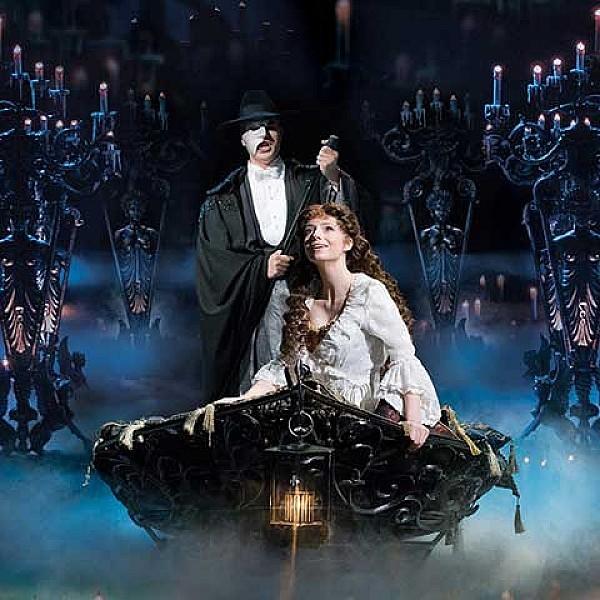
The title sequence makes the transformation complete. “The Phantom of the Opera” does not sound like conventional 19th-century opera. Its famous organ introduction is aggressive, amplified and deliberately theatrical. The production has moved from the elegant surface of the opera house into the Phantom’s world. Brightman’s voice now has to operate against a much harder sonic environment.
This is where her range becomes production material. Christine can still sound unmistakably soprano while the surrounding music becomes increasingly contemporary. The contrast is the point. Her voice does not disappear inside the arrangement. It cuts through it.
Before the complete show even opened, the title song had already been released as a single on January 3, 1986, with Brightman singing opposite Steve Harley—a UK hit before the musical itself existed onstage. So once again, recorded music was helping establish the identity of a stage production before audiences encountered the finished theatrical machine. The original London cast recording, released the following year, went on to sell tens of millions of copies worldwide, becoming one of the best-selling cast albums ever made.
Christine Cannot Compete With the Chandelier

Then comes the obvious problem. How does a performer remain important inside a production containing one of musical theatre’s most famous scenic effects? The chandelier is designed to command attention. Maria Björnson’s scenery and more than 200 costumes create an enormous visual world. Hal Prince’s direction controls scale. Gillian Lynne’s musical staging fills that world with movement.
Christine stands inside all of it. Trying to become visually larger than the production would be impossible. So Brightman’s function is different. She provides the human scale. The chandelier can terrify an auditorium. Christine tells us why we should care that it falls.
Maria Björnson Had to Design Around a Voice

Costume design becomes especially important with Christine. The character moves through multiple identities: chorus girl, emerging opera performer, young woman caught between Raoul and the Phantom, masked-ball participant, the Phantom’s imagined star. Her appearance cannot remain static. Yet the costume cannot interfere with the instrument around which the role was constructed.
Breathing matters. Posture matters. Movement matters. Quick changes matter. Microphone placement matters. The visual silhouette therefore has to cooperate with vocal mechanics. This is one of musical theatre’s least visible engineering relationships: the costume designer dresses the body that produces the sound. A spectacular costume that compromises breathing is not spectacular for long.
“All I Ask of You” Requires the Opposite Technology
One of Phantom’s smartest structural choices is that after the underground spectacle, the production gives Christine a comparatively direct human relationship. Raoul. “All I Ask of You” works because the theatrical language changes. The Phantom’s world is built around illusion, control, hidden spaces and manipulated perception. Raoul’s scene needs clarity. Two people. A promise. Open emotional communication.
Brightman’s voice therefore performs a different production function. With the Phantom, it can sound enchanted. With Raoul, it needs to sound present. Same performer. Same instrument. Different dramatic acoustics.
The Role Was Already Becoming a System

By the time Phantom reached Broadway, Christine was no longer merely Sarah Brightman’s role. It was becoming a repeatable production track. Brightman opened the Broadway production at the Majestic Theatre on January 26, 1988, again opposite Michael Crawford. But a long-running musical cannot remain dependent on its original performer. Eventually somebody else must sing the role. Then another. Then another.
And this creates one of the most interesting consequences of writing for a specific voice: how do you turn something personal into something reproducible?
Every Christine Inherits Sarah Brightman’s Problem
The role has now passed through generations of performers. Different vocal colors. Different bodies. Different acting choices. Different cultural backgrounds. Yet certain requirements remain. Christine must sound capable of inhabiting an operatic environment. She must retain lyric clarity. She must negotiate a demanding upper register. She must move through extensive staging. She must maintain the illusion eight performances a week. And she must do all of this inside a production whose technical machinery is extraordinarily precise.
Brightman was not merely the first person to perform those requirements. Her instrument helped determine what those requirements became.
The Production Outlived Its Original Voice
Brightman gave her final performance as Christine in 1988. Phantom continued. And continued. The Broadway production eventually closed on April 16, 2023, after 35 years and 13,981 performances—the longest run in Broadway history.
Those numbers create a fascinating contradiction. A role designed around one highly specific performer became one of the most replicated female roles in commercial musical theatre. Personal became industrial.
But the Original Recording Preserved the Blueprint
Stage performances disappear. Recordings do not. The original London cast recording preserved Brightman’s Christine alongside Michael Crawford’s Phantom. That recording allowed later performers to hear not merely the written notes but one early interpretation of how the character’s voice could inhabit the score.
This creates both an advantage and a danger. A reference can preserve production knowledge. It can also become imitation. Every new Christine therefore faces a difficult balance: respect the musical architecture, without becoming a copy of Sarah Brightman. The stronger the original performance becomes culturally, the harder that problem gets.
Then Sarah Brightman Left Broadway Behind
Brightman’s later career makes the Phantom story even more interesting. She did not remain primarily a Broadway performer. Instead, she developed an international concert career combining classical and popular repertoire. That trajectory reveals that the qualities Lloyd Webber used in Christine were not limited to one theatrical role.
The hybrid voice could travel. Opera-derived technique. Pop amplification. Large-scale visual presentation. Orchestral arrangements. Arena-sized staging. In some ways, Brightman’s later concert career expanded the same contradiction Phantom had already exploited: how can a classical-sounding voice operate inside contemporary spectacle?
Forty Years Later, Christine Still Begins With the Same Problem

In 2026, Phantom marks 40 years since its West End premiere. That history is not simply a history of actresses. It is a history of a production specification: voice, character, costume, sound, movement, lighting, scenery, repeatability. Every performer entering the role inherits the relationship between those systems. And at the beginning of that chain stands a soprano for whom much of the music was specifically written.
Editor’s Take — Sarah Brightman Wasn’t Cast Inside Phantom. Part of Phantom Was Built Around Her.
Most musical-theatre casting begins after the composer has already established what the role needs. Sarah Brightman’s Christine complicates that sequence. Her voice was present while the musical language itself was being formed. Lloyd Webber has said he began writing for her years before Phantom, and Brightman has recalled that much of Christine’s material was created around her instrument.
That makes her more than an original cast member. She became one of the production’s design parameters. Maria Björnson could change what Christine looked like. Hal Prince could determine where she stood. Gillian Lynne could determine how she moved. Sound could amplify her. Lighting could isolate her. The chandelier could fall above her. But underneath all of those systems remained something established unusually early: what Christine sounded like.
That may explain one of Phantom’s great production paradoxes. The show became famous for machinery. Yet one of its most durable pieces of machinery was never mechanical at all. It was a human voice.
References
The Phantom of the Opera — Official History
Andrew Lloyd Webber — The Phantom of the Opera History
OPB — Phantom of the Opera Takes Final Broadway Bow After 13,981 Performances


