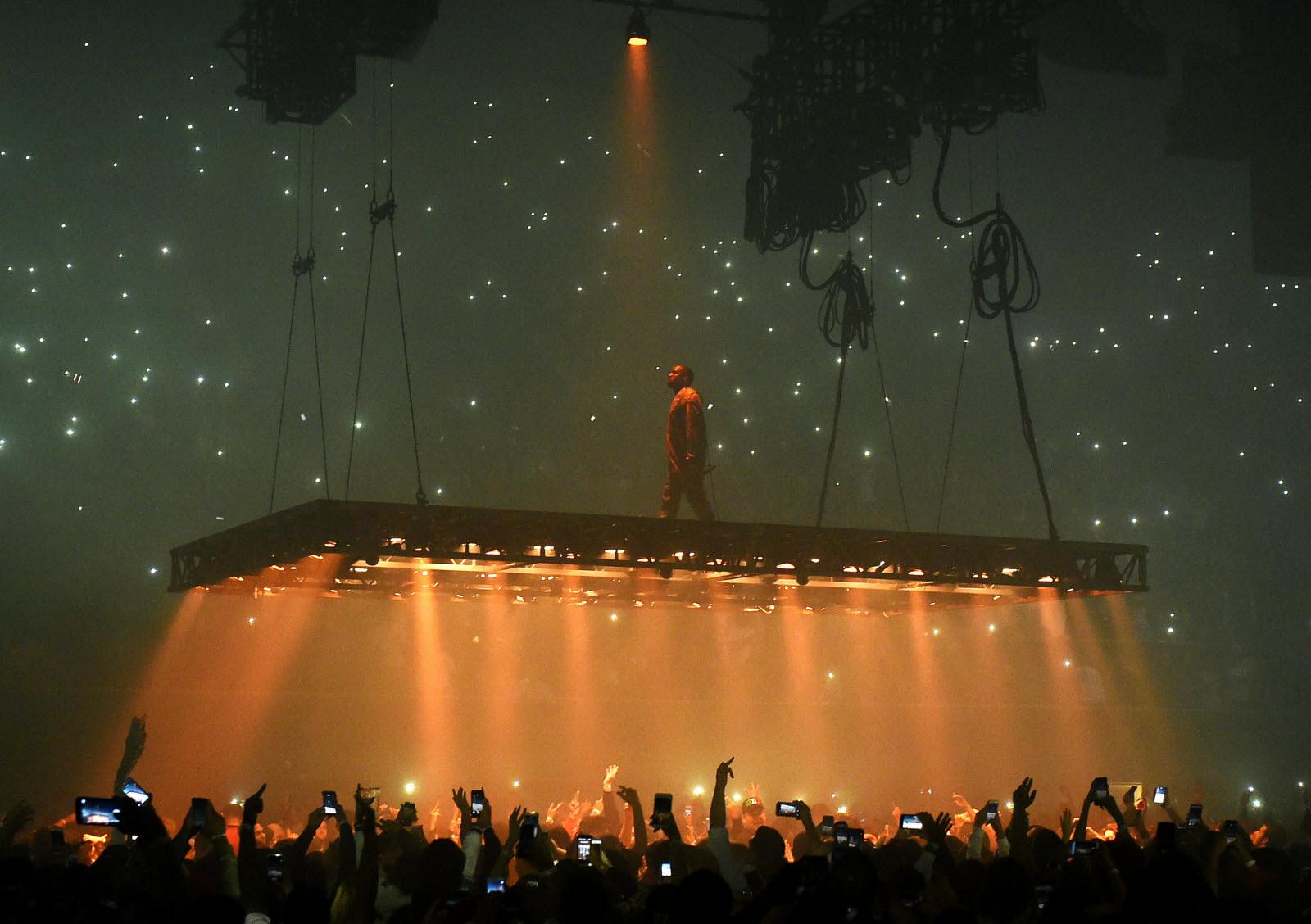
Kanye West Removed the Stage—and Put It Above the Audience
On August 25, 2016, people entering Bankers Life Fieldhouse in Indianapolis encountered something wrong with the room.
There was no conventional stage.
The arena floor was open, and thousands of spectators were standing where the stage would normally dictate where they should look. Then a rectangular platform appeared above them—with Kanye West standing on it.
West later said the final concept had required at least eight months of planning, including conversations with stage designers and studying tours by artists including U2, Radiohead, Daft Punk, Trent Reznor, Michael Jackson and The Rolling Stones.
But the most important idea was remarkably simple: instead of bringing the audience toward the stage, move the stage over the audience.
First, Remove the Most Important Object in the Concert

Almost every arena concert begins with the same architectural assumption. There is a stage. Once its location is established, almost everything else follows.
The best seats face it. The PA points away from it. Lighting positions are designed around it. Barricades separate it from spectators. Cameras point toward it. Audience movement is organized by it.
Saint Pablo removed that reference point.
SGPS ShowRig, which built the custom performance deck and supplied its rigging and automation, describes the system as a suspended stage mounted beneath a gantry that travelled up and down the arena.
Suddenly, the performer did not own one end of the building. He could occupy the space above almost any part of the floor.
The Floor Became the Second Stage
This reversal created something more radical underneath the platform. The audience became scenery.
People on the floor were no longer standing several metres away from a performer behind a barricade. They were moving directly beneath him.
From the seats, therefore, spectators could see two performances simultaneously: Kanye above, and the crowd below.
West explicitly described this as part of the concept. He said he wanted the experience to be about more than watching the artist—to let people watch their friends, sing together and see themselves and what they were wearing.
That means the floor crowd was not an accidental consequence of the design. It was part of the design.
The Stage Didn’t Just Hang. It Travelled.

A suspended platform would already have changed the relationship between artist and audience. But SGPS added another capability.
The gantry system allowed the platform to travel along the length of the arena. That distinction matters.
A conventional B-stage brings an artist closer to one section of the audience. A runway brings the artist along one predetermined route. The Saint Pablo platform changed the location of the performance itself.
Spectators who had been behind Kanye could later find him above them. People underneath the platform moved with it. The best position on the floor therefore became temporary.
Approximately 15 Feet Changed Everything
Contemporary reports placed West roughly 15 feet above the crowd during the opening show. That height created a carefully balanced relationship.
Too high, and the platform becomes conventional overhead scenery. Too low, and interaction with the moving crowd becomes difficult and potentially unsafe. At roughly this scale, West was visibly separated from the audience but still physically connected to it.
The Guardian observed that the platform could tilt, move and dip toward the spectators, at moments bringing West close enough that fans beneath him could nearly touch him.
The distance was therefore not merely engineering clearance. It became dramaturgy. Sometimes Kanye was remote. Sometimes he descended toward the crowd. The machine controlled social distance.
The Most Important Lights Were Under the Stage

Normally the underside of a concert stage is something production hides. Cables. Steel. Motors. Structure. Darkness.
Saint Pablo turned that underside toward thousands of spectators. Lighting integrated beneath and around the suspended platform illuminated the people directly below it. Contemporary architectural analysis of the show describes both edge and underside lighting as part of the system.
This changed what the arena audience saw. The visual focus was not always Kanye. Sometimes the brightest object in the composition was the crowd underneath him.
The platform therefore behaved like an enormous moving lighting fixture. Where it travelled, a pool of human activity travelled with it.
There Was No Scenery to Hide Behind
Consider how little remained. No conventional scenic wall. No giant castle. No long runway. No band occupying risers. No elaborate collection of props competing for attention.
A suspended rectangular deck. One performer. A moving mass of people. Light. Haze. Darkness.
This minimalism created an unusual risk. In a heavily scenic production, architecture can carry moments when the performer is relatively still. On Saint Pablo, Kanye himself had to carry the visual composition. The platform did not distract from him. It exposed him.
Minimalism is not necessarily simpler production. Sometimes it removes the places where production can hide.
The Secondary System Was Light, Not Scenery
Architectural analysis of the design identifies a second suspended system composed of four rectangular sections. These elements could move independently and were used primarily to create changing ambient-light environments around the main performance platform.
That gave the production two different overhead languages. One structure carried Kanye. The other shaped the space around him.
Instead of filling the arena with physical scenery, the design manipulated planes of light above the crowd. The room could feel compressed. Then open. Dark. Then flooded. The architecture existed only when illuminated.
The Rigging Became the Scenic Design

SGPS identifies Trask House as production designer and credits its own team with the custom deck, automation and rigging. This is an important distinction from many concert productions.
Usually rigging supports the scenery. Here, the rigging was fundamental to the scenery.
The arena roof had to support a system capable of carrying the platform and performer while allowing controlled horizontal travel. The gantry had to interface with different arena structures as the tour moved from building to building.
Suspension geometry mattered. Load distribution mattered. Travel paths mattered. Position feedback mattered. Emergency stopping mattered.
A platform floating effortlessly above an audience was only convincing because an enormous amount of engineering above it behaved predictably. The apparent absence of architecture depended on hidden architecture.
Every Arena Was a Different Ceiling
This is where the concept becomes more difficult than photographs suggest. A conventional touring stage can bring much of its own architecture with it. A flying system depends heavily on what exists overhead.
Every arena has different roof structures, rigging points, load capacities, dimensions, scoreboards, catwalks, access procedures, and local operating conditions.
Yet the audience expected the same illusion every night. The platform should simply appear to float. That meant the touring production had to translate one visual idea into multiple buildings.
The artist sees one stage. The rigging department sees a new structural problem at every venue.
The Audience Was Now Under a Moving Machine

The design also reversed one of the oldest rules of concert safety. Traditionally, the audience is kept away from large moving stage machinery. On Saint Pablo, spectators were deliberately placed underneath the moving performance platform.
That does not mean safety was abandoned. It means safety engineering became more consequential. SGPS’s role included the automation and rigging responsible for the custom deck.
Controlled movement, redundant suspension logic, travel limits, operational procedures and constant awareness of the crowd beneath the machine become central to a concept like this.
The visual experience says: Kanye is floating above you. The engineering requirement says: his position must never become unpredictable.
Then Someone Tried to Climb Onto It
Eventually, the audience tested the boundary. During a September 2016 performance, a spectator attempted to pull himself onto the suspended platform from below. West gestured toward him, and the man dropped back into the crowd.
It was a brief incident. But from a production perspective it reveals a fundamental consequence of the design. The platform was close enough to create intimacy. That also made physical interaction possible.
A traditional stage has barricades. Saint Pablo had vertical separation. The same distance that created the show’s defining relationship also became its security boundary.
The Crowd Had to Choreograph Itself

There was another effect that no automation programmer could completely control. When the platform moved, the crowd beneath it moved too.
People followed Kanye. Openings formed. Density shifted. Energy travelled through the floor. The audience effectively generated its own choreography around the position of the stage.
This is radically different from a seated audience. It is also different from a normal general-admission floor where attention points consistently toward one end of the building.
The stage became a moving gravitational centre. Where Kanye went, the crowd responded. Production was not merely moving scenery above people. It was moving people indirectly.
The Best View Could Be From the Worst Seat
The design also challenged another arena convention. Normally the closer you are to the stage, the more valuable the ticket. But what happens when the stage moves?
A spectator at one end of the floor could temporarily be far away. Minutes later, Kanye could be directly overhead. Someone in a fixed arena seat could watch not only West but also the changing patterns of thousands of people beneath him.
The upper bowl gained a perspective unavailable to the floor. From above, the crowd became a visual texture. The entire arena became readable.
This is why the design worked particularly well in photographs and social-media video. The show had no single privileged camera angle.
The Platform Was Deliberately Uncomfortable
Contemporary reviews noted that the stage did not always appear perfectly static. It could tilt and visibly react to West’s movement.
That instability contributed to the experience. A perfectly rigid suspended deck might have looked like a conventional stage that happened to be elevated. A platform with perceptible physical behaviour constantly reminded the audience that it was actually hanging in space.
West’s own body became part of that visual evidence. When he moved, the audience could perceive that the object supporting him was not connected to the floor. The machinery was real. So was gravity.
There Was Almost Nothing to Put on Instagram—Except Everything

In 2016, audience-generated video was already transforming how concert design circulated. Saint Pablo was unusually compatible with that environment.
A phone camera did not need to capture an elaborate scenic sequence to communicate the idea. One frame was enough: Kanye. Floating platform. Thousands of people underneath.
The production concept could be understood almost instantly. That is extremely powerful design. The photograph explains the engineering idea before the viewer knows anything about the tour.
And every floor spectator became part of somebody else’s image. West’s stated intention that people should see themselves and their friends therefore extended beyond the building. The audience became content.
Eight Months of Design Produced Something That Looked Like Nothing
After the Indianapolis opening, West explained that the final concept had taken at least eight months of planning. He said he had travelled and spoken with leading stage designers while studying previous concert experiences.
That is perhaps the greatest contradiction of Saint Pablo. Months of design. Custom fabrication. Rigging. Automation. Arena engineering. Moving overhead structures. Lighting. Safety systems. Touring logistics.
And the audience walks into the building and thinks: Where is the stage?
Production usually demonstrates value by showing what it built. Saint Pablo demonstrated value by making the conventional stage disappear.
The Tour Ended Before the Idea Did
The Saint Pablo Tour did not complete its originally planned run. Remaining dates were cancelled in November 2016. That curtailed the production’s lifespan. It did not erase its design significance.
SGPS still presents the tour in its concert portfolio as a production that replaced the conventional end stage with a travelling suspended deck over the audience.
The important innovation was not simply that a performer flew. Concerts had flown performers before. Platforms had moved before. Artists had performed above audiences before.
The conceptual difference was making the suspended platform the primary stage for essentially the entire performance and allowing the floor beneath it to become the second half of the composition.
The stage did not extend into the audience. The audience occupied the space where the stage used to be.
Editor’s Take — IMMERSIVE LAB
The radical idea behind Saint Pablo was not suspension technology. It was reassigning ownership of the arena floor. Once Kanye West moved overhead, the most valuable physical territory in the building was returned to the audience.
SGPS’s gantry, automation and custom deck made that reversal technically possible, but the machinery was successful precisely because spectators stopped thinking about machinery. They followed the light, followed the platform and eventually followed one another.
Most concert design asks how to make a stage more impressive. Saint Pablo asked a much more dangerous question: what if we remove the stage and make the audience complete the picture?
References & Further Reading
SGPS ShowRig — Kanye West: Saint Pablo Tour — Custom performance deck, rigging and automation.
ArchDaily / INTERIORS Journal — INTERIORS: Kanye West’s Saint Pablo Tour — Spatial analysis of the Main Stage, Secondary Stage, track system and lighting architecture.
The FADER — Kanye West Said His New Tour Is Inspired By The Rolling Stones And Daft Punk — Reporting on West’s E! interview about the eight-month development process.
The Guardian — Kanye West Tour Review: Saint Pablo’s Floating Stage Takes Yeezy to New Heights — Contemporary account of the platform’s movement and audience interaction.
The FADER — Kanye West’s Saint Pablo Tour Is a Utilitarian Dream — Contemporary description of the suspended stage, illuminated crowd and moving overhead lighting system.
Next in LIVE STAGE: Bon Jovi — The Circle Tour, where a massive moving video structure had to behave simultaneously as screen, scenery and architecture.
https://immersivelabkorea.com/bon-jovi-put-five-industrial-robots-on-a-rock-stage/


