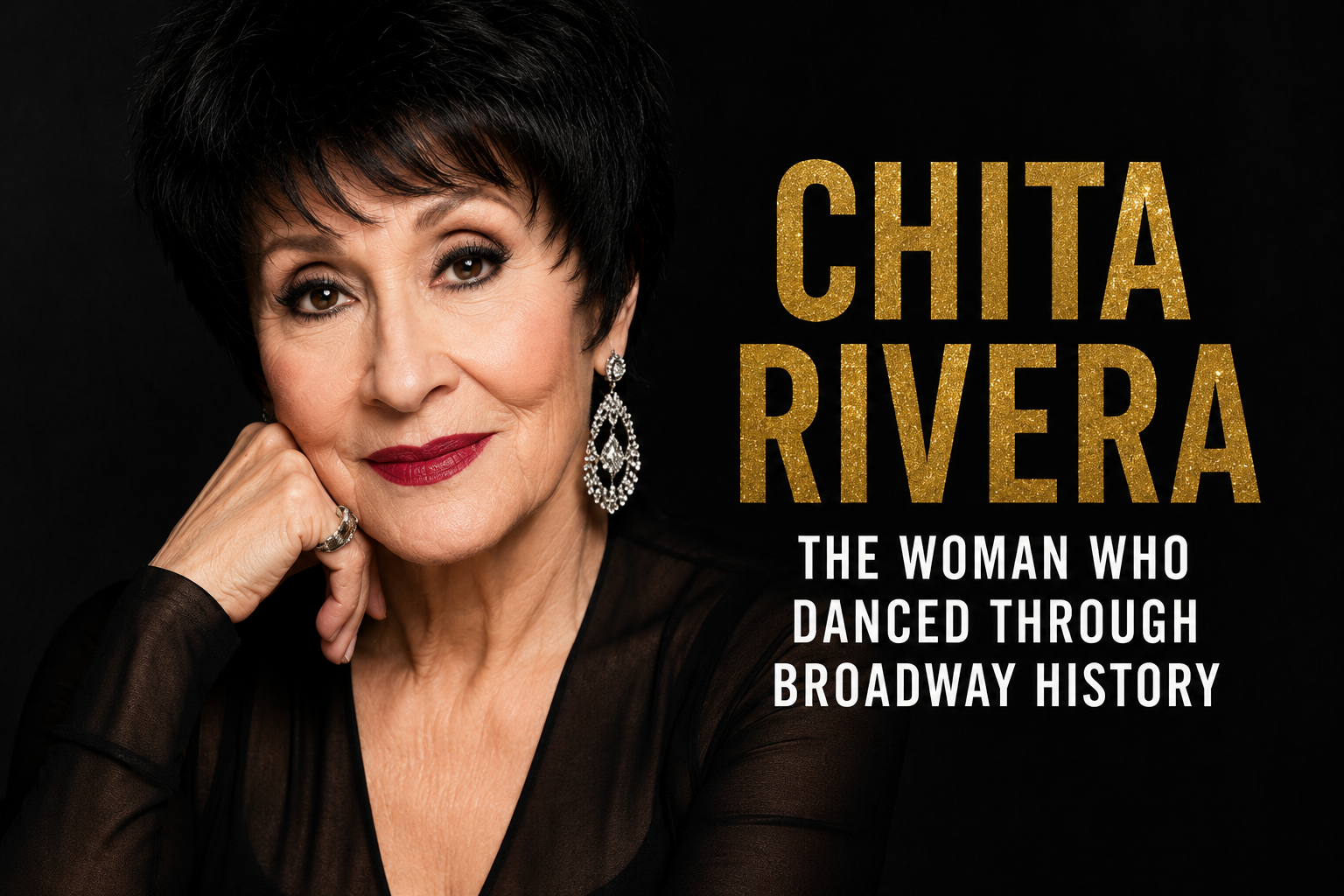
Chita Rivera
The Woman Who Danced Through Broadway History
There are Broadway stars who become famous because of one unforgettable role.
Chita Rivera did something rarer.
She kept becoming unforgettable.
In 1957, she exploded onto Broadway as Anita in West Side Story. Nearly two decades later, she created Velma Kelly in Chicago. In the 1980s came The Rink. In the 1990s, Kiss of the Spider Woman. And in 2015, at the age of 82, she returned to Broadway in The Visit and earned her tenth Tony nomination. Her Broadway record stretches across generations of musical-theatre history.
That longevity alone would be remarkable.
But longevity is not the reason Chita Rivera belongs in LEGENDS.
She matters because Broadway kept changing around her—and somehow, she kept changing with it.
This is not simply the story of a dancer who stayed onstage for decades.
It is the story of a performer whose body became a living archive of American musical theatre.
Before Chita Rivera, There Was Ballet

Long before Broadway knew the name Chita Rivera, there was Dolores Conchita Figueroa del Rivero, a girl growing up in Washington, D.C.
She began ballet training as a child, enrolled by her mother at a school in Washington run for young dancers. By fourteen, her talent had earned her an audition in New York, where legendary choreographer George Balanchine awarded her a scholarship to the School of American Ballet.
The trajectory seemed obvious.
She could have pursued classical ballet.
Instead, Broadway intervened.
At seventeen she joined the national tour of Call Me Madam as a principal dancer. Early Broadway appearances followed in productions including Guys and Dolls and Can-Can.
She was learning the stage from inside the ensemble.
That distinction is important.
Rivera did not arrive on Broadway as a manufactured star. She learned how a musical breathes from the chorus outward—how an ensemble creates momentum, how choreography carries character, and how a performer can command attention even before the script gives her permission to do so.
Then, in 1957, the permission became unnecessary.
Anita Arrives
West Side Story already had extraordinary ingredients.
Leonard Bernstein.
Stephen Sondheim.
Arthur Laurents.
Jerome Robbins.
But a musical does not become history because famous names appear on its poster.
Someone still has to walk onto the stage and make the characters live.
For Anita, that person was Chita Rivera.
She was not the romantic center of the musical. Tony and Maria carried the central love story.
Yet Anita possessed another kind of force.
Confidence.
Sexuality.
Humor.
Anger.
Practical intelligence.
And movement that seemed inseparable from personality.
Rivera’s Anita did not appear to stop acting when choreography began.
The dancing was the acting.
That is precisely why the role became so important.
Robbins had created a theatrical world in which movement could define community and conflict. Rivera had the physical intelligence to turn that concept into a human being.
Her performance brought stardom, and she repeated the role in London.
Broadway had discovered Chita Rivera.
But Anita would not be allowed to define her forever.
The Woman Behind Rosie

In 1960 came Bye Bye Birdie.
Rivera originated the role of Rose Alvarez opposite Dick Van Dyke’s Albert Peterson.
The musical had a very different temperature from West Side Story.
Instead of street violence and tragedy, there was satire, teenage hysteria, television culture and the absurdity surrounding a rock-and-roll idol.
Rivera adapted.
Rosie needed comedy.
Timing.
Romantic frustration.
Authority.
And the ability to shift between grounded acting and explosive musical performance.
The role brought Rivera her first Tony nomination in 1961.
More importantly, it demonstrated something that would become central to her career:
Chita Rivera was not a dancer who happened to act.
She was becoming a complete musical-theatre performer.
Then Broadway Became Chicago
By 1975, Broadway was changing again.
The optimism of the traditional musical had darkened.
Audiences were ready for irony.
Celebrity could be manufactured.
Crime could become entertainment.
Morality could become performance.
Into that world came Chicago.
John Kander and Fred Ebb provided the score. Bob Fosse directed and choreographed. Gwen Verdon played Roxie Hart.
And Chita Rivera originated Velma Kelly.
If Anita had been fire, Velma was control.
She understood the audience.
She understood the spotlight.
She understood that in the world of Chicago, guilt mattered less than the ability to sell a story.
Rivera’s body now communicated something different from the young Anita of 1957.
This was not youthful rebellion.
It was precision.
Authority.
Danger.
The role earned Rivera another Tony nomination.
Think about the distance between these two characters.
Anita belongs to a community struggling for dignity and belonging.
Velma turns notoriety into performance.
Rivera could inhabit both because she understood something fundamental:
Style is never enough.
Movement has to reveal the person underneath it.
The Rink — And the Tony Finally Arrives

By 1984, Rivera had already accumulated a career most performers would consider complete.
Then came The Rink.
She played Anna, the owner of a decaying roller rink, opposite Liza Minnelli as her daughter Angel.
The musical gave Rivera something different again.
Age.
Memory.
Motherhood.
Regret.
Conflict between a woman and the daughter who has returned to a place both of them understand differently.
Rivera was no longer simply the kinetic force inside someone else’s musical.
She was carrying emotional weight at its center.
And Broadway recognized it.
For The Rink, Chita Rivera won her first Tony Award for Best Actress in a Musical.
After decades of dancing, singing and acting across Broadway, the award did not mark the culmination of her career.
Instead, it arrived just before the event that could have ended it.
The Body That Had Carried a Career

For a dancer, the body is not merely an instrument.
It is the workplace.
The vocabulary.
The memory.
The thing upon which every future performance depends.
In 1986, Rivera was involved in a serious automobile accident.
Her left leg was badly injured.
For an artist whose identity had been built around movement, the implications were enormous.
A conventional version of this story would turn the accident into a simple inspirational formula:
She was injured.
She fought back.
She returned.
But that makes what happened too easy.
A dancer does not simply return to the body she had before.
She has to discover what the body can become now.
And Rivera did.
Kiss of the Spider Woman — The Second Life

The decisive answer arrived with Kiss of the Spider Woman.
The musical, with music by John Kander, lyrics by Fred Ebb and a book by Terrence McNally, placed Rivera in the role of Aurora—the glamorous fantasy figure who becomes the Spider Woman.
The production was dark.
A prison.
Political brutality.
Fear.
Fantasy.
Desire.
Death.
Rivera’s character existed partly as escape, partly as seduction, partly as threat.
This was not nostalgia for the Chita Rivera of West Side Story.
It required another version of her entirely.
When Kiss of the Spider Woman opened on Broadway in 1993, Rivera was sixty years old.
She won her second Tony Award for Best Actress in a Musical. The production itself won Best Musical, while Kander and Ebb won for the score.
Seven years after an accident that might have ended a dancer’s career, Rivera was standing at the center of Broadway again.
Not as a survivor invited back for sentimental reasons.
As the best actress in a musical.
That difference matters.
She Refused to Become Her Own Museum
Long careers create a peculiar danger.
Eventually, audiences stop seeing the artist in front of them.
They see memory.
The famous role.
The old photograph.
The younger body.
The performer becomes a museum of herself.
Rivera resisted that.
She appeared in the 2003 Broadway revival of Nine and received another Tony nomination. She later created Chita Rivera: The Dancer’s Life, an autobiographical theatrical journey through the choreography, people and productions that shaped her career; it brought another Tony nomination in 2006.
But even a show built around her own history did not become the final chapter.
There was still another new character waiting.
The Visit — 82 Years Old, Still Creating
In 2015, Rivera returned to Broadway in Kander and Ebb’s The Visit.
She played Claire Zachanassian, an enormously wealthy woman returning to the impoverished town where she had once been humiliated.
Claire offers salvation.
But there is a price.
The town will receive her fortune if someone commits murder.
It is a role built around power rather than physical virtuosity.
An older Rivera did not need to reproduce the speed of Anita or Velma.
She had something else.
Presence.
Stillness.
History.
An audience looking at Claire was also looking at a performer who had spent more than half a century under Broadway lights.
At 82, Rivera received her tenth Tony nomination for The Visit. The Tony Awards noted that this made her the performer with the most nominations at that point.
That achievement reveals something extraordinary.
Her first Tony nomination came for Bye Bye Birdie in 1961.
Her tenth came in 2015.
Fifty-four years separated them.
What Chita Rivera Changed

Rivera’s importance cannot be measured only through longevity or awards.
She also occupied Broadway at a time when Latina performers were rarely allowed such sustained visibility.
Her Puerto Rican heritage was part of her identity, but her career resisted confinement to a single category of role.
Anita.
Rosie Alvarez.
Velma Kelly.
Anna.
Aurora.
Claire Zachanassian.
These women do not belong to one theatrical stereotype.
Rivera’s career demonstrated that a Latina performer could stand at the center of major American musicals across decades without being reduced to one definition.
In 2002, she received a Kennedy Center Honor, becoming the first Latina to be so recognized.
In 2009, President Barack Obama awarded her the Presidential Medal of Freedom.
And in 2018, the Tony Awards honored Rivera with the Special Tony Award for Lifetime Achievement in the Theatre.
The honors acknowledged more than celebrity.
They recognized cultural impact.
Director’s Perspective — Broadway Changed. Chita Changed With It.
There is an easy way to misunderstand Chita Rivera.
Look at the résumé and conclude that her greatness was endurance.
It was not.
Endurance was the result. Adaptation was the achievement.
The Broadway that created Anita in 1957 was not the Broadway that created Velma Kelly in 1975.
The Broadway of The Rink was different again.
So was the Broadway of Kiss of the Spider Woman.
And by the time The Visit opened in 2015, the industry, the audience and Rivera herself had all changed dramatically.
Yet she remained theatrically relevant.
Why?
Because she did not spend her career trying to preserve the young woman who danced in West Side Story.
She allowed age to change the material she could carry.
Physical virtuosity became authority.
Speed became precision.
Precision became presence.
And eventually, presence alone could command a theatre.
That is a much more interesting definition of longevity.
A Living Archive of Broadway

Consider what passed through Chita Rivera’s career.
Jerome Robbins.
Leonard Bernstein.
Stephen Sondheim.
Bob Fosse.
John Kander.
Fred Ebb.
Harold Prince.
Terrence McNally.
And generations of performers who came after them.
Rivera was not observing Broadway history from the audience.
She was standing inside it.
Through her career, we can watch musical theatre evolve from the integrated dance storytelling of West Side Story, through Fosse’s cynical show-business world of Chicago, into the darker psychological musical theatre of Kiss of the Spider Woman and finally the austere late-career world of The Visit.
That is why Chita Rivera deserves something more than the word “star.”
She became a bridge between eras.
Why This Legend Still Matters
Young performers are often told to build a brand.
Chita Rivera’s career offers almost the opposite lesson.
Build the craft strongly enough that the brand can change.
She danced.
She acted.
She sang.
She played comedy.
She played danger.
She played mothers, lovers, performers, fantasies and women capable of terrifying power.
When injury changed her body, she changed her relationship to movement.
When age changed what the stage asked of her, she found new forms of authority.
And when Broadway began looking backward at her as a legend, she continued looking forward to the next role.
Rivera died in January 2024 at the age of 91.
But Broadway does not remember her simply because she stayed for a long time.
It remembers her because, across that extraordinary span, she kept showing audiences something new.
A Lasting Legacy
There is an image of Chita Rivera that seems to contain the whole story.
Not Anita.
Not Velma.
Not Aurora.
Imagine instead an empty Broadway stage.
A dancer walks into the light.
Decades pass.
The choreography changes.
The composers change.
The directors change.
The audience changes.
The dancer changes too.
But she remains there.
Not because the theatre owes her a place.
Because she keeps earning one.
That is Chita Rivera’s legacy.
She did not merely dance through Broadway history.
For more than half a century, she helped create it.
References & Further Reading
Chita Rivera — Official Website
chitarivera.com
Chita Rivera — Internet Broadway Database
IBDB Profile
Tony Awards — Chita Rivera Special Award for Lifetime Achievement
Tony Awards
Encyclopaedia Britannica — Chita Rivera
Britannica Biography
Next in LEGENDS
Some legends changed how Broadway was written.
Some changed how it was directed.
Some changed how it moved.
Chita Rivera showed what happens when a performer remains extraordinary long enough to travel through all those changes.
Next Legend — Coming Soon
https://immersivelabkorea.com/patti-lupone-the-voice-broadway-could-never-tame/
Continue Exploring
Broadway Collection — The productions that changed musical theatre.
LIVE STAGE — The concerts and performances that redefined live entertainment.
WORLD DISCOVERY — Extraordinary theatres, venues and cultural destinations around the world.
THE SHOW X-FILES — The hidden stories, controversies and breakthroughs behind famous productions.
About LEGENDS
LEGENDS is an original editorial series from IMMERSIVE LAB, dedicated to the people who changed the language of entertainment.
Not simply to celebrate famous careers, but to ask:
What did they change? Why did it matter? And why can we still feel their influence today?
Because behind every unforgettable performance is someone who made the stage different from the way they found it.
IMMERSIVE LAB
Broadway gave Chita Rivera a stage.
She gave Broadway more than sixty years of movement, character and change.
The steps eventually stop. The influence does not.
IMMERSIVE LAB — The Stories Behind the Stage.


