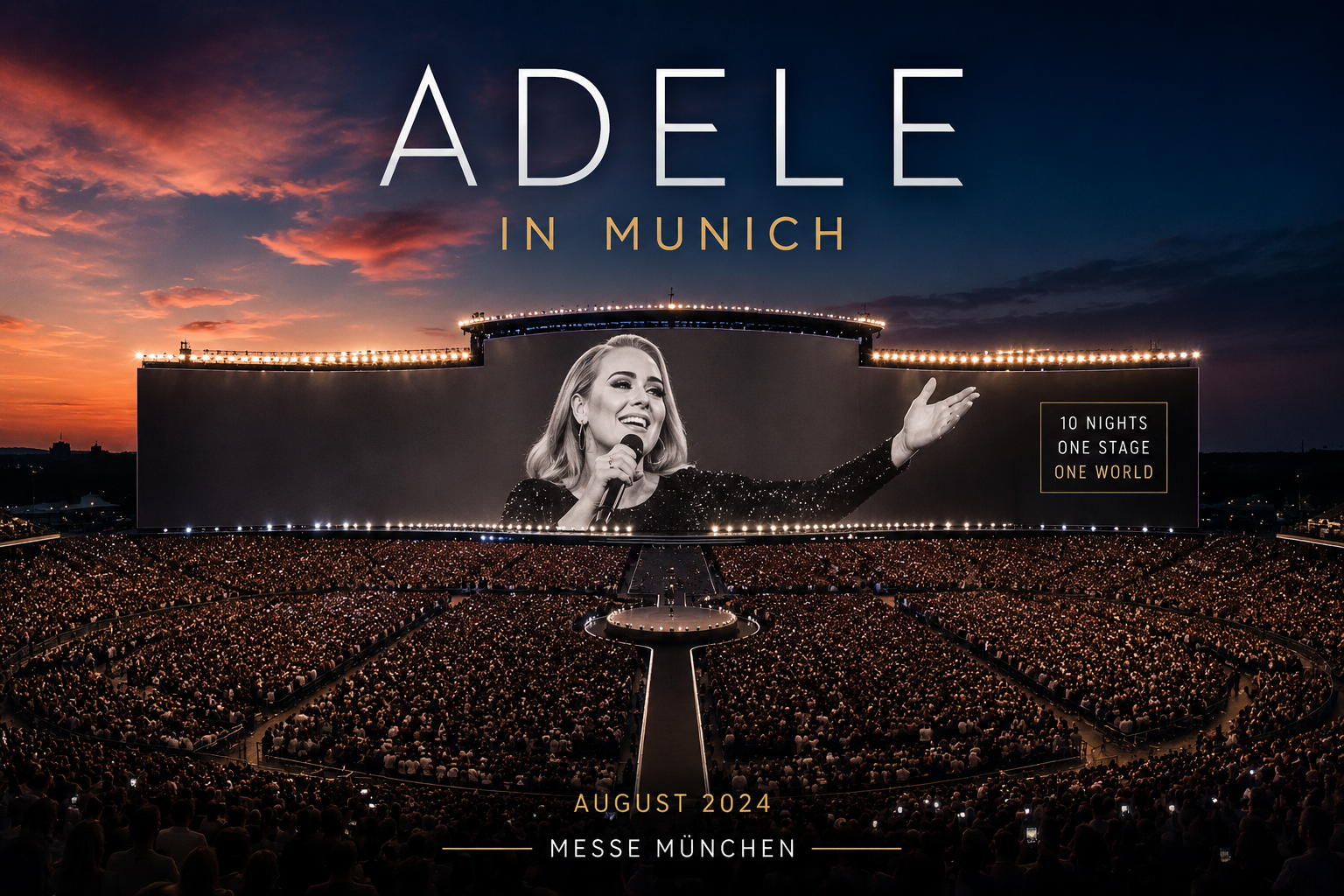
Adele in Munich: The Stadium Built for Just Ten Concerts
What If the Venue Your Show Needs Doesn’t Exist?
Imagine planning ten concerts. Then imagine discovering that no existing venue quite fits the experience you want to create.
Most artists would adapt the production to the stadium. Adele’s team reversed the equation.
In August 2024, an enormous temporary open-air arena appeared on the grounds of Messe München in Munich, Germany. It existed for one purpose: Adele.
Ten performances took place between August 2 and August 31. More than 730,000 people ultimately attended the residency, with roughly 73,000 spectators filling the specially constructed arena each night.
Then the concerts ended. And the extraordinary temporary world created around them began to disappear.
For an industry dominated by global stadium tours, Adele in Munich presented a radically different proposition: instead of taking the concert to audiences around the world, what if you created something extraordinary enough that the world would come to the concert?
Why Munich?

Adele had already demonstrated the power of residency with Weekends with Adele in Las Vegas. Las Vegas offered intimacy. Munich presented the opposite challenge.
How could Adele perform for tens of thousands of people without losing the emotional closeness that defines songs such as Hello, Someone Like You, Easy on Me and When We Were Young?
A conventional football stadium could provide seats. But seats were not the only requirement. The production needed control over architecture, audience layout, video, hospitality and the entire experience surrounding the concert.
Messe München offered something potentially more valuable than an existing stadium. Space. A blank canvas.
The outdoor exhibition grounds could accommodate a temporary arena designed around the production rather than forcing the production to conform to a permanent building. Messe München later described the project as a specially built pop-up arena that occupied its outdoor grounds for the four-week concert series.
That distinction changed everything. This would not simply be Adele performing in Munich. For one month, Munich would contain a place built specifically for Adele.
A Stadium That Did Not Exist

Temporary concert infrastructure is nothing new. Festivals construct stages. Sporting events install temporary grandstands. Promoters transform parks and fields into performance sites every summer.
But Adele in Munich pushed the idea toward something much closer to temporary architecture. A vast audience environment had to accommodate more than 70,000 people per performance.
That meant solving many of the same problems faced by permanent stadiums: crowd circulation, entrances and exits, emergency access, security, power, food and beverage operations, toilets, medical services, transportation and sightlines.
But there was another problem that mattered even more creatively. How do you make someone sitting an enormous distance from the stage feel emotionally connected to one singer? That question produced the defining visual feature of the entire production.
The Screen Was Almost a Building

Behind Adele stretched an extraordinary panoramic video surface. The screen measured approximately 220 metres across. Sony Music reported that organizers described it as the world’s largest outdoor screen at the time.
At that scale, a screen stops behaving like conventional concert video. It begins behaving like architecture.
A close-up of Adele’s face could stretch across an extraordinary portion of the audience’s field of vision. Black-and-white imagery could transform the entire stage into a monumental moving photograph. Landscape-format visuals could extend almost to the edges of the venue.
Instead of placing a performer in front of a giant rectangle, the production created a visual horizon. And that was crucial because Adele presents a very different design challenge from many stadium artists.
She does not need an endless sequence of dancers, flying systems, kinetic scenery and explosive choreography to hold an audience. Her most powerful instrument is often stillness. A voice. A face. A lyric. A moment of silence before the next line.
The production therefore faced an unusual task. It did not need to make Adele more spectacular. It needed to make intimacy visible from 200 metres away.
Making 73,000 People Feel Close

This may be the most important creative achievement of Adele in Munich. Stadiums naturally create distance. A performer becomes a tiny figure surrounded by architecture. The larger the audience becomes, the harder it is to preserve subtle emotion.
Adele’s music works in precisely the opposite direction. Her songs often feel like private conversations that happen to be sung in front of thousands of people. Munich had to reconcile those two scales.
The enormous screen became the bridge. When cameras moved close to Adele, spectators far from the stage could see expressions that would normally be visible only from the front rows. The technology magnified details rather than replacing them.
That distinction is important. The screen was enormous. But its purpose was not simply to make the concert feel enormous. Paradoxically, its greatest achievement was making an enormous concert feel smaller.
This is one of the most interesting lessons from the entire production: sometimes the most successful technology disappears emotionally. The audience stops thinking about pixels, processors and screen dimensions. They simply feel closer to the performer.
The Stage Extended Into the Audience

The visual relationship was not limited to the giant screen. A long catwalk extended Adele’s performance environment into the audience, bringing physical movement into a production otherwise capable of overwhelming the singer through sheer scale.
The principle was simple. If tens of thousands of spectators cannot all move closer to Adele, then parts of the stage can move Adele closer to them.
This balance between monumental scale and human proximity became the central design tension of the residency. The production could become gigantic when necessary. But it repeatedly returned attention to one person.
That restraint mattered. Because the biggest danger in designing a stadium show for Adele would have been creating a spectacle so large that it swallowed the artist it was supposed to celebrate. Munich largely did the opposite. The spectacle framed Adele.
Then They Built Another World Outside

The arena itself was only part of the project. Outside stood ADELE World. Messe München advertised it as a pre-show and post-show destination, opening before the arena gates and remaining open until midnight.
Visitors encountered food and beverage areas, entertainment and attractions. Sony Music highlighted features including a Ferris wheel, the “I Drink Wine” bar, karaoke and live entertainment.
This changed the meaning of the ticket. The experience no longer began when Adele walked onto the stage. It could begin hours earlier.
Fans could arrive, eat, drink, meet other fans, explore the environment and gradually move toward the concert. And when the final song ended, the experience did not necessarily stop immediately.
That makes Adele in Munich important beyond concert design. It suggests a different model for large-scale live entertainment. The concert becomes the center of a much larger ecosystem.
From Concert to Destination

Theme parks have understood this principle for decades. Major sporting events understand it. Las Vegas understands it perhaps better than anywhere. People do not travel only for the central attraction. They travel for the world surrounding it.
Adele in Munich applied that logic to a concert residency. Fans came from Munich, elsewhere in Germany and internationally; Messe München specifically credited the ten-show run with drawing more than 730,000 Adele fans from Munich and around the world.
For many visitors, attending Adele was therefore not simply a night out. It became part of a trip. Hotel. Train or flight. Munich. ADELE World. The arena. The concert. The memory.
That changes the economics of live entertainment. But more importantly for LIVE STAGE, it changes the creative boundaries of the show. Where does the performance begin? At the first song? At the arena entrance? At ADELE World? Or perhaps the moment someone books a trip to Munich because this extraordinary temporary place exists only for a few weeks?
Ten Nights Changed the Mathematics

Building a venue of this scale for one performance would be difficult to justify. Ten performances change the calculation.
The same arena remains in place. The same screen remains standing. Audience infrastructure does not need to be dismantled overnight and transported hundreds of kilometres to another city.
Traditional stadium touring spends enormous resources moving. A residency can redirect more of that effort toward building. That difference allows designers and producers to consider structures that would be impractical for a conventional one-night tour stop. The venue itself becomes part of the production.
And that may be the most important shift represented by Munich. The question was no longer: How do we fit Adele’s concert into this stadium? It became: What kind of venue does Adele’s concert actually need?
Director’s Perspective
The 220-metre screen is the obvious headline. The temporary stadium is the spectacular photograph. ADELE World is the clever commercial extension. But none of those is the most important idea.
The real innovation was reversing the traditional relationship between show and venue. Normally, a production arrives at a building and adapts. Munich allowed the building to follow the production.
That changes what a concert designer is allowed to imagine. The venue is no longer simply a container. It becomes scenery. It becomes technology. It becomes audience experience. It becomes part of the artistic concept itself. And perhaps most importantly, it can disappear when the story is finished.
For ten nights, Adele did not simply perform in Munich. A temporary world appeared because the performance required it.
The Concert That Became a Destination
The most remarkable thing about Adele’s Munich residency may not have happened during the concert at all. It happened before the first song.
Thousands of people arrived hours early. They ate, drank, explored, met other fans and rode a Ferris wheel inside ADELE World. The area opened before the arena itself and remained open until midnight, deliberately extending the experience beyond Adele’s time on stage.
This was no longer simply a concert venue with concessions outside. It was becoming a destination. And that distinction may be one of the most important ideas to emerge from Adele’s ten nights in Munich.
ADELE World Changed Where the Show Began

A conventional concert has an obvious beginning. The house lights go down. The artist walks onto the stage. The first song starts. Munich blurred that boundary.
ADELE World included entertainment, food and beverage areas, a Ferris wheel, karaoke, the themed “I Drink Wine” bar and additional live entertainment. None of those elements was the concert itself. But together they changed the psychology of attending it.
The ticket was no longer simply permission to occupy a seat for several hours. It became entry into a temporary environment built around Adele. That encourages audiences to arrive earlier. It gives fans somewhere to gather. It creates additional opportunities for food, beverage and merchandise spending.
Most importantly, it turns waiting into part of the experience. The show begins emotionally before the show begins musically.
730,000 People Came to a Place Built for One Artist

Across the four-week run, more than 730,000 fans attended the ten concerts at Messe München. The venue itself described the series as both an international and regional success.
That number matters for more than bragging rights. Hundreds of thousands of people were persuaded to travel to the same temporary destination during a single month. Some were local. Others came from elsewhere in Germany. Many travelled internationally.
Instead of repeatedly transporting the largest components of the production from stadium to stadium, the residency concentrated audiences around one extraordinary installation. That reverses one of the basic assumptions of touring.
Traditionally: the show travels to the audience. Munich demonstrated another possibility: the audience travels to the show.
For most artists, that model would be impossible. For a global superstar with sufficient demand, it becomes fascinating.
A Residency Can Spend Differently
This does not mean a residency is automatically cheaper. Building a temporary arena of this scale requires enormous expenditure before the first spectator enters: infrastructure, temporary seating, power, security, video, audio, lighting, hospitality, transport planning, audience services, weather preparation, staffing. The list is formidable.
But there is a fundamental operational difference from a conventional stadium tour. The production does not have to disappear immediately after every performance. On a touring show, crews begin dismantling almost as soon as the audience leaves because trucks must move equipment toward the next city.
Munich stayed. The screen stayed. The grandstands stayed. ADELE World stayed. The infrastructure served another audience a few days later.
Ten performances allow the enormous setup effort to be distributed across an entire residency rather than a single night. That creates a different creative equation. A touring production must constantly ask: Can this move? A residency can ask: What can we build if it doesn’t have to move tomorrow?
The 220-Metre Screen Was Not Really About Size

The giant screen understandably dominated coverage of the production. It measured approximately 220 metres long and 30 metres high, while a 93-metre catwalk extended the performance into the audience.
Those are spectacular numbers. But focusing only on dimensions misses the point. The screen solved an artistic problem.
Adele is not an artist whose stadium performance depends on continuous choreography. Many of her strongest moments involve very little physical action. She stands. She sings. She speaks. She reacts. The smallest facial expression can carry more emotional information than an enormous stage effect.
In a 70,000-plus-capacity environment, that intimacy could easily disappear. The screen allowed the opposite to happen. A face became landscape. A glance became visible from the rear of the arena. A quiet performance could occupy a gigantic visual field without needing to become louder or busier.
The technology served Adele’s identity instead of forcing Adele to serve the technology. That is why the screen mattered.
When the Audience Became Part of the Visual Language
Adele’s songs created another kind of spectacle. Not machinery. Not pyrotechnics. People.
Imagine tens of thousands singing Someone Like You together inside a venue constructed for only ten nights. At that moment, the audience itself becomes scenography. The scale of the crowd amplifies something that began as an intimate song.
That tension—private emotion experienced collectively—is at the heart of Adele’s stadium appeal. Munich did not try to disguise it. It designed around it. The production could be enormous without requiring Adele herself to perform as though she were competing with the architecture. Instead, the architecture helped the audience concentrate on her.
A Temporary Venue Can Create Permanent Economic Impact

The project also demonstrated why cities may become increasingly interested in destination concerts. Messe München said the residency brought more than 730,000 fans from Munich and around the world and described the ten concerts as a major economic success for the city and surrounding region.
Those visitors required more than concert tickets: transportation, hotels, restaurants, retail, local services. A major residency therefore operates differently from a single stadium date. The artist becomes a temporary tourism anchor.
Las Vegas has built much of its entertainment economy around this principle. Broadway contributes to New York tourism through another version of it. The West End does the same for London. Munich demonstrated how a superstar concert residency can potentially create a similar effect without requiring a permanent entertainment district. For several weeks, the destination can be constructed. Then removed.
And Then It Ended
The final Munich performance took place on August 31, 2024, completing the ten-show run that began on August 2. Adele thanked Munich, the people behind the production and the fans who had travelled to attend, saying she would never forget the experience.
Then something happened that separates this production from almost every famous stadium in the world. The venue had completed its purpose. There would be no next football season. No permanent museum. No daily visitors returning to see Adele’s arena.
The temporary architecture could come down. The site could return to serving Messe München’s wider exhibition program. The concert venue had behaved almost like theatrical scenery. It existed because the story required it. When the story ended, the set disappeared.
The Disappearance Was Part of the Magic
Normally, entertainment architecture celebrates permanence. Broadway theaters accumulate history. Opera houses become landmarks. Stadiums become symbols of cities. Munich offered something different. Impermanence.
There is emotional power in knowing that an experience has an expiration date. You cannot simply decide to visit Adele’s Munich arena five years later. The place existed during August 2024 because those ten concerts needed it. Then that version of the site was gone.
This makes the residency surprisingly similar to live performance itself. A concert happens once. Even if the same setlist is performed the following night, the audience changes. The atmosphere changes. The mistakes change. The emotions change.
Live performance matters partly because it cannot be perfectly repeated. Munich expanded that idea from the performance to the architecture. Not only the concert was temporary. The concert’s world was temporary too.
What Munich Could Mean for Future Superstar Concerts
The obvious question is whether others will follow. Could another global artist build a temporary arena for a month? Could a residency become a seasonal attraction? Could several artists share temporary infrastructure? Could concerts be combined with exhibitions, immersive installations, branded hospitality, fan experiences and destination tourism?
Technically, many things are possible. Economically, the answer is much harder. Adele’s model requires extraordinary demand. A temporary venue creates enormous upfront risk. Weather matters. Transportation matters. Crowd management becomes a city-scale problem. A residency that fails to attract sufficient audiences cannot simply move to another market next week.
This is therefore unlikely to replace conventional touring. But it does not need to. The more interesting possibility is that it becomes another category of live entertainment. Not tour. Not traditional residency. Not festival. Destination concert.
An artist announces something that will exist in one place, for a limited period, and nowhere else. Scarcity becomes part of the attraction.
Best Moment: When the Screen Made a Stadium Feel Intimate
The most important moment of Adele in Munich was not necessarily the biggest visual effect. It was the repeated transformation of a 220-metre video surface into something emotionally small.
A close-up. A face. A singer delivering a lyric to an audience of tens of thousands. That contradiction captures the entire production. Everything surrounding Adele was monumental. Yet the show repeatedly tried to make the relationship between singer and spectator feel personal. That is far harder than simply making something large.
If You Study Only One Thing
Do not study the screen merely as an LED specification. Study why it existed. Ask what problem it solved.
The rear seats were extremely far from the performer. Adele’s performance language depends heavily on expression and emotional detail. Therefore the video system had to translate intimacy across enormous distance. That is the production lesson worth remembering.
Technology becomes meaningful when it solves an artistic problem. The screen was impressive because it was huge. It was successful because it had a reason to be huge.
Director’s Perspective
There is a temptation in live production to define innovation through equipment. More pixels. More automation. More lasers. More kinetic systems. More effects.
Adele in Munich suggests another definition. Innovation can begin by changing the question.
Instead of: Which stadium can accommodate the show? Ask: What environment does this particular artist need?
Instead of: How can we make the singer compete with 70,000 spectators? Ask: How can technology make 70,000 spectators feel closer to the singer?
Instead of: How quickly can this production move to the next city? Ask: What could we build if the production didn’t have to move at all?
Those questions produced a temporary arena, a monumental panoramic screen and an entertainment environment surrounding the performance. But the most memorable fact may remain the simplest. For one month in Munich, there was a stadium built around Adele. More than 730,000 people came to experience it. Then the concerts ended. The temporary world had done its job. And that disappearance may ultimately be part of what made it unforgettable.
Next in LIVE STAGE
https://immersivelabkorea.com/beyonce-renaissance-world-tour-stage-production/
About LIVE STAGE
LIVE STAGE is IMMERSIVE LAB’s global editorial series exploring the world’s most unforgettable concerts, stadium tours and live performances — and the creative decisions, production technology and people that bring them to life.
Editorial Note
This article examines Adele’s 2024 Munich residency from the perspective of live-production design, temporary venue architecture, audience experience and destination entertainment. Attendance, venue dimensions and event details were checked against Messe München, the City of Munich and Sony Music sources.
References & Further Reading
Messe München — Adele Concert Series Results
City of Munich — Adele in Munich
Messe München — Adele in Munich Event Information
Sony Music — Adele Kicks Off Munich Summer Shows
Image Credits
Only photographs whose reuse rights have been individually verified should be published with this article.
IMMERSIVE LAB image standard: CC BY, CC BY-SA, CC0/Public Domain, or officially authorized reusable press photography only.


