For decades, Las Vegas was known as the gambling capital of the world.
People traveled there to play cards, pull slot machine levers, and spend nights inside enormous casino resorts.
But something changed.
Today, millions of visitors arrive in Las Vegas for reasons that have little to do with gambling.
They come for concerts.
They come for immersive attractions.
They come for spectacular architecture.
Most importantly, they come for experiences.
Las Vegas may be the first city in history to transform experience itself into a major economic industry.
And in many ways, it became the blueprint for the future of entertainment cities around the world.
From Gambling Destination To Experience Destination
The original success of Las Vegas was built on casinos.
For many years, gambling was the city’s primary attraction.
Hotels existed mainly to support casino operations.
However, as gambling opportunities expanded across the world, Las Vegas faced a critical challenge.
If people could gamble elsewhere, why would they travel to Las Vegas?
The city needed a new answer.
That answer was experience.
Rather than competing through gambling alone, Las Vegas began creating attractions that could not be replicated elsewhere.
The city shifted its focus from transactions to memories.
And that decision changed everything.
Building A City That Feels Like A Stage
One of the most remarkable aspects of Las Vegas is that the city itself feels like a giant performance.
Visitors do not simply walk through streets.
They move through environments designed to create emotional reactions.
The Bellagio Fountain is one of the most famous examples.
Every day, thousands of people gather to watch a free water performance synchronized with music and light.
Hotels became destinations rather than accommodations.
The Venetian recreated Venice.
Paris Las Vegas recreated Paris.
New York-New York recreated Manhattan.
Instead of building hotels, Las Vegas built stories.
Every property became a different world.
Every visitor became part of the experience.
Entertainment Became The City’s Engine
As Las Vegas evolved, entertainment became one of its most powerful economic drivers.
Major artists established long-term residency shows that attracted visitors from across the globe.
Concerts became tourism products.
Tourism became an economic strategy.
The city discovered something important.
People are willing to travel long distances for unforgettable experiences.
This principle would later influence destinations such as Dubai, Singapore, Tokyo, and many other cities seeking to strengthen their tourism industries.
The Arrival Of Sphere
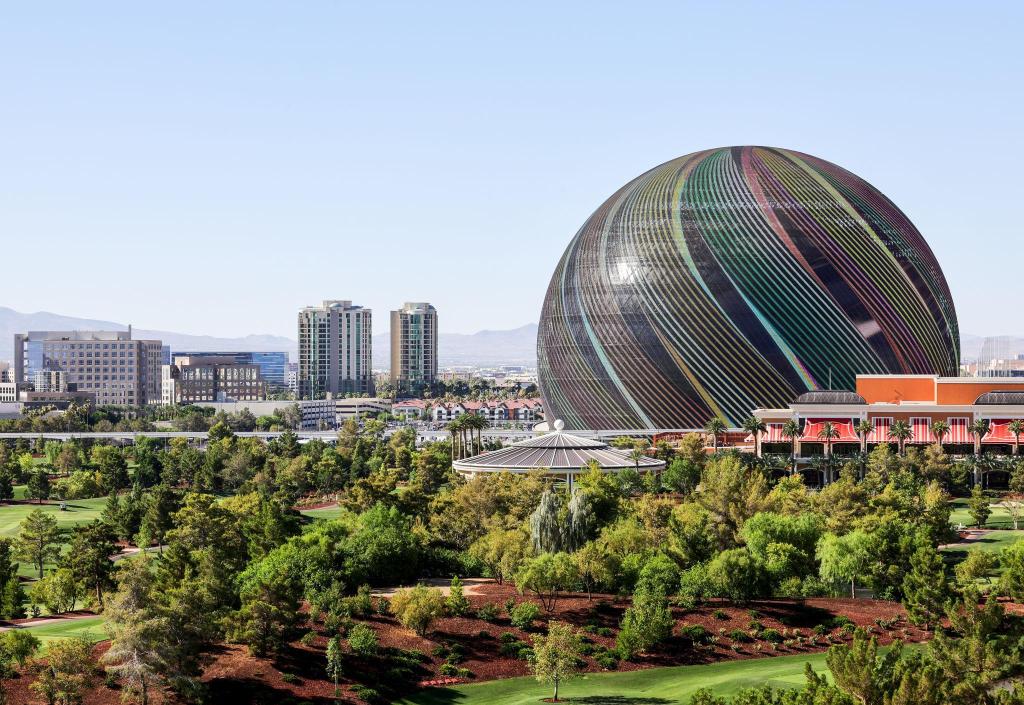
The opening of Sphere Las Vegas marked a new chapter in the city’s evolution.
Sphere is not simply another venue.
It represents a different way of thinking about entertainment.
Traditional venues separate performers from audiences.
Sphere dissolves that boundary.
The audience is no longer watching a show.
The audience is entering a show.
Massive immersive visuals surround visitors in every direction.
Advanced sound technology creates a level of realism rarely experienced in traditional theaters.
Sphere demonstrates that future entertainment may not be about larger stages.
It may be about deeper immersion.
Why Cities Around The World Study Las Vegas
Urban planners, tourism officials, and entertainment developers increasingly study Las Vegas as a model.
The reason is simple.
Las Vegas does not sell buildings.
It sells emotions.
It sells memories.
It sells experiences.
In an era where many cities can construct skyscrapers and transportation systems, emotional identity becomes a competitive advantage.
People remember how a place made them feel.
And Las Vegas understands this better than almost any city in the world.
IMMERSIVE LAB Perspective
The future of cities is not only about infrastructure.
It is about experience design.
Las Vegas recognized this transformation earlier than most destinations.
By turning entertainment into economic infrastructure, the city created a model that continues to influence urban development worldwide.
The success of Las Vegas proves a powerful idea.
People do not travel for buildings.
They travel for experiences.
And in the future, the most successful cities may be those that understand this simple truth better than anyone else.
 IMMERSIVE LAB
댓글 남기기